Some unsafe situations look obvious, but many do not. A message that seems friendly, a person who asks for "just a little" personal information, or a shortcut that saves time can all seem harmless at first. Personal safety is not about being scared all the time. It is about learning how to notice clues, make smart choices, and protect yourself in everyday life.
Because you learn online from home, your safety skills need to work in several places: during your school day from home, when you are out in your neighborhood or community, and when you are using phones, games, apps, and websites. The goal is simple: help you stay safe, confident, and ready to act.
Good safety habits can prevent small problems from turning into serious ones. If you protect your password, think before sharing your location, and know when to contact a trusted adult, you lower your risk. If you ignore warning signs, you may give someone access to your information, your feelings, or even your physical safety.
Personal safety is a life skill, just like learning to cook simple meals or manage your time. The more you practice, the more natural it becomes. You do not need to be perfect. You just need to notice, pause, and choose wisely.
Personal safety means taking actions to protect your body, feelings, information, and well-being. It includes knowing your surroundings, setting limits, avoiding risky situations, and getting help when needed.
Boundaries are rules or limits about what is okay and not okay for your body, your space, your time, or your private information.
Trusted adult means an adult who listens, takes your concerns seriously, and helps you stay safe, such as a parent, guardian, relative, coach, counselor, or community leader.
One of the most important parts of safety is paying attention to your body's warning system. You may feel a tight stomach, a racing heart, sudden confusion, or the feeling that something is "off." That feeling does not always mean danger, but it is a sign to slow down and pay attention.
Being safe does not mean you never talk to new people, never go outside, or never use technology. It means you make careful choices. You notice where you are, who you are with, what information you are sharing, and whether the situation matches what a safe person would do.
A safe person respects your "no." A safe person does not pressure you to keep secrets from trusted adults. A safe person does not rush you, threaten you, flatter you to get something, or ask for private photos or personal details.
Safety comes from awareness plus action
Knowing a safety rule is helpful, but using it is what protects you. For example, it is not enough to know that sharing your home address online is risky. Real safety means choosing not to share it, using privacy settings, and telling an adult if someone asks for it. Awareness helps you notice a problem. Action helps you handle it.
Another key idea is that safety is layered. You can protect yourself in more than one way at the same time. You might stay with a group in the community, keep your phone charged, know where trusted places are, and tell an adult where you are going. Online, you might use a private account, a strong password, and avoid chatting with strangers. Several small safety choices together are stronger than only one.
Since your school day happens at home, your safety plan should fit your home routine. If you are home alone for part of the day, know the family rules: whether to answer the door, whether to answer unknown phone numbers, who is allowed to pick you up, and how to contact a parent or guardian quickly.
If someone knocks at the door and you are not expecting them, do not open it just because they seem friendly. Check with a parent or guardian first if possible. If you cannot confirm who they are, keep the door closed. The same rule applies to phone calls and messages from unknown people. You do not owe strangers information.
Your learning space matters too. Keep personal details out of camera view during video calls. Papers with your full name, address, passwords, or family information should not be visible. If your camera shows a window, house number, or anything that reveals where you live, adjust the angle.
Use school platforms the way your family and teachers expect. Do not click random links in messages, even if they seem to come from a classmate. Accounts can be hacked or faked. If a link or file seems strange, ask a trusted adult before opening it.
Example: handling a suspicious message during the school day
You get a direct message that says, "Your account has a problem. Send your password so I can fix it."
Step 1: Pause
Do not reply right away. Pressure is often a warning sign.
Step 2: Check the source
Look carefully at the username or email. Fake accounts often look almost real.
Step 3: Protect your information
Never share passwords, codes, or private account details in a message.
Step 4: Tell a trusted adult
Show the message to an adult and report it using the app or website tools.
The safe choice is to not engage, save evidence if needed, and get help.
Try This: Make a short home safety list and post it near your study space. Include emergency contacts, family rules for doors and calls, and what to do if internet messages seem suspicious.
[Figure 1] When you are in your neighborhood or community, awareness matters a lot. Good choices about routes, places, and people lower risk before a problem even starts. Safe movement in the community usually includes staying where other people are nearby, choosing visible paths, and noticing trusted places you could go for help.
If you are walking, biking, or spending time outside, pay attention to your surroundings. Keep your head up. If you are using headphones, keep the volume low enough that you can hear what is happening around you. Avoid staring at a screen while crossing streets or moving through public places.
It is safer to tell a trusted adult where you are going, who you are with, and when you expect to return. If plans change, update them. This is not about losing freedom. It is about making sure someone knows where to look if you need help.
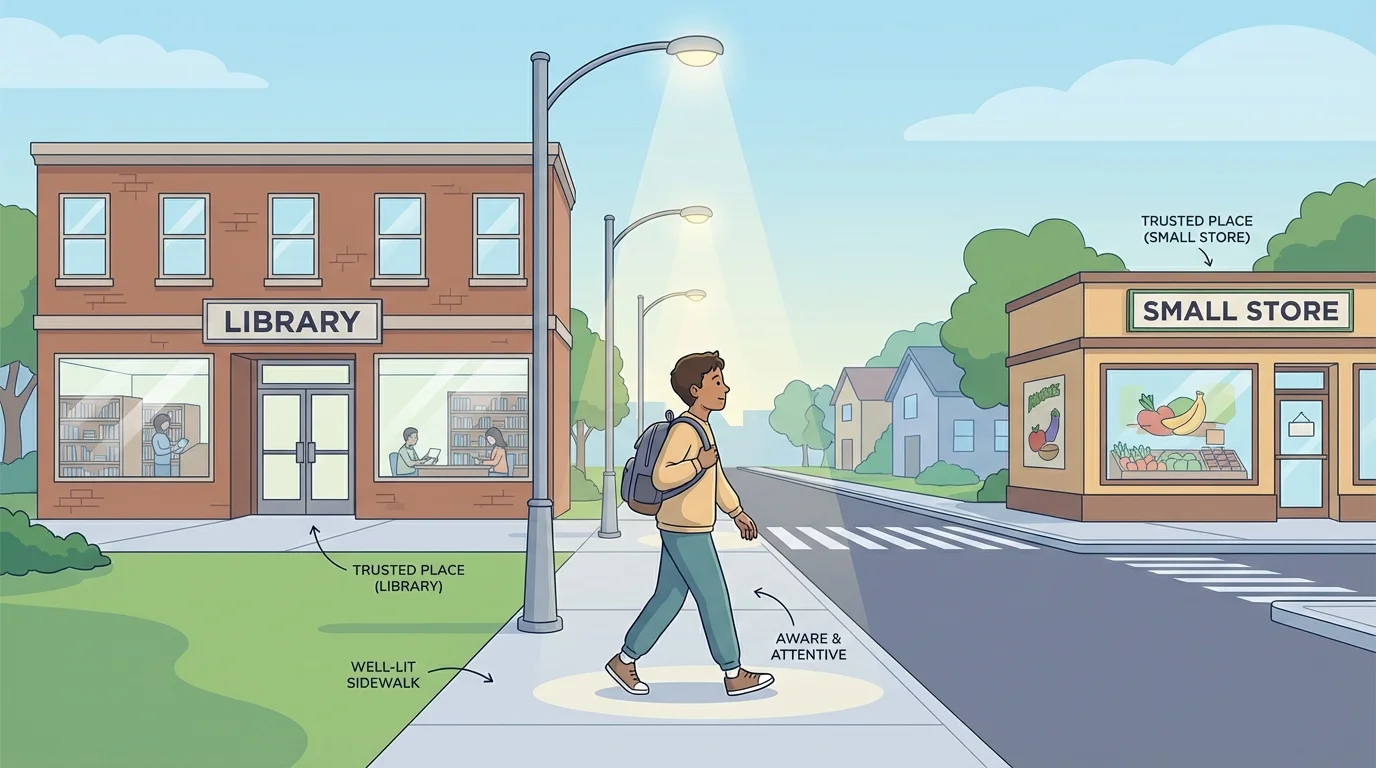
Stay in places that are public and active rather than isolated. If something feels wrong, go toward adults, families, workers, or community helpers. Trusted places can include a library, community center, store desk, front office of a sports facility, or a neighbor your family knows well.
Be careful with rides. Do not go with someone unless your parent or guardian has clearly approved it. Even if the person says, "Your family told me to get you," check first. Safe adults understand why you need to verify.
If someone follows you, keeps asking questions, tries to get you into a car, or invades your space, move away fast toward a safer place and get help. You do not need to be polite in a dangerous situation. Strong words like "No," "Stop," or "I need help" are appropriate when needed.
Later, the same ideas from [Figure 1] still matter in different settings: keep aware, stay where help is nearby, and choose places where other safe people can see you.
Your brain notices patterns quickly, even before you can explain them. That uneasy feeling you get in a risky situation can be an early warning that something is not right.
Try This: With a trusted adult, identify three safe places in your community and three adults you could go to for help if you felt unsafe.
Your body belongs to you. That means you have the right to say no to unwanted touch, unwanted closeness, and conversations that make you uncomfortable. You also have the right to leave and get help.
Sometimes unsafe behavior is obvious, but sometimes it is sneaky. A person may act extra nice, give gifts, offer special attention, or try to make you feel chosen so that you trust them too quickly. This can be part of grooming, which is when someone slowly builds trust in order to break boundaries or take advantage of a child or teen.
Unsafe people may ask you to keep a secret, especially a secret from your parent or guardian. There is an important difference between a surprise and a secret. A surprise, like a birthday card, is meant to be shared later and does not harm anyone. An unsafe secret is meant to hide something wrong.
Peer pressure can also affect safety. A friend, teammate, or online acquaintance may dare you to do something risky, share a photo, meet someone, or break a rule. Real friends do not push you to ignore your safety. You can say, "No, I'm not doing that," "My answer is no," or "I'm leaving." Short, clear responses are powerful.
If someone makes you feel confused, trapped, embarrassed, or scared, tell a trusted adult even if you are not completely sure what is wrong. You do not need perfect proof before asking for help.
"If a secret makes you feel worried, scared, or trapped, it is not a secret you have to keep."
Try This: Practice one boundary sentence out loud, such as "No, stop," or "I'm not comfortable with that." It feels easier to use in real life if you have said it before.
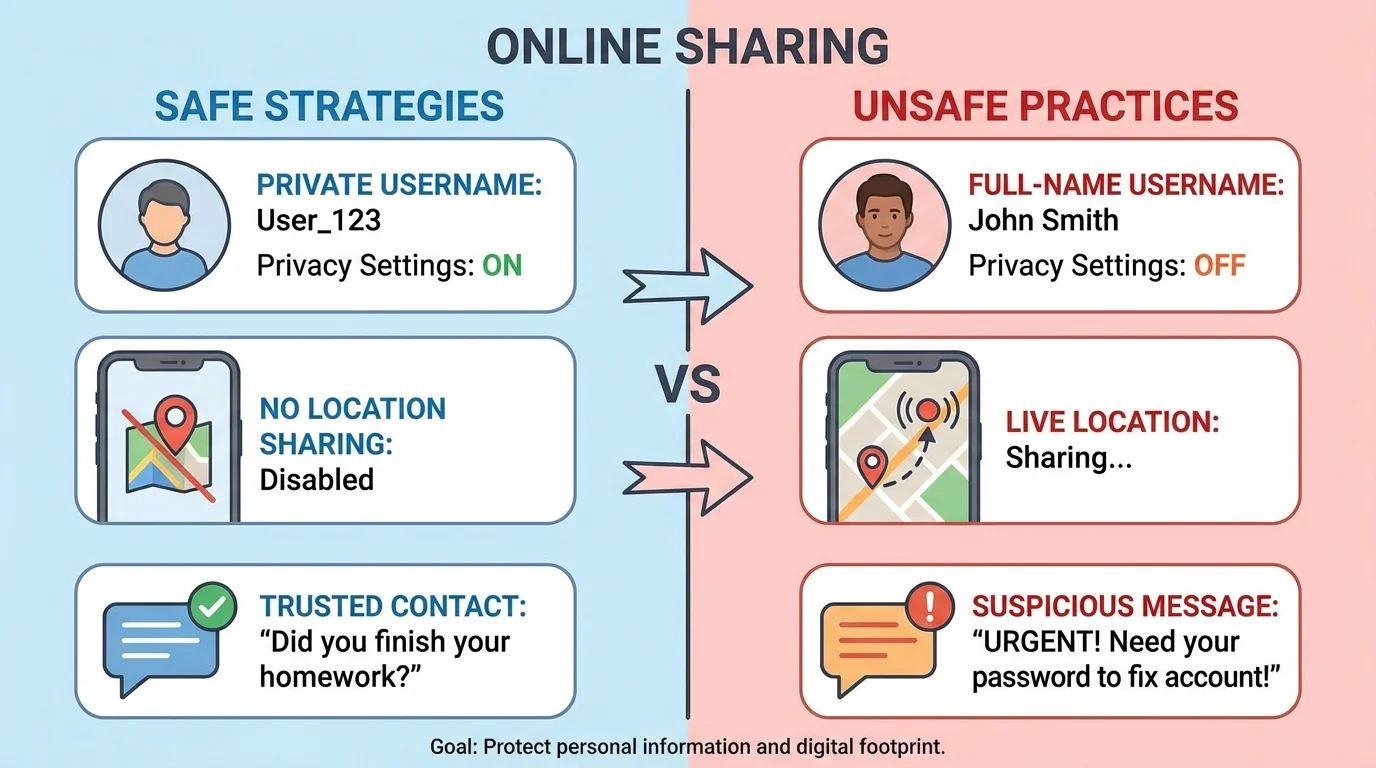
Online spaces can be fun, helpful, and creative, but they also require smart choices. The internet remembers more than people expect. Your digital footprint is the trail of information left by what you post, search, like, share, and send. As [Figure 2] illustrates, even small details like a full name, school logo, neighborhood photo, or live location can reveal more than you meant to share.
Protect private information. This includes your full name, home address, phone number, passwords, school schedule, live location, and personal photos. Do not share these with strangers or with people you only know online. Someone can pretend to be your age, your friend, or a safe person when they are not.
Use usernames that do not reveal too much. A safer username is something general, not one that includes your full name, birth year, team location, or school name. Use privacy settings so only approved people can view what you post when possible.
Be alert for a scam. A scam is a trick used to steal money, passwords, information, or access to an account. Common signs include urgent messages, prizes you did not enter to win, requests for codes, and links that push you to act fast.
Another major issue is cyberbullying, which is bullying through messages, posts, images, games, or apps. It can include mean comments, rumors, threats, sharing embarrassing content, or leaving someone out on purpose. If it happens, do not fight back in the same way. Save evidence, block the person, report it, and tell a trusted adult.
Video calls and gaming chats also need boundaries. Do not turn on your camera in a space that reveals private information. Do not join private chats with strangers. If someone asks for photos, personal details, or to move a conversation to a secret app, that is a warning sign.
It also helps to think before posting. Ask yourself: "Would I be okay if a trusted adult saw this?" "Does this reveal where I am?" "Could this hurt me or someone else later?" The online choices in [Figure 2] show that a safer internet life usually comes from small habits, not one big rule.
| Situation | Unsafe choice | Safer choice |
|---|---|---|
| Someone asks for your password | Send it to be helpful | Refuse and tell a trusted adult |
| You get a mean message | Send a mean reply back | Save it, block, report, and get help |
| You want to post a photo | Post it without checking details | Check for private information in the background first |
| An online friend asks to meet alone | Agree secretly | Tell a trusted adult immediately |
Table 1. Common online situations with unsafe and safer choices.
Try This: Review one app or game you use and check its privacy settings with a trusted adult. Turn off location sharing unless there is a strong reason to use it.
When something feels wrong, it helps to have a plan ready before you need it. The response path in [Figure 3] keeps things simple: notice the problem, move away from danger, contact help, and report what happened. A plan matters because fear can make it hard to think clearly in the moment.
Here is a practical sequence you can remember: Stop, Get Away, Get Help, Report. If the danger is online, add one more step: Save Evidence. Screenshots, usernames, and message times can help adults or platforms take action.
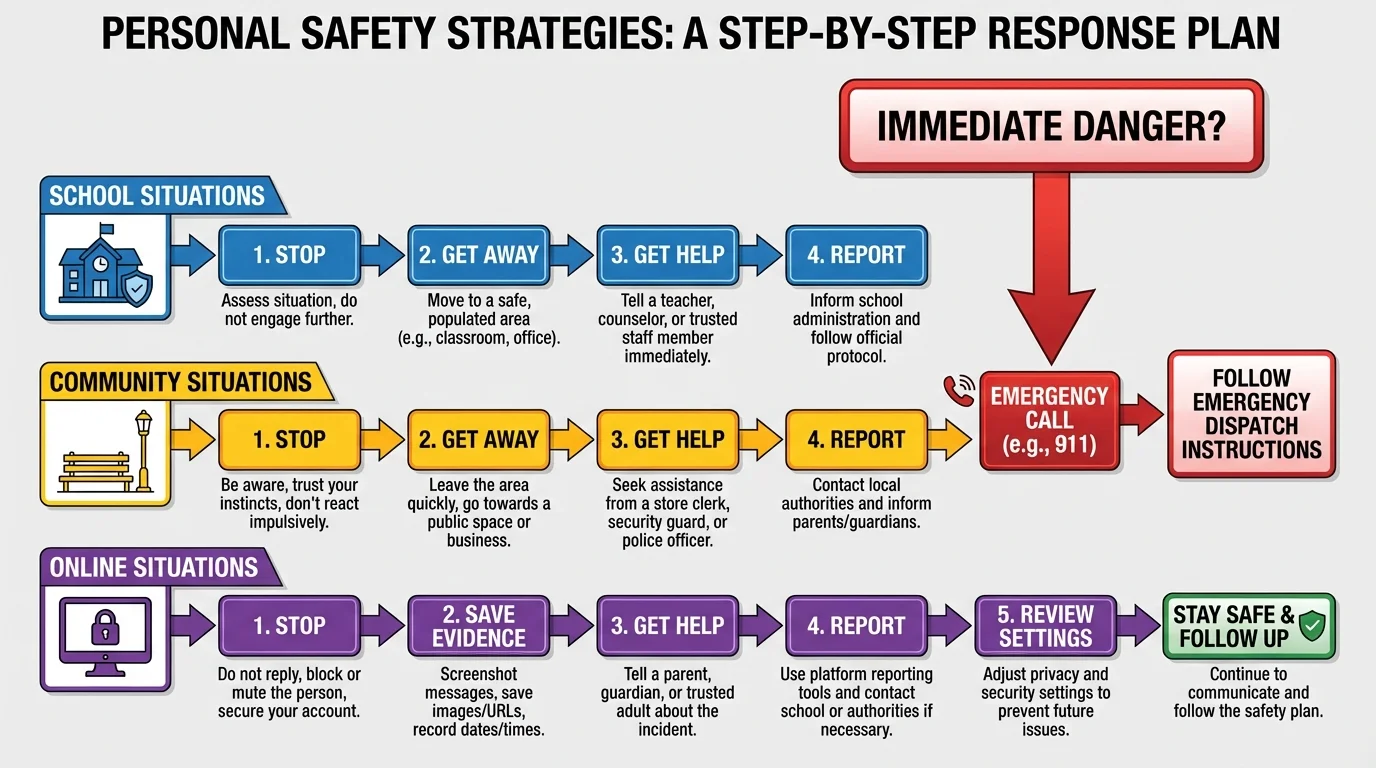
Stop means pause and do not go along with pressure. Get Away means leave the space, close the app, step back, or move toward safe people. Get Help means contact a trusted adult, worker, neighbor, coach, or emergency service if needed. Report means tell what happened, even if you feel embarrassed.
If you are online, avoid deleting everything right away. Save screenshots first if it is safe to do so. This helps show what happened. Then block and report the account.
Example: using the safety response plan
You are in a game chat and another player asks where you live, then becomes angry when you do not answer.
Step 1: Stop
Do not answer the question or argue.
Step 2: Get away
Leave the chat or mute the player.
Step 3: Save evidence
Take a screenshot if possible.
Step 4: Get help and report
Show a trusted adult and use the game's report tool.
This plan protects both your information and your peace of mind.
A common mistake is thinking, "Maybe I'm overreacting." If something feels unsafe, it is better to check with a trusted adult than to stay silent. The steps in [Figure 3] are meant to make that decision easier.
Some situations are uncomfortable. Others are emergencies. An emergency means someone is in immediate danger and needs urgent help right away. Examples include a fire, a serious injury, a person trying to force you somewhere, or a threat of violence.
If you need emergency help, call emergency services as soon as you safely can. Speak clearly. Share your name, location, what is happening, and whether anyone is hurt. If you do not know the exact address, give the best location details you can, such as a nearby store, park, street sign, or landmark.
Staying calm does not mean pretending everything is fine. It means focusing on the next helpful action. One breath, one clear sentence, one safe move at a time.
Memorizing key contact information is still useful, even with smartphones. If your phone battery dies or you cannot unlock it, knowing a parent's phone number or your home address can help you get assistance faster.
Try This: Memorize at least two important phone numbers and your full home address if your family says that is appropriate and safe to know.
The strongest safety skills are often quiet, everyday habits. Charge your device. Keep emergency contacts available. Tell a trusted adult where you are going. Check privacy settings. Notice exits and nearby adults in public places. Trust your instincts when something feels off.
It also helps to think ahead. Before going somewhere, ask: Who will be there? How will I get home? Who can I contact if plans change? What will I do if my phone stops working? These questions are simple, but they make you more prepared.
Safe habits are not about fear. They are about confidence. When you know what to do, you are less likely to freeze, panic, or follow pressure from others. You are more likely to protect yourself and ask for help quickly.
Personal safety also includes caring for your emotional well-being. If a scary or upsetting situation happens, talk to someone you trust. Feeling shaken, angry, or embarrassed afterward is normal. Getting support is part of staying safe too.
