Missing a ride by just a few minutes can turn a simple plan into a stressful mess. You might be late to practice, miss a library event, or keep someone waiting for you. The good news is that independence is not about doing everything alone right away. It is about learning how to think ahead, use the tools around you, and make smart choices so you can handle more of your own life.
As you get older, you will have more chances to go places, join activities, keep appointments, and manage your own schedule. That means you need three connected skills: getting from place to place, knowing when to leave, and planning for problems before they happen. When these skills work together, you seem reliable. People trust you more. You also feel calmer because you know what to do.
Independence does not mean never needing help. It means you can make a plan, follow it, and ask for help in a smart way when needed. If you are going to a community class, sports practice, a volunteer event, or a doctor's appointment, you need to know four things: where you are going, when you need to be there, how you will get there, and what you will do if something changes.
When people do not plan, they often guess. Guessing can lead to problems. Maybe you think the trip will take 10 minutes, but it really takes 20. Maybe you assume someone else will remind you, but they are busy. Maybe you forget your water bottle, phone, address, or money for the bus. Small mistakes can stack up.
Planning ahead reduces stress
A good plan answers questions before they become problems. Instead of waiting until the last minute, you make choices early: what time to leave, what route to take, what to bring, and who needs updates. This saves time and helps you stay calm when something unexpected happens.
Think of planning like setting up dominoes in the right order. If the first one is wrong, the rest fall the wrong way too. But if the first few choices are solid, the rest of the day goes much more smoothly.
Different trips need different transportation. As [Figure 1] shows, the best choice depends on distance, safety, time, cost, weather, and how much adult help is needed. Learning to compare options is part of becoming more responsible.
Your transportation choice might include transportation such as walking, biking, getting a family ride, joining a carpool, or using public transit. Each option has strengths and limits. Walking is free and simple for short distances, but it may not work if the route is unsafe or too far. Biking can be faster, but you need a helmet, safe roads, and secure bike storage. A family ride may be dependable, but only if you ask in advance and confirm the time.
Public transit includes city buses, trains, or shuttles. It can help you become more independent, but you must read the route, know the stop, and understand the schedule. Carpooling can also work well when families share rides, but it requires clear communication and respect for other people's time.
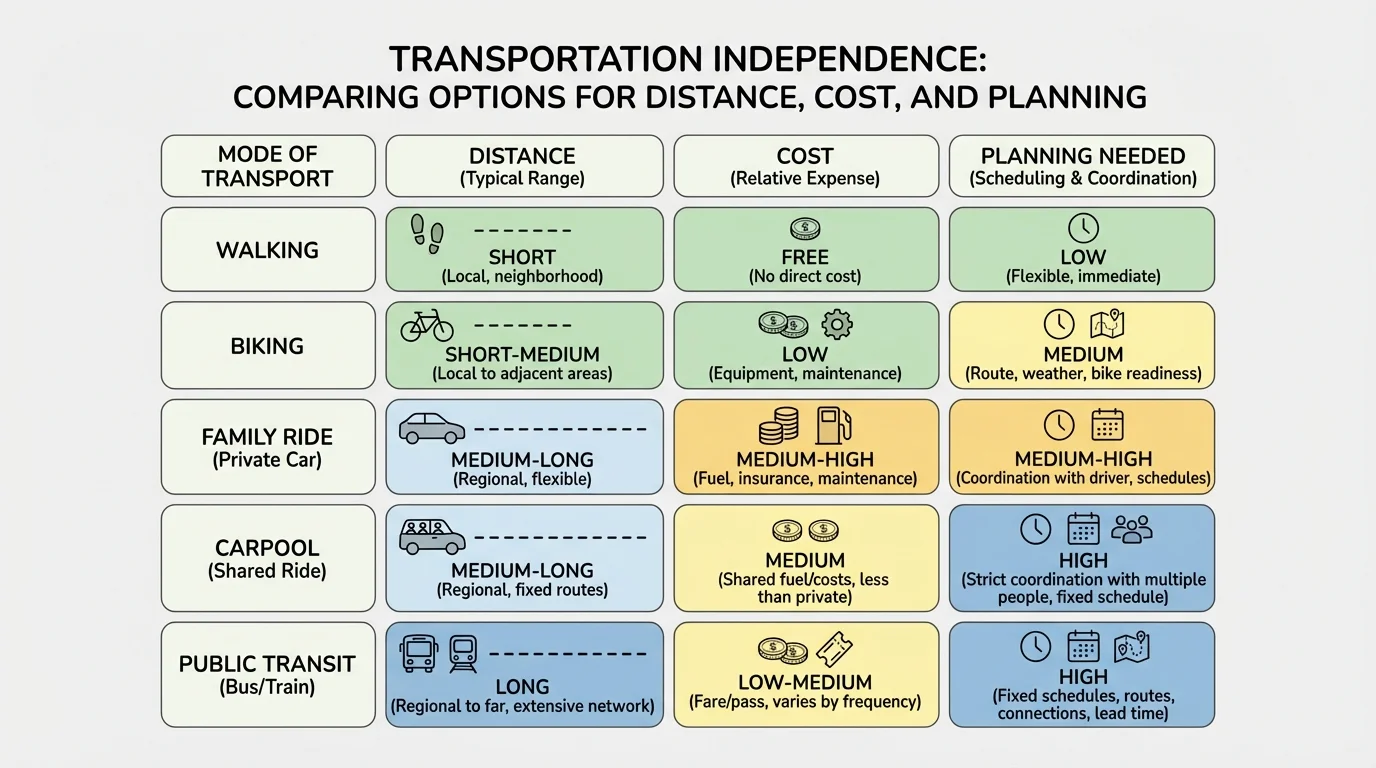
One smart habit is to ask: What is the most realistic option for this trip? If you are going somewhere close on a sunny afternoon, walking with permission may make sense. If you are going farther away and need to arrive at an exact time, a planned ride or transit route may be better.
| Option | Best for | Things to check |
|---|---|---|
| Walking | Short trips nearby | Safe route, weather, daylight, permission |
| Biking | Medium-distance trips | Helmet, safe roads, bike condition, lock |
| Family ride | Time-sensitive trips | Ask early, confirm pickup time, location |
| Carpool | Activities with shared schedules | Driver, pickup plan, contact info |
| Public transit | Longer trips with set routes | Schedule, stop location, fare, backup plan |
Table 1. Common transportation choices and the main things to check before using each one.
Later, when you compare options again, [Figure 1] helps you notice an important pattern: the more independent the transportation is, the more planning you usually need beforehand.
Many reliable people are not faster than everyone else. They are simply better at leaving early, checking details, and building backup plans.
A ride is not really "set" until the details are clear. You should know who is driving, the pickup time, the pickup place, and how you will communicate if something changes. Saying "I think someone can take me" is not a plan. Saying "My aunt is picking me up at 4:10 at the community center entrance" is a plan.
One of the strongest independence skills is learning to work backward from your arrival time. A schedule tells you when something starts, but you also need to know when to get ready, when to leave, and how long travel will take. [Figure 2] illustrates how this works step by step.
Suppose your art class starts at 5:00. If the trip takes about 20 minutes, you do not leave at 5:00. You count backward. You may want to arrive 10 minutes early, which means arriving at 4:50. Then you subtract the 20-minute trip and a 10-minute buffer. That means you should leave at 4:20. If you need 10 more minutes to gather your supplies and put on your shoes, your get-ready time starts at 4:10.
This extra time is called buffer time. Buffer time is a small block of extra minutes added to your plan in case things move slowly. Maybe traffic is heavier, maybe you cannot find your notebook, or maybe the bus is slightly delayed. Adding even 5 to 10 minutes can make a big difference.
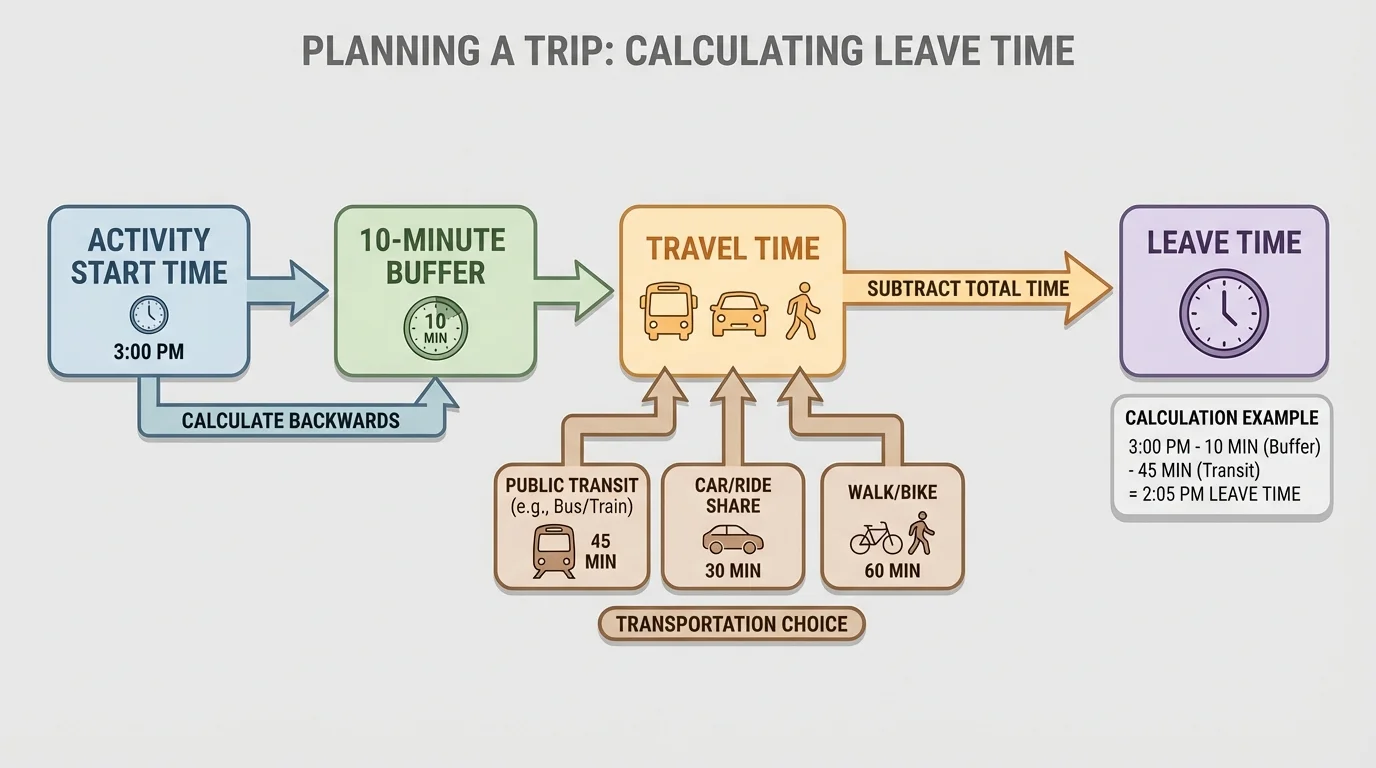
Here is a simple way to calculate a leaving time:
\[\textrm{Leave time} = \textrm{Arrival time} - \textrm{Travel time} - \textrm{Buffer time}\]
For example, if you want to arrive at 4:50, the trip takes 20 minutes, and you want a 10-minute buffer, then your leaving time is found by subtracting both amounts. In time terms, that gives you 4:20. The key point is to add your extra minutes on purpose and be consistent about how you plan them.
Example: Planning for a library workshop
A workshop begins at 3:30. You want to arrive 10 minutes early, and the bus ride takes 15 minutes.
Step 1: Find the target arrival time.
Start at 3:30 and move back 10 minutes. Your target arrival time is 3:20.
Step 2: Subtract travel time.
Move back 15 more minutes from 3:20. You should leave at 3:05.
Step 3: Add your getting-ready time.
If you need 10 minutes to get your bag and shoes, begin getting ready at 2:55.
Now your plan is clear: get ready at 2:55, leave at 3:05, arrive at 3:20, and begin at 3:30.
Transit schedules need special attention. A bus that comes every 30 minutes is very different from one that comes every 10 minutes. If you miss a bus that arrives at 4:00 and the next one is at 4:30, being just a little late can cost you a lot of time.
That is why you should check the route, stop location, and timing before the day of the trip whenever possible. Looking at a digital map or transit app the night before is smarter than trying to figure everything out while rushing. When you do this, the planning pattern in [Figure 2] becomes a tool you can use again and again.
A short leaving-home routine can prevent many problems, and [Figure 3] shows the kind of checklist that makes travel smoother. Before you walk out the door, pause and ask yourself: Do I have what I need? Do I know where I am going? Do I know how I am getting back?
A checklist is useful because your brain can forget things when you are in a hurry. A checklist does the remembering for you. It can be written on paper, kept in a notes app, or posted near the door.
Your checklist might include: phone charged, water bottle, needed items for the activity, exact address, ride details, payment or pass if needed, and one trusted contact person. If the trip is new, add directions and a screenshot of the location.
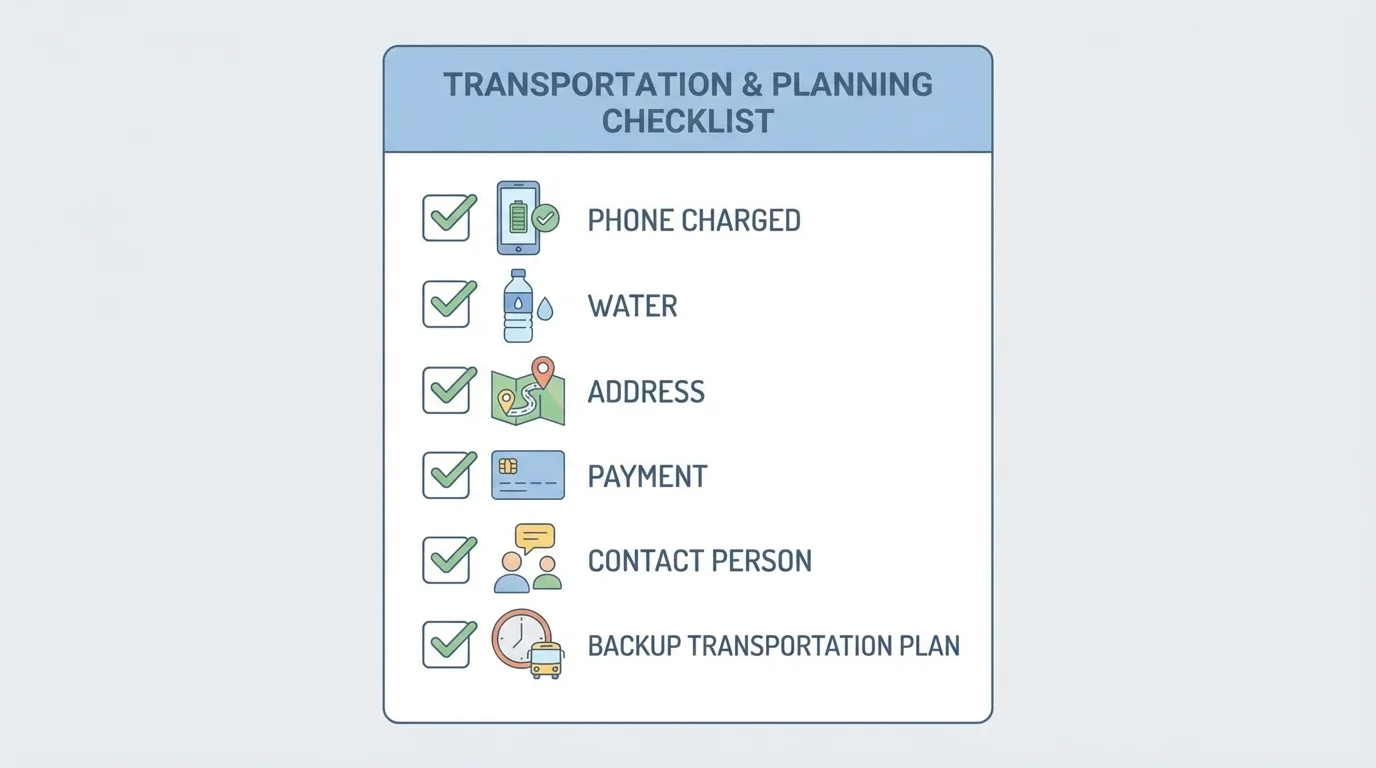
It also helps to think about your backup plan. A backup plan is what you will do if the original plan fails. If your ride is running late, can another approved adult help? If the weather changes, should you switch from walking to a ride? If your activity ends early, who should you contact?
Route is the path you take to get from one place to another. Destination is the place you are going. Delay is anything that makes you later than planned. These words matter because clear planning depends on knowing where you are headed, how you will get there, and what slows you down.
A good plan also includes the return trip. Many people remember how they are getting somewhere but forget how they are getting home. Before you leave, know both directions of the plan.
Independence grows best when it is matched with safety. If you are traveling on foot or by bike, use safe routes, stay alert, and follow family or community rules. If you are waiting for a ride, stay in the agreed place and keep your device available if that is part of your plan. If you are using public transit, know your stop and pay attention instead of getting lost in a game or video.
Communication matters just as much as timing. If you are going to be late, tell the right person as soon as possible. A short, clear message works best: "I am on the way, but traffic is slowing us down. My new arrival time is about 4:15." That is more helpful than saying, "Sorry, running late."
"Being responsible means people can count on you."
You should also respect other people's time. If someone is giving you a ride, be ready before pickup time, not at pickup time. If pickup is at 6:00, being outside and prepared at 5:55 is usually better than rushing at 6:01. Responsibility is often measured in minutes.
If a plan changes, stay calm and solve one problem at a time. First, make sure you are safe. Second, contact the person who needs to know. Third, switch to your backup plan if one is approved. Panicking wastes time; clear steps save it.
You do not need to wait for a huge event to practice these skills. Everyday situations are the best training ground. Maybe you are going to a community sports practice, a library program, music lessons, a youth group, or a family appointment. Each one gives you a chance to plan transportation, estimate time, and prepare what you need.
Here are a few realistic examples:
Example 1: You have soccer practice at 5:30. Your parent can drive, but only if you are fully ready by 5:05. If your gear is not packed and your water bottle is empty, the ride gets delayed. The lesson is simple: preparing earlier protects the whole plan.
Example 2: You want to attend a free workshop at the library. The event starts at 2:00, and the bus stop is a 7-minute walk from your house. If the bus leaves at 1:35, you may want to leave home at about 1:25 so you can reach the stop without rushing.
Example 3: You are meeting a community club leader for a volunteer project orientation on a video call, not in person. Transportation is not the issue, but scheduling still is. You need to know the start time, set a reminder, charge your device, and log in early. Independence includes digital planning too.
Case study: Two different outcomes
Jordan and Maya both have a 4:00 community class.
Step 1: Jordan guesses.
Jordan starts getting ready at 3:50, cannot find the notebook, and forgets to confirm the ride. Jordan arrives late and stressed.
Step 2: Maya plans.
Maya checks the address, packs supplies after lunch, confirms the ride, and sets a reminder for 3:20. Maya arrives early and calm.
The difference is not luck. The difference is planning.
These examples show that independence is really a group of habits. You notice details, prepare early, and communicate clearly. Over time, people trust you with more responsibility because you handle the smaller responsibilities well.
You do not have to master everything at once. Start with one skill. Maybe this week you practice checking the time needed for a trip. Next week, maybe you pack your own bag the night before. After that, maybe you help confirm the ride plan or look up the transit schedule with an adult. Small steps build strong habits.
One way to grow is to move from being reminded to remembering for yourself. At first, an adult may help you with every part of the plan. Later, you may only need a quick check-in. Eventually, you may be able to handle most of the planning on your own and ask for help only for safety decisions or approvals.
Another useful habit is reflection. After a trip or activity, ask yourself: What worked? What almost went wrong? What should I do earlier next time? This kind of review helps you improve without waiting for someone else to point things out.
Time management is easier when you use tools consistently. Calendars, reminders, alarms, and notes are not signs that you are forgetful. They are signs that you know how to support your brain.
If you want to become more independent, focus on being predictable. Predictable means you usually know your plan, follow through, and update people when needed. That makes life easier for you and for everyone around you.
Try This: Before your next activity, make a mini plan with the arrival time, leaving time, what you need to bring, and one backup option.
Try This: Create a short travel checklist on paper or in your phone and use it every time you go somewhere important.
Try This: The next time someone else manages a ride or timing for you, pay attention to each step so you can learn how to do more of it yourself.
