One person does not need to be old enough to vote, run a city, or lead a giant organization to make a real difference. Communities change every day because ordinary people notice a problem, care enough to act, and do something helpful. At your age, civic action is not about doing everything on your own. It is about learning how to help in smart, safe, respectful ways.
Civic action means doing something to help improve your community or support the common good. Your community can be your neighborhood, an online group, a town library program, a sports team, a faith group, a local park, or a cause you care about. When you take civic action, you move from just noticing a problem to helping solve it.
Service means directly helping meet a need. Advocacy means speaking up to encourage change. Participation means joining responsibly in community life, such as discussions, events, meetings, or group decisions.
This matters because problems do not fix themselves very often. Litter stays on the ground unless people clean it up. A group may remain unfair unless someone respectfully points out the problem. Important community decisions may ignore kids' needs unless young people share their experiences clearly and politely.
Effective civic action also builds trust. When people see that you are honest, prepared, and respectful, they are more likely to listen to you. When people act carelessly, spread false information, or attack others, they often make the problem worse.
You can think of civic action in three main forms, as [Figure 1] shows: helping directly through service, speaking up through advocacy, and joining community life through respectful participation. Sometimes one project uses all three.
Service is hands-on help. You might sort donated items for a shelter, help a younger child read during a community program, create encouraging cards for hospital patients, or help an adult-organized neighborhood cleanup.
Advocacy is using your voice. You might write a respectful email to a parks department about broken playground equipment, create a fact-based post to raise awareness about animal adoption, or ask a local group to add more recycling bins.
Respectful participation means being involved in ways that support fair discussion and shared decision-making. You might attend a community virtual meeting with a parent, contribute ideas on a youth advisory board, or leave a thoughtful comment in an online community forum.
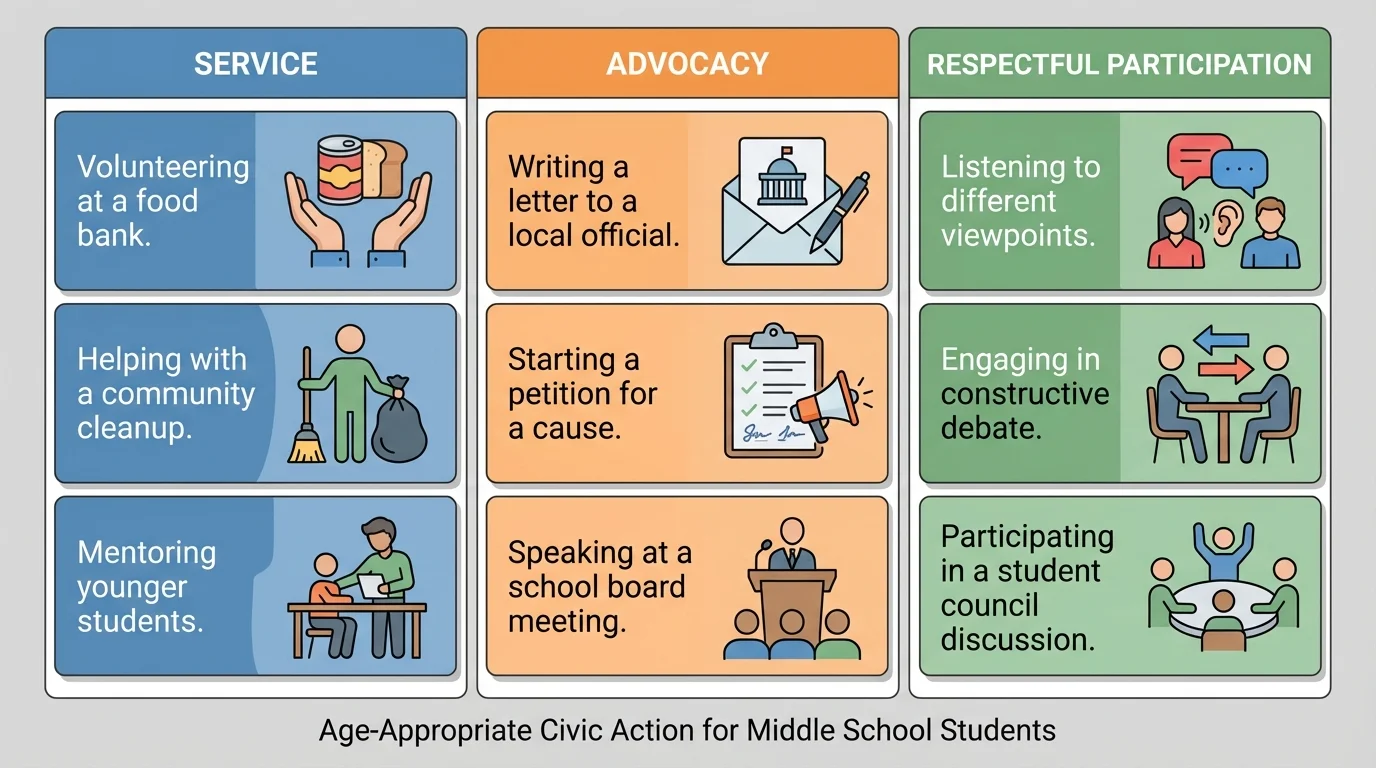
These three paths are different, but they often work together. For example, if a local animal shelter needs help, service might be collecting supplies, advocacy might be creating an awareness campaign about pet adoption, and participation might be joining a town discussion about pet care resources. Later, when you plan your own action, [Figure 1] helps you decide which path fits best.
A good civic project starts with a real issue, not just a random activity. Ask yourself: What problem do I notice? Who is affected? What small part of it could I help improve? This keeps your action realistic.
At your age, your most effective actions are usually local, specific, and manageable. Instead of trying to "fix hunger everywhere," you might help collect canned food for one pantry. Instead of trying to "stop all cyberbullying," you might help create a kindness campaign in an online youth group. Smaller actions can still matter a lot.
Choose an issue where your action matches your age and resources. Good civic action is not about doing the biggest thing. It is about doing a useful thing well. A focused effort with clear facts and adult support usually helps more than a giant plan that never happens.
Good places to notice needs include your neighborhood, local events, libraries, parks, animal shelters, food banks, online communities, and clubs you belong to outside school. You can also notice needs at home that connect to community life, like helping a family member access community resources or translating flyers with an adult if you speak more than one language.
[Figure 2] shows a quick safety check to use before you act: Is this safe? Do I have adult permission if needed? Are my facts correct? Am I being respectful? If the answer to any of these is no, pause and fix the problem first.
Safety comes first. Do not share private information online, such as your address, phone number, passwords, or daily schedule. If a civic action involves meeting people, handling money, traveling, or public posting online, involve a trusted adult.
Legal awareness means understanding that even good goals do not make unsafe or harmful actions okay. You should not trespass, damage property, harass people, post false claims, or collect donations without proper adult supervision and clear permission. Respect community rules, event rules, and online platform rules.
Fact-checking matters because advocacy is stronger when it is accurate. Before reposting a claim, ask: Who said this? Is it current? Is there evidence? Can I confirm it with a trustworthy source such as a government website, local organization, or established news source?
Respect matters because real change often requires other people to listen. You can disagree strongly without insulting, threatening, mocking, or shouting others down.
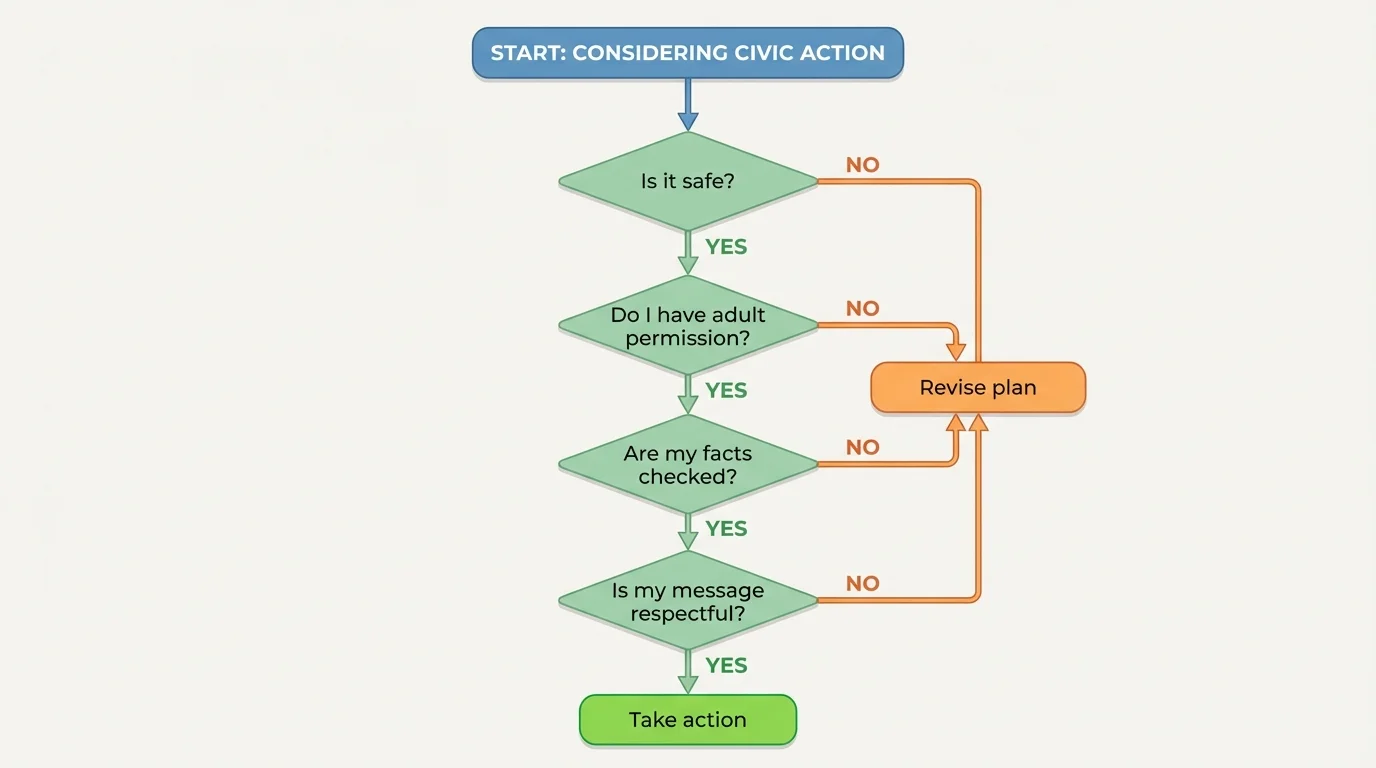
If someone online pressures you to act fast, keep a secret, or ignore a parent or guardian, that is a warning sign. Responsible civic action is open, safe, and supervised when needed. The safety questions in [Figure 2] are useful any time you want to post, organize, or contact a group.
Service is often the easiest place to begin because you can see the need and respond to it directly. This kind of action teaches responsibility, teamwork, and follow-through.
Examples of age-appropriate service include helping collect pet food for a shelter, making thank-you cards for community helpers, helping clean a park with adults, sorting donations, helping younger children during a community reading event, or creating simple digital flyers for a nonprofit with adult guidance.
To do service well, be dependable. If you say you will help, show up on time, complete the task, and listen to directions. A small job done responsibly can be more helpful than a bigger promise you do not keep.
Example: Helping a food pantry
You notice that a local food pantry needs canned soup and pasta.
Step 1: Confirm the need
Check the pantry website or ask an adult to contact the pantry so you know what items are actually needed.
Step 2: Ask for adult support
Get permission to help organize a small collection with family, neighbors, or a community group.
Step 3: Share clear information
Tell people what to donate, where to drop it off, and the deadline.
Step 4: Follow through
Help sort items, check expiration dates with an adult, and deliver them on time.
This is service because it directly helps meet a community need.
Service becomes even stronger when you listen to the people or groups you want to help. Do not assume what others need. Ask respectfully, check their list, and support their real priorities.
Advocacy is about asking for change. Instead of directly providing the help yourself, you use information, communication, and cooperation to encourage others to act.
At your age, advocacy might mean writing a polite message, making a poster or digital graphic, speaking during a youth meeting, creating a petition with adult guidance, or sharing information about a problem and a possible solution. Strong advocacy uses facts, respectful language, and a clear request.
For example, if a park has overflowing trash cans, a weak message would be, "Nobody cares about this place." A stronger message would be, "Our park trash cans are often full by Saturday afternoon. Could the pickup schedule be reviewed or another can be added near the playground?" The second message is specific, respectful, and easier to act on.
When you want someone to act, it helps to include three things: the problem, evidence, and a reasonable request. This keeps your message focused instead of emotional and confusing.
Advocacy is not the same as arguing all the time. It is not about being the loudest person. It is about helping others understand why something matters and what change could help.
Online advocacy needs extra care. Before posting, ask: Is this true? Is it kind? Is it necessary? Could this embarrass or target a person unfairly? Public messages can spread very quickly, and harmful posts are hard to take back.
Participation means taking part in community life responsibly. This includes listening, speaking honestly, following agreed rules, and helping groups work well even when people disagree.
You practice respectful participation when you attend a club meeting and let others finish speaking, when you join a community cleanup and follow instructions, when you comment thoughtfully in an online discussion, or when you help a youth group make decisions fairly.
A big part of participation is knowing how to disagree respectfully. You can say, "I see it differently because..." or "I understand your point, but I think..." instead of using insults or rude jokes. Respectful disagreement keeps the conversation open.
"Disagreement does not have to become disrespect."
Another part of participation is learning basic civic habits: paying attention, asking questions, checking facts, and considering how decisions affect different people. These habits prepare you to be a thoughtful community member now and in the future.
A clear process makes civic work less overwhelming. Instead of jumping in randomly, you can use a simple plan, as [Figure 3] illustrates, to move from noticing a problem to taking useful action.
Step 1: Notice a specific problem. Try to describe it in one sentence.
Step 2: Learn the facts. Find out who is affected, what the real need is, and whether someone is already working on it.
Step 3: Choose your action type. Is service, advocacy, participation, or a mix the best fit? [Figure 1] helps you compare the options.
Step 4: Ask for adult guidance if needed. This is especially important for public communication, transportation, money, or online posting.
Step 5: Make a small plan. Decide who will do what, what materials are needed, and when the action will happen.
Step 6: Take the action responsibly. Be polite, honest, and dependable.
Step 7: Reflect. Ask what worked, what did not, and what you would improve next time.
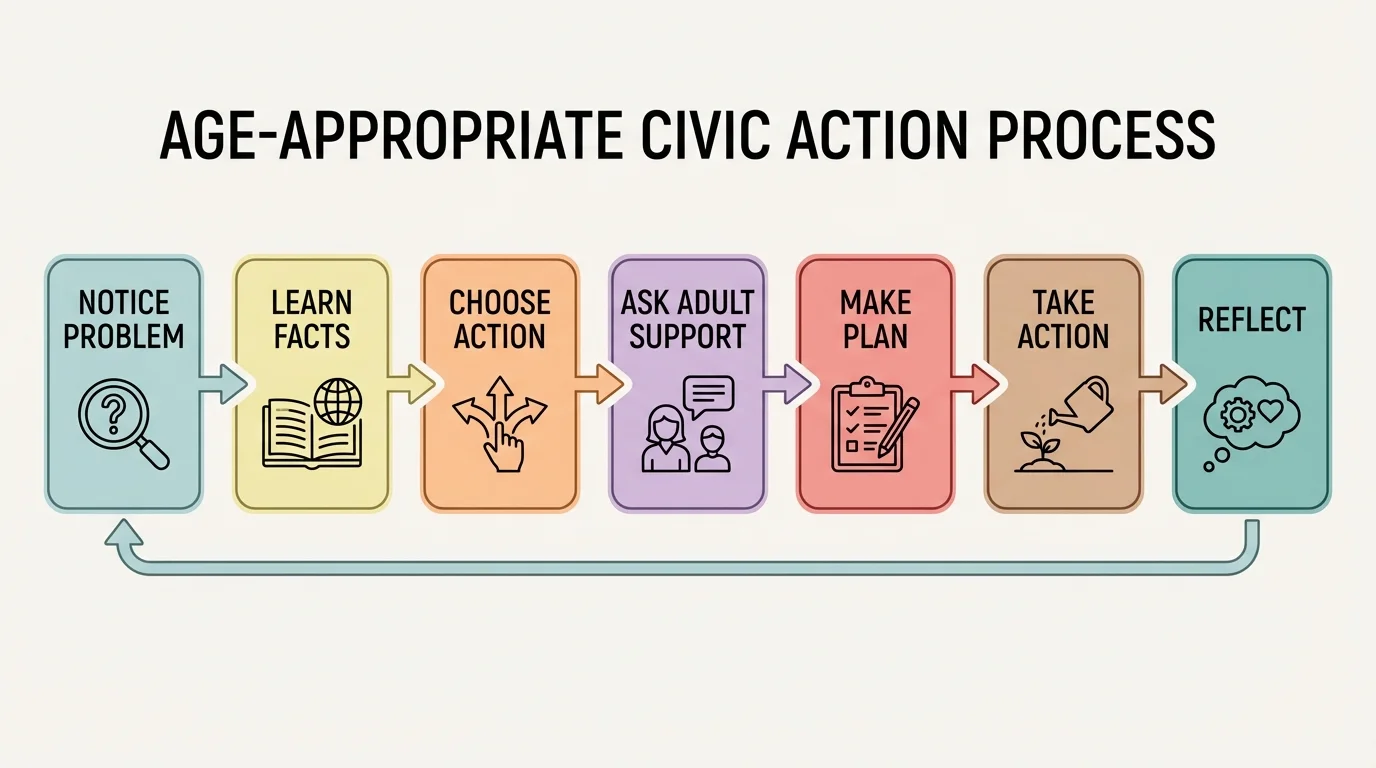
Reflection is important because not every idea works perfectly the first time. If your awareness post did not reach many people, you can improve the message. If your service event collected fewer items than expected, you can change the timing or communication next time. The process in [Figure 3] reminds you that learning from the result is part of responsible action.
Some civic actions fail because people act without thinking. Here are a few common mistakes.
| Mistake | Why It Causes Problems | Better Choice |
|---|---|---|
| Posting without checking facts | It spreads misinformation and hurts trust. | Verify information with reliable sources first. |
| Trying to solve everything alone | It can become unsafe or too big to manage. | Work with adults or established groups. |
| Using rude or angry language | People stop listening and conflict grows. | Be firm, specific, and respectful. |
| Ignoring what people actually need | Your effort may not help much. | Ask the organization or community what is needed. |
| Giving up too quickly | Some change takes time and patience. | Reflect, adjust, and try again. |
Table 1. Common mistakes in civic action and more effective alternatives.
Notice that the better choices are not dramatic. They are thoughtful. Good civic action is usually steady, organized, and respectful rather than loud or impulsive.
Many communities have youth advisory boards, volunteer programs, and service days where young people can contribute meaningful ideas. Adults often value student input when it is thoughtful, informed, and respectful.
That is one reason legal awareness and respectful participation matter together. If you care about a problem but ignore safety or rules, people may focus on your behavior instead of your message. If you follow good process, your ideas have a better chance of being taken seriously.
Here are a few examples of what age-appropriate civic action can look like in daily life.
Scenario 1: You see mean comments in an online youth group. A helpful response is not to start insulting people back. Better choices include saving evidence if needed, reporting the behavior to the group moderator, privately encouraging respectful discussion, and helping share group guidelines about kindness.
Scenario 2: Your local library needs more participation in a reading drive. You could help by making a clear flyer with adult approval, inviting neighbors, or helping sort donated books. That combines service and participation.
Scenario 3: A community garden lacks volunteers. You could ask a parent to help you contact the organizers, sign up for a workday, and invite friends or relatives. That is service. If you also create a respectful message explaining why the garden matters for fresh food access, that becomes advocacy too.
Scenario 4: A crosswalk near a park feels unsafe. You should not try to direct traffic yourself. A better action is to tell a trusted adult, gather observations carefully, and help write a respectful message to the town or neighborhood association asking for review.
In each case, the same big ideas appear: notice a need, choose an action that fits your age, stay safe, communicate respectfully, and follow through.
You do not need to wait until you are older to practice citizenship. Every time you help responsibly, speak up thoughtfully, or participate respectfully, you are building the habits of a strong community member.
