Some people think success comes from luck or talent alone. But in real life, progress usually comes from something more powerful: knowing what matters, putting in steady work, and taking ownership of your choices. That matters when you want better grades in online learning, want to save for something important, want to improve at a sport or instrument, or want to be more dependable at home.
A personal goal is not just a wish like "I want things to go better." A goal becomes useful when you connect it to your daily actions. If you say you want to become better at organizing your homework, but you never set aside time to do it, the goal stays stuck. If you say family responsibilities matter, but you ignore chores or forget promises, your actions send a different message. Goals work best when your choices match your words.
Goals help you make decisions when you have too many things competing for your time. You might want to play games, watch videos, message friends, finish assignments, help at home, practice a hobby, and get enough sleep. Since you cannot do everything at once, goals help you decide what should come first.
Good goals also build trust. When people see that you follow through, they learn they can count on you. That matters with parents, coaches, relatives, teammates, club leaders, and even online group partners. A person who keeps trying, stays honest, and takes responsibility often earns more opportunities over time.
Many adults use goal systems every day without calling them that. Athletes, artists, business owners, and community volunteers often break big goals into small weekly actions so they can keep moving forward.
Goals are not only about getting things for yourself. They can also help you become the kind of person others can rely on. That is why this topic is really about more than planning. It is about character.
A strong personal goal connects what matters, what you do, and what you take responsibility for, as [Figure 1] shows. In other words, your goal should match your priorities, require real effort, and include responsibility for your choices.
Effort means the work you put in. It includes practice, time, attention, and persistence. Priorities are the things you decide matter most right now. Responsibility means owning your actions, keeping commitments, and fixing mistakes when needed.
Personal goal means something important you decide to work toward. It is not just something you hope happens. It is something you plan for and act on.
These three parts work together. If your priority is improving your reading, your effort might be reading for twenty minutes each weekday and asking for help with hard words. Your responsibility is sticking to the plan, noticing when you skip it, and getting back on track.
Without effort, a goal is just talk. Without priorities, you can end up busy but unfocused. Without responsibility, it becomes easy to blame other people, distractions, or bad moods every time progress slows down.
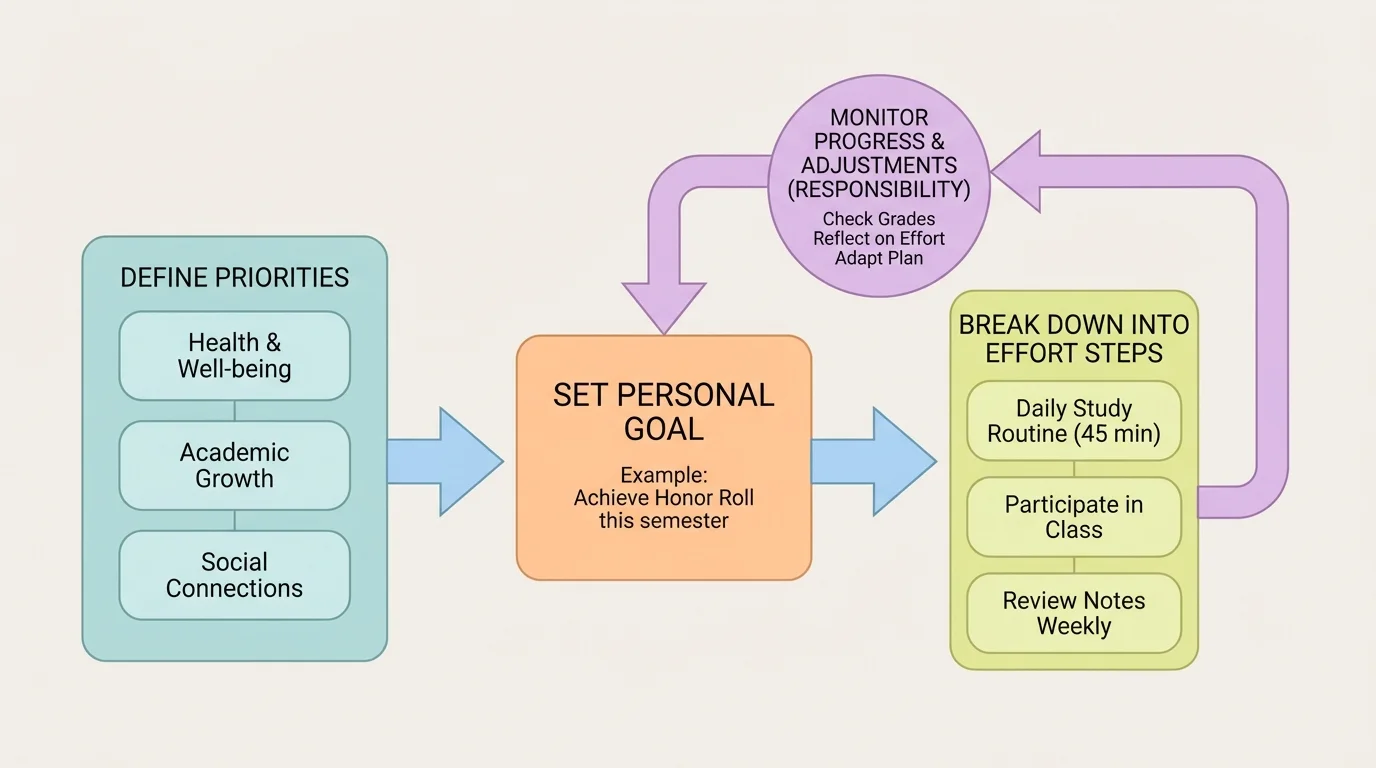
Later, when you create your own goal plan, think back to [Figure 1]. If one part is missing, the plan usually becomes weak.
Before choosing a goal, ask yourself a simple question: What matters most right now? Your answer should include both needs and values. A need is something important for daily life, like finishing schoolwork, helping your family, getting enough rest, or managing your time. A value is a quality you care about, like honesty, kindness, improvement, health, creativity, or being dependable.
If your week feels too full, priorities help you sort tasks into levels. For example, turning in an assignment on time may matter more than leveling up in a game. Feeding a pet may matter more than scrolling through videos. Practicing for a music lesson tomorrow may matter more than starting a new craft project today.
One useful way to choose priorities is to ask these questions:
Sometimes two good things compete with each other. You may want to help a friend online and also need to study. In that case, your priority is not deciding which thing is "good" and which thing is "bad." It is deciding which one needs to happen first and how to handle the other responsibly.
Choosing priorities is not the same as choosing favorites. A priority answers the question, "What deserves my attention first right now?" You can care about many things at once, but you still need an order.
This is especially important in online learning. At home, there may be more distractions and fewer bells or reminders than in a school building. That means you need to notice your own choices more carefully.
Clear goals are easier to follow than fuzzy wishes, as [Figure 2] illustrates. "I want to do better" sounds nice, but it does not tell you what to do tomorrow. A clear goal answers questions like: What am I trying to improve? What actions will I take? How often? By when?
Here are some examples of vague goals and clearer goals:
| Vague Goal | Clearer Goal |
|---|---|
| Do better in math | Complete math assignments on time for the next 4 weeks and practice facts for 10 minutes each weekday. |
| Be more helpful | Wash dishes after dinner on Monday, Wednesday, and Friday for the next month without being reminded. |
| Save money | Save $5 each week for 8 weeks to buy art supplies. |
| Get healthier | Take a 20-minute walk or an active movement break 5 days each week for 3 weeks. |
Table 1. Examples showing how vague goals can be turned into clear, actionable goals.
A clear goal should still be realistic. If you create a goal so huge that it does not fit your age, schedule, or energy, you may feel defeated quickly. For example, saying you will read for 3 hours every night might sound impressive, but if you also have chores, meals, and bedtime, it may not last. A smaller, steady plan often works better.
You can use this simple goal pattern: I will + action + schedule + time limit. For example: "I will review science notes for 15 minutes after lunch on school days for the next 2 weeks."
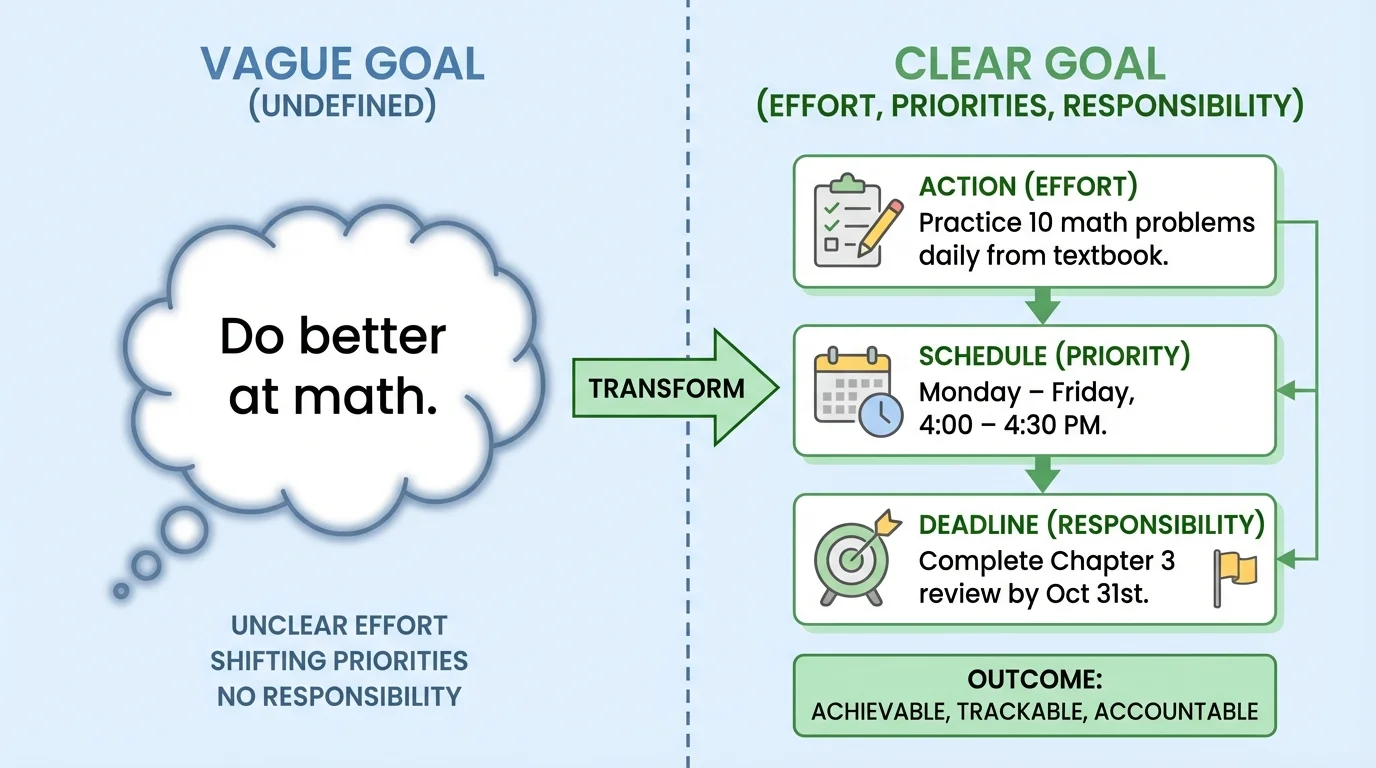
Notice that good goals are not about sounding impressive. They are about being usable. That is why [Figure 2] matters: it shows how a thought becomes a plan.
Every goal has a cost, but that cost is usually not money. The price is time, energy, attention, patience, and repeated practice. If your goal is important, your schedule should show it.
This is where many people get stuck. They pick a goal based on what sounds good, but they do not ask, "What effort will this require?" If you want to improve your writing, you may need to draft, revise, read examples, and ask for feedback. If you want to get stronger in a sport, you may need regular practice, stretching, sleep, and healthy meals. If you want to save $20 in 4 weeks, you might divide the total into equal weekly amounts: \(20 \div 4 = 5\). That means saving $5 each week.
Breaking effort into small steps helps. Instead of "work harder," say exactly what you will do. For example:
Small actions may not feel dramatic, but repeated actions create progress. A person who reads for 20 minutes a day often improves more than a person who reads a lot once and then quits for a week.
Real-life goal example: saving for headphones
You want headphones that cost $24. You can earn $6 each week by doing extra approved tasks at home.
Step 1: Find how many weeks are needed.
\[24 \div 6 = 4\]
Step 2: Turn the answer into a goal.
You can say, "I will earn and save $6 each week for 4 weeks to buy the headphones."
Step 3: Add responsibility.
Write down each week's earning, ask for permission before spending money on other things, and keep the money in a safe place.
This goal works because the amount, effort, and time plan match each other.
When your effort matches your goal, progress becomes more visible. When your effort is too small or too random, your goal may stall.
Responsibility is not about being perfect. It is about being honest and dependable. If you forget something, responsibility means admitting it. If you make a mistake, responsibility means fixing what you can. If you fall behind, responsibility means restarting instead of pretending the goal no longer matters.
Sometimes students think responsibility only means following rules from adults. It does include that, but it also means self-management. Can you keep track of your own materials? Can you remember a commitment you made? Can you tell the truth about why something did not get done?
Here are responsible responses compared with irresponsible ones:
| Situation | Responsible Response | Irresponsible Response |
|---|---|---|
| You missed a homework deadline. | Admit it, make a plan, and complete it as soon as possible. | Pretend you forgot because the work was unfair. |
| You spent savings money on snacks. | Update your plan and start saving again. | Say the goal was impossible anyway. |
| You promised to help at home but got distracted. | Apologize and finish the task. | Wait for someone else to do it. |
| You feel overwhelmed. | Ask for help and adjust the plan. | Quit without telling anyone. |
Table 2. Comparison of responsible and irresponsible responses in common goal-setting situations.
Being responsible also means noticing how your actions affect other people. If you keep your space organized, finish your work on time, and follow through on promises, you make life easier for others too.
"Responsibility is not about never falling behind. It is about returning to what matters."
This idea becomes especially useful during setbacks, which is why responsibility connects closely with the reset process you will see later.
A written goal plan makes your next step visible, as [Figure 3] demonstrates. You do not need a fancy app. A notebook page, a note on a device, or a printable chart can work.
Use these parts in your plan:
Here is an example: You want to be ready for weekly online science lessons.
Your goal might be: "I will prepare my science notes and materials the night before each science class for the next 5 weeks." Your reason: "I want to feel less rushed and participate better." Your steps: check the lesson page, gather supplies, charge your device, and review one page of notes. Your check-in: place a check mark on your tracker each time you finish.
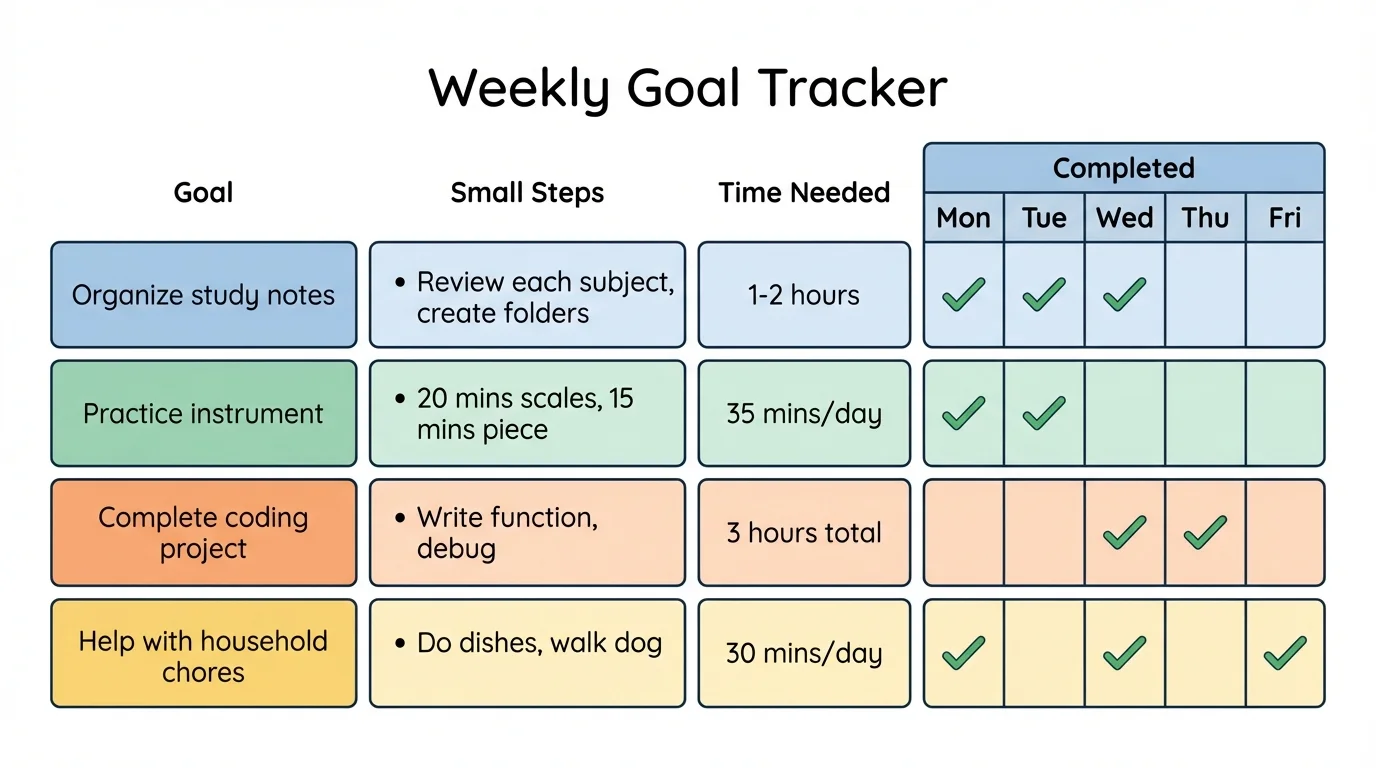
You can use the same method for personal life goals too. For example, "I will text my grandmother every Sunday afternoon for the next month," or "I will feed the dog by 7:00 each morning for 2 weeks without reminders."
Simple weekly planning example
Step 1: Pick one main goal.
"I will complete all online assignments by Friday evening this week."
Step 2: Break it into smaller actions.
Check assignments each morning, finish one hard task before free time, and review missing work on Thursday.
Step 3: Add a check-in.
At the end of each day, mark whether you stayed on track.
Plans work best when they are short enough to use and clear enough to follow.
Later, if you feel lost or distracted, looking back at [Figure 3] can remind you that progress often comes from simple repeated actions, not from waiting to "feel ready."
Setbacks do not mean failure if you respond with a plan, as [Figure 4] shows. Everyone runs into problems: distractions, low motivation, unexpected family plans, technology issues, tiredness, and poor time choices.
The key is not pretending obstacles do not exist. The key is noticing them early and adjusting. If your study time always gets interrupted at night, maybe your new plan is to work earlier. If your phone pulls your attention away, maybe it needs to stay across the room. If your goal is too large, maybe the reset is shrinking the step instead of quitting completely.
Use this reset method:
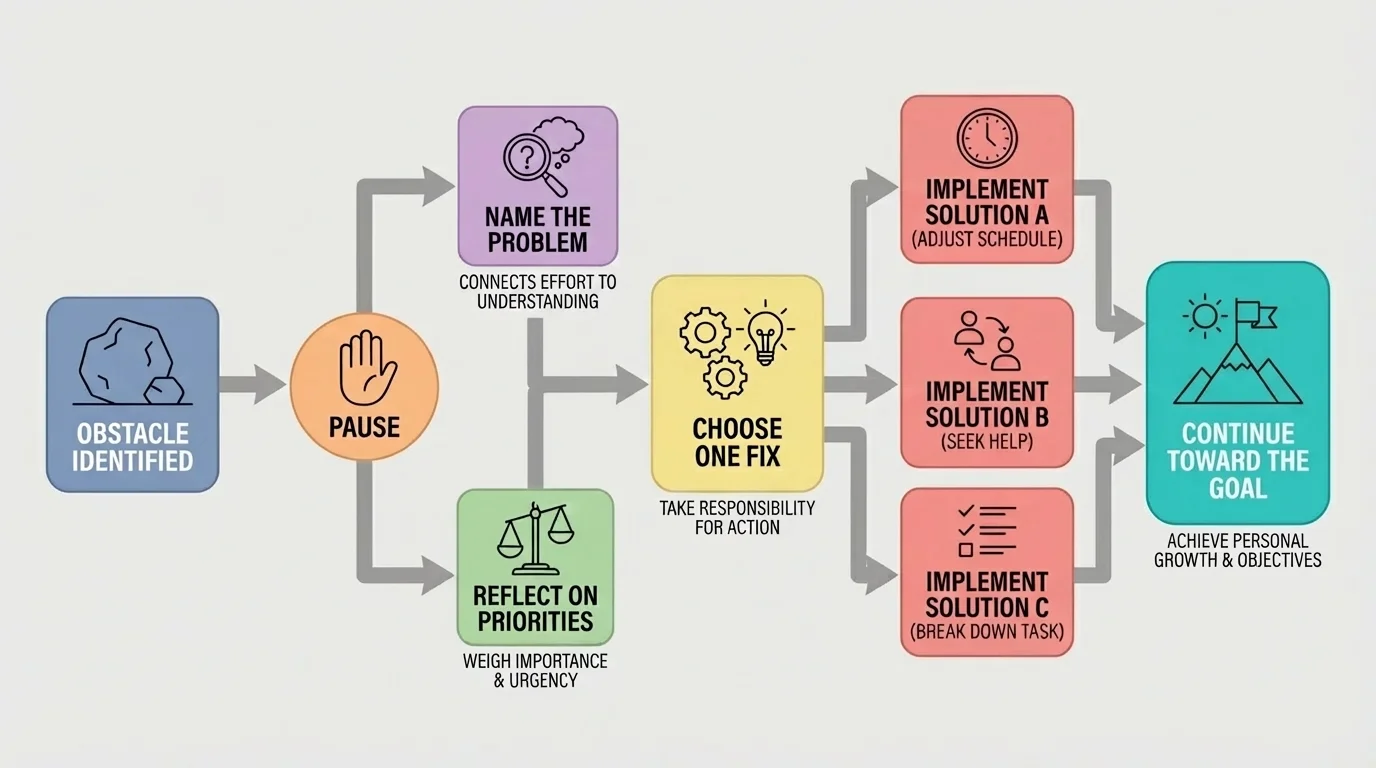
For example, suppose your goal is to read 20 minutes every weekday, but you skipped three days because you were tired. A poor response would be, "I failed, so it does not matter now." A stronger response would be, "Evening reading is not working. I will read for 10 minutes after lunch and 10 minutes before dinner."
This is where setbacks can teach you something. They often reveal what needs to change. As [Figure 4] makes clear, the obstacle is not the end of the path. It is a signal to choose a smarter next move.
You already know that habits grow through repetition. Goal setting uses the same idea: one good choice repeated many times becomes progress you can see.
If you need help, asking is responsible, not weak. You might ask a parent to remind you of a new routine, ask a coach for practice advice, or ask a trusted adult to help you create a quieter work space.
Your goals affect more than just you. If your goal is to be on time for an online volunteer meeting, other people can begin on schedule. If your goal is to save money wisely, you may become more thoughtful about spending. If your goal is to manage your mood before posting online, you help create a safer and kinder digital space.
This is one reason personal goal setting matters for the future. The habits you build now can shape what kind of teen and adult you become. A student who learns to plan, follow through, and reset after mistakes is building skills that help with future jobs, leadership roles, family responsibilities, and community involvement.
Responsible goals often spread outward. When you become more dependable, organized, or thoughtful, other people benefit too. Goal setting is personal, but its effects are often shared.
Think about these examples:
Future planning does not mean you need to know your whole life right now. It just means making choices today that support the kind of future you want.
Goals often fail when they stay separate from your daily routine. To make them last, attach them to things you already do. For example, review your planner right after breakfast, practice keyboarding right after logging off school, or pack materials right before dinner.
Helpful tools include timers, checklists, calendar reminders, sticky notes, and simple trackers. If you are using numbers, keep them easy to read. For example, if you want to save $12 in 3 weeks, you can divide the total: \(12 \div 3 = 4\). That tells you to save $4 each week. If you want to practice for 60 minutes across 4 days, you could split it into \(60 \div 4 = 15\) minutes per day.
A habit does not need to be huge to be useful. In fact, very small habits often work best at first. Five minutes of review, one cleaned area, one completed checklist, or one honest check-in can be enough to keep a goal alive.
People are more likely to keep a goal when they can see progress. A row of check marks, a savings jar filling up, or a completed checklist can make effort feel more real.
If a tool helps you remember and act, it is a good tool. If it is too complicated and you stop using it, simplify it.
Strong personal goals are not about perfection, and they are not about pleasing everyone. They are about deciding what matters, choosing actions that fit, and taking ownership of the results. When your priorities are clear, your effort becomes more focused. When your effort is consistent, responsibility becomes easier to practice. When responsibility grows, other people begin to trust you more.
You do not need ten goals at once. One well-chosen goal can teach you a lot. Start with something real, something useful, and something you are willing to work on even when you do not feel like it. Then let your actions prove that your goal matters.
