One of the biggest myths about independence is that it means doing everything alone. It does not. Real independence usually comes from having good systems, a workable routine, and clear responsibilities. If you know where things belong, when tasks need to happen, and what you are responsible for, you spend less time feeling overwhelmed and more time actually getting things done.
You may not be paying rent or managing an entire household yet, but you are already building the habits that support adult life. Managing tasks such as dishes, laundry, pets, shared spaces, and your daily schedule teaches you how to manage real life. These skills matter at home now, and they will matter even more later when no one is constantly reminding you what to do.
Independence is the ability to manage your life, make responsible choices, and handle tasks without needing someone else to direct every step. It does not mean you never ask for help. It means you can notice what needs to be done, plan for it, and follow through.
Home is where this usually begins. If you can wake up on time, keep track of your online school responsibilities, help care for shared spaces, and complete regular tasks, you are practicing self-management every day. That is a major life skill.
Household system is a repeatable way of getting something done at home. Schedule means a plan for when tasks happen. Responsibility means a job or duty that you are expected to handle. Together, these help turn chaos into order.
Without these supports, people often rely on memory, last-minute rushing, or repeated reminders from others. That can lead to missed deadlines, unfinished chores, frustration, and arguments. With them, daily life becomes more predictable and manageable.
[Figure 1] A household system is not fancy. It is simply a reliable method. For example, if dirty clothes always go in one basket, clean towels always go on one shelf, and charging cables always go in one drawer, you do not waste time hunting for things. A good system lowers stress because the environment itself helps you remember what to do.
Systems are powerful because they reduce the number of decisions you have to make. Instead of asking, "Where should I put this?" every time, the answer is already built into the system. Instead of waiting until a room becomes a disaster, a daily reset keeps it under control.
Some common home systems include a place for shoes by the door, a dishwashing routine after meals, a checklist for packing materials before online classes, a weekly laundry day, or a family calendar for appointments and shared tasks. These may seem small, but small systems are often what keep a home running smoothly.
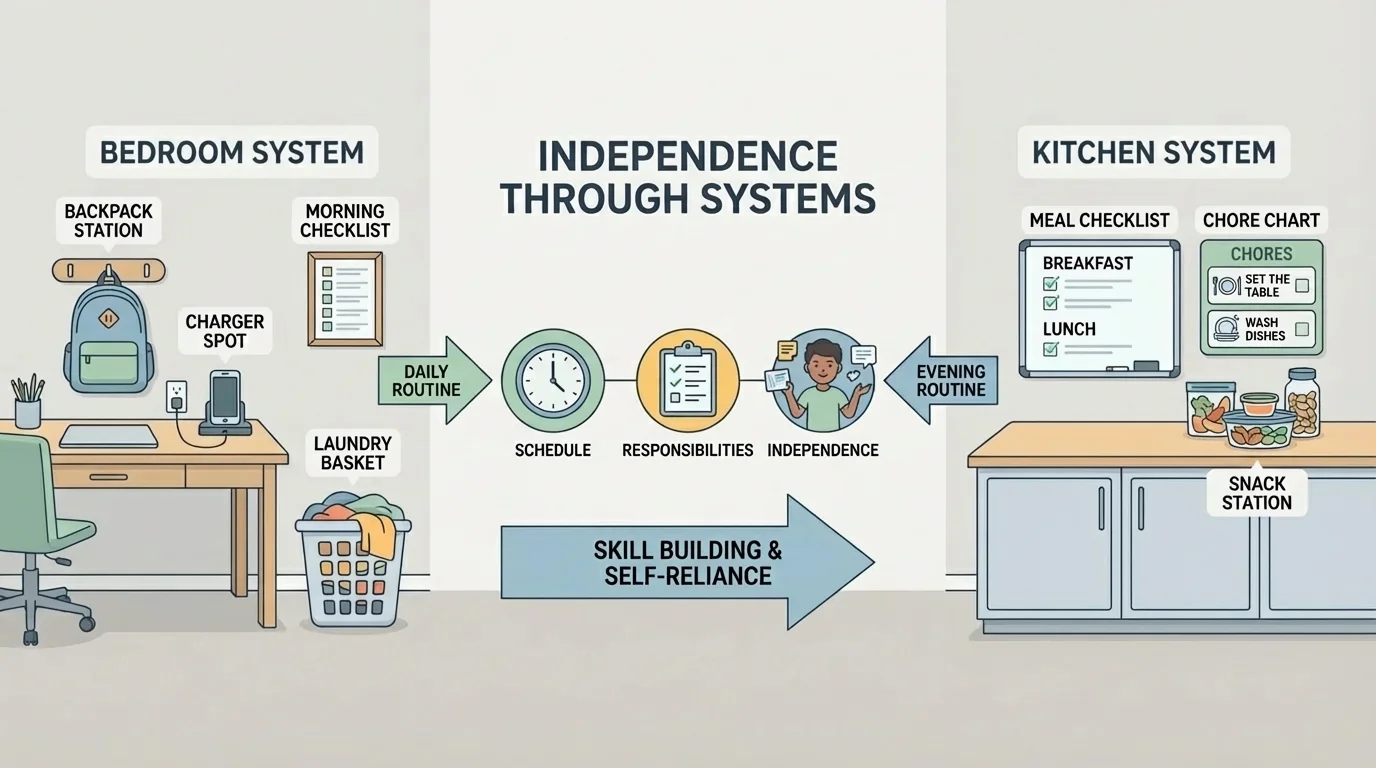
You can also have systems for communication. For example, your family may decide that schedule changes go on a shared calendar or are posted in a group message. That way, everyone knows what is happening without confusion. A communication system is just as useful as a cleaning system.
Why systems make you more independent
When you use a system, you depend less on reminders from other people. The system becomes your guide. Over time, this builds confidence because you start to trust yourself: you know where things go, what comes next, and how to keep up with everyday life.
This matters because adult life involves many systems. People use calendars, shopping lists, bill reminders, medication schedules, meal plans, and cleaning routines. Learning to use simple versions now prepares you for more complex responsibilities later. The same idea we saw in [Figure 1] applies in adult life: when your environment is organized, your brain has more energy for decisions that actually matter.
[Figure 2] A schedule helps you decide when things happen. This is different from a system, which focuses more on how something gets done. A schedule turns good intentions into action. You may want to clean your room, finish assignments, walk the dog, and relax, but if you never choose a time, those tasks can pile up. A visible weekly plan helps you see whether your time is realistic.
Students learning from home especially need schedules because home contains many distractions. A bed, game console, snacks, notifications, and family activity can all compete with your plans. If your day has no structure, it becomes easier to delay tasks and harder to notice where your time went.
A schedule also protects your energy. If you know that dishes happen after dinner, laundry happens on Saturday morning, and schoolwork review happens before free time, you do not have to argue with yourself each day. The decision is already made.
Schedules should include more than work. They should also include sleep, meals, movement, downtime, and personal care. Independence is not about being busy every minute. It is about managing your time so important things happen consistently.
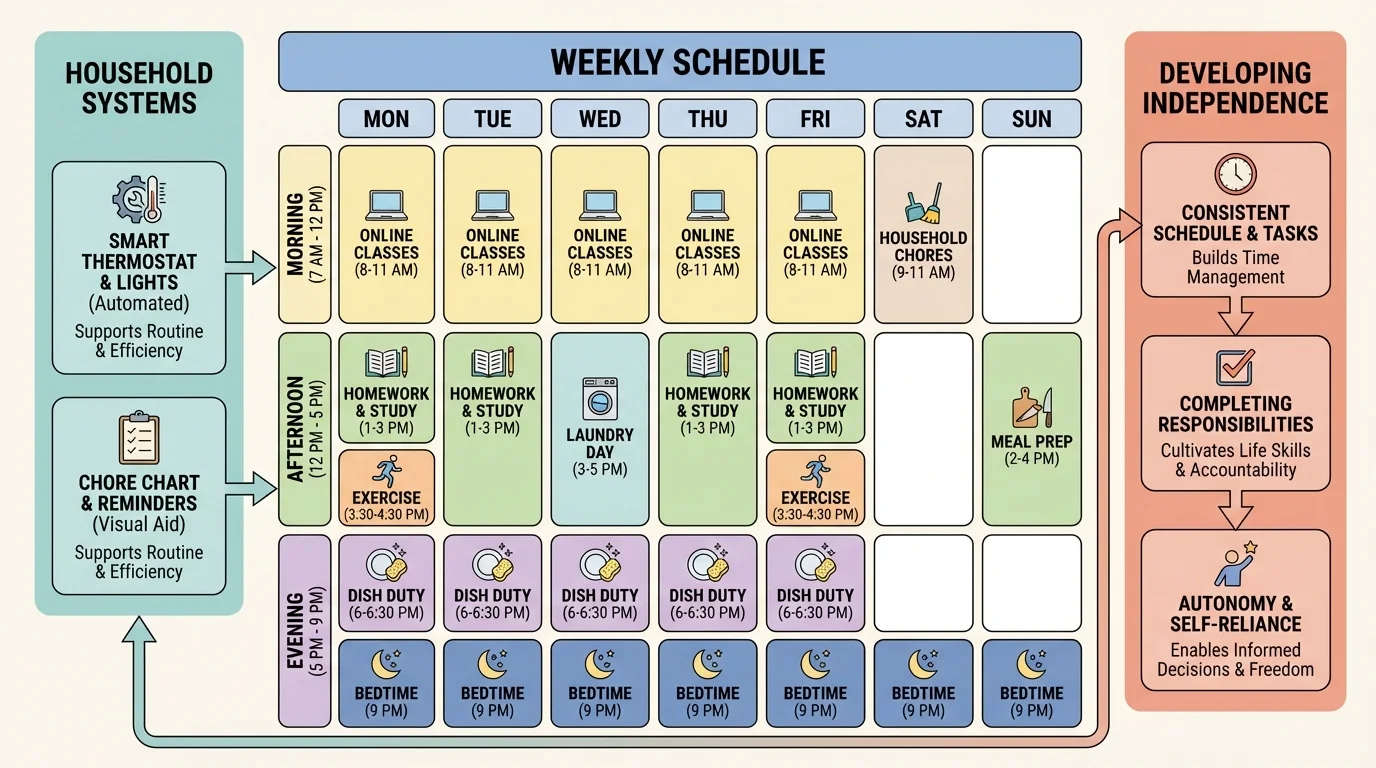
Good schedules are realistic. If you tell yourself you will clean the entire house, complete all assignments, exercise for two hours, and reorganize your closet in one evening, you will probably fail and feel discouraged. A better plan is smaller and repeatable.
For example, instead of saying, "I'll clean everything later," you might schedule a 15-minute room reset each evening. Instead of trying to do all homework at once, you might block one work session after lunch and a shorter review session before dinner. As [Figure 2] illustrates, balanced schedules leave room for both work and rest.
Many people feel "busy" not because they have too much to do, but because they have no clear order for doing it. A simple schedule can reduce stress even when the amount of work stays the same.
When schedules are missing, responsibilities often become emergencies. That is when a person suddenly realizes there are no clean clothes, the trash was never taken out, or an assignment is due in 10 minutes. Planning ahead prevents these preventable problems.
A responsibility is something others can count on you to do. It may be feeding a pet, unloading the dishwasher, taking out recycling, folding laundry, wiping counters, or keeping your study area ready for online classes. Responsibilities are not just chores; they are ways of showing that you can contribute to a shared life.
When you handle responsibilities consistently, people trust you more. That trust often leads to more freedom. If your family knows you will finish your tasks without repeated reminders, they are more likely to believe you can handle bigger decisions too.
Responsibilities also build accountability. Accountability means owning your actions and their results. If you forget to feed a pet, that affects a living creature. If you leave dirty dishes everywhere, someone else must deal with them. If you complete your part, the household runs better for everyone.
Real-life comparison
Situation A: Jordan waits until someone complains before doing chores.
The trash overflows, dishes stack up, and Jordan says, "I forgot." Family members become frustrated because they cannot rely on Jordan.
Situation B: Jordan has two clear jobs: trash on Tuesday and Thursday, dishes after dinner on weekends.
Jordan checks the schedule, does the tasks, and marks them complete. The family does not need to remind Jordan, and trust grows.
The difference is not personality. The difference is structure, follow-through, and accountability.
Responsibility is also connected to respect. In a household, your actions affect other people. Independence is not only about taking care of yourself. It is also about understanding that shared spaces and shared schedules require cooperation.
The best systems are simple enough that you will really use them. If a system has too many steps, you may ignore it. Start with the tasks that cause the most stress or mess in your daily life.
One useful area is your school setup. Keep chargers, notebooks, headphones, and login information in one consistent place. If your study area is always cluttered, make a system: supplies in one container, papers in one folder, trash removed at the end of each day, and device charging every night.
Another area is laundry. A simple laundry system might be: dirty clothes into the basket, empty pockets before washing, wash on one set day, move clothes promptly, fold the same day, and put them away before bedtime. This prevents the common problem of living out of a clean laundry pile.
Meals can also use systems. You can help by learning where food belongs, how leftovers are labeled, when dishes are done, and what basic cleanup happens after eating. Even if an adult cooks most meals, knowing the routine helps you support the household instead of just waiting to be served.
How to build one household system
Step 1: Pick one problem.
Choose something specific, such as losing your charger, forgetting to put away shoes, or leaving cups in your room.
Step 2: Choose one place and one rule.
Example: "My charger always goes in the top desk drawer when I'm done."
Step 3: Make it visible.
Use a basket, label, sticky note, or checklist until the habit feels automatic.
Step 4: Repeat daily.
Systems work because they are repeated, not because they are exciting.
Step 5: Adjust if needed.
If the system keeps failing, make it easier instead of giving up.
Try This: Choose one thing you often misplace and give it a permanent home today. That one change can save time every single week.
Once your systems are in place, your weekly routine becomes easier to manage. A weekly schedule should include tasks that happen every day, tasks that happen a few times a week, and tasks that happen once in a while.
Start by listing your fixed commitments, such as online classes, club meetings, sports practice, music lessons, or family events. Then add home responsibilities like taking out trash, folding laundry, vacuuming, feeding pets, or helping with meal cleanup.
After that, look for open spaces. Those are the times you can use for homework, room resets, hobbies, exercise, and rest. If your schedule is too packed, you may need to shorten tasks, move them, or ask your family to adjust who does what.
| Task Type | Example | Best Time | Why It Helps |
|---|---|---|---|
| Daily task | Make bed | Morning | Starts the day with order |
| Daily task | Clear study area | After schoolwork | Keeps supplies ready |
| Several times a week | Dishes | After dinner | Prevents buildup |
| Weekly task | Laundry | Saturday morning | Ensures clean clothes are ready |
| Weekly task | Vacuum bedroom | Sunday afternoon | Keeps space healthy and neat |
Table 1. Examples of household tasks and times they can fit into a weekly schedule.
A schedule should be visible and easy to check. Some students use a paper planner, a wall calendar, a whiteboard, or a calendar app. The tool matters less than the habit of checking it regularly.
"What gets scheduled gets done more often than what gets remembered."
Try This: Set one regular time each week to look ahead. Even 10 minutes of planning can stop last-minute stress before it starts.
[Figure 3] In a shared home, fairness matters. People become frustrated when one person does most of the work and another person avoids it. Clear agreements reduce this problem, and the process shows how a household can assign tasks, define expectations, and check whether they are complete.
Fair does not always mean everyone does exactly the same tasks. It means responsibilities are divided in a way that makes sense for each person's age, ability, schedule, and other commitments. A younger child may put away toys while an older student handles dishes, pet care, or laundry.
What matters most is clarity. If someone says, "Help out more," that is vague. If they say, "Please unload the dishwasher every weekday by 5:00 p.m.," that is clear. Independence grows when you know exactly what is expected and can meet that expectation reliably.
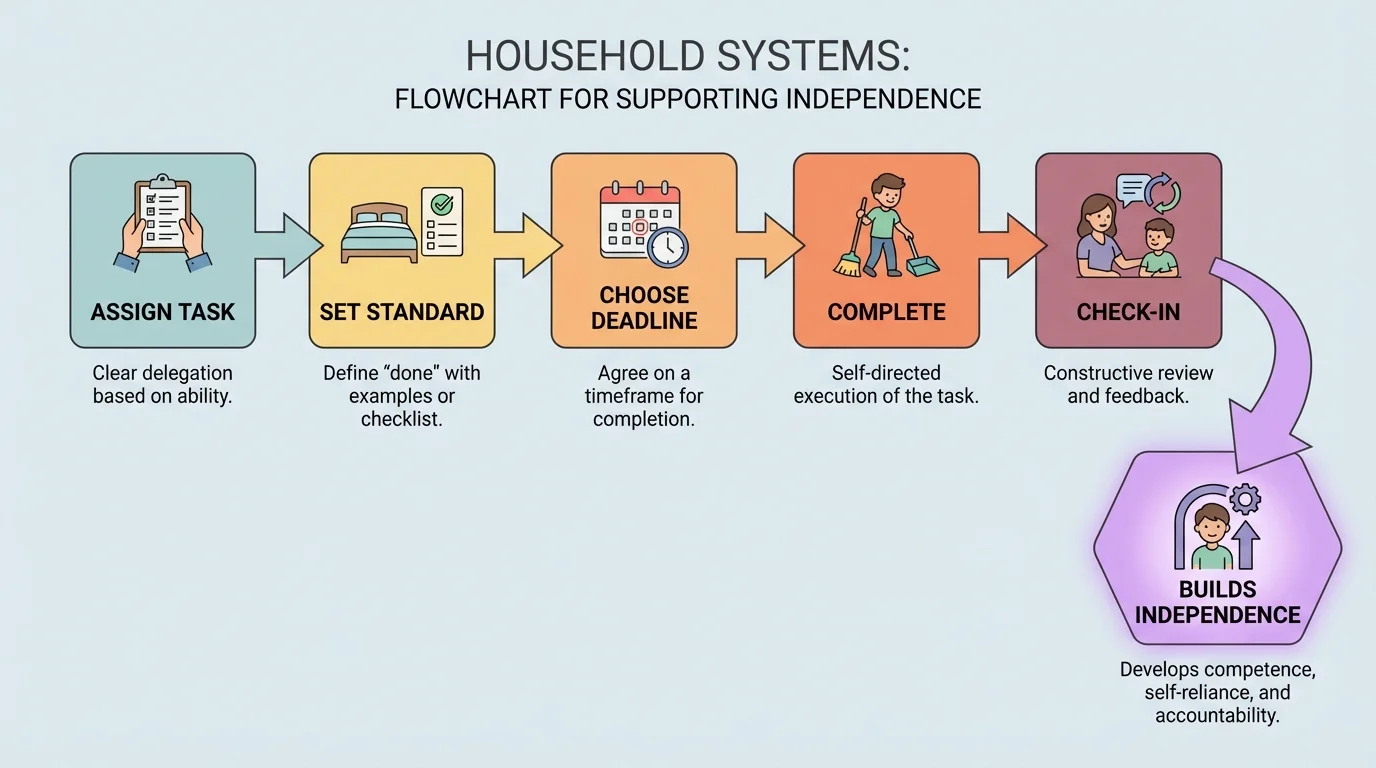
When responsibilities change, communication matters. Maybe a parent is working late, a sibling is sick, or you have an unusually busy week. Instead of ignoring the task, speak up early. Responsible people communicate before a problem gets bigger.
Clear expectations prevent conflict
Many household arguments are not really about laziness. They are about unclear expectations, different standards, or poor communication. When tasks are named clearly, scheduled clearly, and checked fairly, people are less likely to blame each other.
This is why checklists can help. For example, "clean the kitchen" might mean wiping counters, loading dishes, putting food away, and taking out trash. If everyone means something different, conflict happens. The same decision path we saw in [Figure 3] helps households move from confusion to agreement.
Even good systems fail sometimes. That does not mean you are bad at responsibility. It usually means the system needs improvement.
If you keep forgetting tasks, the problem may be that the reminder is hidden. Put the checklist where you will see it, such as near your desk, mirror, or device. If a task always gets skipped at night, move it earlier in the day.
If your room gets messy fast, you may own more loose items than your storage system can handle. Add containers, reduce clutter, or give categories clear homes. Mess often comes from objects having no assigned place.
If you feel overloaded, look honestly at your schedule. Too many responsibilities at one time can cause shutdown. Break larger jobs into smaller parts. "Clean room" can become "pick up clothes," "clear desk," and "empty trash." Smaller steps are easier to start.
Problem-solving example
Problem: Maya keeps forgetting to take the recycling out on pickup day.
Fix 1: Maya adds the task to a shared family calendar with a reminder the night before.
Fix 2: Maya places the recycling bin near the door on the evening before pickup.
Fix 3: Maya links the task to an existing habit: after brushing teeth on pickup morning, take the bin outside.
Maya did not just try harder. Maya changed the system so success became easier.
That is an important idea: successful people do not rely only on motivation. They create conditions that support follow-through.
Household skills may seem ordinary, but they connect directly to adult independence. The person who can keep track of chores today is practicing for keeping track of bills, appointments, and deadlines later. The person who can follow a schedule at home is building the same skill needed for work shifts, due dates, and transportation plans.
Living with roommates, family members, or a future partner also requires these skills. Shared living works better when people communicate, divide tasks, and respect systems for cleaning, food, laundry, and quiet time.
These habits also affect your reputation. Whether you are helping at home, volunteering, babysitting, or working a first job someday, people notice if you are reliable. Reliability often matters as much as talent. Being the person who follows through is a major strength.
Independence is not about proving that you never need support. It is about becoming someone who can manage daily life with increasing skill. Household systems, schedules, and responsibilities are not boring extras. They are the training ground for real freedom.
Try This: Pick one responsibility you already have and do it this week without being reminded once. That is a direct step toward greater independence.
