Some of the worst decisions people make are not caused by a lack of intelligence. They happen because someone feels rushed, upset, cornered, or unsure. A text message gets answered too quickly. A rumor gets shared without checking. A disagreement turns into an online fight. A deadline approaches so quickly that panic takes over. Knowing how to think in these moments is a practical skill, and it can protect your relationships, your reputation, and your well-being.
Problem-solving is not just for puzzles or school assignments. It is a daily skill you use when a friend is upset with you, when someone pressures you to do something that feels wrong, or when you have to make a choice without knowing exactly how it will turn out. Good problem-solvers are not perfect. They are people who slow down, notice what is happening, and choose their next step on purpose.
Conflict, pressure, and uncertainty are common in everyday life. You might disagree with a sibling about shared space at home. You might feel pressured to reply instantly in a group chat. You might have to decide whether to join an activity, post something publicly, spend your money, or trust information online. In each case, the challenge is not only the situation itself. The challenge is staying clear-headed while it happens.
You do not always make your best decisions when emotions are intense. When you feel threatened, embarrassed, or rushed, you are more likely to react quickly instead of think carefully.
If you handle these situations well, people learn they can trust you. You protect your time, avoid unnecessary drama, and solve problems faster. If you handle them poorly, small issues can grow. One angry post can damage a friendship. One rushed choice can create a bigger problem tomorrow than the one you were trying to escape today.
Conflict is a disagreement or clash between people, needs, goals, or values. Conflict is not automatically bad. In fact, healthy conflict can help people solve problems and understand each other better. The real issue is how the conflict is handled.
Pressure is the feeling that you must act, agree, perform, or decide in a certain way. Pressure can come from other people, from time limits, from social media, or from yourself. Sometimes pressure is direct, like "Come on, just do it." Sometimes it is indirect, like feeling you need to look confident, keep up, or not disappoint anyone.
Uncertainty means you do not have complete information about what is true, what will happen next, or which choice is best. Life often works this way. You may not know whether a friend is ignoring you or just busy. You may not know whether an opportunity is worth the risk. Good decision-making does not require perfect certainty. It requires careful thinking.
Conflict is a disagreement or tension between people, ideas, needs, or goals.
Pressure is a force that pushes you to act quickly or in a certain way, even if you are not fully comfortable.
Uncertainty is a situation where important facts or outcomes are unknown.
These three often overlap. A conflict can create pressure. Pressure can make uncertainty feel worse. Uncertainty can make conflict harder because people may guess, assume, or overreact. That is why one strong problem-solving process can help in all three situations.
Before you solve the problem, you need to manage yourself. That does not mean ignoring your feelings. It means not letting your feelings take control. If your heart is racing, your stomach feels tight, your face feels hot, or your thoughts are spinning, your first job is to slow down.
Try a quick reset. Take one slow breath in for a count of \(4\), hold for \(4\), and breathe out for \(6\). Relax your shoulders. Put your phone down for a minute if needed. Read the message again later instead of answering instantly. Even a short pause can stop a bad reaction from becoming a bigger problem.
This is where emotional regulation matters. Emotional regulation means noticing your emotions and managing how you respond to them. You still feel angry, embarrassed, worried, or frustrated. But instead of exploding, shutting down, or agreeing to something you do not want, you choose a response that helps.
Pause first, solve second
When emotions are high, your goal is not to become emotionless. Your goal is to create enough space between the feeling and the action so you can choose wisely. A pause gives your thinking time to catch up with your emotions.
A useful question is: What am I feeling, and what am I tempted to do right now? That question helps you separate the emotion from the action. For example, you might feel embarrassed and be tempted to send a rude reply. You might feel pressured and be tempted to say yes immediately. Once you notice the temptation, you have more control over it.
A strong problem-solving framework gives you a path to follow when your mind feels messy. As [Figure 1] shows, the process moves from a trigger to a thoughtful choice instead of a quick reaction. You can use the same process whether you are dealing with a disagreement, a hard decision, or a stressful situation.
Step 1: Name the problem clearly. Be specific. "Everything is awful" is too vague. "My friend thinks I ignored them because I did not answer for two hours" is clearer. "I have three tasks due soon and I do not know where to start" is clearer. A clear problem is easier to solve.
Step 2: Gather facts. Ask what you know for sure, what you are assuming, and what information is missing. Facts are things you can check. Assumptions are guesses your brain may be filling in.
Step 3: Identify feelings and needs. Feelings matter because they affect decisions. Needs matter because they point toward solutions. You may need respect, time, safety, space, honesty, or support.
Step 4: List possible options. Try to think of at least \(3\) options before choosing. When people feel stressed, they often act like there are only \(2\) choices: fight or give in, quit or panic, answer now or lose everything. Usually there are more options than that.
Step 5: Predict consequences. Ask what could happen next for each option. Think short-term and long-term. Also ask: Is this safe? Is it respectful? Does it match my values? Would I be okay with someone I trust seeing this choice?
Step 6: Choose the best next step. Notice that this does not always mean solving everything at once. Sometimes the best next step is sending a calm message, asking a question, taking a break, or getting advice from an adult.
Step 7: Reflect afterward. After the situation, ask what worked, what did not, and what you would do differently next time. Reflection turns experience into skill.
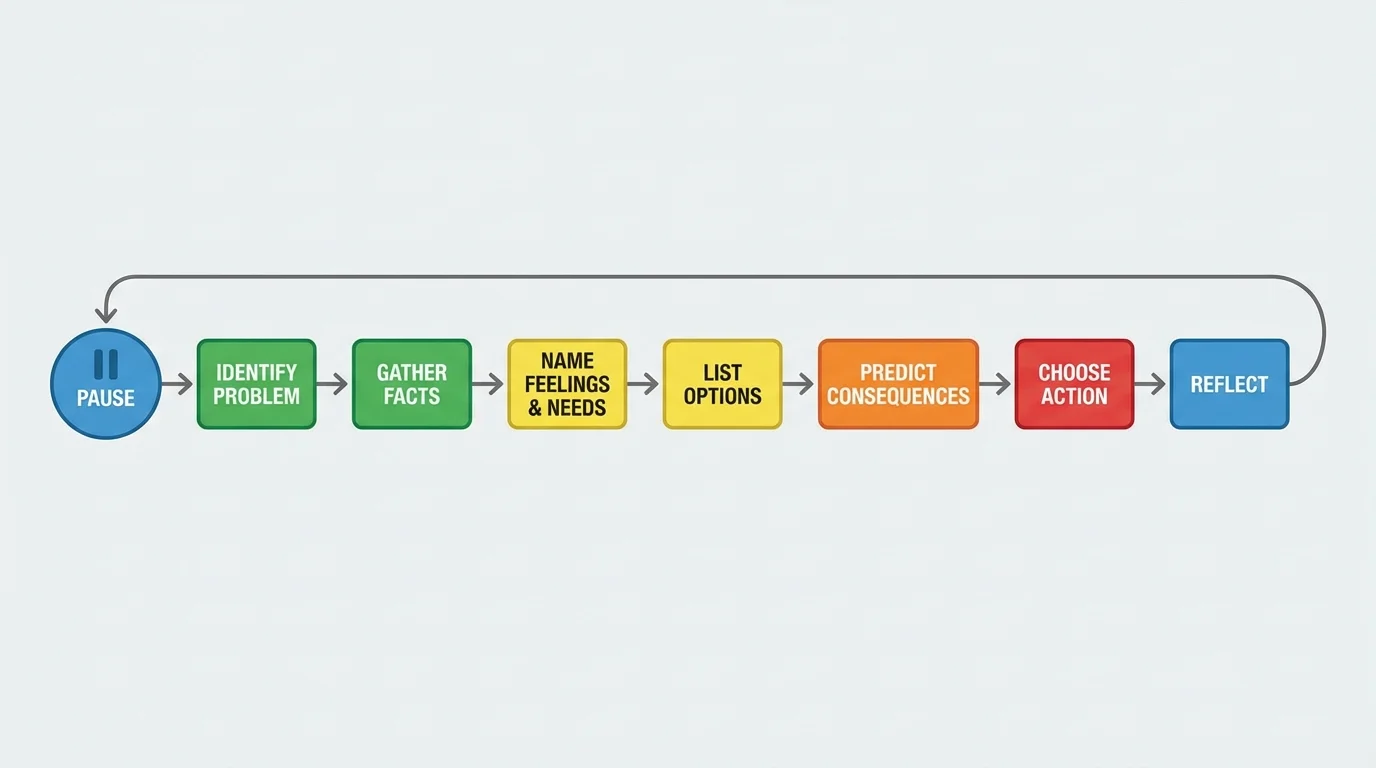
You do not need to follow these steps perfectly every time. The point is to avoid acting on the first impulse. The more you practice, the faster and more natural this process becomes.
Using the framework in a real situation
You see a message in a group chat: "Wow, thanks for leaving me out." You think it is about you, and you feel angry.
Step 1: Name the problem
The problem is not "They hate me." The clearer problem is: "A message feels directed at me, but I do not know the full context."
Step 2: Gather facts
You know the message was posted. You do not know for sure who it was about or what happened before it.
Step 3: List options
Option \(1\): reply angrily in the chat. Option \(2\): ignore it completely. Option \(3\): send a private, calm message asking what is going on.
Step 4: Predict consequences
Option \(1\) may increase drama. Option \(2\) may leave the problem unresolved. Option \(3\) gives a chance to clear things up respectfully.
A calm private message is often the strongest choice.
When conflict happens, your goal is not to "win" at all costs. Your goal is to solve the issue while protecting respect and safety. This approach helps keep the conversation focused on the problem instead of turning it into a personal attack.
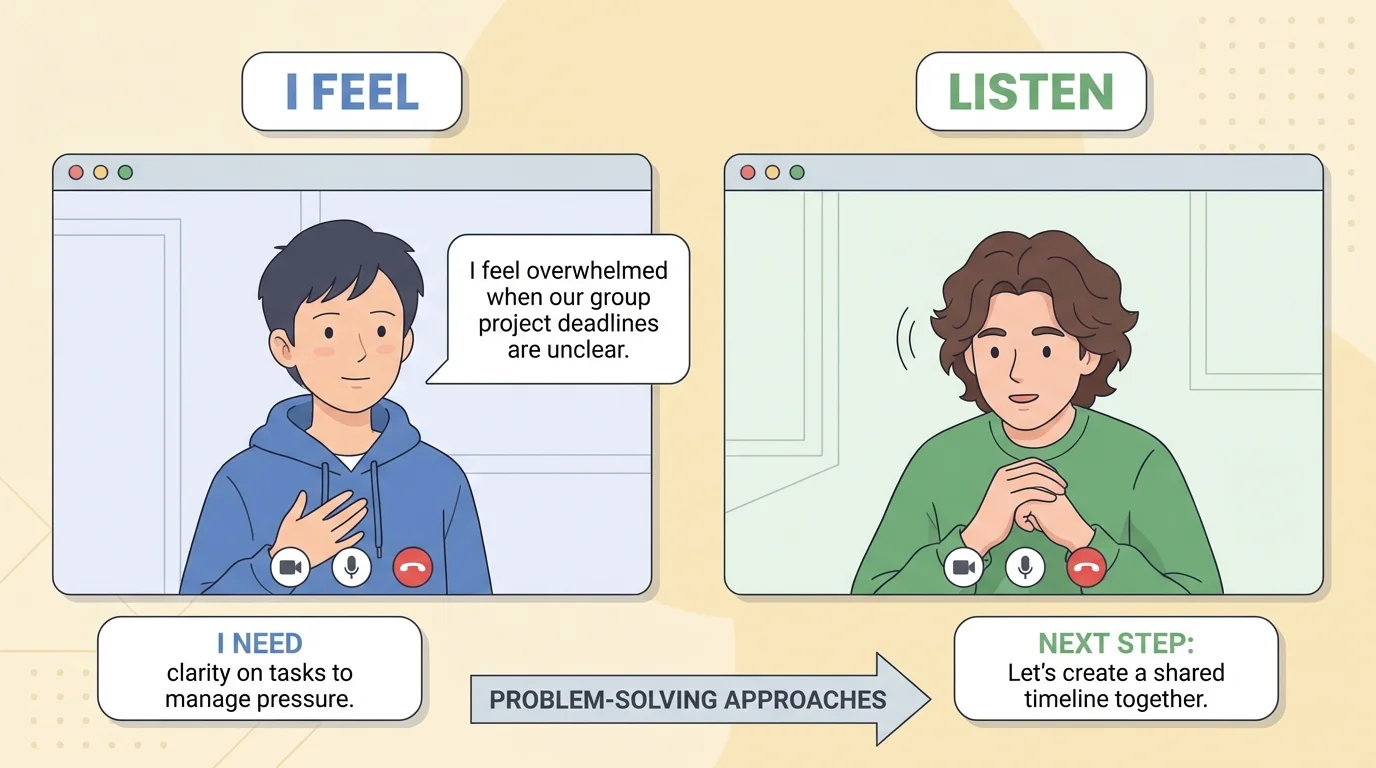
[Figure 2] One of the best tools for conflict is the I-statement. An I-statement explains your experience without blaming the other person. For example: "I felt frustrated when the plan changed and I did not know what was happening." That is very different from: "You always ruin everything." The first opens a conversation. The second usually starts a fight.
Another key skill is active listening. Active listening means you focus on understanding the other person before trying to prove your point. That can sound like: "So you thought I was ignoring you?" or "Let me make sure I understand." Listening does not mean you agree with everything. It means you are making sure you heard correctly.
Healthy conflict also includes boundaries. A boundary is a limit that protects your well-being. You can say, "I want to talk about this, but not if we are insulting each other," or "I need \(10\) minutes to calm down before I respond." Boundaries are not punishments. They are rules for respectful interaction.
If the conflict is getting intense, step back. You do not have to continue a conversation that is becoming unsafe, threatening, or abusive. In those situations, getting help is not weakness. It is good judgment. A trusted adult, parent, guardian, coach, counselor, or community leader can help you think clearly and stay safe.
Sometimes compromise works. Sometimes it does not. A compromise means both sides give a little to find a workable solution. But if the issue involves safety, respect, or your values, compromise may not be the right goal. For example, you should not compromise on being treated with basic respect.
Later, when you reflect on the conflict, think back to the communication pattern you practiced earlier. Did you explain your feelings clearly? Did you listen carefully? Did you protect your boundaries? Those questions help you improve.
Pressure often works by making you feel that you must decide right now. This is common in friendships, online spaces, advertising, and stressful deadlines. Someone may push you to share private information, join drama, spend money, break a rule, or agree to something before you have time to think.
A useful response is to slow the pace. Say, "I need time to think," "I am not deciding right now," or "Let me check first." If someone refuses to give you time, that is important information. Pressure usually gets stronger when the other person benefits from your rushed decision.
Watch for common pressure tactics:
These tactics do not prove something is a good idea. They often mean someone is trying to control the decision instead of letting you make it freely.
"If you need to be pushed into it, it is probably worth questioning."
You can prepare short responses in advance. That makes it easier to resist pressure when you are nervous. Try: "No, I am not doing that." "That does not work for me." "I am logging off." "I said no." "I am not comfortable with that." A short, calm no is often stronger than a long explanation.
Pressure can also come from yourself. You may expect perfection, compare yourself to other people online, or panic when time is short. In that case, the problem is not another person pushing you. It is your own thoughts pushing you. When that happens, return to facts. Ask: What is the actual deadline? What is the next small step? What matters most right now?
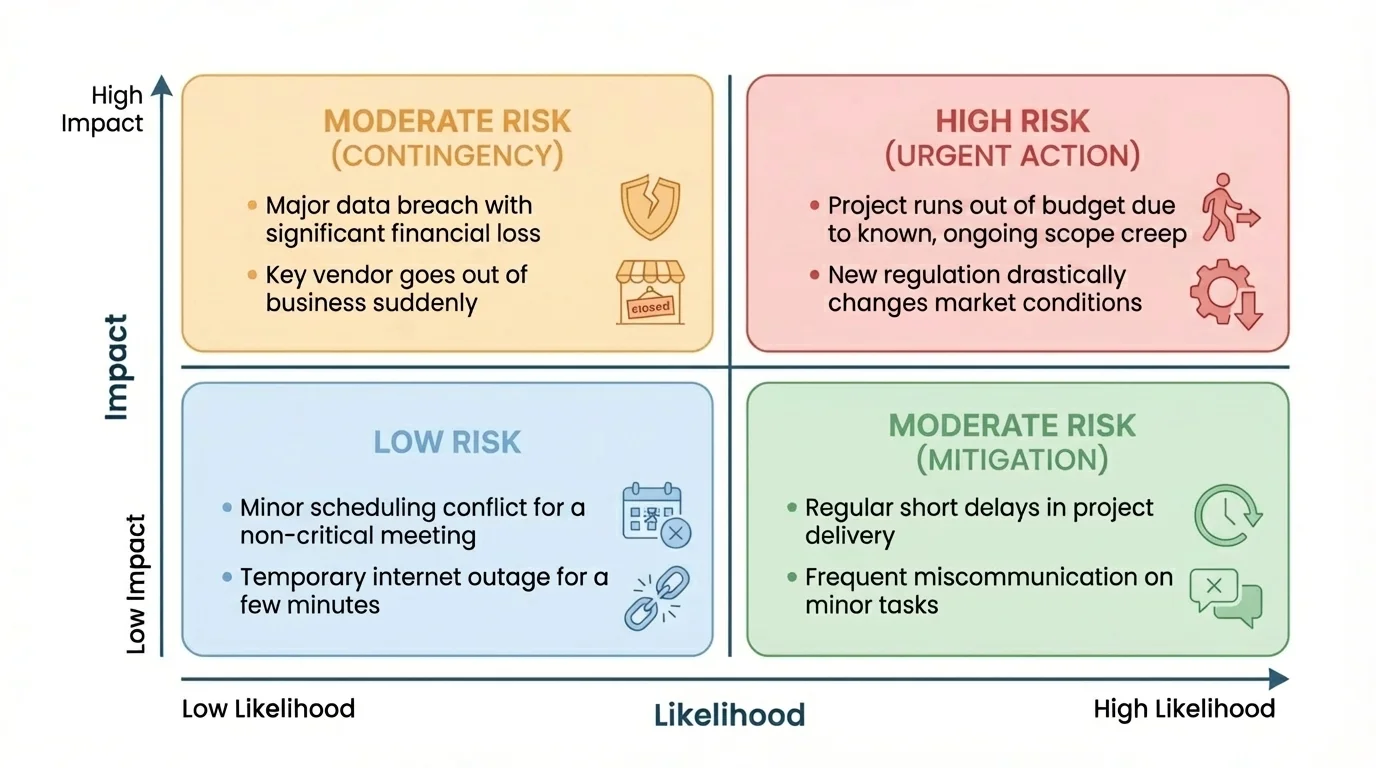
Some problems do not come with clear answers. You may have incomplete information, mixed signals, or several reasonable options. In those situations, decision-making becomes a matter of weighing risk, not waiting forever for perfect certainty. The simple risk view helps you think about both how likely something is and how much it matters if it happens.
[Figure 3] Start with three questions: What is the best-case scenario? What is the worst-case scenario? What is the most likely scenario? This keeps your mind from getting trapped at one extreme. If you only think about the best case, you may ignore danger. If you only think about the worst case, you may become too afraid to act at all.
Next, think about risk assessment. Risk assessment means judging both the chance of something happening and the impact if it does. A choice with low chance but very high harm still deserves caution. A choice with moderate uncertainty but low harm may be okay if you have a backup plan.
For example, suppose you are invited to join an unfamiliar online project with people you do not know well. The best case is that you learn something new and make useful connections. The worst case is that your time is wasted or your personal information is misused. The most likely case may be somewhere in the middle. A smarter choice might be to join only after checking who is involved, what the rules are, and whether you can leave easily if it feels wrong.
When information is missing, do not fill every gap with assumptions. Instead, ask better questions. Who is involved? What are the rules? What is the deadline? What happens if I wait? What happens if I say no? What proof do I have? Who can help me check this?
Another smart tool is a backup plan. A backup plan is a second option you prepare in case the first choice does not work. Backup plans reduce stress because they remind you that one uncertain choice does not control your whole future.
Uncertainty does not mean helplessness
You do not need to know everything to make a good decision. You need enough reliable information, a sense of the risks, and a plan for what you will do next if things change.
Thinking this way helps in many situations: choosing how to spend your weekend, deciding whether to trust a source online, responding to mixed messages from a friend, or picking between two opportunities that both have pros and cons.
Here is a quick checklist for difficult moments. Ask yourself:
You can also use a simple message script when emotions are high: "I want to handle this well. I need a little time to think, and then I will respond." That kind of message protects both the relationship and your decision-making.
If you get stuck, reach out to your support network. This may include a parent, guardian, older sibling, mentor, coach, or another trusted adult. Asking for help is part of strong problem-solving, not a sign that you failed.
| Situation | Unhelpful reaction | Helpful response |
|---|---|---|
| Friend sends a rude message | Reply instantly with anger | Pause, ask what happened, respond calmly |
| Someone pressures you online | Say yes to avoid awkwardness | Use a short no and step away |
| You are unsure what to do | Guess and hope | Gather facts and ask questions |
| Deadline stress builds up | Panic and avoid the work | Break the task into smaller steps |
| Conflict becomes intense | Keep arguing to win | Pause, set boundaries, get help if needed |
Table 1. Examples of unhelpful reactions and stronger problem-solving responses in everyday situations.
Scenario 1: Online conflict. A friend stops replying after you posted photos from an event they missed. Instead of assuming they are being dramatic, you pause and check the facts. Then you send: "I noticed you have been quiet. If something bothered you, I am willing to talk." That response lowers defensiveness and invites honesty.
Scenario 2: Time pressure. You have a big assignment, chores, and a family commitment all in one evening. Instead of saying, "I cannot do any of this," you name the problem clearly and choose the next step. You might list the tasks, estimate time, and start with the most urgent piece. Even if you cannot finish everything, a calm plan is better than panic.
Breaking a stressed evening into a plan
You have \(3\) tasks and \(120\) minutes.
Step 1: Estimate time
Task A takes \(45\) minutes, Task B takes \(30\) minutes, and Task C takes \(20\) minutes. Total planned work is \(45 + 30 + 20 = 95\) minutes.
Step 2: Compare with available time
You have \(120\) minutes, so the remaining time is \(120 - 95 = 25\) minutes.
Step 3: Use the extra time wisely
You can use the \(25\) extra minutes for a short break, unexpected delays, or asking for help if one task takes longer.
A simple plan lowers stress because the situation becomes clearer.
Scenario 3: Uncertainty. You are invited to join a weekend activity, but the details are vague. Instead of automatically agreeing because you do not want to miss out, you ask who is going, where it is, how long it lasts, and what the expectations are. That is careful decision-making, not overthinking.
As you become more experienced, you will notice a pattern: strong choices usually come from slowing down, asking better questions, and thinking ahead. That is true in conflict, under pressure, and in uncertainty.
Not every problem needs an instant solution. Many situations improve when you pause, gather facts, and choose the best next step instead of trying to fix everything at once.
The goal is not to remove all stress from life. That is impossible. The goal is to become someone who can stay grounded when stress appears. That kind of calm thinking helps you protect your relationships, your safety, and your future choices.
