A message does not have to be true to affect you. If you hear the same idea over and over in videos, songs, comments, group chats, or posts, it can start to feel normal even when it is unhealthy. That matters because your beliefs guide your choices: who you trust, what behavior you excuse, what you think you "owe" someone, and when you decide to get help.
As you get older, you will hear a lot of opinions about dating, friendship, attraction, privacy, loyalty, and what "real love" is supposed to look like. Some messages are helpful. Others are based on fear, control, stereotypes, or pressure. Learning to spot the difference protects your feelings, your boundaries, and your safety.
Healthy relationships are not built on guessing games, guilt, or power. They are built on respect, honesty, consent, trust, and the ability to say no without being punished for it. If you believe unhealthy messages, you may accept behavior that is rude, manipulative, or even dangerous because it has been presented as romantic, normal, or "just how people are."
Consent means a clear, freely given yes. It is not pressure, silence, fear, or giving in to avoid conflict.
Boundary means a limit you set to protect your comfort, values, time, body, and personal information.
Manipulation means trying to control someone through guilt, pressure, threats, lies, or emotional tricks instead of honest communication.
These ideas connect directly to personal safety. Safety is not only about strangers. It also includes people you know, people you text, people you game with, people you follow online, and people who act friendly while ignoring your limits.
[Figure 1] Your beliefs about relationships do not appear out of nowhere. They are shaped by many messages at once: what you see online, what friends say, what adults demonstrate, what entertainment celebrates, and what you tell yourself after repeated experiences. If one harmful idea shows up in all those places, it can feel "obvious" even when it is wrong.
For example, if a student sees videos that treat jealousy as cute, hears friends say "if they care, they should want to know your password," and watches characters in a series track each other's location without consequences, that student may start believing control equals love. That belief can lead to risky choices, like sharing private information or accepting invasions of privacy.
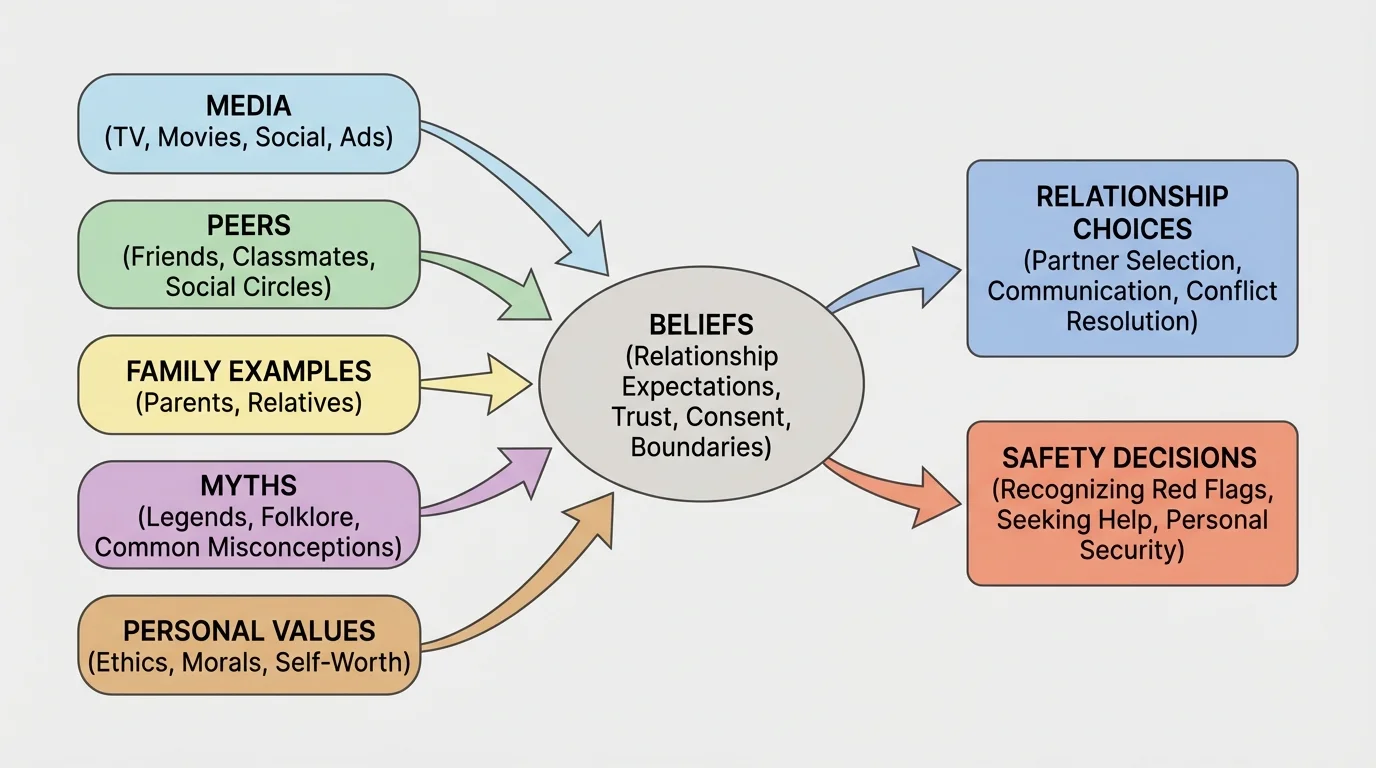
[Figure 1] Beliefs matter because they act like a filter. If your filter is healthy, you are more likely to notice red flags early. If your filter is distorted by myths, you may explain away problems. Instead of thinking, "This person is disrespecting my boundary," you might think, "Maybe this is just what relationships are like."
A strong personal filter asks questions such as: Is this respectful? Is this mutual? Is there pressure? Do I feel safe? Can I say no? Those questions can interrupt unhealthy messages before they become habits.
Repeated exposure can make a message feel more believable even when there is no good evidence for it. That is one reason trends, rumors, and stereotypes can spread so quickly online.
When you understand how messages shape beliefs, you gain more control. You stop automatically absorbing ideas and start choosing which ideas deserve your trust.
[Figure 2] Some harmful messages are called myths. A myth is a popular idea that sounds true but is actually misleading or false. In relationships, myths are especially tricky because they are often presented as romantic, dramatic, or mature.
Myth 1: Jealousy proves love. Reality: jealousy can happen, but it does not prove respect or trust. A person who constantly accuses you, checks up on you, or demands proof of loyalty is not showing healthy care. They are showing insecurity or control.
Myth 2: If you really like someone, you should do whatever they ask. Reality: caring about someone never removes your right to boundaries. You do not owe anyone your time, photos, location, passwords, personal details, or physical affection.
Myth 3: Pressure is normal. Reality: pressure is a warning sign. Healthy people do not rush you, guilt you, threaten to leave, or say things like "If you loved me, you would." They respect your answer the first time.
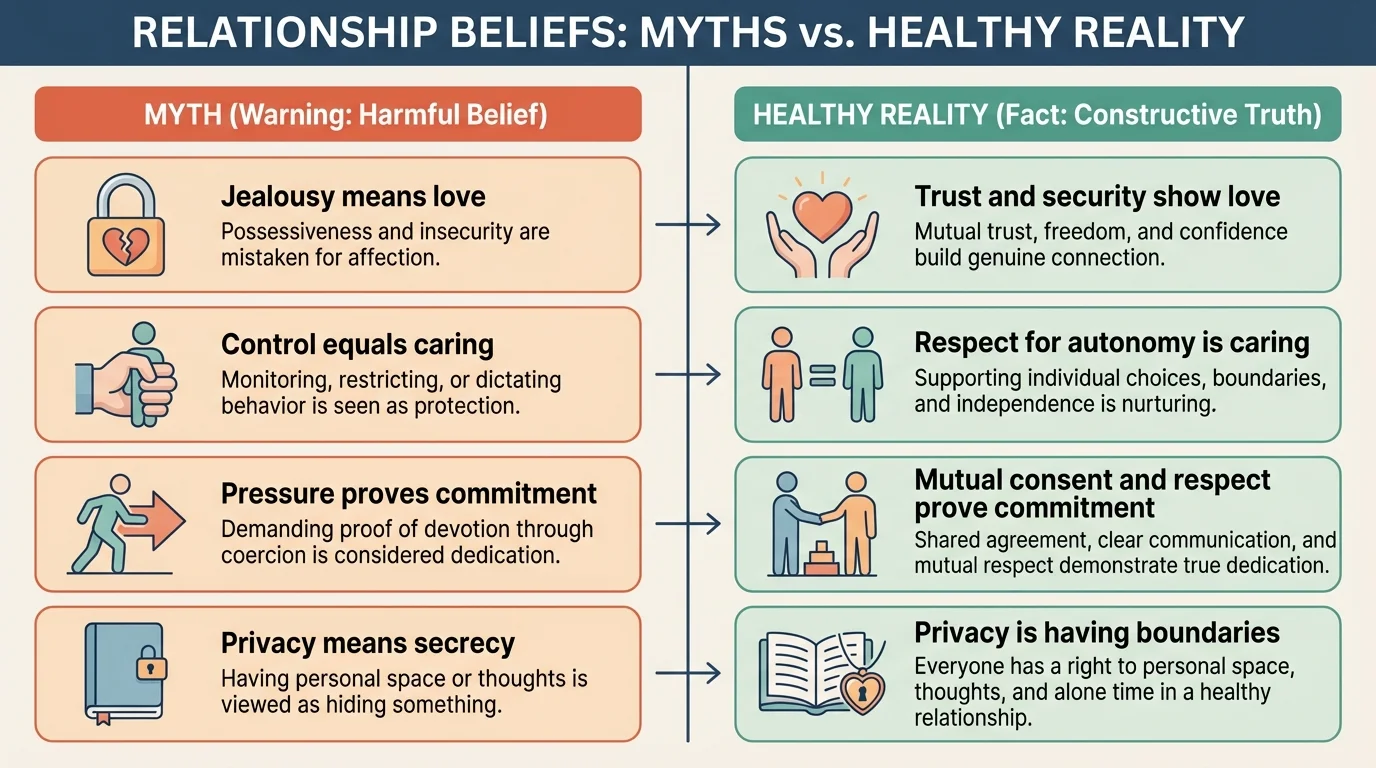
Myth 4: Privacy means you are hiding something. Reality: privacy is healthy. You can care about someone and still keep your messages, accounts, thoughts, and personal space private. Privacy protects safety and independence.
Myth 5: Popular behavior is safe behavior. Reality: a lot of people doing something does not make it wise. Sharing passwords, posting your location publicly, meeting someone alone without telling an adult, or sending personal photos can still be unsafe even if peers treat it as normal.
These myths can lower your standards. When that happens, disrespect starts to look ordinary. Later, if a more serious problem appears, you may hesitate to act because the early warning signs already seemed acceptable. That is why noticing myths early is so important.
Think about how [Figure 2] contrasts fantasy with reality. Healthy relationships do not need control to feel strong. They need trust, communication, and respect for limits.
Media literacy means thinking carefully about the messages in entertainment, advertising, social media, and online content instead of absorbing them automatically. Media can teach helpful things, but it can also make unhealthy behavior look exciting, funny, powerful, or desirable.
For example, a show might present nonstop texting, dramatic arguments, or tracking someone's activity as signs of passion. An influencer might joke about going through a partner's phone. A song might treat persistence after a clear no as romantic. These messages can blur the line between attention and disrespect.
Social media adds extra pressure because what you see is often edited. People post highlights, not the full truth. You might see couple photos, matching bios, expensive gifts, or constant updates and think, "That must mean the relationship is strong." But public display does not prove private respect.
How media shapes expectations
Media often rewards speed, drama, beauty, and attention. Real healthy relationships usually look calmer: asking before sharing information, respecting time apart, accepting no, apologizing sincerely, and handling conflict without threats. Because healthy behavior can seem less dramatic, media may under-show it even though it is safer and stronger.
Another problem is stereotypes. Media can spread ideas like "boys should always push," "girls should always please," or "being tough means ignoring feelings." Those ideas are harmful to everyone. They pressure people into roles instead of encouraging honest, respectful communication.
A smart question to ask is: Who benefits from this message? Sometimes the answer is attention, clicks, status, or profit, not your well-being. The more clearly you see that, the less power the message has over you.
Peer pressure is the influence people your age can have on your choices, whether directly or indirectly. It is not always obvious. Sometimes it sounds like teasing, dares, jokes, trending challenges, or comments like "everyone does this."
Peer messages can affect beliefs about what is normal, what is embarrassing, and what makes someone "mature." If a group chat laughs at boundaries, treats clingy behavior as sweet, or mocks someone for saying no, that group is teaching unhealthy beliefs even if no one says, "You must do this."
Pressure can also be silent. If everyone around you acts like constant access is expected, you may feel guilty for wanting privacy. If friends praise risky behavior, you may worry that being careful makes you seem immature. But real maturity is making choices that protect your safety and values, even when others disagree.
| Message You Might Hear | What It Really Means | Healthier Response |
|---|---|---|
| "If you trust them, share your password." | Pressure to remove privacy | "Trust does not require access to my accounts." |
| "It's not a big deal, just send it." | Pressure to ignore risk | "If I am uncomfortable, it is a big deal." |
| "Everyone meets online people alone." | Normalizing unsafe choices | "Safety matters more than fitting in." |
| "You're rude if you leave them on read." | Pressure to be constantly available | "I do not owe instant replies all the time." |
Table 1. Common peer-pressure messages about relationships and safer ways to respond.
One useful skill is hearing the message underneath the message. A joke can still pressure you. A trend can still be risky. A popular opinion can still be wrong. You do not need a crowd's approval to protect yourself.
Real-world example: Group chat pressure
A student is added to a chat where friends keep saying it is normal to share a live location with someone you like.
Step 1: Notice the hidden message.
The hidden message is: "If you do not share, you are not trusting or serious."
Step 2: Compare it to healthy values.
Healthy trust includes honesty and respect, not giving up privacy or safety.
Step 3: Choose a response.
The student might say, "I do not share my location unless I choose to for safety reasons, and not because someone pressures me."
Step 4: Protect your space if needed.
Mute the chat, leave it, or talk to a trusted adult if the pressure continues.
That kind of response is not dramatic. It is strong. It keeps control of your choices where it belongs: with you.
A red flag is a warning sign that a relationship or interaction may be unhealthy or unsafe. A green flag is a positive sign of respect and care. Learning both matters because safety is not only about spotting danger; it is also about knowing what good treatment looks like.
Common red flags include ignoring your no, demanding passwords, getting angry when you talk to others, insulting you as a joke, pressuring you to keep secrets, rushing closeness, asking for private images, threatening to harm themselves if you do not comply, or showing up in places after you said you wanted space.
Common green flags include respecting boundaries, accepting no without argument, speaking honestly, apologizing and changing behavior, checking before sharing your information or photos, and supporting your friendships, interests, and independence.
Personal safety also includes digital safety. That means protecting account information, thinking before sharing photos, using privacy settings, turning off location sharing unless there is a clear safe reason, and remembering that screenshots can make "temporary" messages permanent.
Boundaries are not punishments. They are tools for safety and self-respect. You can set a boundary even with someone you care about.
If something feels off, pay attention. Your discomfort does not have to be "proven" before it matters. Sometimes your first clue is simply that you feel tense, trapped, watched, guilty, or afraid to say no.
When you hear a relationship message online or from peers, do not accept it automatically. Use a quick reality-check process to test whether the message supports respect and safety or pushes you toward pressure and risk.
[Figure 3] Step 1: Name the message. What exactly is being suggested? Example: "If someone really cares, they should always answer right away."
Step 2: Check for pressure. Does the message demand access, speed, proof, or obedience? Healthy relationships allow time, choice, and privacy.
Step 3: Check for consent and boundaries. Does the message respect a clear yes or no? Does it allow someone to change their mind? If not, it is unsafe.
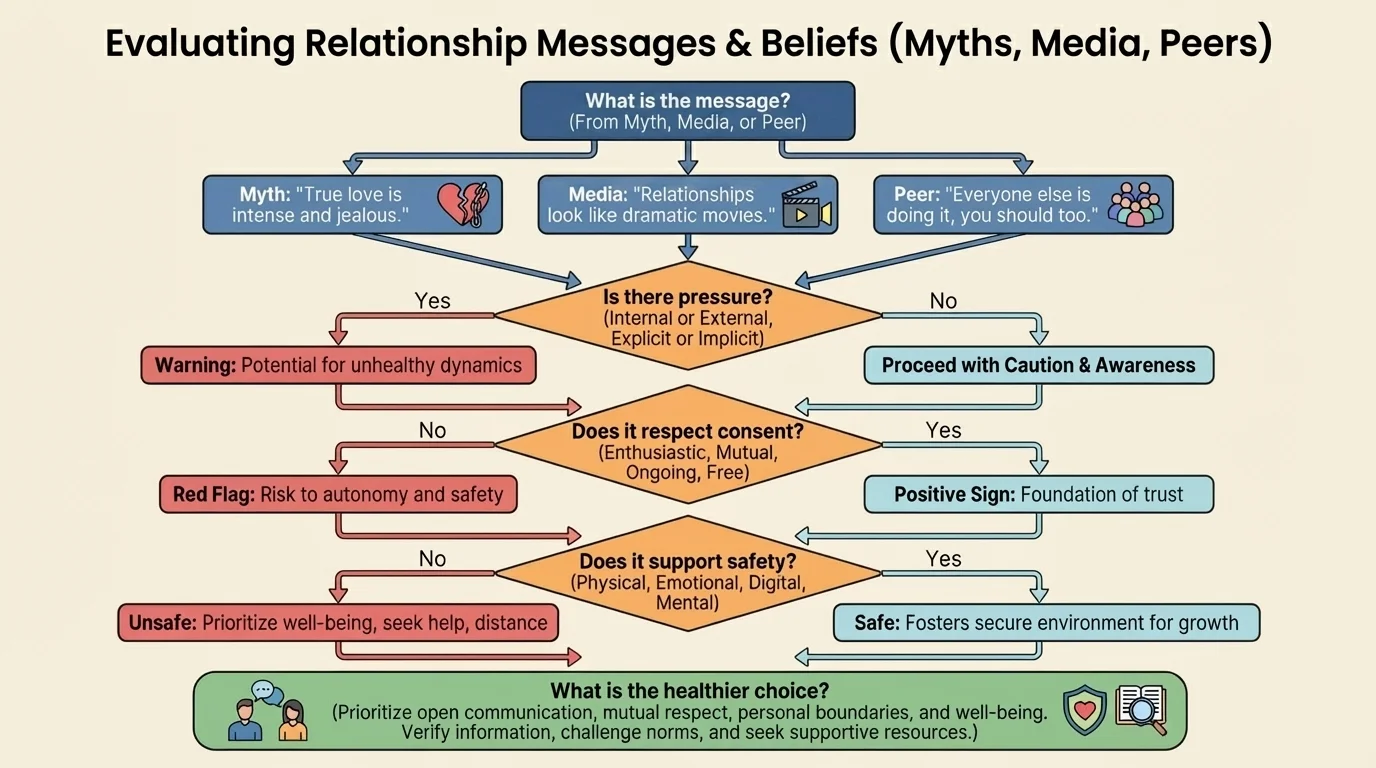
Step 4: Ask who benefits. Is this message helping both people feel respected, or is it mainly helping one person gain control, attention, or access?
Step 5: Flip the situation. If your friend described this exact situation, what would you tell them? It is often easier to spot unfairness when you imagine it happening to someone else.
Step 6: Choose the safer action. You can pause, say no, set a boundary, ask for help, block someone, or leave a conversation. You do not have to keep participating while you figure things out.
This process works for small moments and serious ones. For example, if someone says, "If you cared, you would send a picture," the reality check is clear: there is pressure, your boundary is being tested, and the safer choice is no. The same thinking applies to location sharing, passwords, secret meetups, and constant monitoring.
Later, when you see the same patterns again, [Figure 3] helps you respond faster because you already know the questions that matter most.
[Figure 4] If a person, message, or plan makes you feel unsafe, act early. You do not need to wait until the situation gets worse. A simple safety plan can help you protect yourself quickly and clearly.
First, create distance. Stop replying right away if needed. Exit the chat, log off, leave the call, or move to a safer place with other trusted people around.
Second, do not handle serious pressure alone. Tell a trusted adult such as a parent, guardian, counselor, coach, activity leader, or another safe adult in your life. If someone threatens you, blackmails you, stalks you, or pressures you for private content, involve adult help immediately.
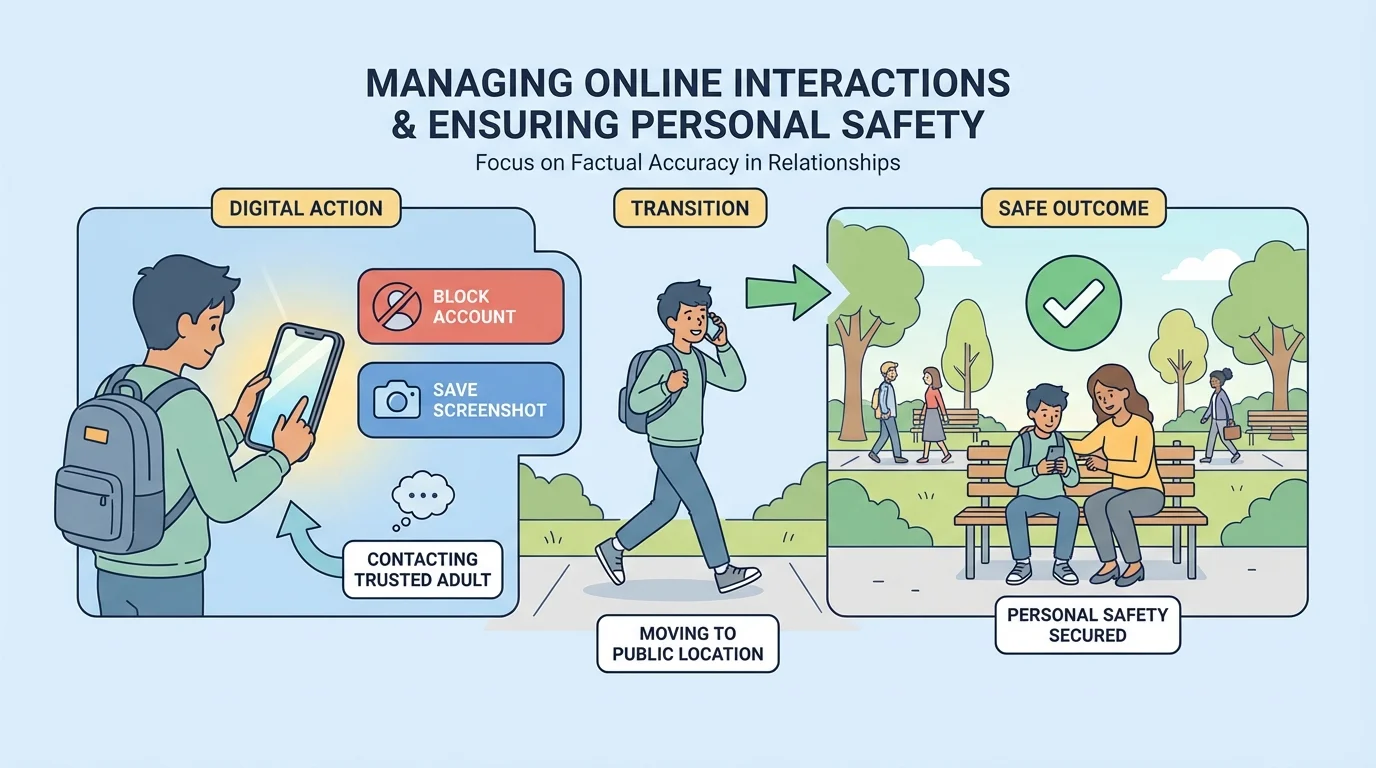
Third, save evidence when appropriate. Screenshots, usernames, dates, and messages can help if you need support from adults, platforms, or authorities. Do not keep arguing to "win." Protect the information and step back.
Fourth, use safety tools. Block accounts, report content, tighten privacy settings, change passwords, and turn off location sharing. If a meeting is planned and something feels wrong, do not go alone or at all. Trust the warning sign.
Fifth, get urgent help in emergencies. If you are in immediate danger, contact emergency services right away and get to a safe adult or public place as fast as possible.
Real-world example: A meetup starts to feel wrong
You planned to meet someone you know from online, but they suddenly change the location and insist you come alone and keep it secret.
Step 1: Notice the red flags.
Changing the plan, insisting on secrecy, and isolating you are all warning signs.
Step 2: Stop the plan.
Do not go. You are allowed to cancel without explaining everything.
Step 3: Tell a trusted adult immediately.
Share the messages and details so you are not managing the risk by yourself.
Step 4: Protect your accounts and information.
Block the person and review your privacy settings, especially location tools.
Notice how the safest choice is often the least dramatic one: stop, tell, protect, and leave. You do not need perfect proof before taking your own safety seriously.
Healthy beliefs are built on repeated truth, not repeated pressure. One way to strengthen them is to choose what you let influence you. Follow creators who model respect. Spend time with people who do not mock boundaries. Pay attention to adults and role models who show calm honesty instead of control.
You can also practice short responses ahead of time. That makes it easier to speak when pressure happens fast. Examples include: "No, I'm not comfortable with that." "I do not share passwords." "I'm leaving this conversation." "That joke is not funny." "I need to talk to an adult about this."
Another strong habit is checking your own self-talk. If you catch yourself thinking, "Maybe I'm overreacting," pause. Ask whether you would say that to a friend in the same situation. Often, your instincts are picking up on disrespect before your mind has fully explained it.
"Respect is not something you have to earn by giving up your boundaries."
Over time, strong beliefs lead to stronger choices. You become more likely to notice red flags early, less likely to excuse pressure, and more willing to ask for help. That is not being dramatic. It is being safe, thoughtful, and self-respecting.
And remember: a healthy relationship should make your world feel steadier, not smaller. It should support your safety, not test it. The more clearly you can question myths, media messages, and peer pressure, the more confidently you can protect yourself and build relationships based on real respect.
