Some people spend years chasing a plan that never really fit them. Others choose a path that matches who they are, what they want, and what real life requires. The difference is often not talent. It is decision-making. When you think about life after high school, you are not just picking a school or a job. You are choosing a direction that affects your time, money, stress, freedom, and future opportunities.
That may sound like a lot for a ninth-grade student, but this is actually the perfect time to start. You do not need your whole future figured out right now. You just need to begin asking smart questions. The best postsecondary choice is not the one that sounds impressive online. It is the one that fits your interests, your goals, and the adult responsibilities you will eventually need to manage.
Postsecondary refers to education, training, service, or work options after high school. It includes many choices, not just college. Some students go to a four-year university. Some attend a community college. Some enter a trade school or training program. Some begin an apprenticeship. Some join the military. Some work full time while earning certifications. Some take a carefully planned gap year.
If you only hear one message, let it be this: there is no single "correct" path for everyone. A strong choice depends on fit. A path that works well for one person could be expensive, stressful, or unnecessary for someone else.
Postsecondary pathway means any education, training, service, or work option you choose after high school to help you build a career and adult life.
Career pathway is a route that connects your interests and skills to jobs in a certain field, along with the training needed to get there.
Thinking early helps you avoid drifting. When people drift, they often follow friends, give in to pressure from family or social media, or choose based on status instead of fit. That can lead to wasted time, debt, frustration, or changing directions later.
Before you compare schools or programs, start with yourself. Your interests are the topics, activities, or problems that naturally catch your attention. Your strengths are things you do well or learn quickly. Your values are the things that matter most to you, such as stability, creativity, helping others, income, flexibility, or independence.
For example, maybe you like editing videos, designing graphics, or building gaming setups. That could connect to digital media, marketing, web design, information technology, or audio production. Maybe you enjoy solving practical problems, fixing bikes, cooking, caring for children, or helping family members with tech. Those are clues. They may point toward healthcare, education, skilled trades, hospitality, computer support, or other fields.
A useful way to think about this is to look for patterns. Ask yourself: What do I choose to do without being forced? What kinds of tasks make time go by fast? What problems do people ask me to help solve? What topics do I search online just because I want to know more?
Many adults work in jobs that did not even exist when they were younger. That is why learning how to evaluate pathways matters more than memorizing one "perfect" career choice.
Your pathway does not need to match a hobby exactly. Liking music does not mean you must become a famous performer. It might connect to sound engineering, music teaching, event management, marketing, or content production. The goal is to notice what your interests suggest about the kind of work you may enjoy.
One smart move is to translate interests into career clusters, which are broad groups of related jobs. Instead of saying, "I like animals," you can explore veterinary care, wildlife work, grooming, training, pet business, or biology-related jobs. Instead of saying, "I like sports," you might consider physical therapy, coaching, athletic training, sports media, or sports management.
Here are a few examples of how interests can connect to possible pathways:
| Interest or Strength | Possible Career Area | Possible Pathway |
|---|---|---|
| Fixing things, working with tools | Electrician, mechanic, HVAC technician | Trade school, apprenticeship, certification |
| Helping people feel better | Nursing, medical assisting, counseling | Community college, university, certification |
| Computers and problem-solving | IT support, coding, cybersecurity | Certification, community college, university |
| Drawing, design, content creation | Graphic design, marketing, animation | Portfolio programs, college, certifications |
| Leadership and structure | Military, business, emergency services | Military service, college, academy training |
Table 1. Examples of interests connected to career areas and possible postsecondary pathways.
Notice that one interest can lead to more than one route. That is important. You are not looking for one tiny doorway. You are building a range of realistic options.
Your short-term goal is something you want to achieve in the near future, such as finishing high school strong, building a portfolio, getting part-time work experience, or improving communication skills. A long-term goal reaches farther ahead, such as becoming financially independent, working in healthcare, owning a business, or living in a certain area.
Goals matter because the same pathway can look very different depending on what you want. If your goal is to start earning money quickly, a shorter training route may fit better than a long degree program. If your goal is to become a physical therapist, doctor, architect, or teacher, you will likely need college and more years of education. If your goal is flexibility and low debt, you may compare community college, certifications, and work-based learning more closely.
Goals act like a filter. Once you know what kind of life you want, you can sort options more clearly. A pathway is not just about getting accepted somewhere. It is about whether that route moves you toward the life you want to build.
Try to make goals specific enough to guide your choices. "I want to be successful" is too broad. "I want a job where I solve technical problems, earn steady income, and do not need to spend four years in college first" is much more useful.
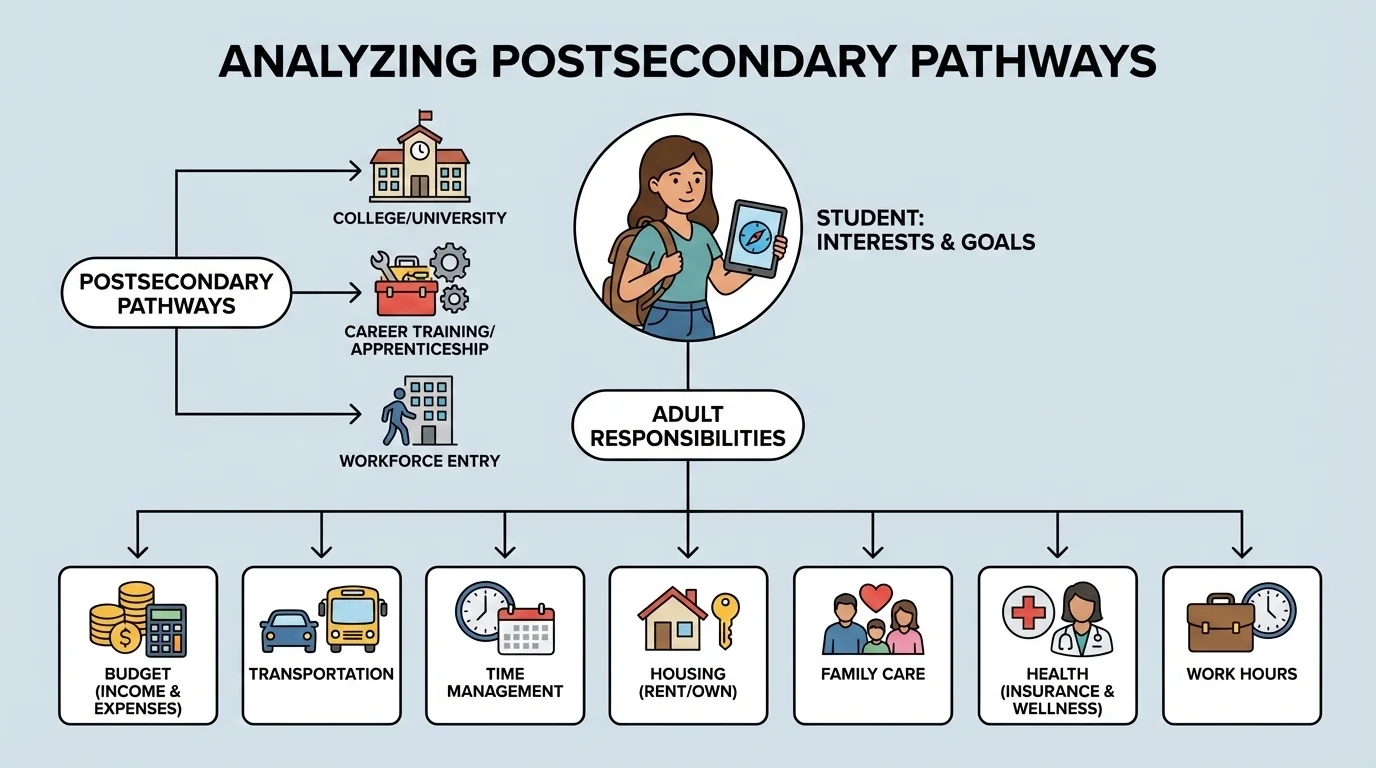
As you get older, your decisions will be shaped not only by dreams but also by adult responsibilities. These are the real-life duties that come with growing up, as [Figure 1] illustrates through connected pressures like money, time, transportation, and family obligations. A good pathway is one you can actually manage, not just admire from a distance.
One major factor is money. Some pathways cost a lot. Others pay you while you learn. A four-year college may open doors in some careers, but it can also involve tuition, books, technology, transportation, and living expenses. An apprenticeship may let you earn income while training. Community college may be a lower-cost starting point. Certifications can sometimes lead to work faster, though not always for every field.
Time is another responsibility. Some students can focus mostly on school after high school. Others may need to work, care for younger siblings, help support family, or manage their own health needs. A pathway with flexible scheduling, online courses, local access, or part-time options may fit better.
Transportation matters too. If a training program is far away and you cannot reliably get there, that affects your success. Housing can matter. So can childcare in adulthood, work hours, and health insurance. These topics may sound "grown up," but they are exactly the kinds of things people must think through before making a smart decision.
When people ignore responsibilities, they may choose a path that becomes overwhelming. For example, someone might enroll in a program without considering commute time, work schedule, and costs. After a few months, stress piles up. Missing assignments or work shifts becomes common. The problem is usually not laziness; it is poor planning.
On the other hand, when someone plans honestly, they can choose a route that works. Maybe they start with community college close to home, complete general courses at lower cost, and transfer later. Maybe they begin with a certification, earn income, and continue training afterward. Maybe they choose an apprenticeship because they need both learning and pay at the same time.
Different postsecondary options can all lead to success, but they differ in cost, training length, structure, and lifestyle, as [Figure 2] shows in a side-by-side comparison. The best choice depends on what career you want and what you can realistically handle.
Here are some of the most common pathways:
Four-year college or university: Often needed for careers such as engineering, teaching, some business roles, and many science-based professions. It can offer a broad education and campus resources, but it may take longer and cost more.
Community college: Usually costs less than a four-year school and may offer two-year degrees, transfer options, and career-focused programs. It can be a smart path for students who want flexibility or a lower-cost start.
Trade school: Focuses on specific job skills such as welding, cosmetology, plumbing, automotive work, or medical assisting. Training is often shorter and more hands-on.
Apprenticeship: Combines paid work with training. This is common in skilled trades and can be a strong option if you want to earn while learning.
Military: Can provide training, structure, benefits, and education support, but it also requires service commitment and a lifestyle that is not right for everyone.
Direct entry into the workforce: Some people begin working right after high school, especially in jobs that offer advancement or employer training. This can make sense if it is part of a plan, not just a reaction.
Gap year: A year used intentionally for work, service, training, or career exploration. It works best when planned with purpose rather than used to avoid decisions.
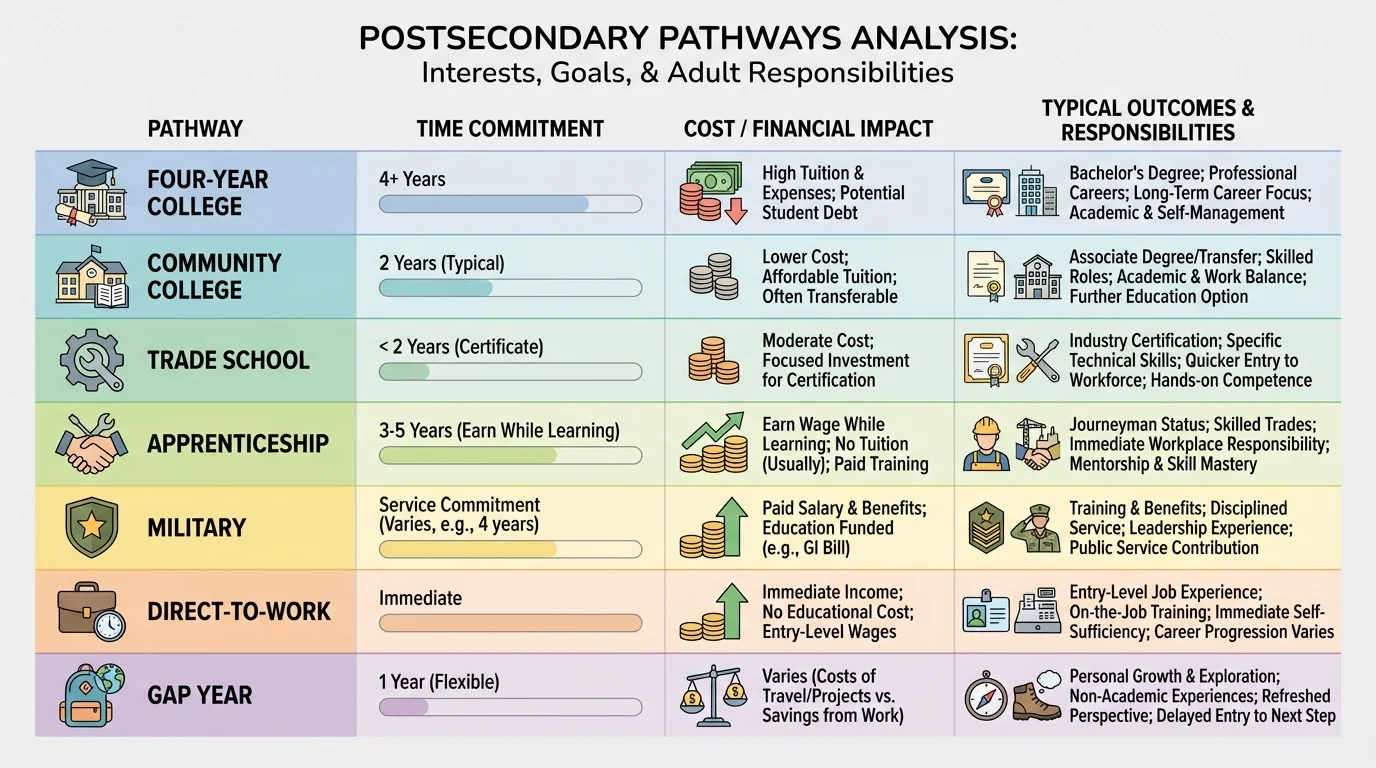
Later, when you compare your own options, think back to the side-by-side comparison. A pathway with higher cost might still be worth it if it is required for your career goal and leads to good long-term opportunities. A lower-cost route may be smarter if it gives you the training you need without unnecessary debt.
| Pathway | Typical Time | Cost Level | Good Fit For |
|---|---|---|---|
| Four-year college | Around 4 years | Often high | Careers requiring degrees, broad academic study |
| Community college | Around 2 years | Often lower | Transfer plans, local access, career programs |
| Trade school | Several months to around 2 years | Varies | Job-specific skill training |
| Apprenticeship | Varies by trade | Low upfront; paid training | Earn-while-you-learn options |
| Military | Service commitment varies | Training provided | Structure, service, benefits, technical training |
You do not need a perfect answer today. You need a process. The pathway decision process starts by asking who you are, what you want, and what your real-life limits are. That order matters.
Step 1: List your top interests, strengths, and values.
Step 2: Name several career areas that match those patterns.
Step 3: Research what training each career actually requires.
Step 4: Compare pathways by cost, time, flexibility, and location.
Step 5: Check adult responsibilities: work, transportation, family needs, health, and budget.
Step 6: Keep a backup option in case your first plan changes.
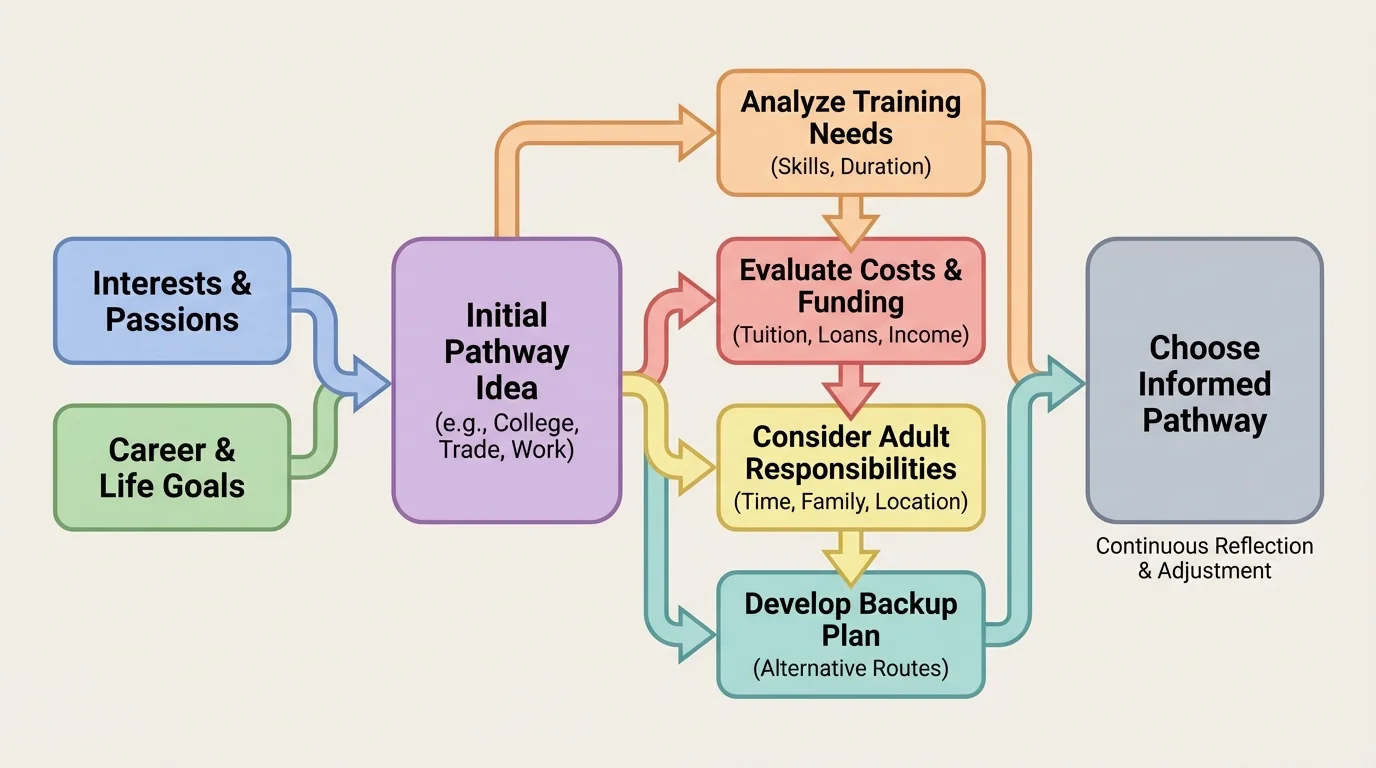
This process helps you avoid two common mistakes. The first is choosing only by emotion, such as "this sounds cool." The second is choosing only by fear, such as "this seems safest." Strong decisions use both excitement and reality.
Example: comparing two options
Jordan likes working with computers and wants steady income soon after high school. Jordan is also thinking about future independence and wants to avoid large debt.
Step 1: Identify interests and goals
Jordan enjoys troubleshooting devices, learning software, and solving technical problems. A short-term goal is to gain employable skills quickly. A long-term goal is financial stability.
Step 2: Compare pathways
Option A is a four-year computer science degree. Option B is an IT support certification plus community college courses. Both can lead to tech careers, but they differ in time and cost.
Step 3: Check responsibilities
If Jordan expects to work part time and help at home, the lower-cost and more flexible option may fit better at first.
Jordan might begin with certification and community college, then continue later if a higher degree becomes useful.
Notice that this is not "settling." It is strategy. Starting with a smaller step can still lead to a strong future.
Consider three students with different situations.
Mia loves biology and wants to become a nurse. Her goal requires formal education and licensing, so she researches nursing programs, compares local community college and university options, and looks at costs. Her pathway likely includes college because her career goal requires it.
Andre enjoys building things, dislikes sitting still for long periods, and wants to earn money quickly. He explores electrical work and learns that an apprenticeship may offer paid training. For him, a skilled trade route may fit both his interests and his financial goals.
Sofia is creative, makes short videos online, and likes branding and design. She explores digital marketing, graphic design, and media production. She may build a portfolio, take certifications, and possibly attend college depending on the exact role she wants. Her path might include several stacked experiences rather than one single program.
"Do not choose a path just because it is popular. Choose it because it is preparing you for the life you actually want."
Each student is serious about the future, but none of them needs the exact same route. This is the purpose of pathway analysis.
Be careful if a plan depends on vague thinking. Warning signs include saying "I will figure out the money later," "I do not know what job this leads to," or "everyone says this is the best option." Those are signals to pause and research more.
Ask practical questions before committing: What jobs can this lead to? How long does the training take? What is the total cost? Can I do part of it online? Do I need transportation? Will I be able to work while doing it? Is there a cheaper first step? What happens if I change my mind?
Adult responsibilities are connected. If one area is weak, like transportation or scheduling, it can affect everything else. That does not mean your plan is impossible. It means your plan needs support.
You do not need to wait until senior year to start building clarity. You can begin now in small ways.
Try This: Make a list of five things you enjoy doing, five things you do well, and five things that matter to you in adult life. Look for patterns.
Try This: Pick three career areas and research the training each one needs. Notice which ones require a degree, certification, license, apprenticeship, or work experience.
Try This: Talk with an adult you trust by phone or video call about their path after high school. Ask what they wish they had known at your age.
Try This: Start a digital folder for your future plans. Save notes about careers, training programs, scholarships, certifications, and questions you still have.
Try This: Practice making decisions based on both goals and reality. If one option sounds exciting, ask: Does it match my interests? Does it move me toward my long-term goals? Can I realistically manage the responsibilities that come with it?
The more you practice this now, the more confident and prepared you will be later. You are not locked into one future. You are learning how to choose wisely.
