Have you ever tried to build something, clean up, or make a snack with other people? Sometimes it feels faster and more fun. That is because people can do more when they work together as a team. Teamwork is an important life skill you can use at home, on a video call, in a club, or when helping in your community.
Teamwork means that people work together to do the same job or reach the same goal. A goal is what you want to get done. Maybe your family wants to clean up the room. Maybe you and a friend want to finish a picture during an online meetup. Maybe a group wants to sing a song together on a call.
Good teamwork has three big parts: listening, cooperating, and finishing. When you listen, you hear what others say. When you cooperate, you help and share. When you finish, you keep going until the job is done.
Listen means to pay attention to what another person is saying. Cooperate means to work well with others. Shared task means a job that more than one person does together.
When teamwork goes well, people feel happy, included, and proud. When teamwork does not go well, people may feel left out, upset, or tired because one person is doing everything alone.
[Figure 1] Good listening helps a team work smoothly. Good listening looks calm and ready: your eyes are focused, your ears are attentive, and your mouth is quiet while another person talks. You can do this at home or during an online activity.
Try these listening steps: stop your hands, look at the person or screen, keep your body still, and wait until it is your turn. Then you can speak. This helps everyone feel heard.
If someone says, "Please put the blocks in the box," and you listen carefully, you know what to do. If you do not listen, you may put the blocks in the wrong place, and the job takes longer.
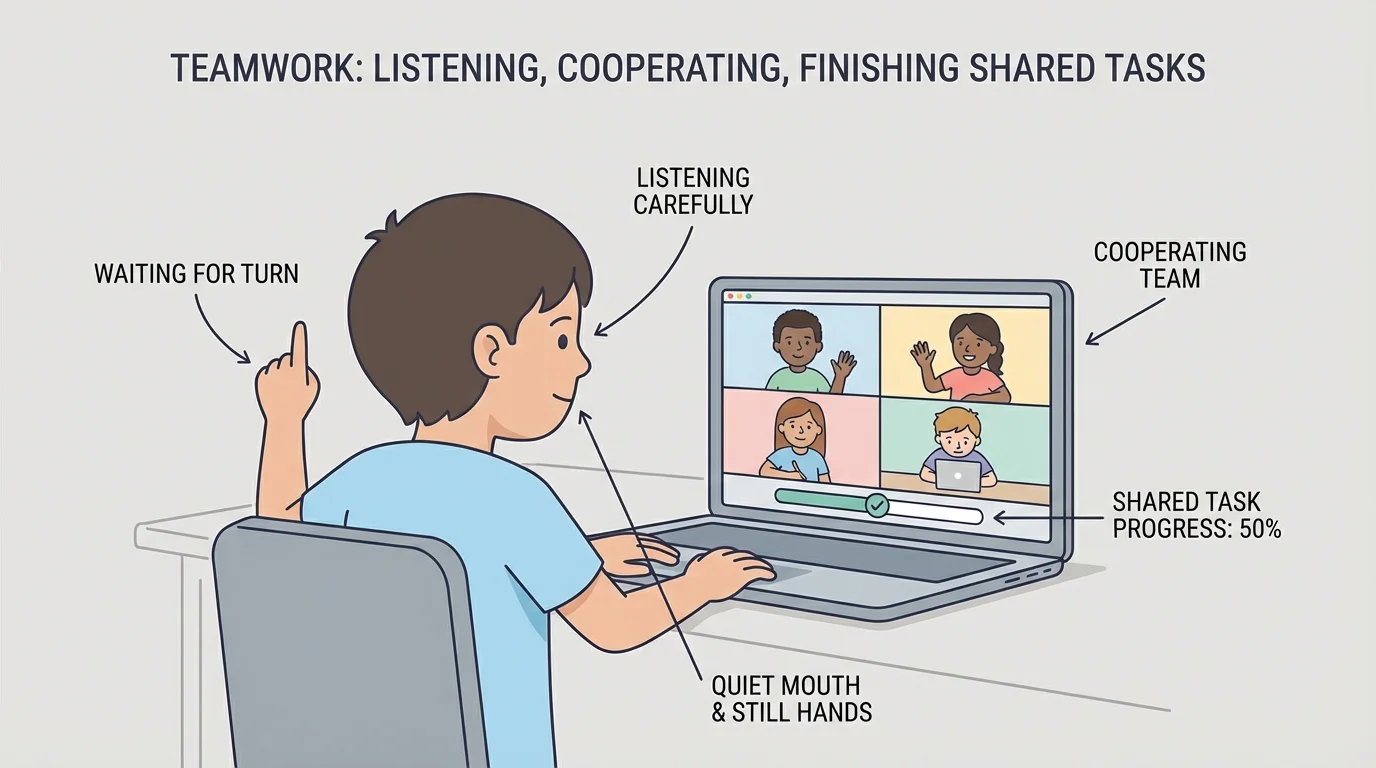
You can also show listening by using small words: okay, I can help, or your turn. Nodding, waiting, and not interrupting are also kind listening choices.
Teams work better when everyone feels heard. Even young children can solve problems more easily when they take turns listening and speaking.
Later, when you work with others, remember what calm listening looks like. Listening is not just being quiet. It is paying attention so you know how to help.
Cooperate means doing your part and letting other people do their parts too. In [Figure 2], each person has a small job, but everyone is helping with one big job together.
Sometimes one person passes napkins, one person puts fruit in a bowl, and one person carries cups. That is sharing jobs. No one has to do everything alone.
You can cooperate by taking turns, sharing materials, asking before grabbing, and using kind words. You might say, "You do this part, and I will do this part," or "Can I help you?"
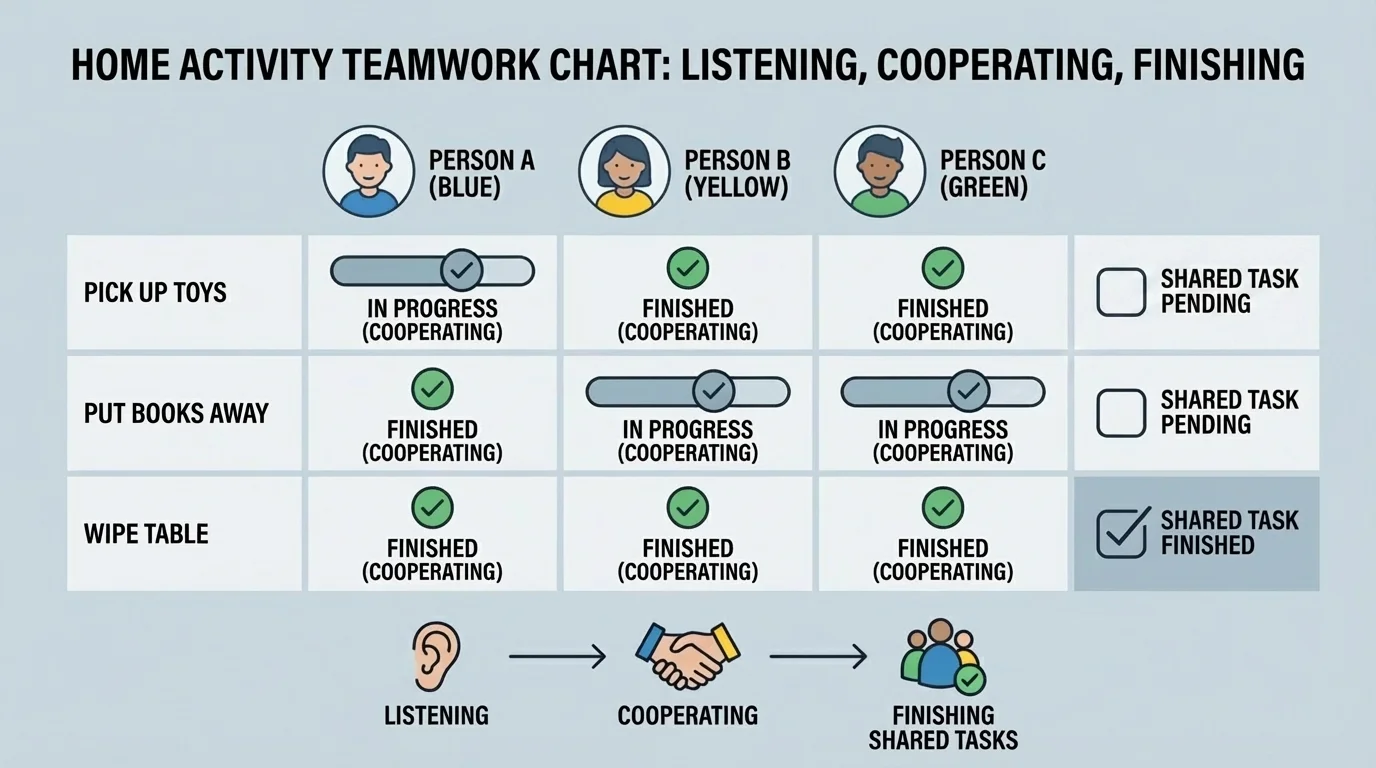
If two people want the same job, stop and use words. You can say, "You go first. I can go next." That keeps the team moving.
Teamwork at home
A family is cleaning the play area together.
Step 1: One person says the goal.
"Let's make the floor clean."
Step 2: The jobs are shared.
One person picks up stuffed animals. One person puts books on a shelf. One person gathers blocks.
Step 3: Everyone helps kindly.
They use words like "I can help" and "Thank you."
Step 4: They check together.
They look around to see if anything is left on the floor.
The job gets done faster because everyone cooperates.
Sharing jobs does not mean every job is the same. It means every person has a part that helps the whole team. As [Figure 2] shows, many small jobs can make one big job easier.
[Figure 3] A shared task has a beginning, a middle, and an end. A simple way to work as a team is to start, do your part, check your work together, and then finish as a team.
Sometimes starting is easy, but finishing is harder. A team needs to keep going even when the fun part is over. Maybe you helped make a craft, but now the markers need caps and the paper scraps need to be thrown away. Finishing means doing the last part too.
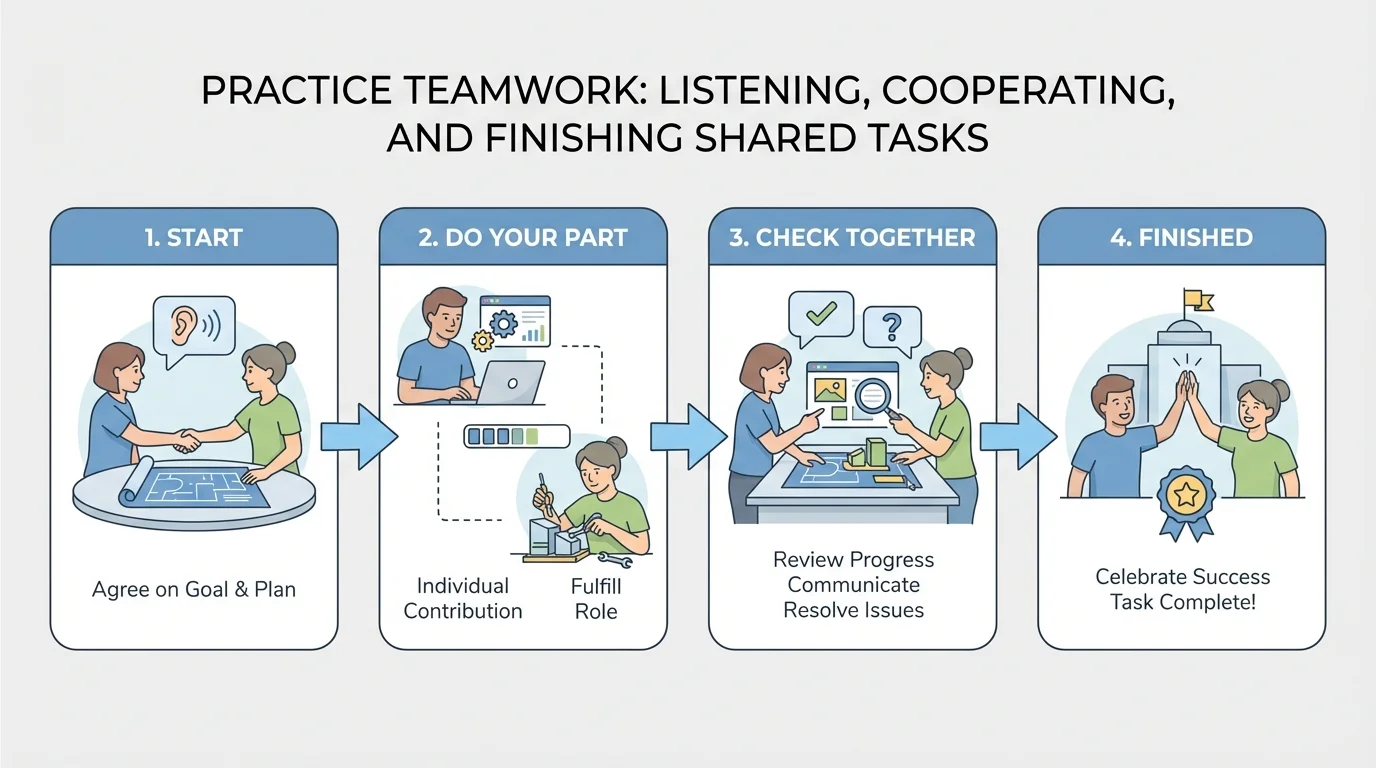
When teams finish shared tasks, everyone can feel proud. You may hear, "We did it." That happy feeling helps people want to work together again.
Why finishing matters
If a team starts a job but leaves the last part undone, someone else usually has to fix it later. Finishing shared tasks shows responsibility and care for other people.
When you forget to finish, the mess may stay, the plan may stop, or another person may feel frustrated. The steps in [Figure 3] help you remember that teamwork is not over until the whole job is complete.
Sometimes teamwork is tricky. People may talk at the same time. Someone may want to be first. Someone may feel upset. This happens to everyone sometimes.
When that happens, pause your body and take a breath. Use simple words: "I feel mad." "I want a turn." "Can we share?" "Can you help me?" Calm words help a team solve the problem.
You do not have to be perfect. You just need to keep practicing. A good team member tries again, listens again, and helps again.
"Many hands make light work."
— Old saying
If the problem is too big, ask a grown-up to help. Asking for help is also part of being responsible. It helps the team get back on track.
You can practice teamwork in small, real ways every day. Help put away groceries with a family member. Join an online story time and wait for your turn to speak. Work with a sibling to feed a pet, water a plant, or tidy a room.
Use this easy plan: listen, help, finish. First, listen to the job. Next, do your part. Last, check if the whole job is done.
Every time you listen kindly, cooperate fairly, and finish a shared task, you grow stronger as a helper and a leader. Teams need people like that.
