Have you ever given someone directions to the pencil sharpener, the swings, or your classroom? You were already using geography words. Geography is about places and spaces, and we can talk about those places by using simple location words. These words help us tell where something is and how to get there.
When we describe a place, we can talk about which way to go and how far something is. We can also compare one thing to another. For example, we can say the library is near the office, or the cubby is next to the door. These words help other people understand exactly which place we mean.
Direction tells which way to go. Distance tells how far away something is. Location tells where a person, place, or thing is.
We use location words every day at school, at home, in stores, and outside. They help us move safely, find things, and describe places clearly.
Location words are important because people need clear directions. If a teacher says, "Walk forward to the rug," students know which way to move. If a friend says, "Your lunchbox is close to your backpack," you know where to look.
These words are also useful in geography. Geographers describe where places are. Even first graders can do this. You can describe where the playground is compared with the school, or where the park is compared with your house.
People all over the world use direction words, but maps help everyone share information about places in a clear way, even when they live far apart.
Good location words make our speaking and writing clearer. Instead of saying "It is over there," we can say "It is next to the bookshelf" or "It is near the window."
Your body can help you learn direction words, as [Figure 1] shows. Forward means moving ahead. Backward means moving to the back. Left is one side of your body, and right is the other side.
If you stand facing the board, one step forward takes you closer to the board. One step backward takes you away from it. If you turn your body, your left and right stay with your body. That is why it helps to point to your left hand and your right hand when you practice.
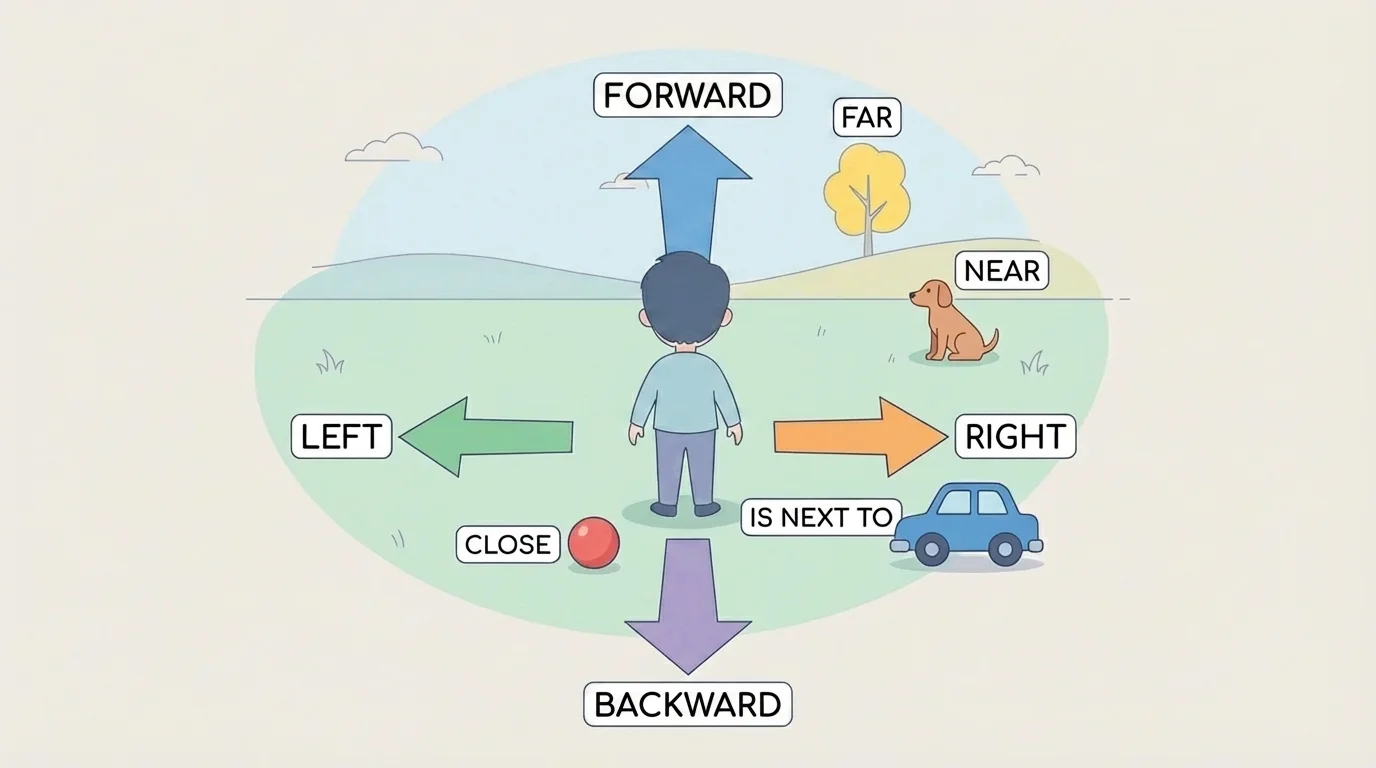
Here are some examples. "Walk forward to the sink." "Take two steps backward from the table." "The reading corner is on the left side of the room." "The teacher's desk is on the right side of the room." These sentences tell where something is or which way to move.
Direction words are helpful outside too. On the playground, you might hear, "Go forward to the slide, then turn right." In a hallway, someone might say, "The art room is on the left." These words help us move from place to place.
Using direction words in school
Step 1: Start at the classroom door.
Step 2: Walk forward to the coat hooks.
Step 3: Turn left to face the cubbies.
Step 4: Take one step backward to make space.
These words tell a clear path from one place to another.
When we follow directions, we must listen carefully. The words forward and backward tell movement. The words left and right tell which side. As we saw in [Figure 1], these words work best when you think about the way your body faces.
Some location words tell distance. Near means not far away. Far means a long way away. Close also means near. When things are close, they are almost beside each other or only a short distance apart.
You can use these words with objects and with places. A pencil can be near your notebook. The water fountain can be far from the playground. Your desk may be close to the window. These words help us understand space.
Sometimes we compare two things. "The office is near our classroom." "The zoo is far from our school." "The trash can is close to the door." These comparisons tell how much space is between things.
| Word | What it means | Example |
|---|---|---|
| near | not far away | The crayons are near the paper. |
| far | a long way away | The farm is far from the city. |
| close | very near | The chair is close to the table. |
Table 1. Distance words and simple examples of how they describe space.
Distance words help in geography because places are not all the same distance apart. A park may be near your house, but the ocean may be far away. We use these words when we talk about neighborhoods, towns, and other places.
We can also compare one object or place with another by using position words. Next to means right beside something. Close to means near something.
[Figure 2] If a chair is next to a desk, the chair is right beside the desk. If your backpack is close to your desk, it is nearby. Sometimes next to and close to seem alike, but next to usually means even nearer.
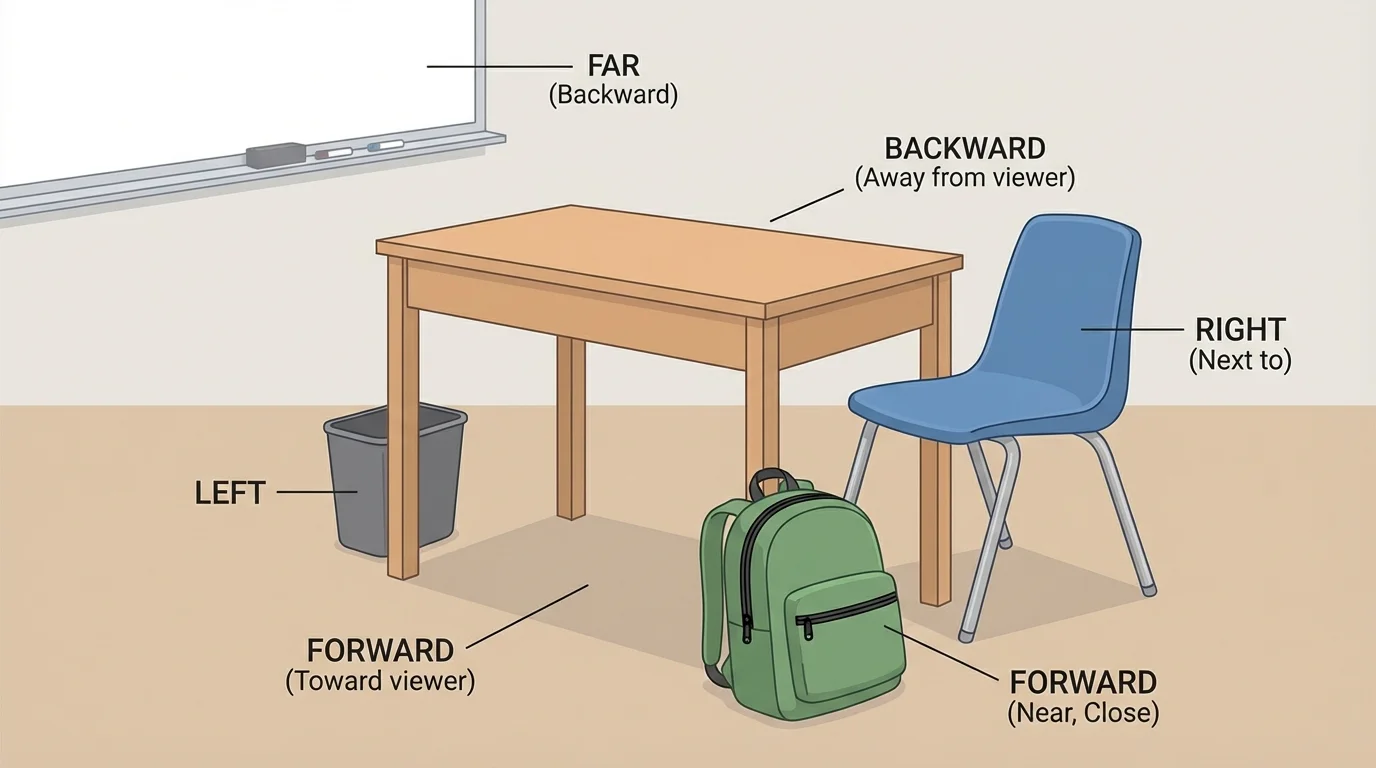
Here are examples with places: "The nurse's office is next to the main office." "The cafeteria is close to the gym." "The flower bed is next to the school wall." These sentences compare one place with another place.
Position words are useful because they make our descriptions more exact. Instead of saying "My seat is over there," you can say, "My seat is next to the bookshelf." Instead of "The ball is somewhere nearby," you can say, "The ball is close to the fence."
Comparing places means telling where one place is by using another place as a guide. This is an important geography skill because we often understand new places by hearing how they are placed near, far, left, right, or next to something we already know.
Later, when you look at a map, you will use the same idea. A park can be next to a road. A pond can be close to a forest. A store can be far from a school. The same location words work for real places and for maps.
A map helps us describe places and spaces, and [Figure 3] shows how simple location words can fit on one small neighborhood map. A map is a drawing of a place seen from above. On a map, we can tell where things are by using words like left, right, near, far, and next to.
Suppose a map shows a school, a park, a library, and houses. We might say, "The park is near the school." We might also say, "The library is to the right of the school." These are geography sentences because they describe where places are.
Maps help us think about spaces that are bigger than one room. In a classroom, you can see the whole room. In a neighborhood, you may need a map to help you picture where places are.
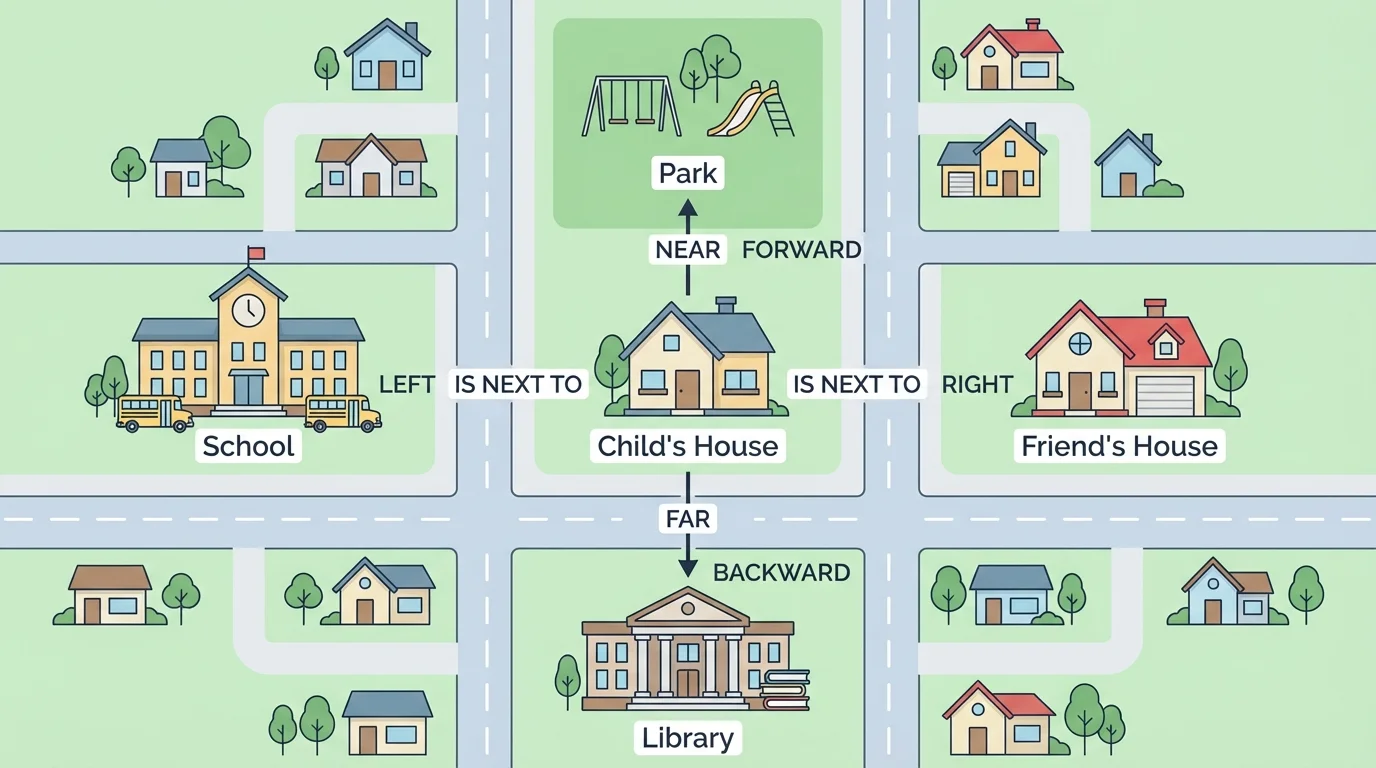
On a simple map, left and right are shown by the sides of the paper. Near means two places are close together on the map. Far means they are not close together. Next to means one place is right beside another place. One picture can help us describe many place relationships at once.
Geography is not only about big continents and oceans. It is also about learning to describe the spaces around us clearly. When you talk about where the office, playground, or bus area is, you are using geography skills.
Location words help us every day. At school, they help us find classrooms, line up safely, and follow directions. At home, they help us explain where toys, shoes, and books belong. Outside, they help us describe parks, stores, and streets.
For example, you might say, "The stop sign is near the corner." "Our mailbox is close to the front door." "The garden is next to the fence." "Walk forward on the sidewalk, then turn right." These are all good location sentences.
You already know many places around you: classroom, home, playground, street, and park. Now you are adding special words that help describe where those places and things are.
These words also help with safety. If a grown-up says, "Stay close to me," that tells you about distance. If a crossing guard says, "Step backward," that tells you about direction. Clear location words help people understand quickly.
When we speak carefully, others can picture the place in their minds. That is what geographers do. They describe where places are and how places are arranged in space.
