Have you ever seen a class clean up a room much faster when everyone helps? That is the power of a team. A team is a group of people who work together. In school, on the playground, at home, and in sports, people often do better when they help one another.
A team is a group of people working toward the same goal. A goal is something the group wants to do. Your class can be a team when everyone helps put books away. Two students can be a team when they build something together. A family can be a team when everyone helps set the table.
Teams work best when each person does his or her part. This means one person should not do all the work while others do nothing. When everyone helps, the job gets done better and faster. Teamwork also helps people feel included and important.
Responsible team member means a person in a group who does what they should do, helps others, and treats people kindly.
Communicate means to share ideas by speaking, listening, using body language, and responding.
[Figure 1] Being part of a group is not only about finishing a job. It is also about how we act with other people. A good team member is helpful, respectful, and ready to work with others.
A responsible team member helps the group in many ways. This person tries their best, listens to directions, and does their job. If the class is making a poster, one child may color, one may glue, and one may hand out paper. Each job matters.
Responsible team members also cooperate. Cooperate means working together peacefully. They share materials, take turns, and wait patiently. They do not grab, shout, or refuse to help. They know that being fair makes the group stronger.
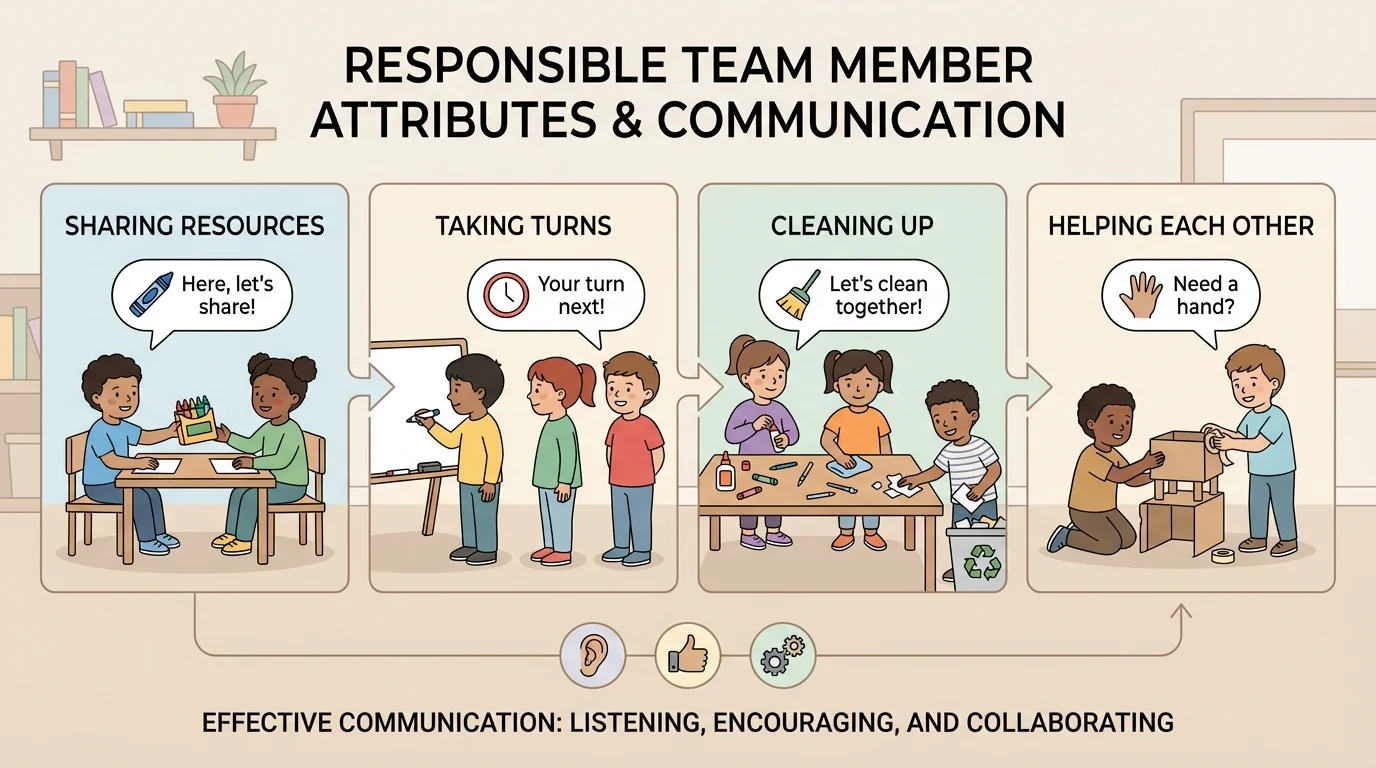
Another important trait is kindness. A kind team member uses friendly words like "please," "thank you," and "you can go first." Kindness helps people feel safe and welcome. When people feel welcome, they are more ready to join in and do their part.
Responsible team members also stay on task. This means they keep working on the group job instead of playing around or bothering others. If they make a mistake, they try to fix it. They do not blame others right away. They are honest and ready to try again.
Groups often finish classroom jobs more smoothly when each person has one clear job. Even a small job, like passing out paper, helps the whole team.
You can see these traits in many places. In a relay race, each runner must be ready. In a music group, each singer or player must join at the right time. In class, each student helps the group when they listen and work carefully. Just like the children in [Figure 1], small helpful actions add up to strong teamwork.
Good teams need good communication. Communication is more than talking. It also means listening, looking at the speaker, and waiting for your turn. When people communicate well, they understand each other better.
[Figure 2] A team member can communicate by speaking in a calm, clear voice. They can say, "I can pass out the crayons," or "Can you help me with the glue?" These words are easy to understand. Good communication helps everyone know what to do.
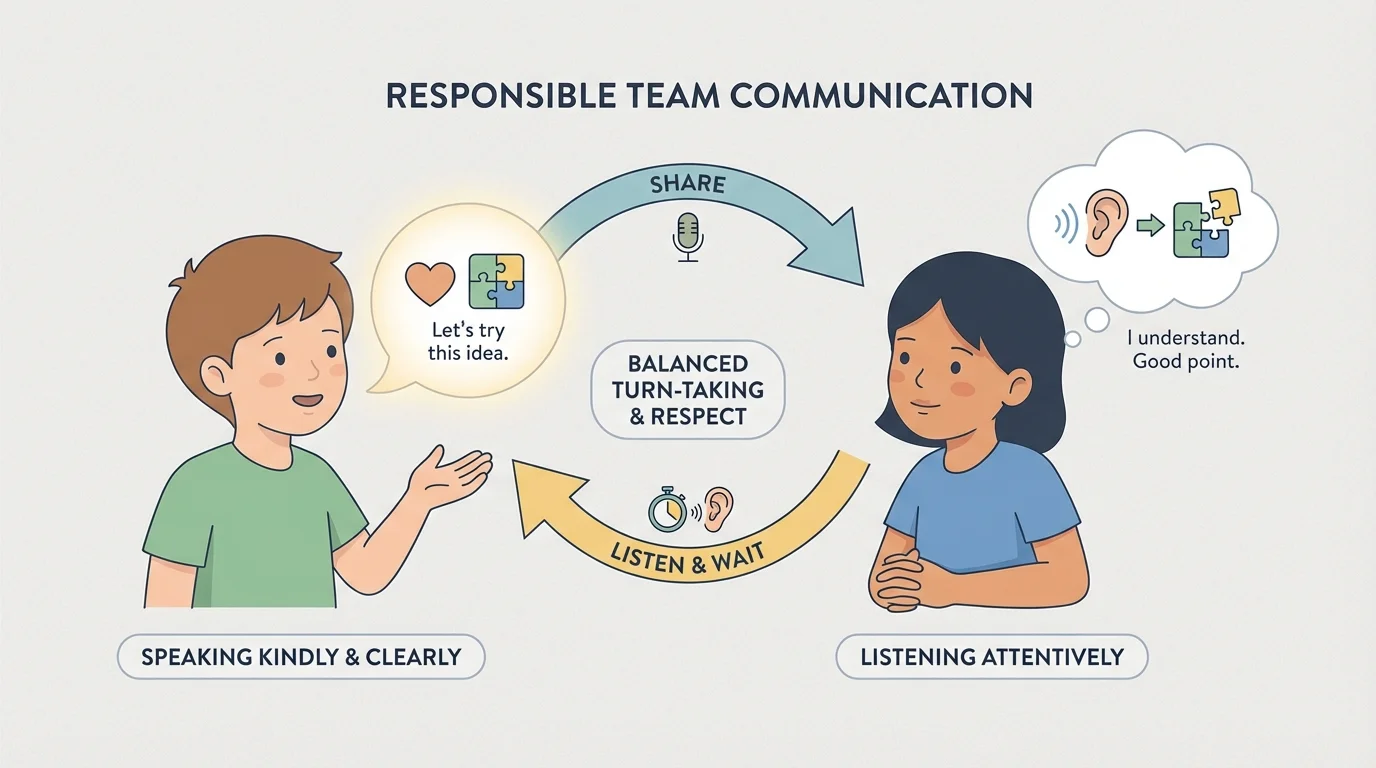
Listening is just as important as speaking. A good listener keeps their body still, looks at the person talking, and thinks about the words they hear. Then they answer politely. This shows respect. Respect means showing that others matter.
Sometimes team members need to ask questions. Asking a question is helpful when someone is confused. A child might say, "What should I do next?" or "Can we take turns?" Questions help stop mistakes and help the group stay organized.
Clear and kind communication helps groups solve problems and finish work. Clear words tell what you mean. Kind words protect feelings. A strong team uses both.
Body language matters too. A smile, a nod, and facing the speaker can show that you are listening. Crossing arms, turning away, or interrupting can make teamwork harder. The children in [Figure 2] show that taking turns to talk helps everyone feel heard.
Good groups have both helpful leaders and responsible team members. A leader helps the group know what to do. The leader may remind everyone of the goal, help share jobs, and make sure people are included.
[Figure 3] But a leader cannot do everything alone. Team members must listen, help, and complete their jobs. A strong group is not one bossy person and silent others. A strong group is many people working together with care.
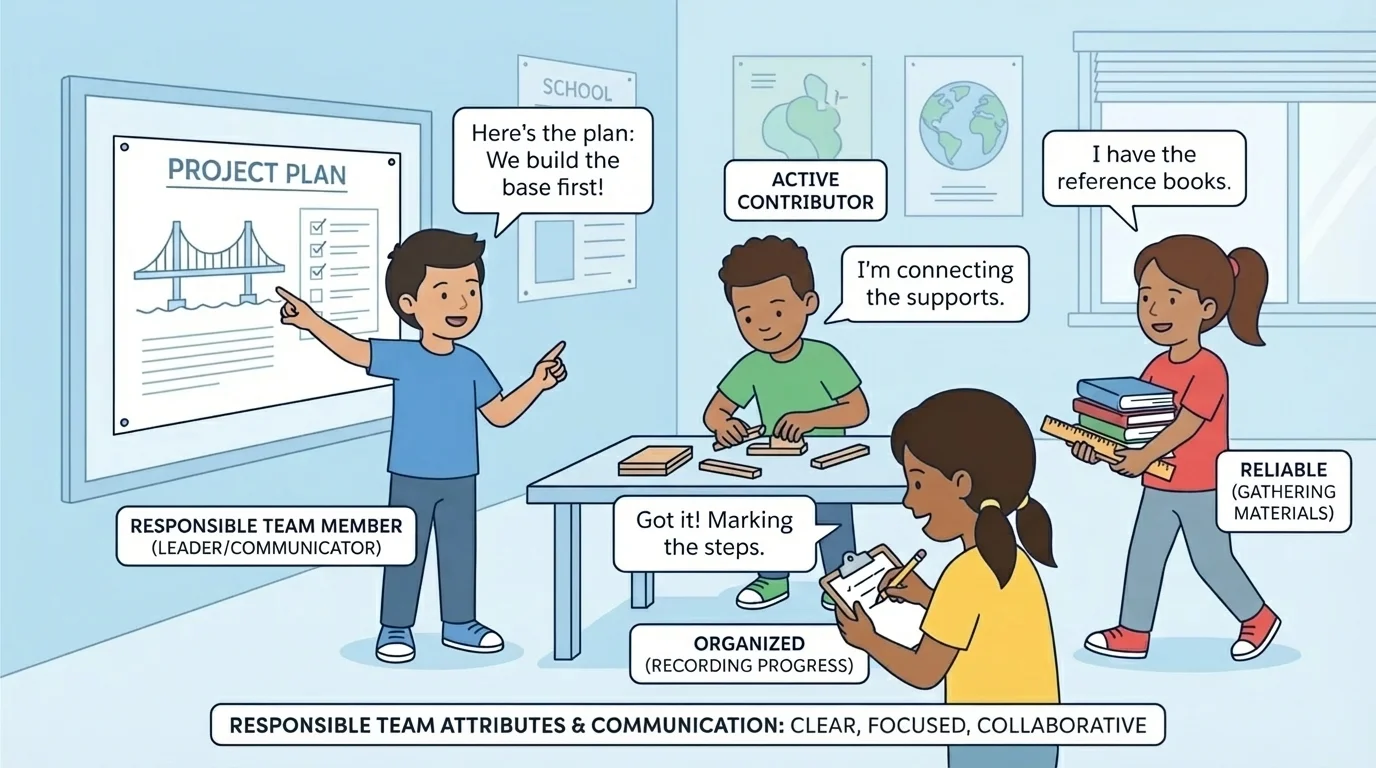
A good leader is kind and fair. A good leader does not yell or leave people out. A good leader says things like, "You can cut, and I will tape," or "Let's all have a turn." This helps the group stay calm and organized.
Team members also help the leader. They follow directions, share ideas politely, and tell the truth if something goes wrong. In [Figure 3], each child has a part, and that is why the group can succeed together.
At school, students may work together to clean the classroom. One student picks up scraps, one pushes in chairs, and one stacks books. If everyone works responsibly, the room becomes neat. If one student refuses to help, the work becomes harder for the rest.
Example: Making a class poster
Step 1: The group decides on one goal.
The goal is to make a poster about seasons.
Step 2: Team members share jobs.
One draws, one colors, one cuts, and one glues.
Step 3: Team members communicate.
They say, "I am done," "Can I help?" and "Let's put this here."
The poster turns out well because everyone helps and speaks kindly.
On the playground, children may play a game together. They need to follow rules, take turns, and speak respectfully. If someone says, "You never let me play," a responsible team member listens and helps fix the problem. Fair play is part of good teamwork.
At home, family members can be a team too. One person may put forks on the table, another may carry napkins, and another may place cups. When each person does their part, the family job gets done.
Sometimes team members disagree. One child may want to use blue paper, and another may want red paper. A responsible team member does not yell or grab. Instead, they use calm words. They might say, "Let's take turns," or "Let's choose together."
If someone forgets a job, the group can remind them kindly. If someone makes a mistake, the group can help fix it. Mistakes happen, and teams grow stronger when they solve problems with patience.
You already know how to be kind, take turns, and follow rules. Those same skills help you become a strong team member.
Sometimes the best thing to say is "I'm sorry." Sometimes the best thing to say is "Can I help?" These simple words can make a big difference. They show honesty, care, and a willingness to work together.
Every day is a chance to practice teamwork. You can listen better, share more, and speak more kindly. You can finish your job and help others when you are done. These actions show responsibility.
You do not have to be perfect to be a good team member. You just need to keep trying. When students work together with respect, communication, and care, groups become stronger and happier.
