A long time ago, a child might have written about a stormy trip in a wagon, while years later an author might write a story about a child on the same kind of journey. Both pieces of writing can be interesting. Both can help us picture the past. But they are not the same kind of evidence. Learning how to tell them apart helps us become strong history detectives.
When we study history, we try to learn what really happened in the past. To do that, we use clues. Some clues come directly from people who were there. Other clues come from people who learned about the past later and wrote about it. Some books are made to inform us, and some are made to tell a story. We need to know which is which.
Primary source means a source made by someone who lived during the time being studied or was there when the event happened. Diaries, letters, photographs, maps, and newspaper articles from that time can be primary sources.
Work of fiction is a made-up story. It may be inspired by real history, but some parts such as characters, conversations, or events may come from the author's imagination.
History is special because it depends on evidence. A real diary entry written during an event gives direct evidence. A novel about that same event may help us imagine what life was like, but it is not direct evidence of the event. That is why comparing different kinds of texts matters.
A primary source comes from the historical time period we are studying, while a work of fiction tells a story that the author creates. As [Figure 1] shows, these two kinds of texts may look very different even when they are about the same topic. One might be a short letter with real names and dates. The other might be a chapter book with dialogue and exciting scenes.
Primary sources can include many things: a soldier's letter, a photograph from a town parade, a poster from wartime, a speech, a ship log, or a diary. These items were made at the time. Because of that, they are very useful for learning what people saw, thought, and did.
Works of fiction include historical novels, made-up stories in picture books, or chapters in which characters live in a real time period but are invented by the author. Fiction can be set during the American Revolution, on the Oregon Trail, or during a famous invention. The setting may be historical, but the story itself may not be entirely true.
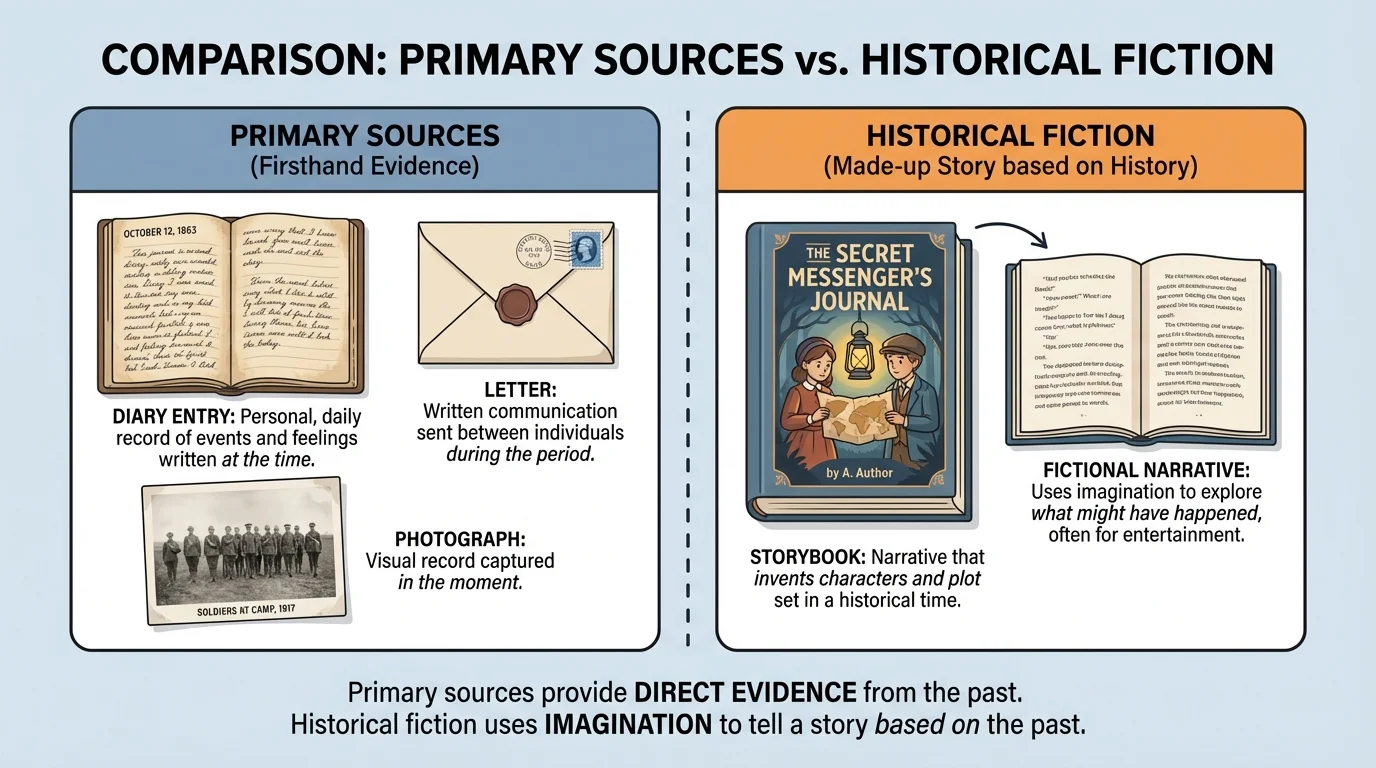
One big idea is this: a primary source is a piece of evidence from the past, but fiction is a story about the past. They are both worth reading, yet we use them in different ways.
The first difference is evidence. Primary sources are used as evidence because they come directly from the time being studied. If a child wrote, "Today our wagon wheel broke," that sentence gives us a direct clue about the trip. In fiction, an author may write the same kind of scene, but the author may have invented that exact moment.
The second difference is purpose. A primary source is usually made for a real reason at the time. Someone writes a letter to family, takes a photograph, or records a speech. A work of fiction is usually written to tell a story, entertain readers, or help readers imagine life in another time.
The third difference is point of view. A primary source gives one person's view. It may be true to that person's experience, but it may not tell the whole story. A work of fiction may include many feelings and scenes, but those parts are shaped by the author's choices.
The fourth difference is language. In a diary, the writing may be short, plain, and personal. In fiction, the language may be more dramatic. The author may describe colors, sounds, and feelings in detail to make the story vivid.
| Kind of text | Who made it? | When was it made? | What is it good for? | What must we remember? |
|---|---|---|---|---|
| Primary source | A person from that time | During the event or time period | Gives direct clues and details | It may show only one viewpoint |
| Work of fiction | An author | Often later | Helps readers picture people and settings | Some parts may be invented |
Table 1. A comparison of primary sources and works of fiction about the past.
Suppose we are studying children traveling west in covered wagons in the 1800s. We might read a real diary written by a young traveler and also a story about a made-up child on the same kind of trip. At the start of this comparison, [Figure 2] helps us picture how the same topic can appear in two different kinds of writing.
A diary might say, "We crossed a river today. Mother was afraid. One ox got loose." These words are simple, but they tell us a real thing that happened to that writer. We learn that river crossings could be dangerous. We learn that families used oxen. We learn that fear was part of the journey.
A fictional story might describe muddy water splashing, a child gripping the wagon seat, and a parent shouting orders. That scene may not be an exact true event, but it helps us imagine the sounds and feelings of travel. The story can make history feel alive.
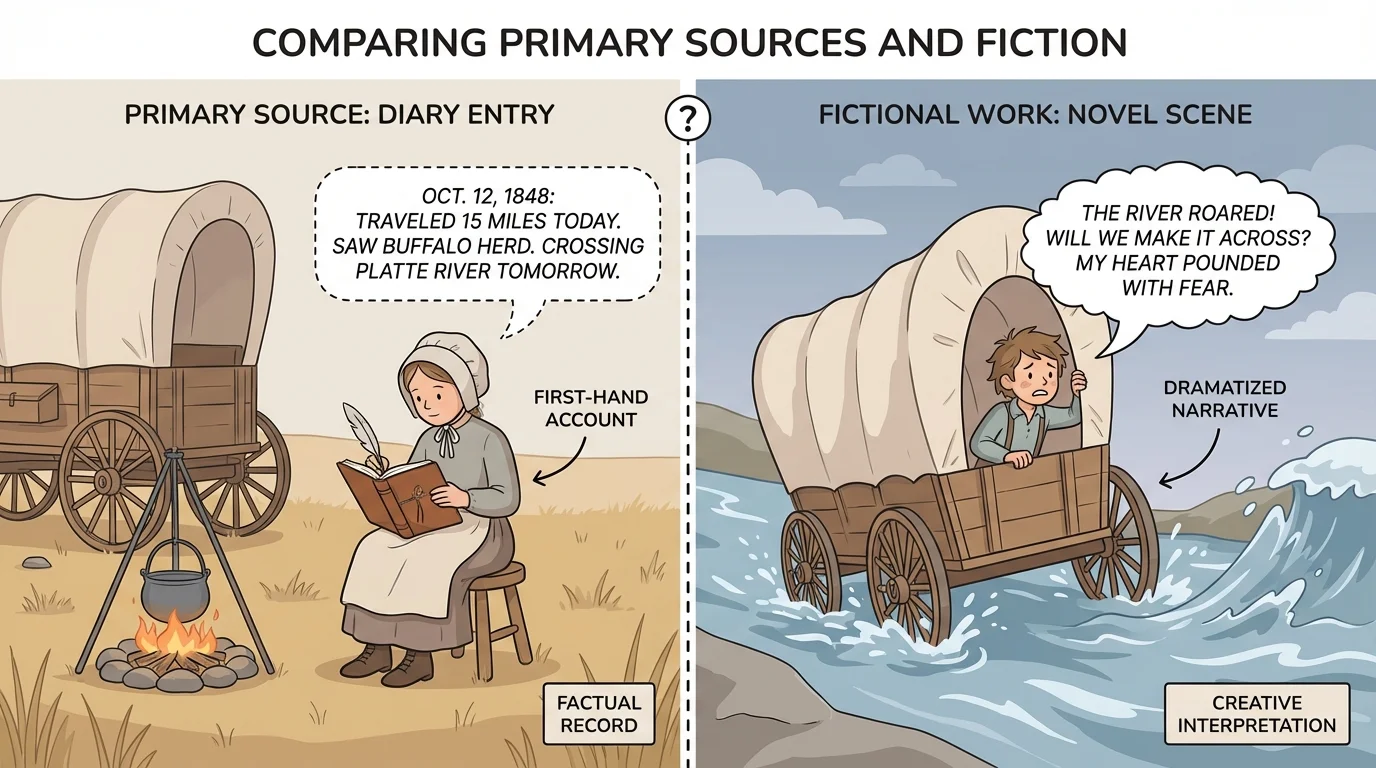
Now we compare them. The diary gives direct proof that one traveler faced a river crossing. The fictional story gives a possible picture of what such a crossing might feel like. The diary answers, "What happened to this person?" The story helps answer, "What might this kind of experience have been like?"
Case study: comparing two texts about pioneer travel
Step 1: Look for facts in the primary source.
The diary mentions a wagon, a river, fear, and an ox. Those details are clues from the past.
Step 2: Look for story details in the fiction book.
The novel may include thoughts, conversations, and scenes that make the journey exciting for readers.
Step 3: Decide what each one can teach.
The diary provides direct evidence from one real person. The work of fiction can show how the setting may have looked and felt, but not every detail can be treated as fact.
Using both texts together gives a fuller picture, but they should not be treated in the same way.
The same comparison works with many topics. A photograph from a one-room schoolhouse is a primary source. A chapter book about a made-up student in a one-room schoolhouse is fiction. A speech by a famous leader is a primary source. A play in which an actor says made-up lines as that leader is fiction.
When you read a primary source, ask: Who made this? When was it made? Why was it made? What details does it give me? What might be missing? These questions help you read like a historian.
When you read fiction about the same topic, ask: Which parts are based on history? Which parts might be imagined? Does the author include a note telling what was real? Does the story match what primary sources say about clothes, tools, homes, or travel?
Comparing means noticing both similarities and differences. If a diary and a novel both say that wagon travel was tiring, that is a similarity. If the novel includes a dramatic rescue that no primary source mentions, that is an important difference. Good readers notice both.
These questions do not make fiction less valuable. They simply help us use each kind of text the right way. In history, we must always ask how we know something is true.
Sometimes a primary source and a fictional story agree on many details. Both may show that children worked hard, weather changed plans, and travel was slow. This agreement can increase our confidence in our understanding. Still, we should remember that the fictional version may add scenes just to make the story better.
A historian does not trust one source without thinking carefully. Primary sources are powerful, but they are not perfect. A person may forget something, tell only one side, or leave out details. A photograph shows one moment, not everything that happened before or after.
This is where the idea of bias matters. Bias means a person sees things in a certain way and that view can affect what they say or show. For example, a leader writing a speech might make events sound more successful than they really were. A child writing a diary may focus mostly on things that felt important to that child.
That is why historians compare many sources. They may read letters, study photographs, examine maps, and use later books written by experts. When several sources support the same fact, we can be more confident about it.
Some famous primary sources are very short. Even a shopping list, a postcard, or a few lines in a diary can teach historians about food, travel, prices, or daily life long ago.
When we remember the limits of primary sources, we become better at comparing them with fiction. Neither kind of text should be read carelessly.
Even though fiction is invented, it can still help us learn. A careful author may study clothes, houses, tools, weather, and ways of speaking before writing a story. That means the setting can be realistic even if the characters are imaginary.
Fiction is often strong at showing feelings. A real letter might simply say that food was scarce. A historical novel may help readers sense the worry, hunger, and hard choices people faced. That emotional picture can help us care about history and remember it.
Later in our study, we can return to the comparison from [Figure 2] and see that the fictional wagon-trip scene adds emotion and description, while the diary gives direct proof from one traveler. Both matter, but for different reasons.
Some fiction books include an author's note at the end. This note may explain which parts are based on real events and which parts were invented. That note is very helpful because it shows how the author used history.
Good history learning often uses more than one kind of source. You might begin with a primary source such as a photograph, diary, or speech. Then you might read a history book written by an expert. After that, you could read a historical story to picture daily life more clearly.
A secondary source is a source made later by someone who studies the past. Textbooks and history books are examples. Secondary sources often use primary sources to explain what happened. When we compare primary sources with fiction, secondary sources can help us check what historians believe is accurate.
For example, if a novel about a Civil War drummer boy says the soldiers used certain tools, a historian can compare that story with letters, photographs, and expert history books. This careful checking keeps history connected to evidence.
When explaining the past, historians often use both primary and secondary sources. Primary sources give direct clues. Secondary sources organize and explain those clues. Fiction may add understanding of setting and emotion, but it does not replace evidence.
This careful use of sources is important in school and in everyday life. People still compare direct evidence and stories today. A video of an event is not the same as a movie scene about that event. A real interview is not the same as a made-up script. Knowing the difference helps us become thoughtful readers and viewers.
History often moves in a sequence, and [Figure 3] shows a simple pattern: first an event happens, then someone from that time creates a source, and later other writers study the event or write stories about it. Seeing this order helps us understand why a diary and a novel are not the same kind of source.
Here is a simple timeline idea. First, an event takes place, such as a family traveling west in the 1800s. Second, someone on the trip writes a diary or letter. Third, a photograph or newspaper article might be made during that time. Fourth, years later, a historian studies those materials and writes a book. Fifth, an author may write fiction set during that same period.
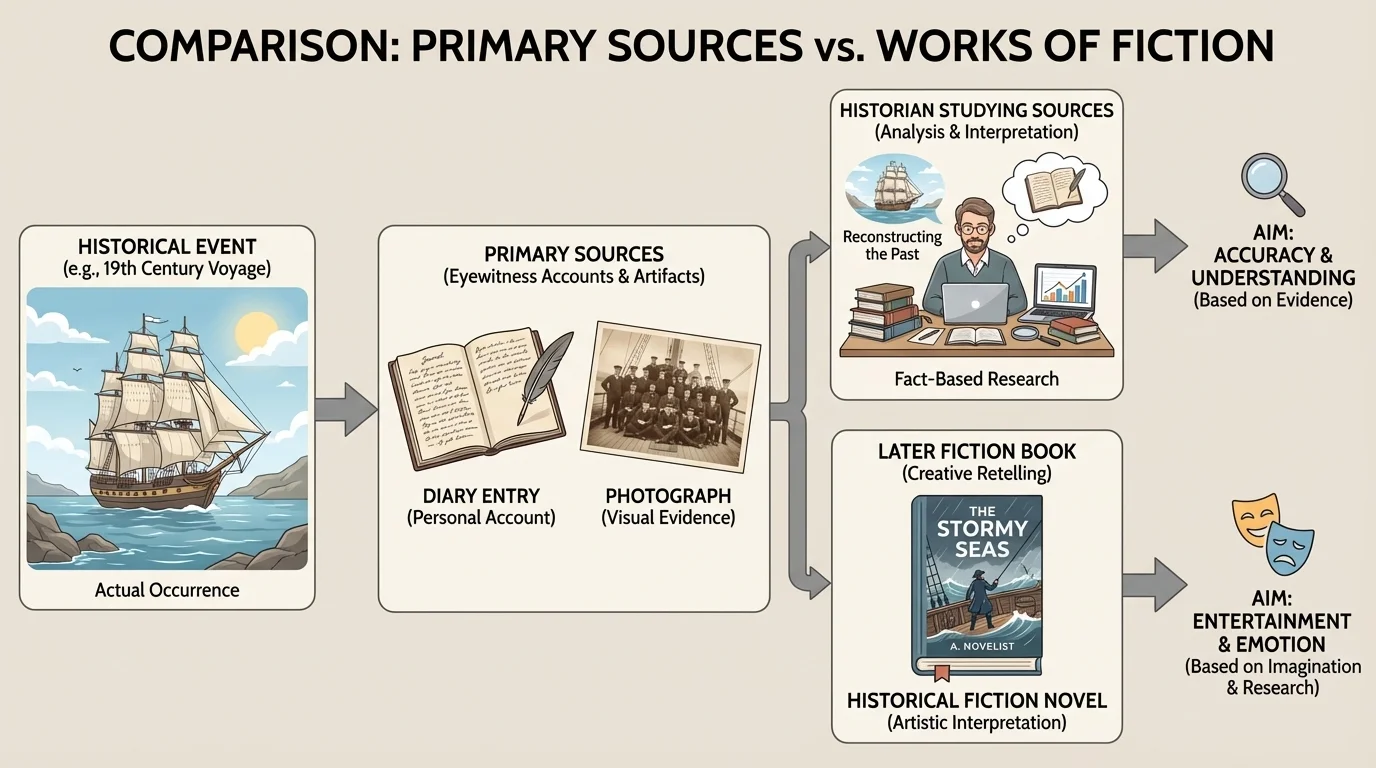
The key people in this process are witnesses, creators, historians, and authors. A witness is a person who saw or lived through something. A creator might be the person who wrote the diary or took the photograph. A historian studies many sources to explain the past. An author of fiction creates a story, sometimes using historical research to make the setting believable.
When we look back at [Figure 1], we can see that the time when a source is made is one of the biggest clues to what kind of source it is. Sources made during the event are usually primary sources. Stories written later may be useful, but if they are invented, they are fiction.
Knowing this helps us explain the past more clearly. We can say, "The diary is a primary source because it was written at the time," or "The novel is fiction because the author created characters and scenes." Those are strong history explanations because they tell not just what we read, but why the source matters.
"History is not only stories from long ago. It is evidence we study to understand those stories."
As readers grow stronger, they learn to enjoy stories and also ask careful questions. That is a powerful combination. It means you can appreciate a moving historical novel while still checking facts in diaries, letters, photographs, speeches, and history books.
