Think about your day for a moment. Someone grew your breakfast, someone made your shoes, someone drove the bus, and someone stocked the store shelves. At the same time, people all around you are choosing what to buy, what to use, and which services they need. This big web of making, buying, and using is part of economics, and it works because producers and consumers depend on each other every single day.
Economics is the study of how people make choices about goods, services, and money. People cannot have everything they want, so they make decisions. They choose what to buy, what to save, what to make, and what to sell.
Goods are things people can touch and use, like books, apples, shoes, and bicycles.
Services are jobs people do for others, like teaching, cutting hair, fixing cars, or delivering mail.
When people exchange goods and services, they help meet each other's needs and wants. A need is something important for living, like food, clothing, and shelter. A want is something extra that a person would like to have, like a toy, a game, or a special treat.
A producer is a person or business that makes goods or provides services, while a consumer is a person who buys or uses goods and services. This difference is easy to see: one side focuses on making, and the other side focuses on buying and using. A farmer is a producer because the farmer grows crops. A shoe company is a producer because it makes shoes. A teacher is also a producer because teaching is a service.
[Figure 1] A consumer uses what producers offer. When a family buys milk, they are consumers. When a student rides on a bus, that student is using a service and is acting as a consumer. When someone gets a haircut, that person is using a service as a consumer.
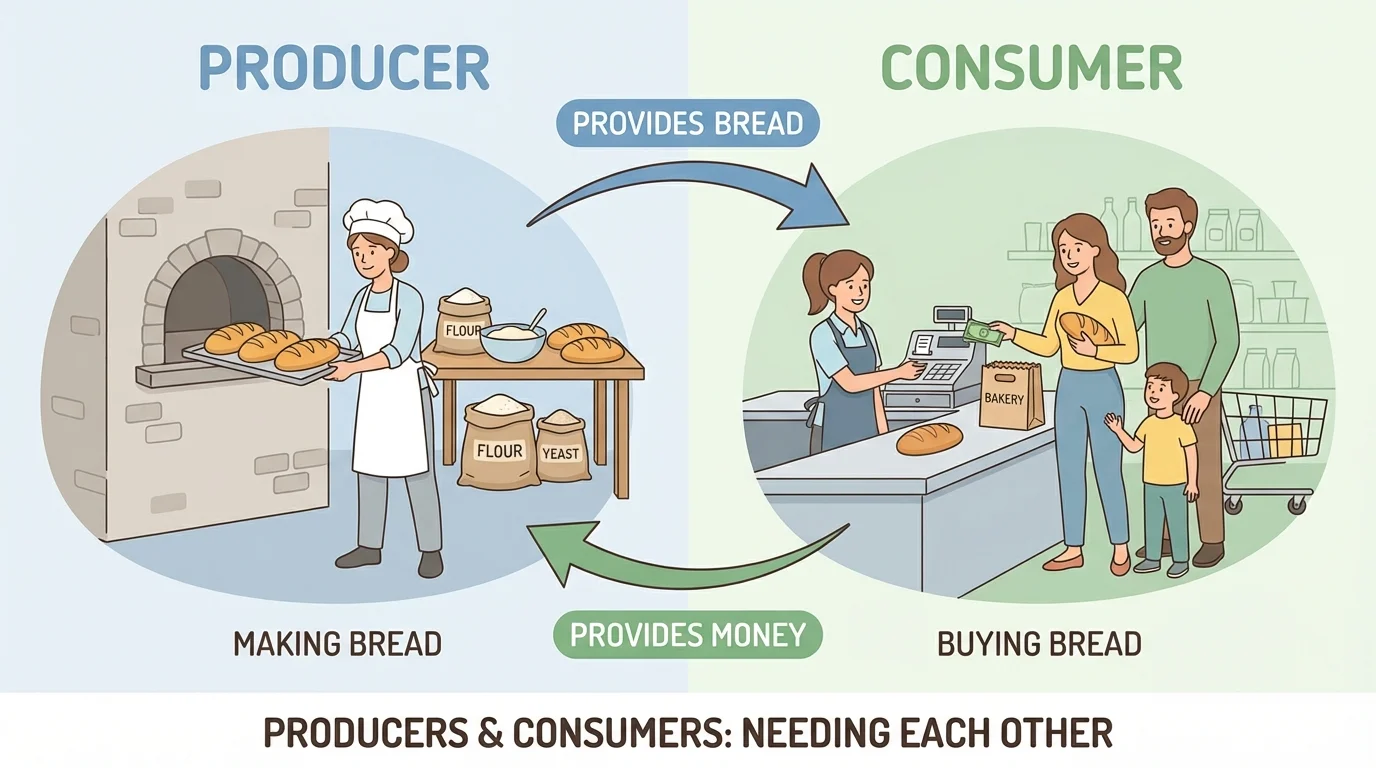
The words producer and consumer describe different roles. They do not describe whether a person is good or bad, rich or poor, young or old. They describe what a person is doing in the economy. Someone may be making something, using something, or even doing both at different times.
One economy, two important jobs
Producers help by creating or providing what people need and want. Consumers help by choosing, buying, and using those goods and services. If only producers existed, things would be made but not used or bought. If only consumers existed, people would want goods and services, but no one would make or provide them.
That is why producers and consumers are connected. They are part of the same system, and each one helps the other.
Producers make many kinds of goods. A baker makes bread. A factory makes pencils. A toy company makes games and dolls. A farmer grows fruits and vegetables. People also produce services. Doctors help people stay healthy. Mechanics repair cars. Teachers help children learn. Firefighters protect communities.
Some producers work alone, and some work in large groups. A person who sells homemade bracelets is a producer. A huge company with many workers is also a producer. No matter the size, the main idea stays the same: producers make goods or provide services that others will use.
Many goods pass through several producers before reaching a consumer. Cotton may be grown on a farm, turned into cloth at a mill, sewn into a shirt at a factory, and then shipped to a store. This means production often takes teamwork.
A single chocolate bar may involve many producers, including farmers who grow cacao, truck drivers who move supplies, factory workers who make the candy, and store workers who sell it.
Because producers spend time, effort, and money to make goods and services, they need people to choose what they offer.
Consumers buy or use goods and services. They decide what they need, what they want, and what they can afford. For example, a family might need bread and milk, but they may choose only one special dessert because they have a budget.
A budget is a plan for how to spend and save money. Consumers use budgets to make choices. If a toy costs too much, a consumer may wait, save money, or choose something else. If one store sells the same notebook for a lower price, a consumer may buy it there instead.
Consumers also help decide what producers keep making. If many people buy apples, stores order more apples. If very few people buy a certain kind of backpack, the store may order fewer of them. In this way, consumers send a message with their choices.
[Figure 2] Exchange happens when people give something and get something in return. Exchange can happen in more than one way. The most common way is with money. A consumer pays money, and the producer gives a good or provides a service.
For example, when someone buys a sandwich, the customer gives money and the restaurant provides food. When a person pays for a haircut, the barber provides a service. When a family pays for electricity, the electric company provides a service that powers lights and appliances.
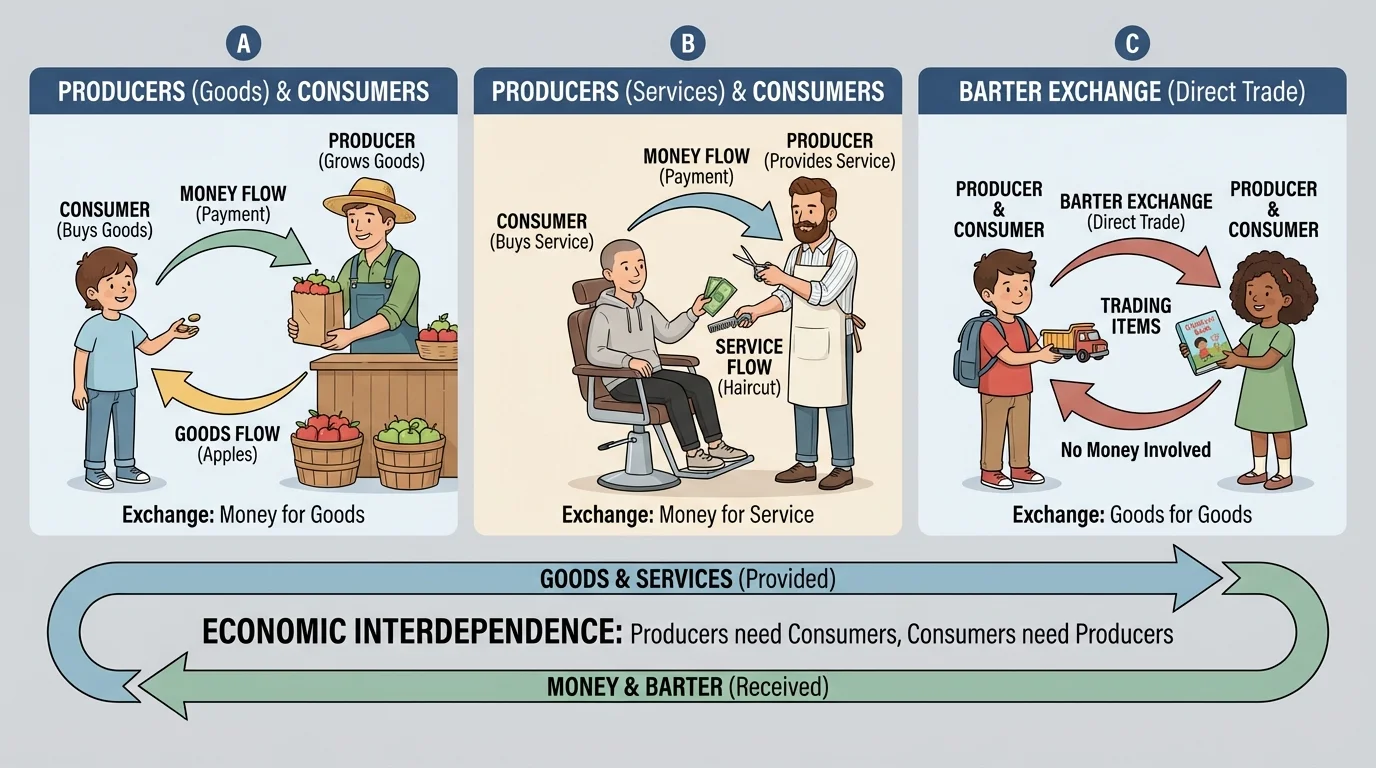
Sometimes exchange happens without money. This is called barter. In a barter, people trade one good or service for another. One child might trade a sticker for a pencil. A neighbor might help rake leaves and receive fresh vegetables from a garden in return. Barter is less common than buying with money, but it is still a form of exchange.
Today, exchange can happen in different places. People may shop in stores, at farmers markets, from street vendors, or online with an adult's help. Even when the place changes, the idea stays the same: producers offer something, and consumers choose whether to get it.
Examples of exchange
Step 1: A bakery makes muffins.
The bakery is the producer because it makes a good.
Step 2: A customer buys two muffins.
The customer is the consumer because the customer buys and eats the muffins.
Step 3: Money is exchanged.
The bakery receives money, and the customer receives the muffins.
This exchange helps both sides. The customer gets food, and the bakery earns money.
Exchange is important because it connects what one person can make with what another person needs or wants.
Producers need consumers because producers make goods and provide services for other people to use. If nobody buys the bread, the bakery cannot keep baking as much bread. If nobody goes to a barbershop, the barber will not have enough customers.
When consumers choose a producer's goods or services, the producer earns income. Income is money earned from work or from selling goods and services. Producers use income to pay workers, buy supplies, improve their business, and support their families.
Think back to the bakery in [Figure 1]. The baker may be skilled and hardworking, but the bakery still needs customers. A producer without consumers cannot stay in business for long.
Consumers also help producers know what people want. If many families buy whole wheat bread, the bakery may bake more of it. If customers ask for smaller muffins, the bakery may change its products. Consumers do not just buy things; they also guide producers with their choices.
Consumers need producers because people cannot make everything by themselves. Most families do not grow all their own food, sew all their clothes, build their own cars, and teach every subject at home. Producers make life easier by specializing in certain goods or services.
A grocery store brings together food from many producers. A hospital brings together many service producers such as doctors, nurses, and technicians. A school provides learning through teachers, librarians, and other workers. Without producers, consumers would have far fewer choices and much less help.
Producers also save consumers time. Instead of every family making soap, shoes, books, and furniture, producers do those jobs. Then consumers can choose what they need and use their time for other work, learning, and family activities.
People in a community often have different jobs. Those jobs help meet the needs of others. Economics connects these jobs through making, buying, selling, and using goods and services.
This is why consumers depend on producers just as much as producers depend on consumers.
Think about a loaf of bread. Its journey across a community helps explain how many producers and consumers depend on one another. First, a farmer grows wheat. Then another producer may grind the wheat into flour. A bakery uses the flour to make bread. A truck driver transports the bread to a store. Store workers place the bread on shelves. Finally, a family buys the bread and eats it.
[Figure 3] In that one loaf of bread, many goods and services are connected. The wheat is a good. The bread is a good. Driving the truck is a service. Stocking the shelves is a service. Buying the loaf is an act of consumption.
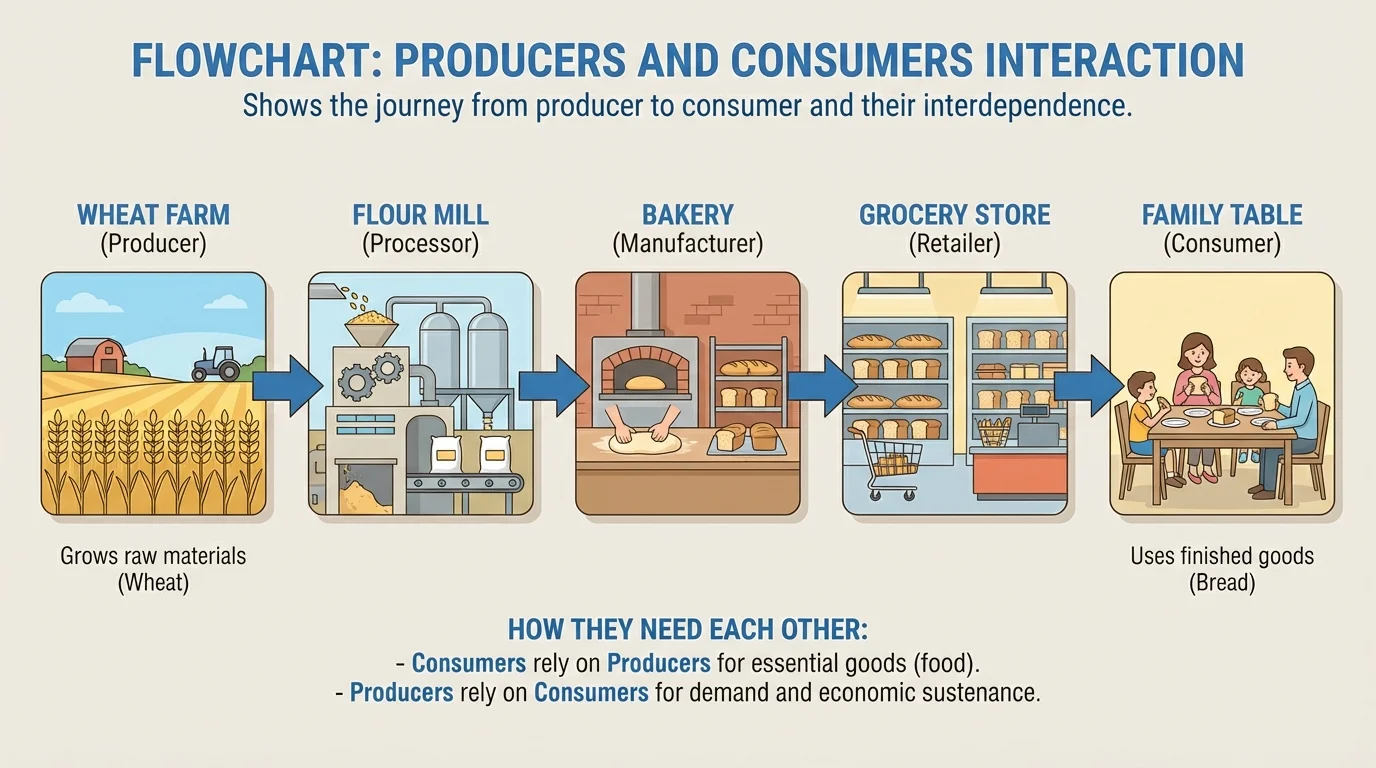
The family needs the producers to grow, make, move, and sell the bread. The producers need the family and other customers to buy the bread. If families stop buying bread, the store orders less, the bakery bakes less, and the farmer may grow less wheat. One choice can travel through the whole chain.
Later, when we think about how goods move through stores and services move through communities, [Figure 3] reminds us that an economy is often like a chain. Each part is connected to the next.
| Role | Example | What happens |
|---|---|---|
| Producer of a good | Farmer | Grows wheat |
| Producer of a good | Bakery | Makes bread |
| Producer of a service | Truck driver | Moves bread to the store |
| Producer of a service | Store worker | Stocks and sells bread |
| Consumer | Family | Buys and eats bread |
Table 1. Examples of producers and consumers involved in getting bread to a family.
A place where buying and selling happen is called a marketplace. A marketplace can be a store, a farmers market, a mall, or an online shop. In a marketplace, producers and consumers meet through exchange.
Consumers try to make smart choices. They may compare price, quality, and usefulness. A lower price can help, but quality matters too. A backpack that costs a little more may last longer. A food choice may be healthier even if another option looks more exciting.
Producers also make choices in the marketplace. They may lower prices, improve quality, create new products, or offer better service. If a producer listens carefully to consumers, that producer can better meet people's needs and wants.
Needs, wants, and choices
Consumers often choose needs before wants, especially when money is limited. Producers notice these choices and often make sure important goods and services are available. This is one way the marketplace reflects what people value most.
When both sides make thoughtful choices, exchange can work smoothly and help many people.
Sometimes one person can be both a producer and a consumer. A child who grows tomatoes in a garden is acting as a producer by growing food. If that same child eats the tomatoes, the child is also a consumer. If the child sells some tomatoes at a stand, the producer role becomes even clearer.
A student who makes friendship bracelets and sells them is a producer. Later, that same student may use the money to buy a book and become a consumer. Adults do this all the time too. A nurse provides a service at work as a producer, then buys groceries as a consumer after work.
This idea is important because it shows that economic roles can change during the day. People are not locked into only one role.
"When people make, buy, and use wisely, a community grows stronger."
Seeing both roles helps us understand why the economy is really about relationships between people.
When producers and consumers work together, communities have jobs, stores, services, and choices. Money moves from consumers to producers, and then producers use that money to pay workers and buy supplies. Those workers and businesses then become consumers too. This movement keeps the local economy active.
For example, when families shop at a local store, the store can pay its workers. Those workers may buy lunches, school supplies, or bus rides. Each exchange helps someone else. That does not mean every choice is easy, but it does show how connected people are.
Understanding producers and consumers also helps us become careful decision-makers. We can ask: What do I really need? Is this a good price? Who made this good? What service am I paying for? These questions help consumers make wise choices and help producers serve people better.
Producers and consumers are different, but neither can do the whole job alone. Producers create and provide. Consumers choose and use. Together, they make exchange possible and help a community meet needs and wants every day.
