Have you ever noticed that two people can both care about the same thing and still disagree? One student may want longer recess, while another wants more art time. Both ideas matter. What makes a big difference is how people talk and listen. When people disagree in a calm, fair, and respectful way, they are using civil discourse. Civil discourse helps people solve problems, learn new ideas, and treat each other kindly even when they do not think the same way.
Civil discourse means talking and listening in a way that shows respect for other people. It does not mean everyone has to agree. In fact, people often use civil discourse when they have different opinions. The important part is that they speak politely, listen carefully, and respond to ideas without being rude or hurtful.
Civil discourse is respectful communication between people, especially when they have different ideas or opinions.
Opinion is what a person thinks or believes about something.
Viewpoint is the way a person sees or understands an issue.
In a classroom, civil discourse might happen during a discussion about rules, books, recess, school lunches, or how to help the environment. At home, it might happen when family members choose a game, a movie, or a chore plan. In each case, people show respect by listening and speaking carefully.
Respecting the views and rights of others is an important part of being a good citizen. Every person has the right to be heard. Every person also has the responsibility to listen and speak respectfully. These two ideas work together.
Good discussions begin with active listening. That means listening with your ears, your eyes, and your mind. Respectful listening includes facing the speaker, staying quiet while they talk, and showing patience with your body and face. A respectful listener is not just waiting for a turn to talk. A respectful listener is trying to understand what the other person means.
Listening with respect can look like this: looking at the speaker, keeping your body calm, not interrupting, and waiting until the speaker is finished. It also means thinking about the message instead of planning a comeback right away. Sometimes a person says something you do not agree with. Even then, respectful listening matters.
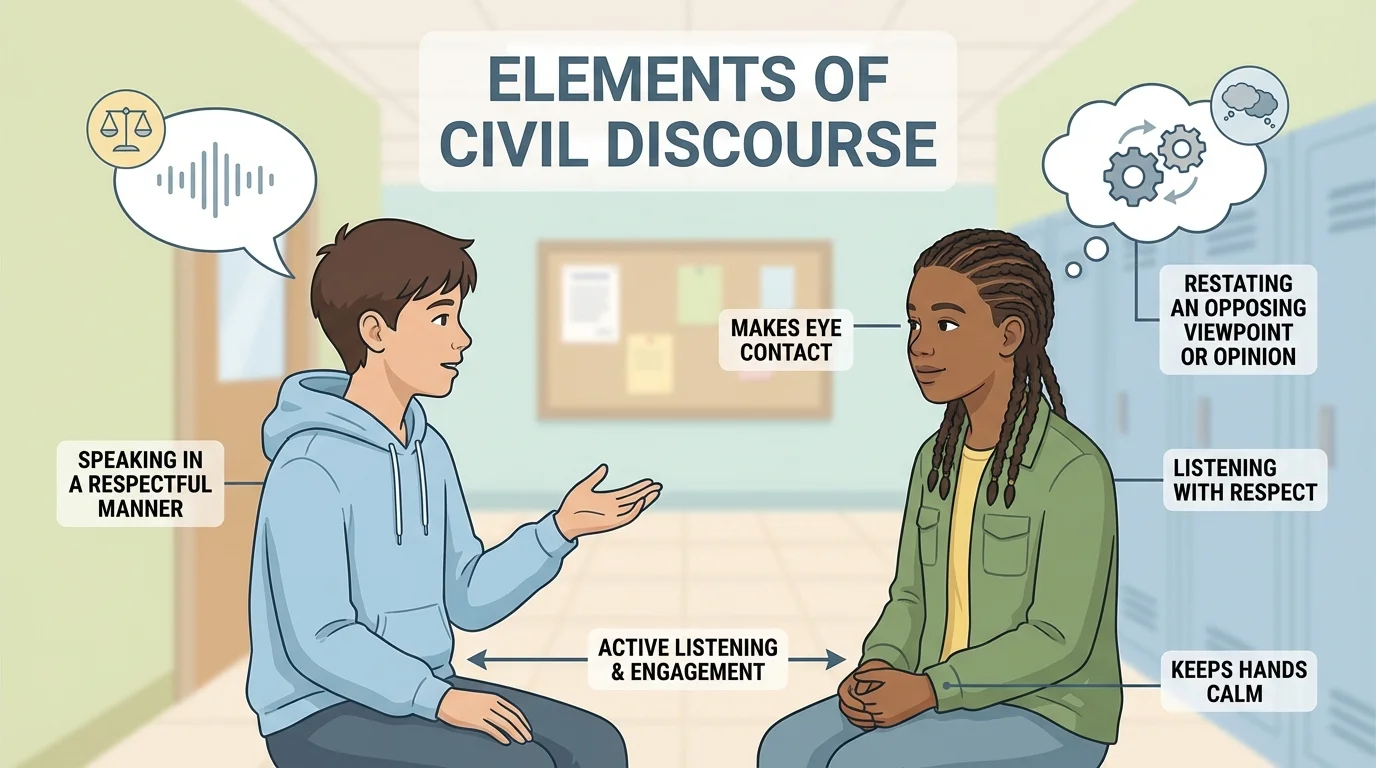
Respectful listening also includes paying attention to feelings. If a classmate speaks softly or looks nervous, a good listener gives them time. If someone is excited, a respectful listener still waits and does not talk over them. Listening shows that another person's thoughts are important.
Why listening matters
When people feel heard, they are more likely to stay calm and explain their ideas clearly. Listening can lower arguments and build trust. It also helps us learn, because other people may know something we do not know.
Sometimes listening is hard. You may feel excited, upset, or very sure that your idea is right. But civil discourse asks you to slow down. Taking a breath, keeping your hands to yourself, and letting someone finish are small actions that show big respect.
Later, when you think about group conversations, remember the listener in [Figure 1]. Respect can be seen not only in words, but also in posture, facial expression, and patience.
After listening comes speaking. Respectful speaking means using kind words, a calm tone, and clear reasons. You can disagree without being mean. Instead of saying, "That's a dumb idea," you can say, "I see it differently," or "I have another idea." The first kind of sentence hurts people. The second kind helps a conversation continue.
When speaking respectfully, focus on the idea, not the person. Saying "I do not agree with that plan" is different from saying "You are wrong." One sentence talks about the plan. The other sentence attacks the person. Civil discourse never requires insults.
Respectful speakers also use words that help explain their thinking. They might say, "I think this because…," "My reason is…," or "An example is…." Giving reasons helps others understand your opinion. It also shows that discussions are about thinking, not shouting.
Respectful and disrespectful speaking
Step 1: A disrespectful response
"No. That idea is terrible."
Step 2: A respectful response
"I disagree because I think our class needs more reading time. I understand why some people want more game time, though."
The respectful response disagrees clearly, but it stays kind and gives a reason.
Tone of voice matters too. The same words can sound kind or unkind depending on how they are said. Rolling your eyes, yelling, or laughing at someone can make a discussion feel unsafe. A calm voice helps everyone take part.
One powerful skill in civil discourse is restating another person's idea. Restating means saying the other person's viewpoint again in your own words before you answer. This shows that you listened and tried to understand. It also gives the speaker a chance to say, "Yes, that's what I meant," or "Not quite."
For example, one student might say, "I think recess should be longer because kids need time to move." Another student could restate that idea by saying, "So you think extra recess would help students exercise and feel better." Then the second student can add an opinion: "I understand that, but I think we also need enough time for science."
Restating does not mean pretending to agree. It means being fair. You are showing the other person's idea accurately, not changing it into something silly or weaker. That is an important part of respect.
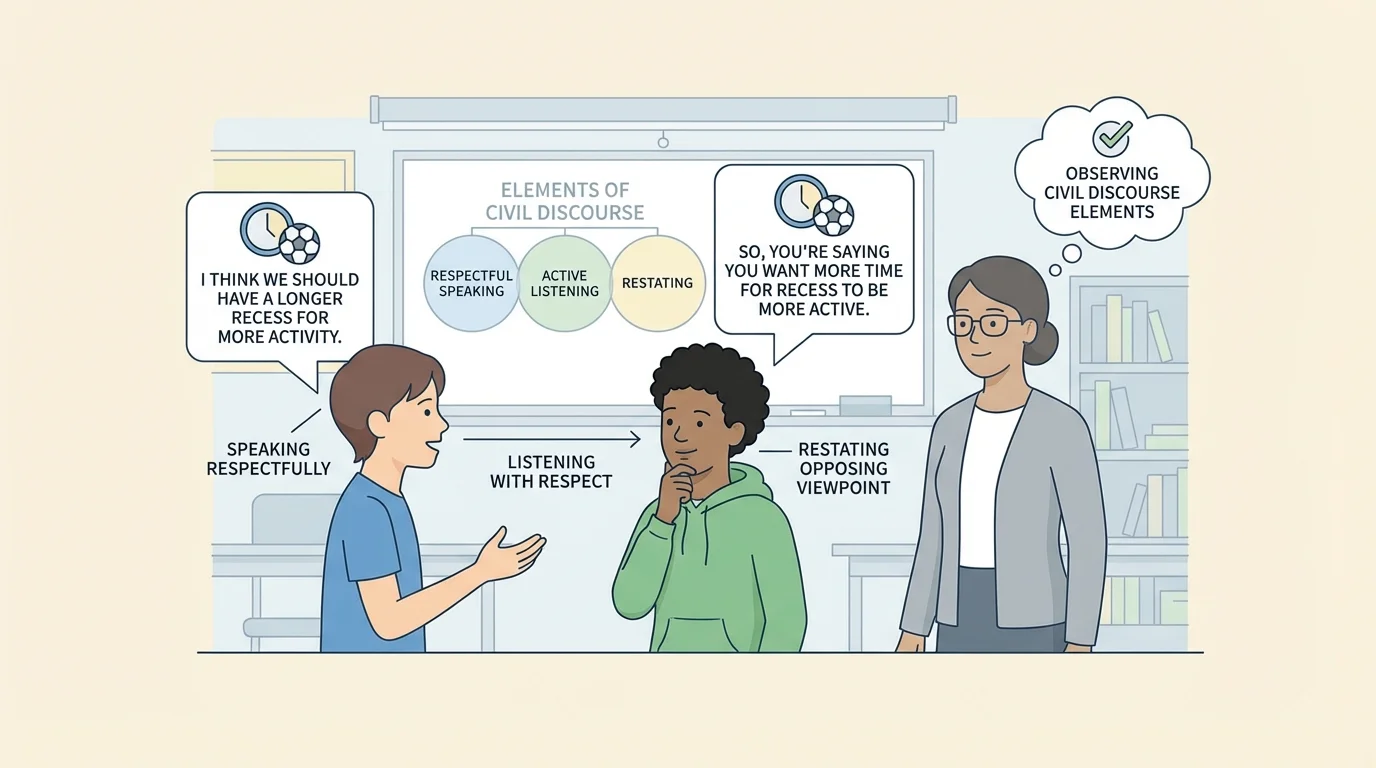
This skill is useful because people often become upset when they feel misunderstood. If you restate carefully, you lower confusion. You also show that disagreement can be thoughtful instead of hurtful.
How restating works
Step 1: Listen to the whole idea.
Do not interrupt while the person is speaking.
Step 2: Start with a phrase such as "I hear you saying…" or "So your opinion is…"
This signals that you are trying to understand.
Step 3: Say the main idea fairly.
Keep the other person's meaning the same.
Step 4: Check for accuracy.
You can ask, "Is that right?"
Step 5: Share your own opinion respectfully.
Now the conversation can continue in a calm way.
When class discussions become more complex, the fair restatement shown in [Figure 2] helps everyone stay focused on understanding first and responding second.
Disagreement is normal. Friends disagree. Teammates disagree. Families disagree. Classmates disagree. Civil discourse does not remove disagreement; it gives people a better way to handle it.
Sometimes disagreement brings strong feelings. You might feel frustrated, embarrassed, or angry. Those feelings are real, but they do not give anyone permission to be rude. A respectful person can pause, take a breath, count quietly, or ask for a moment before replying. These choices help keep the conversation safe.
You already know some classroom rules about taking turns, keeping hands to yourself, and using kind words. Civil discourse uses those same habits during discussion and disagreement.
It is also important to know that not every disagreement is solved right away. People may still have different opinions after a respectful conversation. That is okay. Civil discourse is successful when people listen, speak respectfully, and treat one another fairly, even if they do not end up with the same answer.
Another important part of respectful disagreement is being open to learning. Sometimes another person gives a reason you had not considered. Listening carefully may help you strengthen your own thinking or even change your mind. Changing your mind because of good reasons is not weakness. It is thoughtful learning.
Civil discourse is not only for school lessons. The same habits work in many settings: classrooms, playgrounds, teams, clubs, homes, and communities all benefit from respectful listening and speaking. People make better decisions when they can share ideas without fear of being mocked or ignored.
On a sports team, players may disagree about a strategy. One player may want quick passes, while another wants slower, careful movement. If they interrupt and blame each other, the team struggles. If they listen, restate ideas, and explain reasons, they can work together better.
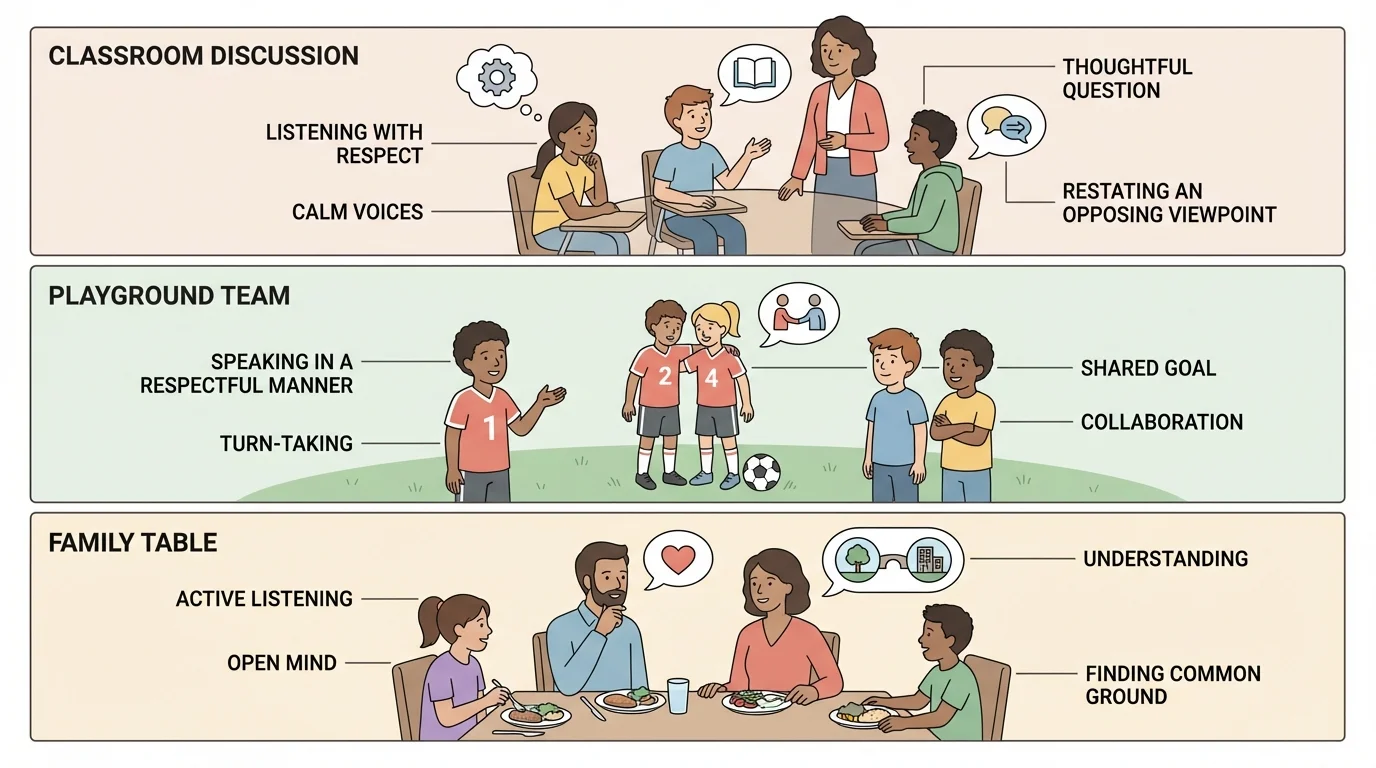
At home, family members may disagree about chores, bedtime, or what to eat. Respectful talk helps everyone feel included. In the community, adults may disagree about parks, roads, rules, or events. Civil discourse helps groups solve problems peacefully.
Many important decisions in schools and communities happen because people talk through different ideas instead of fighting. Respectful discussion is one of the tools that helps a group work together.
The scenes in [Figure 3] remind us that civil discourse is a life skill. It helps with friendship, teamwork, leadership, and citizenship.
Sometimes students know how they want to behave, but they are not sure what words to use. Sentence starters can help. These short phrases make it easier to listen, restate, disagree, and respond politely.
Here are some examples:
| Purpose | Sentence starter |
|---|---|
| To listen and respond | "I hear what you are saying." |
| To restate | "So you think that…" |
| To check understanding | "Is that what you mean?" |
| To disagree politely | "I see it differently because…" |
| To add an idea | "I would like to add…" |
| To find common ground | "We both care about…" |
Table 1. Sentence starters that support respectful listening and speaking during discussions.
Using sentence starters does not make a conversation less real. It helps people choose words that are clear and kind. Over time, these respectful habits become natural.
Each person has thoughts, feelings, and ideas worth hearing. Respecting someone's rights means allowing them to speak, to be safe, and to be treated fairly. Respecting someone's views means listening seriously, even when you disagree. These ideas help a classroom become a place where everyone can learn.
When people are rude, others may stop sharing. That means the group loses ideas. But when people use civil discourse, more voices can join. This makes discussions smarter and fairer. A strong community is not a place where everyone thinks exactly alike. It is a place where people can disagree with respect.
"Disagreeing with someone does not mean disrespecting them."
Being respectful does not mean staying silent when something matters. It means speaking up in a way that protects dignity. Civil discourse helps people stand up for ideas while still honoring the worth of others.
