What if you wanted a new art set, a soccer ball, or a special book series, but you did not have enough money yet? That happens to everyone. The good news is that people can make a plan to earn and save money little by little. Even children can do helpful jobs and earn money in safe ways. When you know your goal and choose good ways to earn, small amounts can add up over time.
A financial goal is something you want to do with money in the future. Your goal might be to buy a toy, save for a class trip souvenir, or collect money for a gift. A goal gives your money a job. Instead of spending every dollar right away, you decide what you are working toward.
Some goals are short-term. That means they can be reached soon, maybe in a few days or a few weeks. For example, saving for an $8 notebook is a short-term goal. Some goals take longer. Saving for a $25 skateboard helmet may take many weeks. Both kinds of goals are important because they teach planning and patience.
Financial goal means an amount of money a person wants to save or spend for a specific purpose.
Earn means to get money by doing work or providing a service.
Save means to keep money now so it can be used later.
When people set a goal, they first decide exactly what they want and how much it costs. Then they think about how to get the money. If the item costs $18 and you already have $4, you still need to save $14. In math, that is written as \(18 - 4 = 14\).
[Figure 1] Children can often earn money by doing jobs that are safe, honest, and approved by a trusted adult. There are many choices, and different children may choose different activities based on their age, skills, and family rules. The important idea is that the work should be useful and done well.
One way to earn money is by doing extra chores at home if a family agrees to pay for them. These should be jobs beyond regular responsibilities. For example, a child might help wash the car, organize the garage, pull weeds, or clean out a closet. Not every chore is paid, but some extra jobs may be.
Another way is helping neighbors with simple tasks when a parent or guardian says it is okay. A child might water plants, bring in mail, rake leaves, sweep a porch, or help pick up sticks in a yard. Some children help care for pets by filling a water bowl, brushing a calm dog, or playing with a pet while the owner is nearby.
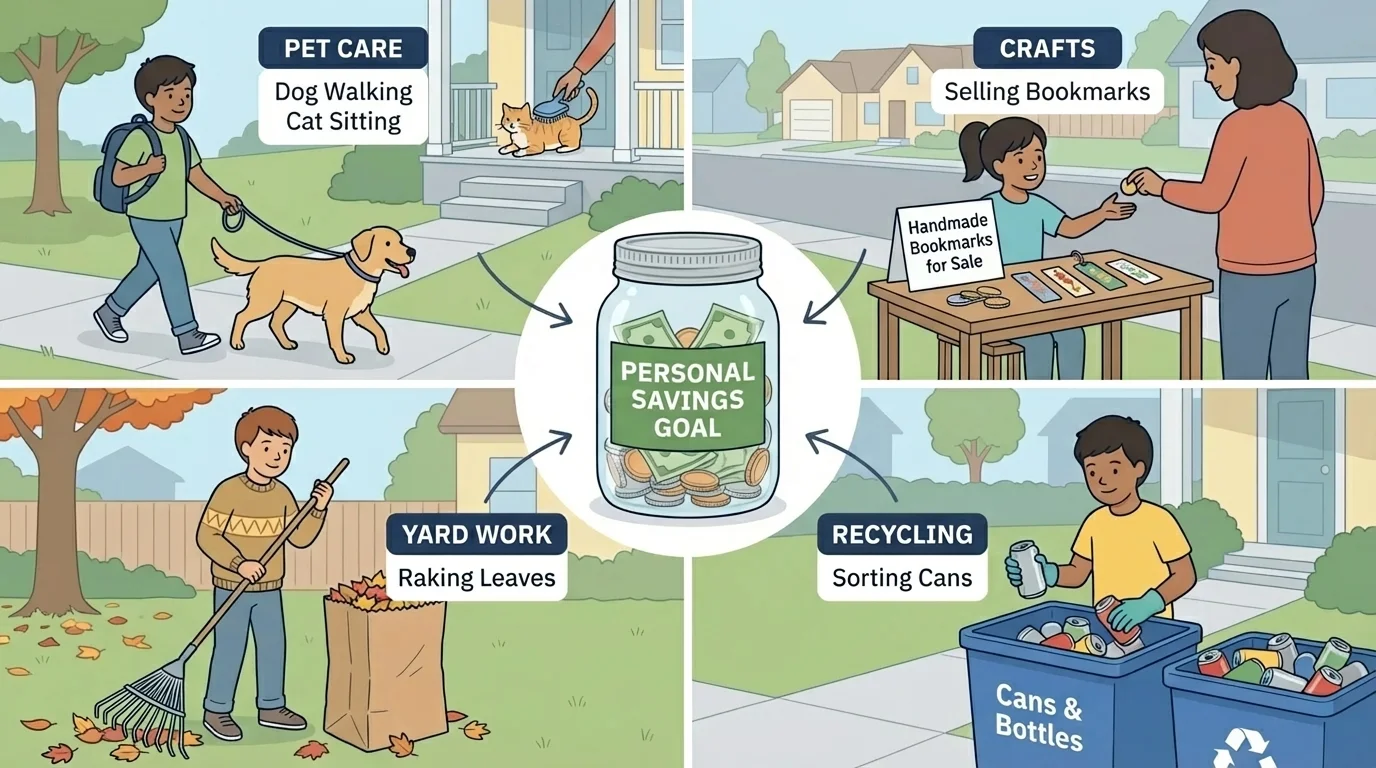
Some children earn money by collecting recyclable cans and bottles where local rules allow it. Others make simple crafts, such as bookmarks or friendship bracelets, and sell them at a family-approved event. A lemonade stand or snack stand may also help a child earn money, but it should always be run with adult help for safety, supplies, and rules.
Children can also earn money by using talents. A student who is neat and careful may help sort books for a family friend. A child who enjoys art may create cards. A child who likes organizing may help tidy toys for a younger cousin. These are all examples of turning skills into useful work.
Small jobs can make a big difference. If a child earns just $2 each week, after \(5\) weeks the total is \(2 \times 5 = 10\), or $10.
Not every idea is a good one. Safe earning activities should match a child's age and should not involve dangerous tools, going places alone, or handling money without adult guidance. The best jobs are simple, useful, and supervised.
Before starting any money-making activity, children should ask a trusted adult for permission. Safety comes first. A job should be done in a safe place, with people the family knows, and with tasks the child can really handle. For example, watering flowers is safer than using a sharp saw. Sorting books is safer than climbing a tall ladder.
A smart activity also fits the child's strengths. If you are careful with animals, pet care may be a good choice. If you like outdoor work, yard cleanup may fit you. If you enjoy making things, crafts may work well. Choosing a good match makes the work easier and often leads to better results.
Good earning choices solve a problem for someone. People usually pay for work when it is helpful. Raking leaves helps a yard look neat. Washing a car saves time for someone else. Making bookmarks gives people something useful or fun. When work helps others, it becomes more valuable.
It is also important to be honest. If you promise to do a job, do your best work. Finish the task, tell the truth, and be polite. People are more likely to ask for your help again if they know you are responsible.
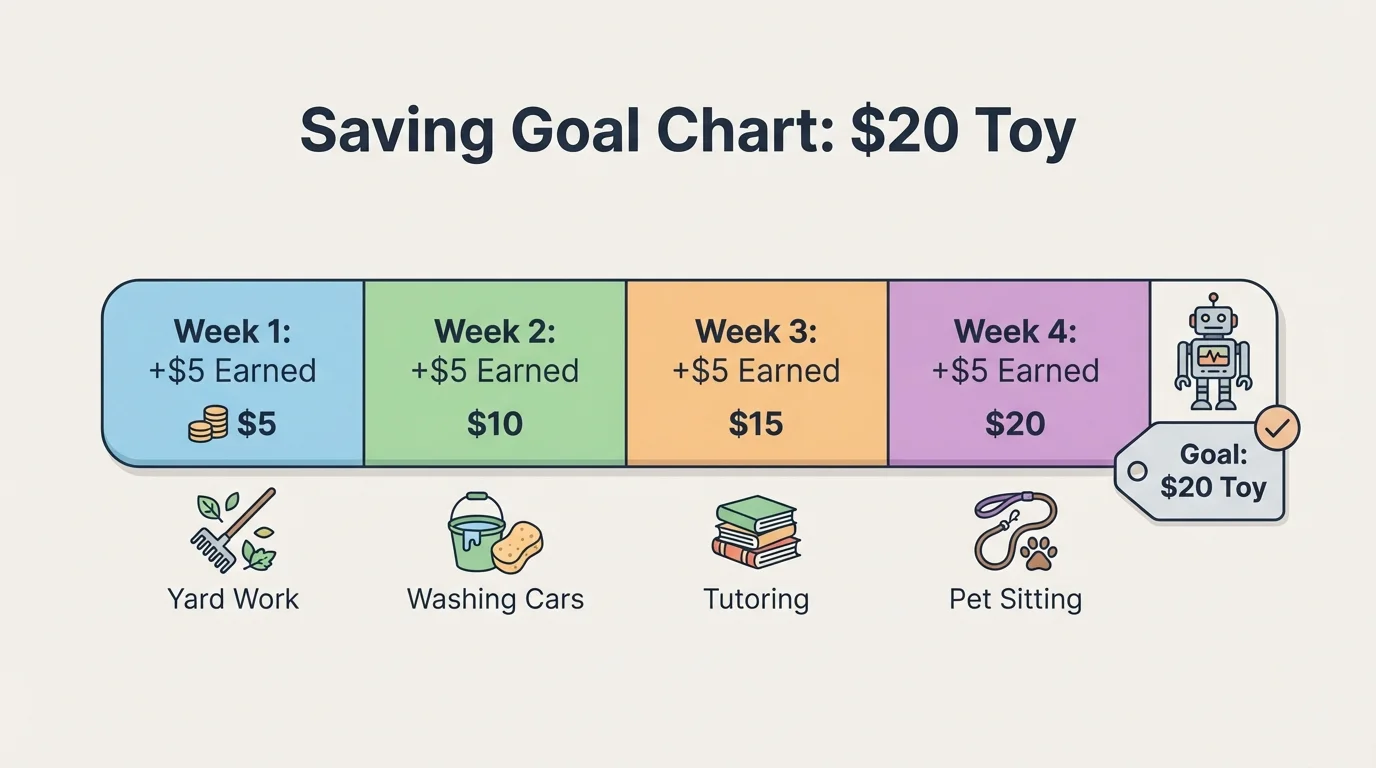
[Figure 2] Once you know your goal, you can make a plan. A plan breaks a big goal into smaller steps, and each small amount earned moves you closer to the total. Instead of only thinking, "I need a lot of money," you can think, "How much can I earn each time?"
Suppose your goal is a $12 puzzle. If you earn $3 each week, how many weeks will it take? You can use repeated addition: \(3 + 3 + 3 + 3 = 12\). That means it will take \(4\) weeks. You can also think of it as \(12 \div 3 = 4\).
Breaking a goal into parts makes it feel possible. If your goal is $20, you might earn $5 each weekend. Then your money grows like this: after one weekend, $5; after two weekends, $10; after three weekends, $15; after four weekends, $20. This steady growth is easy to track.
Sometimes you already have part of the money. Then you subtract to find how much more you need. If the goal is $15 and you already saved $6, the amount left is \(15 - 6 = 9\). Now you can ask, "What jobs can help me earn the last $9?"
A plan should answer three questions: What do I want? How much money do I need? and What can I do to earn it? When you can answer those questions, you are ready to work toward your goal.
Looking at real examples makes planning easier. These examples use simple math to connect earning activities to a goal amount.
Example 1: Earning from yard work
Lena wants a $10 coloring set. She earns $2 each time she helps rake leaves.
Step 1: Find how much she earns each time.
She earns $2 per job.
Step 2: Add the amounts until they reach the goal.
\(2 + 2 + 2 + 2 + 2 = 10\)
Step 3: Count the number of jobs.
There are \(5\) twos, so she needs \(5\) jobs.
Lena can reach her goal by doing 5 yard-work jobs.
This example shows that repeated small earnings can reach a larger total. Many financial goals are reached this way.
Example 2: Starting with some savings
Marco wants a $14 book. He already has $5 and earns $3 for each car-washing job.
Step 1: Find how much more money he needs.
\(14 - 5 = 9\)
Step 2: Find how many $3 jobs make $9.
\(9 \div 3 = 3\)
Step 3: Check the total.
Saved money plus earnings: \(5 + 3 + 3 + 3 = 14\)
Marco needs 3 car-washing jobs.
When you already have some savings, your goal may be closer than you think. That is why checking your saved money matters.
Example 3: Weekly earnings plan
Ava wants a $16 craft kit. She earns $4 each week by helping sort recyclables with an adult.
Step 1: Identify the weekly earning amount.
She earns $4 each week.
Step 2: Multiply or add to find total after several weeks.
After \(4\) weeks, \(4 + 4 + 4 + 4 = 16\).
Step 3: State the answer.
\(16 \div 4 = 4\), so she needs \(4\) weeks.
Ava reaches her goal in 4 weeks.
These examples show that earning money is not random. It works best when you know the total you need and compare it with what you can earn each time.
[Figure 3] After earning money, the next step is deciding what to do with it. Many children put money in a jar, envelope, or small savings box. Some divide money on purpose, and this is a simple way to separate money for saving, spending, and sharing. If your main goal is to buy something later, most of your earned money should go into savings.
Tracking progress helps you stay focused. You can make a list or chart with the amount you earn each time. For example, if your goal is $12 and you earn $3, then another $2, and later $4, your total is \(3 + 2 + 4 = 9\). You can see that you still need \(12 - 9 = 3\).
Some students like to color in a bar each time they save money. Others draw boxes and write the amount in each one. A tracker makes progress easy to see, just like the visual progress chart in [Figure 2]. Watching your savings grow can make it easier to wait and keep going.
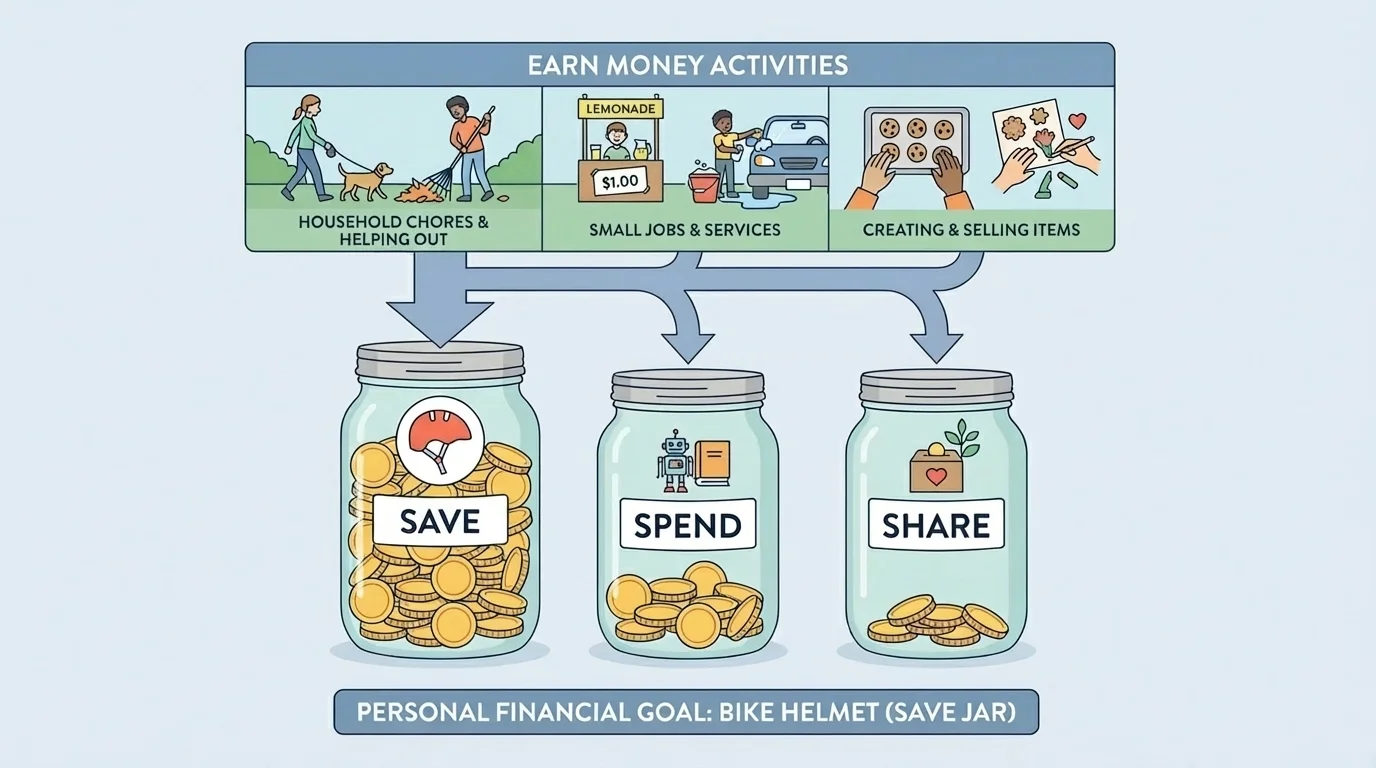
Saving does not mean you can never spend. It means you make choices. If you spend all your money on small treats, you may not have enough for your bigger goal. Smart savers think before they buy.
| Money Habit | What It Looks Like | How It Helps |
|---|---|---|
| Saving | Putting money aside | Helps reach a goal later |
| Spending | Using money to buy something now | Meets wants or needs now |
| Tracking | Writing down amounts earned and saved | Shows progress clearly |
Table 1. Simple money habits that help students manage earned money.
People who earn money successfully often develop good habits. They are on time, follow directions, and finish what they start. They also use materials carefully and treat others with respect. These habits matter because they help people trust you.
Persistence is important too. Sometimes a goal takes longer than expected. Maybe it rains on the day you planned to rake leaves, or maybe you sell fewer bookmarks than you thought. That does not mean your plan failed. It means you adjust and keep working.
You already know how to add, subtract, and skip-count. Those math skills are very useful when you earn money, save money, and figure out how close you are to your goal.
Another good habit is asking, "Was this activity worth my time?" If a job is safe, helpful, and lets you earn toward your goal, it may be a strong choice. If a job is unsafe, unfair, or too hard, it is not a good choice. Responsible earning is about making smart decisions.
As you think about earning money, remember that different families have different rules. Some families may pay for extra chores. Some may focus more on saving gifts or allowance. Some may prefer that children help at home without pay and earn money in other ways. What matters most is creating a safe, honest plan that helps you move toward a goal.
