A single shiny rock helped change Colorado forever. When people heard that gold had been found near the Rocky Mountains, they rushed in by the thousands. New camps appeared. Stores opened. Roads spread. Towns grew. This is the heart of history: one event can lead to many others. When we study Colorado's past, we ask, What happened first? and What happened because of it?
In history, a cause is something that makes another thing happen. An effect is what happens because of that cause. If a railroad is built to a town, that is a cause. More people moving to the town, more goods arriving, and faster travel are effects.
Historians study cause and effect to understand how a place changes over time. Colorado did not become what it is in just one day or because of one event. Mountains, rivers, Native peoples, explorers, miners, farmers, railroad workers, business owners, and lawmakers all played a part. Their actions connected together like links in a chain.
Cause and Effect in history means looking at how one event, decision, or condition leads to another. A cause may create one effect, or it may create many effects. Sometimes several causes work together to create one big change.
When students study Colorado's development, they learn that the land itself mattered. Mountains made travel hard in some places but held valuable minerals. Rivers gave water, but many areas were dry. Because of these conditions, people made choices about where to travel, settle, farm, and build towns.
To learn about the past, historians sort evidence into primary sources and secondary sources. A primary source is something made or used at the time being studied. A secondary source is something created later that explains the past.
A diary written by a miner in the 1800s is a primary source. A photograph of a railroad crew is a primary source. A map made when Colorado was still a territory is a primary source. An arrowhead, a letter, a newspaper from long ago, or a government record can also be primary sources.
[Figure 1] A history book about Colorado, a modern article, or a documentary made many years later is a secondary source. These are useful too, because they help organize information. But primary sources give us direct clues from the people and times we are studying.
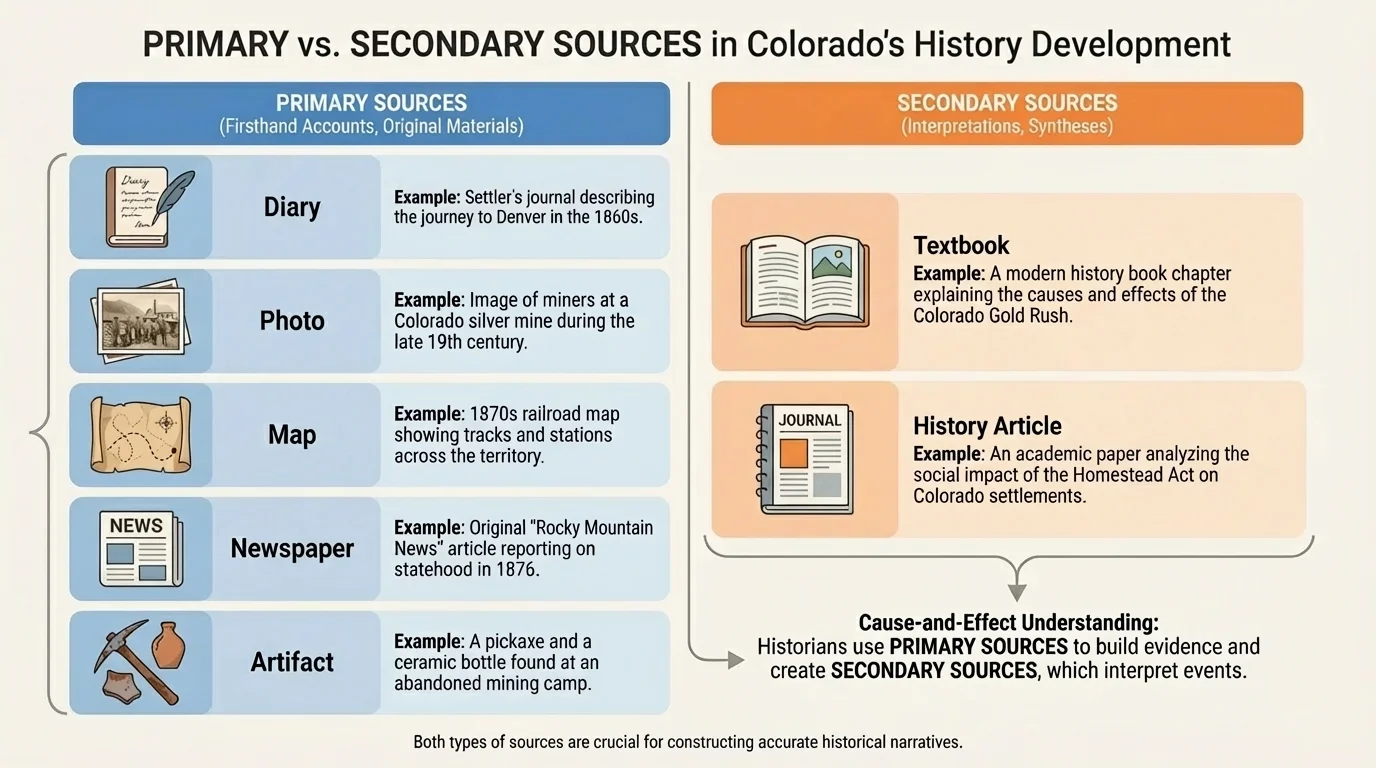
Primary sources help us answer questions such as: What did people see? What did they think was important? What problems did they face? What changed in their daily lives? A photograph of a mining town may show tents, muddy roads, tools, and crowded buildings. Those details help us see the effects of a gold rush.
Why primary sources matter
Primary sources are powerful because they are pieces of evidence from the past itself. They do not tell the whole story by themselves, but they let us hear old voices, examine old objects, and notice details that might be left out of later retellings. Historians compare several primary sources to build a fuller understanding.
Still, every source has a point of view. A miner might write excitedly about finding gold, while a Ute person might describe newcomers taking land and changing the area. Both are important. To understand Colorado fairly, we need more than one voice.
Long before Colorado became a state, many Indigenous nations lived in the region, including the Ute, Arapaho, Cheyenne, and others. They hunted, traded, traveled, and built communities connected to the land. This part of Colorado's history is very important because it reminds us that the story did not begin when settlers from the eastern United States arrived.
Primary sources from early Colorado can include oral histories, treaty records, drawings, objects, and reports from explorers. These sources show that the land already had meaning, routes, and resources before large numbers of newcomers entered.
Trails through the region became important paths for movement and trade. When travelers, traders, and later settlers used these routes, one effect was more contact between groups. Another effect was conflict over land and resources. As more outsiders came, Native communities faced pressure, broken agreements, and loss of control over homelands.
Colorado became a state in 1876, so it is sometimes called the Centennial State because that was 100 years after the United States declared independence in 1776.
Even before statehood, the geography of Colorado helped shape its future. High mountains, open plains, and river valleys influenced where people traveled and settled. This is a good reminder that a cause in history is not always a person or an event. Sometimes a natural feature can also cause change.
One of the biggest causes of change in Colorado history was the discovery of gold. In the late 1850s, news of gold brought waves of people west.
[Figure 2] When miners arrived, they needed food, tools, clothing, shelter, and transportation. Because of that need, shopkeepers, builders, cooks, and teamsters came too. A mining camp could quickly become a busy town. This is a clear cause-and-effect pattern: gold discoveries caused people to move, and the movement of people caused towns to grow.
Primary sources from mining times include letters home, newspaper advertisements, sketches of camps, mining claims, and photographs. If a newspaper announces new businesses opening in a mining town, that source suggests the town is growing. If a miner's letter complains about crowded conditions, that is evidence that many people arrived quickly.
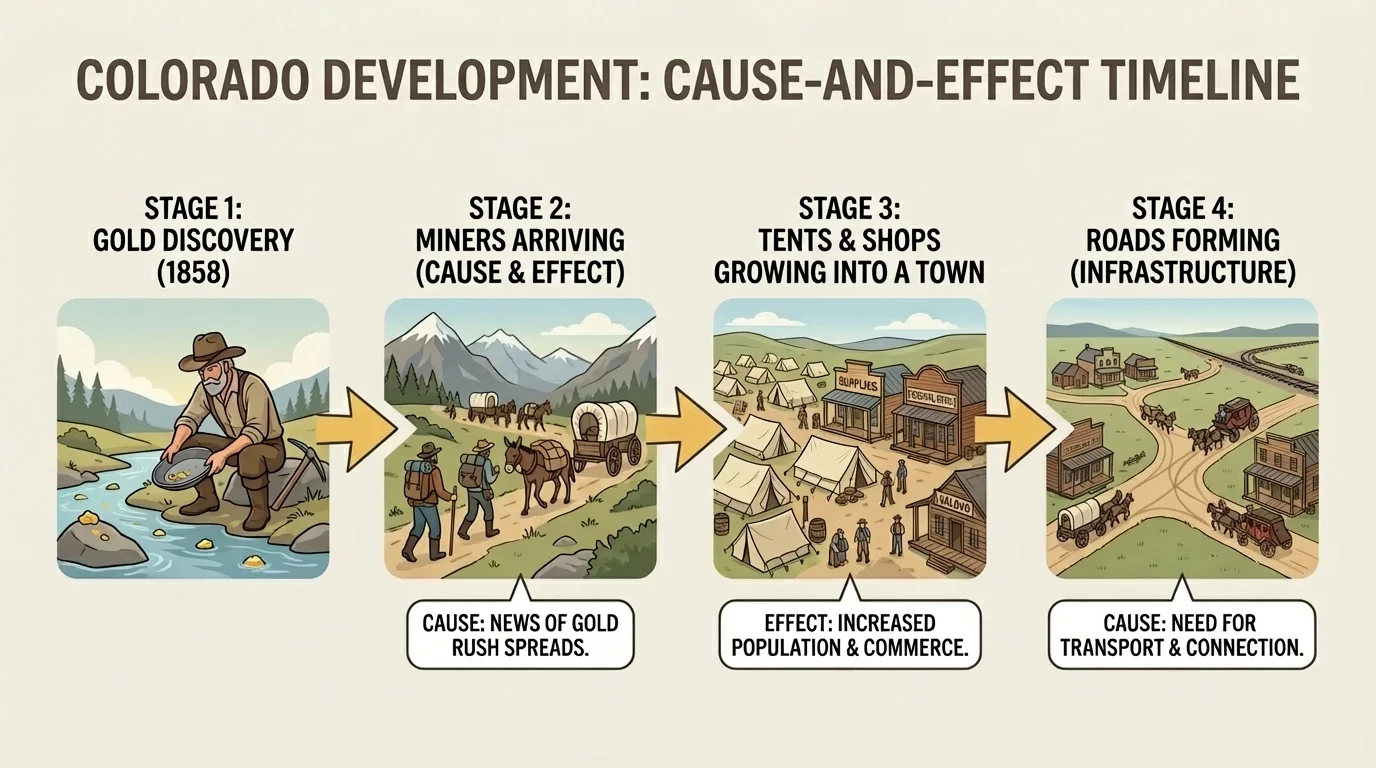
Silver mining also became important. Mining brought jobs and wealth to some people, but it also brought danger. Mines could collapse. Work was hard. Forests were cut for building and fuel. Streams could be polluted. So the effects of mining were not all the same. Some effects helped towns grow, while others harmed land and people.
Reading a primary source for cause and effect
Suppose historians study a photograph of a mining camp in Colorado.
Step 1: Observe details
The photo shows many tents, wagons, tools, and people close together near a mountain stream.
Step 2: Ask what may have caused this scene
A likely cause is that miners heard about gold in the area and traveled there quickly.
Step 3: Identify effects
Effects may include crowded camps, new stores, more roads, and changes to the land near the stream.
Step 4: Check with another source
A letter or newspaper from the same time can help confirm whether a gold rush brought many people into the area.
This is how historians use one source as evidence and then compare it with others.
Later, when we think about why some Colorado towns grew into cities and others became smaller, mining helps explain part of the answer. As we saw with the sequence in [Figure 2], resources in the ground could shape where people built homes, roads, and businesses.
Mining was important, but Colorado's development did not depend on mining alone. Railroads and farming changed the state in powerful ways.
[Figure 3] When railroad lines reached Colorado, travel became faster and goods could move more easily. A cause was the building of railroads. Effects included easier shipping, more trade, and more people moving into towns along the tracks. Denver grew partly because it became a transportation center.
Railroads also helped mining towns receive equipment and send ore out. They helped farmers send crops and cattle to markets. This shows that one cause can have several effects in different places.
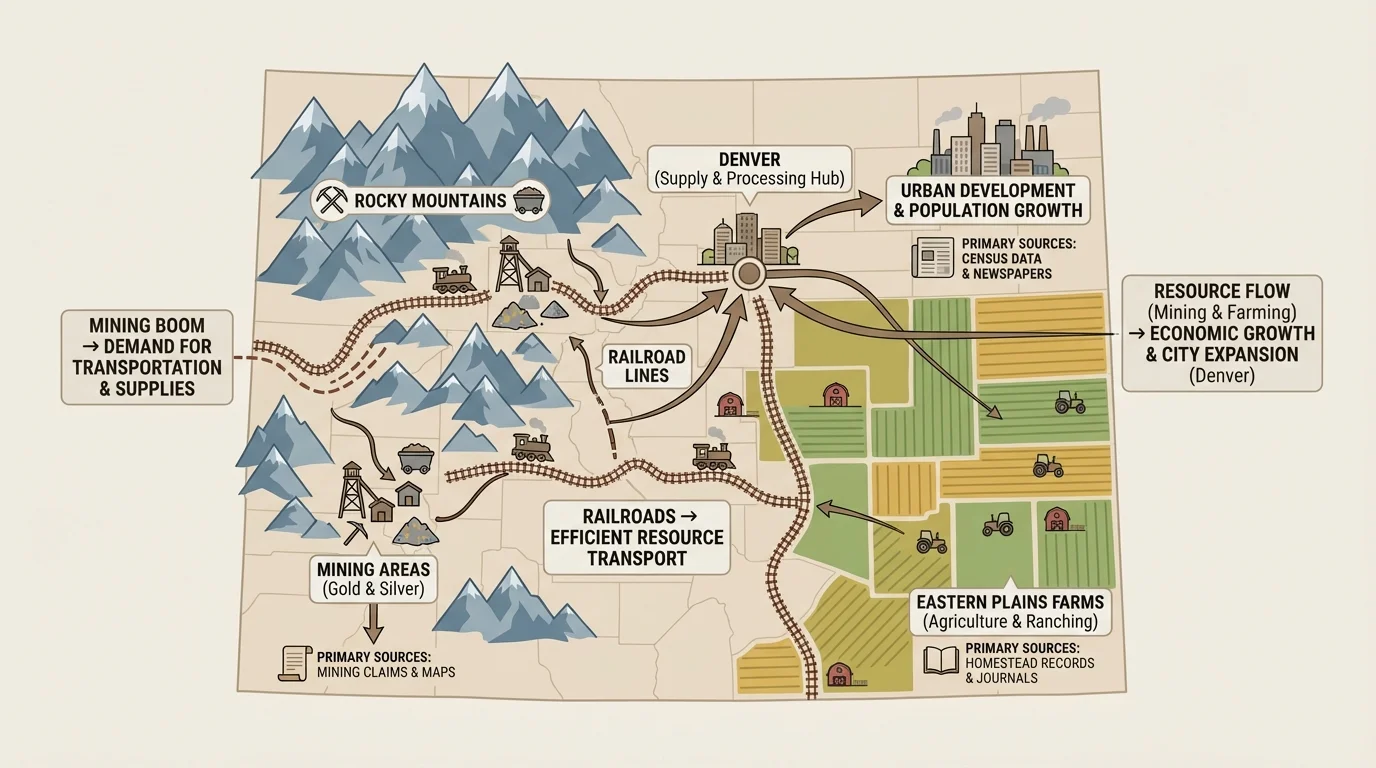
On Colorado's eastern plains, farming and ranching expanded. But much of Colorado is dry, so water mattered greatly. People built ditches, canals, and irrigation systems to move water to fields. If a farmer had access to water, crops could grow more reliably. That meant more farms, more communities, and more trade.
Geography and history work together. Mountains, plains, rivers, and climate are part of the reason people made certain choices in Colorado. The land influenced travel, settlement, work, and conflict.
Primary sources for this part of Colorado history include maps of rail lines, photographs of farms, advertisements inviting settlers west, and records about irrigation projects. A railroad map can show why towns along a line might grow. A farming advertisement can show what people hoped would happen if settlers moved there.
Sometimes a source shows what people wanted others to believe. For example, an advertisement might describe rich farmland and opportunity but leave out drought, hard work, or conflict. That is why historians ask who made the source and why.
Colorado became a state in 1876. Statehood mattered because it gave Colorado a stronger place in the national government. It also showed that enough people had settled there to support state government. Becoming a state was not the only cause of growth, but it was part of a larger pattern of change.
As transportation improved and jobs increased, cities such as Denver grew larger. Businesses, schools, newspapers, and government offices expanded. A census, which is an official count of people, can serve as a source of historical evidence that helps historians measure growth over time.
Territory is land organized by the United States but not yet a state. Statehood is the point when a territory becomes a state with full rights in the union. Census means an official count of the population.
If a city's population rises after a railroad arrives, historians may connect those facts. If businesses open after more families move in, that is another cause-and-effect relationship. History often works through patterns like these rather than one simple answer.
Government records, city maps, photos of streets, and newspaper stories all help us understand urban growth. A photo with electric streetlights, brick buildings, and busy sidewalks tells us the city has changed from an earlier camp or village.
Colorado's development did not affect everyone in the same way. This is why historians compare multiple points of view. A miner might see a mountain valley as a place of opportunity. A railroad company might see it as a route for profit. A farmer might see it as a place to build a life. A Native community might see the same place as part of an ancestral homeland under threat.
A point of view is the way a person or group sees events. Point of view can be shaped by work, culture, goals, and experiences. When historians study Colorado, they do not just ask, "What happened?" They also ask, "Who is telling the story?"
"History is not only about events. It is also about voices."
For example, a government report might describe a treaty as an agreement, while Native people may have experienced it as unfair or broken. A business ad might call a town prosperous, while a worker's letter might describe dangerous conditions and low pay. Both are useful sources, but each shows only part of the picture.
Looking at more than one point of view helps us avoid oversimplifying the past. Colorado's growth included success, struggle, cooperation, and conflict. To understand development honestly, we need to see all of those parts.
When you read a primary source, start by identifying what kind of source it is. Is it a photo, map, letter, newspaper article, speech, object, or record? Then ask what it shows directly and what clues it gives.
Next, look for time words and change words. Phrases such as after, because, as a result, led to, and therefore can signal cause and effect. But even if the source does not use those exact words, the details may still show a relationship.
Questions historians ask
Step 1: Who created the source?
This helps identify point of view.
Step 2: When was it created?
This helps place the source in time.
Step 3: What event or condition may have caused what we see?
This helps identify causes.
Step 4: What happened next because of it?
This helps identify effects.
Step 5: What other sources can confirm or challenge this idea?
This helps historians build an accurate understanding.
Suppose you examine a map showing new rail lines and another source showing town populations rising. You can connect them carefully: the railroad may have helped towns grow. Then you check photos, newspaper reports, or census records to see whether the evidence supports that idea.
That same careful thinking applies to all of Colorado's major changes. Gold rushes, railroads, irrigation, and statehood all created effects, but the strongest historical explanations come from comparing several sources, not from guessing.
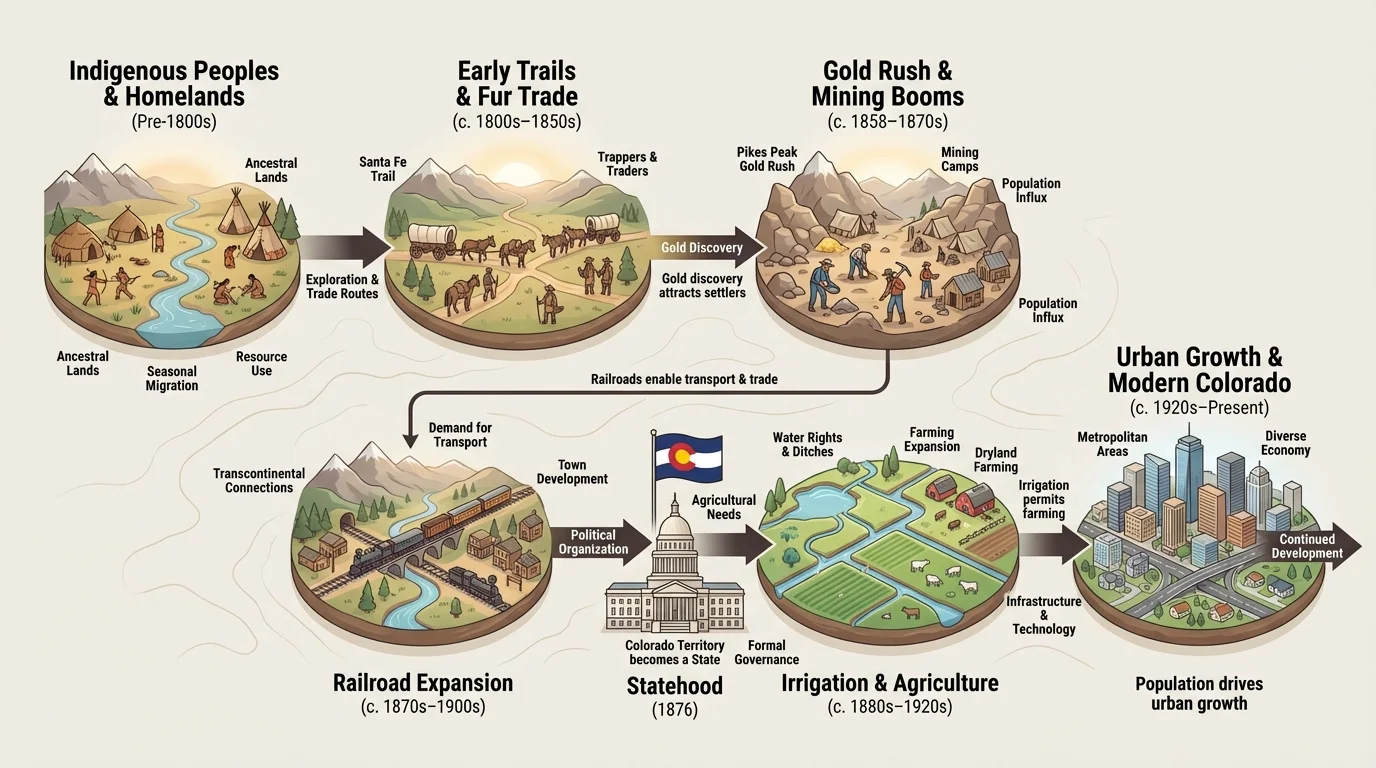
[Figure 4] Colorado's development happened step by step over many years through a sequence of major changes. Indigenous nations lived in the region first. Trails and trade routes connected places. Gold and silver discoveries brought migration. Railroads linked towns and markets. Statehood gave Colorado a new political role. Farming, ranching, and city growth continued to reshape the state.
This timeline matters because it reminds us that causes and effects build on one another. A gold rush could help create a town. A town could attract a railroad. A railroad could help businesses grow. More businesses could bring more people. Development is often a chain of connected changes.
| Event or Condition | Possible Cause | Possible Effect |
|---|---|---|
| People rush into Colorado mining areas | Gold is discovered | Mining camps and towns grow |
| More goods move across the state | Railroads are built | Trade becomes faster and towns expand |
| Fields produce more crops | Irrigation systems bring water | Farming communities grow |
| Cities become larger | Jobs, transportation, and businesses increase | Population rises and services expand |
| Native communities lose land | Settlement and government actions increase | Conflict, displacement, and major cultural changes occur |
Table 1. Examples of cause-and-effect relationships in Colorado's development.
When students study the timeline again later, it helps them see that Colorado's history is not just a list of dates. It is a story of connected actions and consequences. Every source adds another clue.
Some Colorado towns boomed quickly because of mining and then shrank when the mines stopped producing as much. These places are sometimes called boom-and-bust towns because rapid growth was followed by decline.
Understanding Colorado's development means paying attention to both change and evidence. Primary sources let us study what people saw, made, and wrote. Cause-and-effect thinking helps us explain why towns grew, why railroads mattered, why farming depended on water, and why different groups experienced these changes differently.
