Two people can watch the same event and tell completely different stories about what happened. One person says the referee ruined everything. Another says the team simply did not play well. History works in a similar way. People in the past saw events through their own experiences, worries, hopes, and beliefs. That is why historians do not just ask, "What does this source say?" They also ask, "Why does it say it that way?"
[Figure 1] When we study early United States history, we read letters, speeches, diary entries, laws, newspaper articles, paintings, and textbooks. These historical sources help us learn about the past. But a source is not a perfect mirror. It is more like a window with a particular view. The view depends on where the person was standing, what was happening at the time, and what the person believed.
Historical context means the background conditions that surround a source or event. It includes the time period, place, important events, ideas, customs, conflicts, and daily life of the people involved. A source makes much more sense when we study these surrounding factors.
For example, a newspaper article written in the colonies in the 1770s may sound angry about British taxes. That tone is easier to understand if we know that many colonists were upset about taxes passed by Parliament and felt they had no voice in those decisions. Without that background, the article may seem overly dramatic. With context, it becomes clearer.
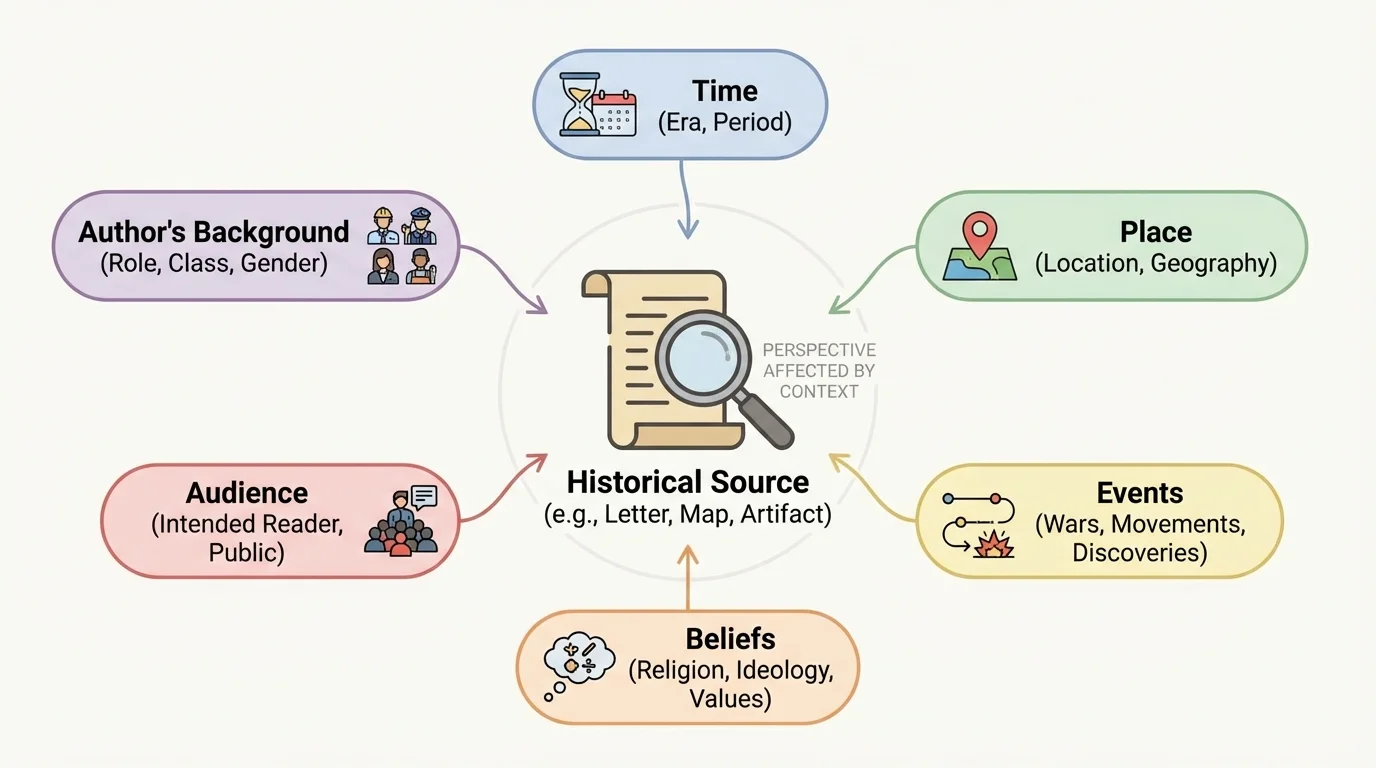
Context does not just explain famous events. It also includes ordinary life. A letter from a child in a farming family might mention chores, weather, and food shortages. Those details tell us what daily life was like. They also remind us that people in the past were making choices within the limits of their time.
Historical context is the background information about a time period that helps explain why people acted, thought, or wrote in certain ways.
Perspective is the way a person views an event, shaped by that person's experiences, beliefs, and position.
A source's perspective is not only about opinion. It is also about location in history. A soldier, a shopkeeper, an enslaved person, a lawmaker, and a child could all live during the same event but experience it very differently.
Primary sources are created by people who lived during the time being studied. Examples include letters, diaries, speeches, treaties, newspaper articles, and photographs from that time. A colonist's diary from 1775 is a primary source because it comes directly from that period.
Secondary sources are created later by people studying the past. Examples include textbooks, biographies, documentaries, and articles written by historians. A book written today about the American Revolution is a secondary source. It may use many primary sources, but it is still written after the events happened.
Both kinds of sources can be affected by context. A primary source may show the strong emotions of the moment. A secondary source may reflect the questions and values of the time when the historian wrote it. That means students should not assume that a secondary source is automatically neutral or that a primary source automatically tells the whole truth.
You may already know that historians gather evidence from many places. A single source can be useful, but historians become more confident when several sources support the same idea or help explain why accounts differ.
Reading both primary and secondary sources helps us build a fuller picture. One source might tell us what happened. Another might help explain why different people understood the event in different ways.
Many things shape how a person writes or speaks. One important factor is the author's background. Age, job, wealth, gender, race, religion, and social position can all affect what someone notices and what seems important. A wealthy merchant and a small farmer might react differently to the same tax law because it affects their lives in different ways.
Another factor is audience, the people the author expects will read or hear the source. A speech to soldiers may sound brave and urgent. A private diary entry by that same person may sound worried and uncertain. The message changes because the audience changes.
Bias also matters. Bias means a leaning or preference that affects how someone presents information. Everyone has some bias because everyone has experiences and beliefs. Historians look for bias not to reject a source immediately, but to better understand it. A source can still be very useful even if it is one-sided, as long as we read it carefully.
Purpose matters too. Was the source meant to persuade, inform, celebrate, complain, defend, or entertain? A poster asking men to join the army is trying to persuade. A law is trying to command. A newspaper editorial may argue strongly for one side. Knowing the purpose helps us understand the language and tone.
Context changes meaning
The same words can mean different things in different times. If a source from the 1800s uses a word we still use today, the author may have meant something a little different. Customs and ideas also change. That is why historians try not to judge a source only by modern meanings. They ask what the words meant to people living then.
[Figure 2] Current events shape sources as well. During war, fear and patriotism can make writing more intense. During economic trouble, people may focus on jobs, prices, and survival. During political conflict, writers may divide the world into "us" and "them."
Early United States history includes periods of conflict, growth, and change. Understanding when a source was created matters because events built on one another.
Think about colonial protests before the American Revolution. A British official might write that new taxes were reasonable because Britain had spent money defending the colonies during the French and Indian War. A colonist might write that the taxes were unfair because colonists had no representatives in Parliament. Both sources discuss taxes, but their contexts are different.
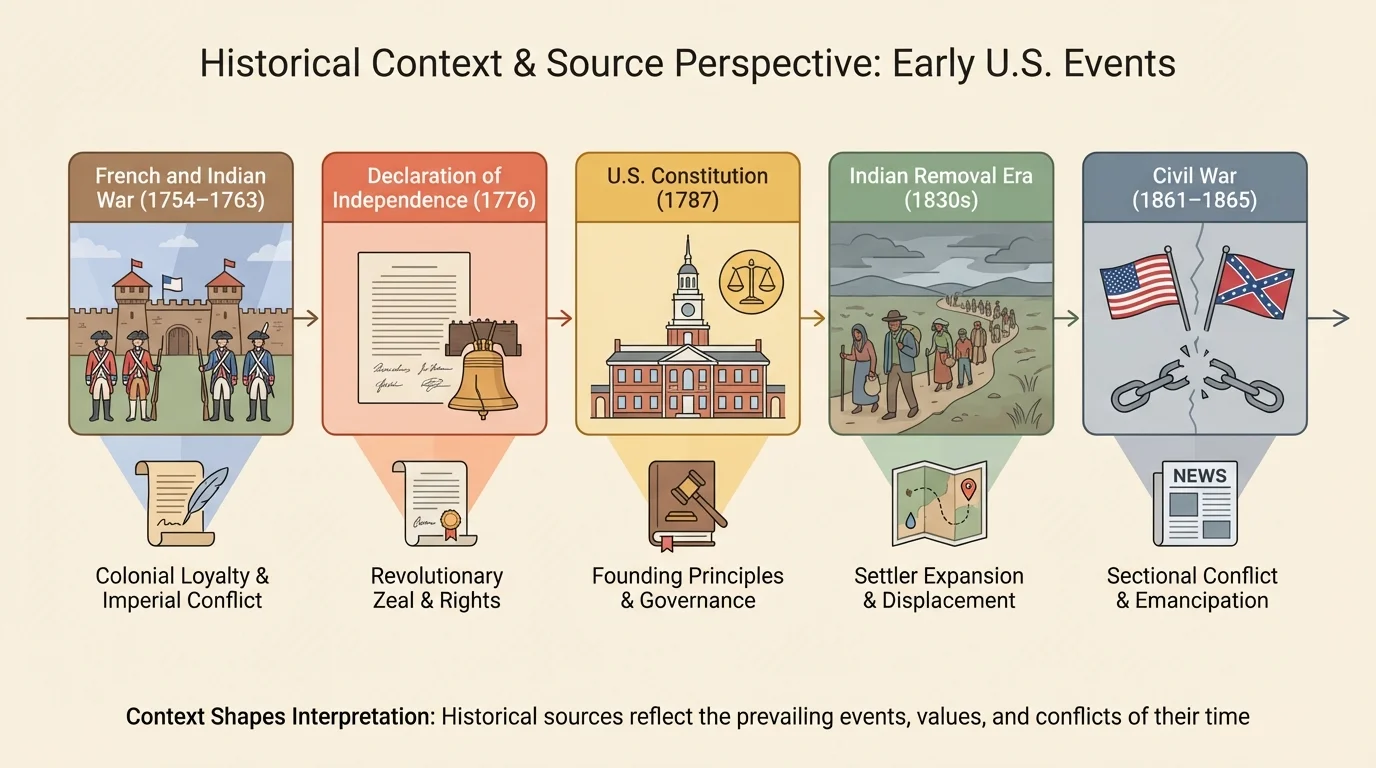
Now consider the Declaration of Independence in 1776. Patriots saw it as a bold statement of freedom. King George III and British leaders saw it as rebellion. Enslaved African Americans might hear powerful words about liberty but also notice that slavery still existed. Their perspective could include hope, disappointment, or both.
Westward expansion offers another strong example. Many settlers wrote about opportunity, land, and new beginnings. Some government leaders described expansion as national progress. But many Native American nations experienced land loss, broken treaties, violence, and forced removal. A settler's journal and a Native leader's speech may describe the same movement westward in completely different ways.
The Civil War era also shows how context affects perspective. A Union soldier might write about preserving the nation. An enslaved person fleeing to freedom might focus on liberation and danger. A Southern political leader might write about states' rights or defending a way of life. Each source reflects a different position within the same conflict.
Case study: One event, different viewpoints
Consider the Boston Tea Party in 1773.
Step 1: Look at a patriot viewpoint.
A patriot newspaper might praise the protest as brave resistance against unfair taxation.
Step 2: Look at a British viewpoint.
A British official might describe the same event as destruction of property and disorder.
Step 3: Add context.
When we remember the tax dispute, anger over representation, and rising tensions between Britain and the colonies, we understand why each side wrote differently.
The event did not change, but the perspective did.
As we saw with the timeline in [Figure 2], sources are easier to understand when we place them in the right historical moment. A source from before the Revolution, during the Revolution, and after independence may use similar words like freedom or rights, but those words may carry different meanings in each stage.
Historians ask careful questions. First, who created the source? Second, when and where was it created? Third, what was happening at that time? Fourth, why was it created? Fifth, who was the audience? Sixth, whose voices are included, and whose are missing?
These questions help students move beyond simply collecting facts. They help us notice whether a source is trying to persuade us, whether it comes from a powerful person or an ordinary person, and whether it leaves out certain groups. A government report and a family letter may both be important, but they offer different kinds of evidence.
| Question | Why It Matters |
|---|---|
| Who created it? | Shows the author's role, interests, and experiences. |
| When was it created? | Connects the source to important events of the time. |
| Why was it created? | Reveals purpose, such as informing, persuading, or recording. |
| Who was the audience? | Helps explain tone, word choice, and what was included. |
| What is missing? | Reminds us that not every voice is represented. |
Table 1. Questions historians ask to understand how context affects perspective in a source.
Sometimes students ask whether a source is "reliable." That is a useful question, but reliability is not always simple. A source can be unreliable for some facts and still be useful evidence of feelings, fears, or beliefs. For example, a rumor in a newspaper may not be accurate as a fact, but it can still reveal what people were worried about at the time.
Some of the most valuable historical clues come from ordinary items such as receipts, maps, clothing lists, and letters about daily chores. They may seem small, but they show what life was really like for people who are not always featured in famous speeches.
That is why historians compare sources. If one document says a policy was welcomed by everyone, but letters from families, newspaper debates, and speeches from Native leaders show anger and resistance, then the fuller picture is more complicated.
Learning about perspective helps us avoid a one-sided history. If we only read the voices of presidents, generals, or lawmakers, we miss the experiences of women, children, workers, immigrants, free Black communities, enslaved people, and Native nations. Early United States history becomes much richer when more voices are included.
This does not mean every source is equally accurate about every fact. It means that different people noticed different parts of history. A battle map shows troop movement. A nurse's letter shows suffering. A speech shows political goals. Together, these sources create a stronger understanding than any single source alone.
"History is not just what happened. It is also how people understood what happened."
Perspective also teaches empathy. Empathy in history means trying to understand how people in the past saw their world, even when their choices were different from ours. It does not mean agreeing with every action. It means working hard to understand the reasons behind words and decisions.
One common mistake is thinking that if two sources disagree, one must be lying. Sometimes that is true, but often the disagreement comes from different experiences. A settler family and a Native community did not experience westward expansion in the same way. Their sources may both be honest about what they lived through, even though their stories differ sharply.
Another mistake is ignoring missing voices. Many people in history had less power to publish books, make laws, or keep records that survived. Historians have to search carefully for those voices in oral histories, artifacts, court records, personal letters, and community traditions.
[Figure 3] A third mistake is using today's ideas too quickly without first understanding the time period. People in the past lived under different laws, customs, and beliefs. Context helps explain behavior, though it does not excuse injustice. Historians can understand why people acted as they did while still recognizing harm.
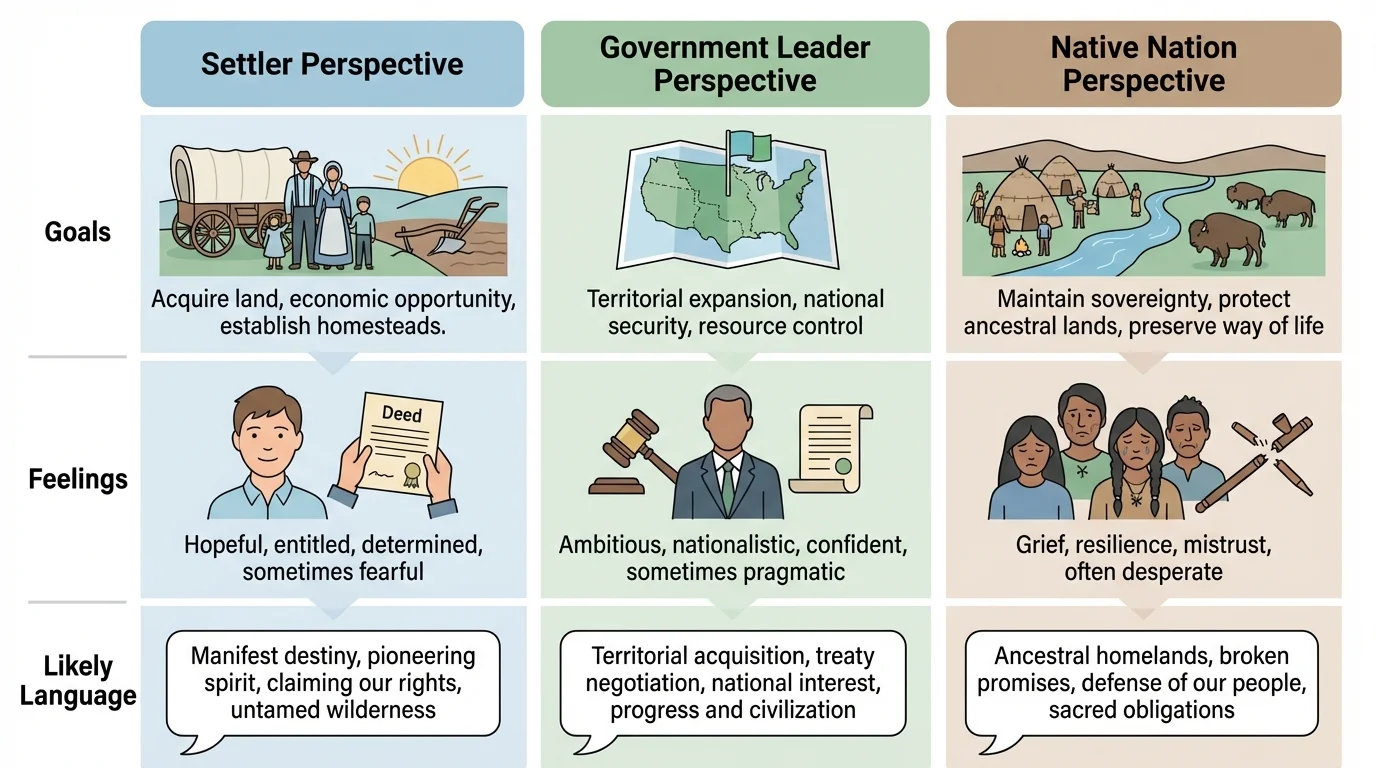
When historians compare sources about westward expansion, the same movement can be described with very different goals, emotions, and word choices depending on whether the speaker is a settler, a government leader, or a Native nation.
A settler diary might describe fertile land, family dreams, and difficult travel. A speech by a government leader might focus on national growth and control of territory. A Native leader's statement might describe loss of homeland, broken promises, and threats to culture. If we read only one of these, our understanding is incomplete.
Now think back to the Boston Tea Party. If we read only a patriot source, we may see heroism. If we read only a British report, we may see lawbreaking. Looking at both sources together helps us understand why the conflict grew. The point is not to flatten all differences. The point is to understand why those differences existed.
Later, when we return to examples like the ones compared in [Figure 3], we can ask stronger questions: Who had power? Who was affected most? Who got to tell the story at the time, and who had to wait for others to listen? Those questions help turn history from a list of dates into an investigation of human experiences.
Recognizing historical context gives us a better way to read the past. It helps us see that sources are shaped by real people living through real events. Once we learn to look for context, we do not just gather information. We begin to understand why people in history thought, argued, celebrated, feared, and hoped the way they did.
