What if a single piece of paper could start an argument across an ocean, change where people were allowed to live, or help create a whole new country? In early American history, documents did exactly that. Laws, declarations, constitutions, and treaties were not just words on a page. They affected land, power, freedom, trade, and daily life. By studying these documents, we can see how people in the past made decisions and why those decisions still matter today.
Historians learn about the past by reading sources carefully. A primary source is something made during the time being studied, such as a law, treaty, diary, letter, map, or speech. A secondary source is made later by someone explaining or studying the past, such as a textbook, article, or documentary. Both are useful, but they do different jobs. Primary sources give us direct clues from the time. Secondary sources help organize and explain those clues.
Point of view means the way a person or group sees an event. In history, point of view matters because people's experiences, goals, and beliefs shape what they say and write.
Treaty means a formal agreement between nations or groups. Treaties often involve land, peace, trade, or promises about how people will live together.
When we examine historical documents, we should ask questions. Who wrote this? Why was it written? Who benefited from it? Who may have been harmed by it? What was happening at the time? These questions help us notice that one document can mean very different things to different people.
Historical documents are important because they capture decisions people made at key moments. Some documents created rules. Some protested unfair treatment. Some announced independence. Some tried to build peace. Reading them helps us understand not only what happened, but also how people argued about what was fair, legal, or right.
For example, a British official, a colonial merchant, and an Indigenous leader might all describe the same event in very different ways. None of those voices should be ignored. A stronger understanding of history comes from comparing many sources, not from listening to only one side.
Earlier in history, European nations competed for land and trade in North America. Indigenous Nations already lived across the continent and had their own governments, cultures, and alliances long before Europeans arrived.
This background is important because the documents in early United States history did not appear out of nowhere. They were shaped by war, trade, settlement, and conflicts over land and power.
After the Seven Years' War, Britain gained more land in North America. The Proclamation of 1763, as [Figure 1] shows, established a boundary line that said colonists should not settle west of the Appalachian Mountains. Britain hoped this would lower conflict between colonists and Indigenous Nations and make western lands easier for Britain to control.
From Britain's point of view, this policy was practical. War had been expensive, and British leaders wanted stability. They believed that slowing settlement might prevent more fighting. But many colonists were angry. Some had hoped to move west after the war. Others had bought land claims or wanted new farmland.
Indigenous Nations had their own point of view, which was often very different from the colonists' view. Many Indigenous communities wanted to protect their homelands from settlement and invasion. To them, the issue was not simply where colonists could go. It was about survival, sovereignty, and keeping control of their lands. The proclamation did not fully protect Indigenous lands, but it did show that Britain understood western settlement could cause serious conflict.
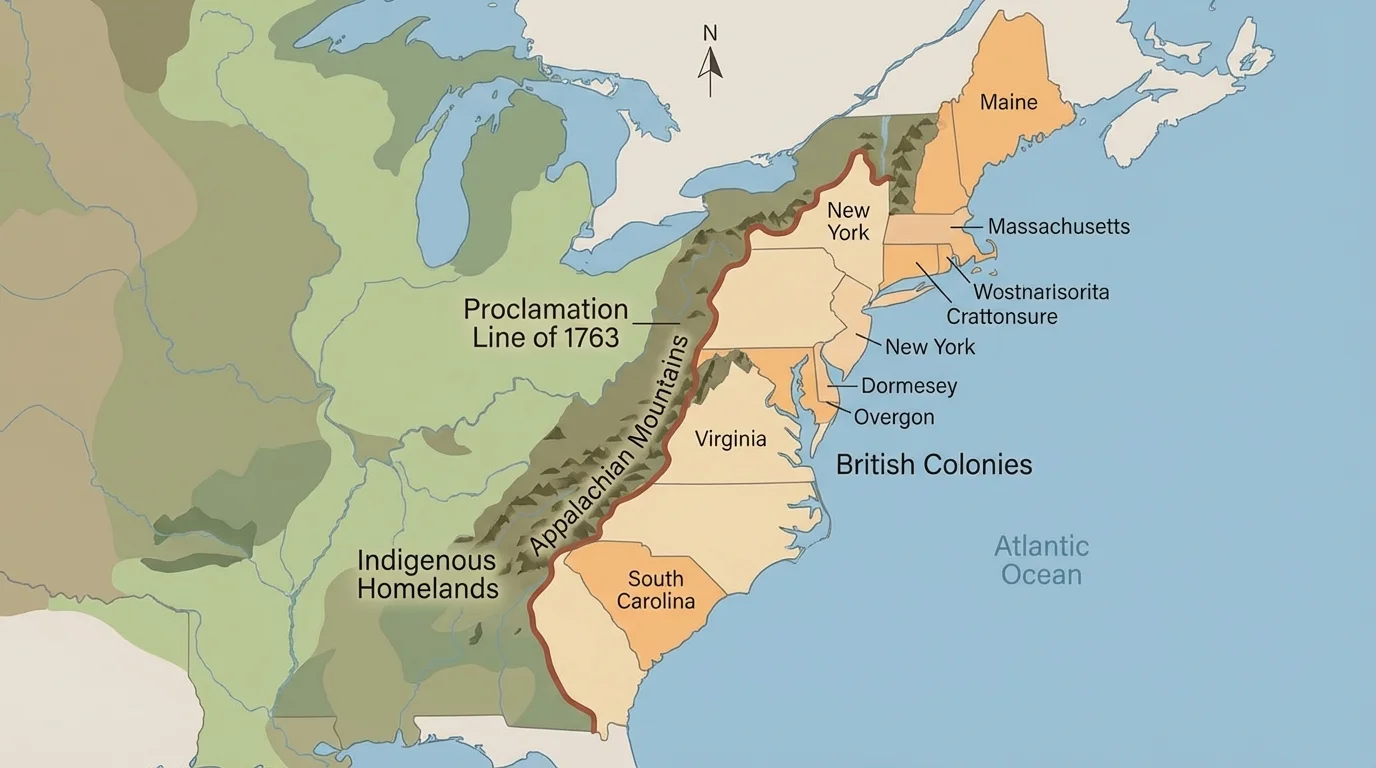
The Proclamation of 1763 is a good example of why historians compare viewpoints. A colonist might describe it as unfair interference. A British official might call it necessary order. An Indigenous leader might see it as incomplete protection against continued land loss. The same policy meant different things to different people.
Reading the Proclamation from three viewpoints
Step 1: Look at the British goal.
Britain wanted to reduce conflict and control its new territory after war.
Step 2: Look at the colonial reaction.
Many colonists felt blocked from land they expected to settle.
Step 3: Look at Indigenous concerns.
Indigenous Nations were defending homelands and political independence.
Looking at all three views gives a fuller and fairer understanding.
Later arguments between Britain and the colonies grew stronger partly because colonists felt that British leaders were making major decisions without understanding colonial needs.
In 1765, Britain passed the Stamp Act. This law required many printed materials in the colonies, such as newspapers, pamphlets, and legal papers, to carry an official stamp showing that a tax had been paid. Britain wanted money to help pay debts from war and the cost of keeping soldiers in North America.
British leaders thought the tax was reasonable. They argued that the colonies benefited from British protection, so colonists should help pay. But many colonists strongly disagreed. They protested that they had no representatives in Parliament. This complaint became famous as taxation without representation.
The Stamp Act mattered not only because of the money involved, but because it raised a bigger question: who had the right to make laws for the colonies? Colonial newspapers, speeches, and meetings spread resistance. Merchants boycotted British goods. Protest groups formed. Eventually, Britain repealed the tax, but trust had already been damaged.
Primary sources from this time include printed stamps, protest pamphlets, newspaper essays, and letters. A historian can compare those with secondary sources to understand both the facts and the feelings of the time. Reading only British government records would miss the anger in the colonies. Reading only colonial protests would miss Britain's financial and political reasons.
Printed paper was a big part of everyday life in the colonies, so the Stamp Act touched many people. That helped turn a tax into a major political fight.
The Stamp Act shows how a document can be more than a rule. It can become a symbol of power, fairness, and rights.
By 1776, many colonists believed their relationship with Britain had broken down too far to repair. The Declaration of Independence, as [Figure 2] shows in the larger timeline of rising conflict, grew out of years of disputes over taxes, laws, protests, and violence. Drafted primarily by Thomas Jefferson and approved by the Continental Congress, the Declaration announced that the colonies were now independent states.
This document had several important purposes. It explained why the colonies were separating from Britain. It listed complaints against King George III. It also stated powerful ideas about government and rights. One famous idea is that governments get their power from the consent of the governed. Another is that people have rights that should not be taken away.
The Declaration became one of the most famous documents in world history because of its language about equality and rights. Yet historians also ask an important question: who was included in those promises? At the time, many people were left out of full freedom and equality, including enslaved Africans, many women, and Indigenous peoples. This does not make the document unimportant, but it does mean we should read it carefully and honestly.
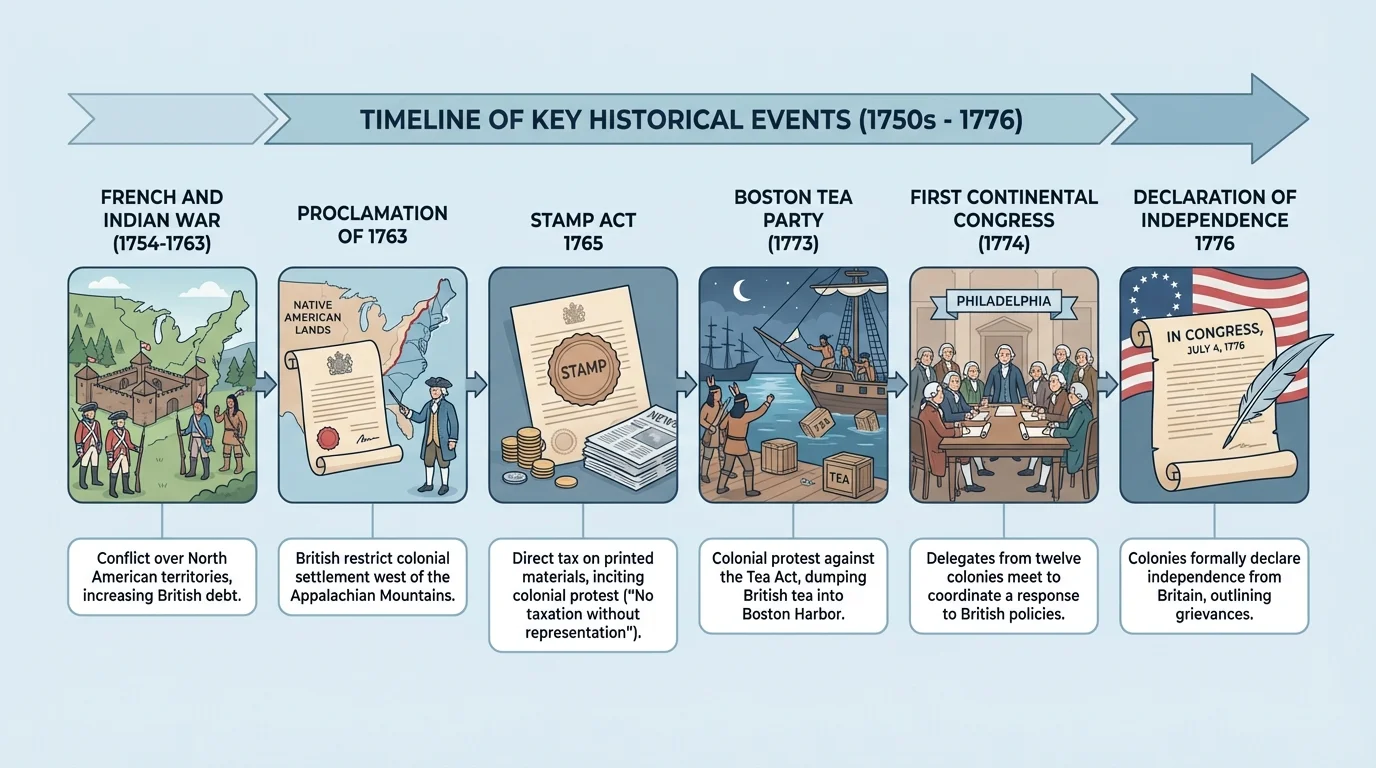
From the patriot point of view, the Declaration was a brave statement of liberty. From the British point of view, it was rebellion. For many Indigenous Nations, the conflict between Britain and the colonies created danger and uncertainty, because whichever side won might threaten Indigenous lands. Some Indigenous groups chose alliances based on survival, strategy, and local conditions.
"Governments are instituted among Men, deriving their just powers from the consent of the governed."
— Declaration of Independence
That line became deeply influential, but historians compare it with what was really happening in 1776. Studying both ideals and reality helps us understand history more completely. The Declaration did not appear suddenly; it was part of a chain of events that pushed the colonies toward independence.
After independence, the new nation needed a stronger government. As [Figure 3] shows, the Constitution created a new plan for governing the United States and divided power among three branches so that no one part would become too powerful. This document replaced the weaker Articles of Confederation.
The Constitution set up the legislative branch to make laws, the executive branch to carry out laws, and the judicial branch to interpret laws. This system is often called checks and balances because each branch can limit the others in certain ways.
At the Constitutional Convention, delegates debated many issues. States argued about representation. Large states and small states wanted different plans. There were also serious compromises over slavery, even though those compromises were unjust and harmful. The Constitution helped build a national government, but it did not solve every problem.
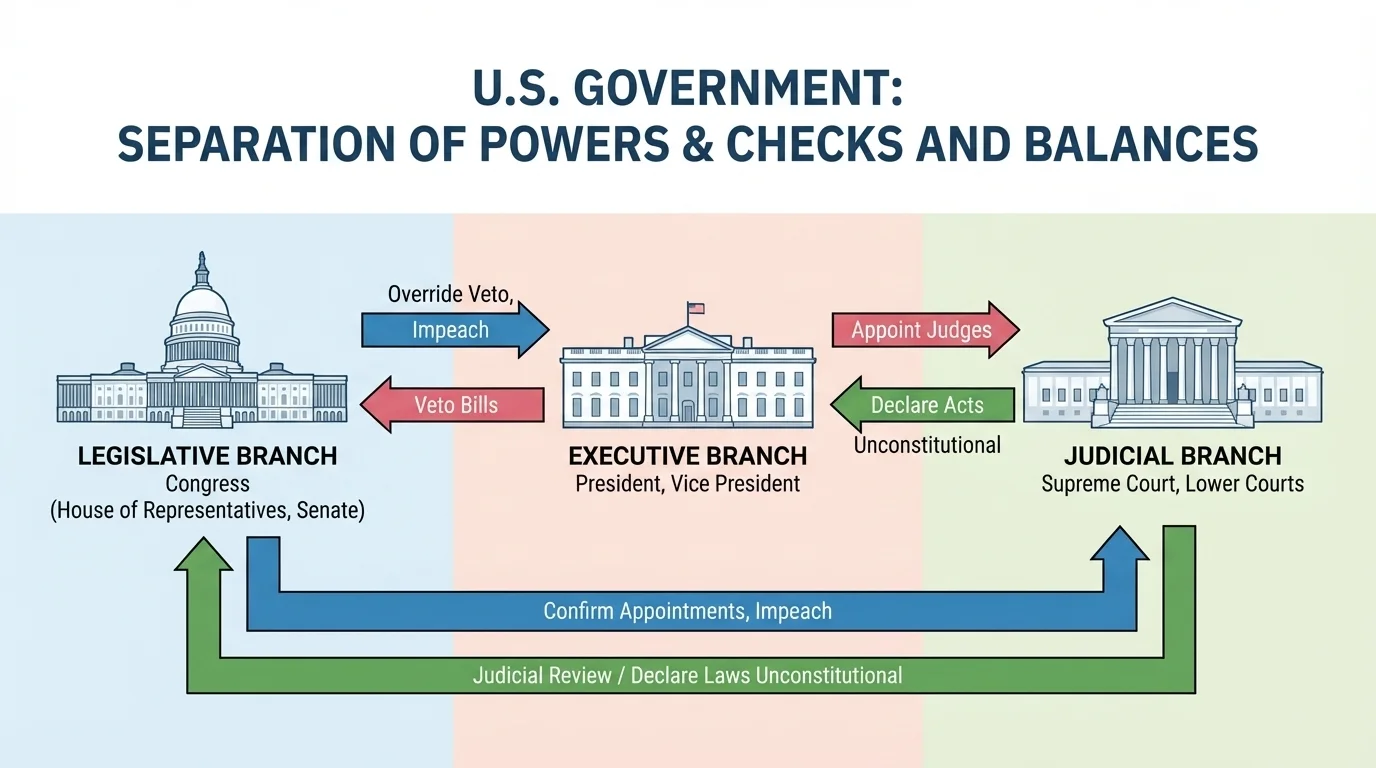
People also disagreed about whether the Constitution should be approved. Supporters, called Federalists, argued that a stronger central government was necessary. Opponents, called Anti-Federalists, worried that the government might become too powerful and threaten individual freedoms. These debates led to the Bill of Rights, which added protections for certain rights.
The Constitution is both a primary source from the nation's founding and a living document that still shapes government today. Historians study it along with letters, convention notes, newspaper essays, and later interpretations. Looking only at the final document would hide the intense disagreements behind it. Looking at those debates shows that the nation's government was built through argument and compromise.
Why the Constitution matters
The Constitution does more than list rules. It organizes power. It explains who can make decisions, how leaders are chosen, and how laws can change. It also shows that building a government involves difficult choices and competing ideas.
When students learn about government today, they are still seeing the effects of this document. The three-branch system remains a basic part of how the United States works.
Not all important historical documents were written only by colonial or United States leaders. Treaties with Indigenous Nations are also essential. The Two Row Wampum Treaty is one important example. As [Figure 4] shows, it is connected to an agreement between the Haudenosaunee and the Dutch in the early 1600s, and its belt symbolism represents two peoples traveling side by side in peace without trying to control one another.
The belt is often described as having two parallel purple rows on a white background. One row stands for the Indigenous canoe. The other stands for the European ship. The rows travel alongside each other on the river of life. The meaning is powerful: each group keeps its own laws, beliefs, and ways of living, while respecting the other.
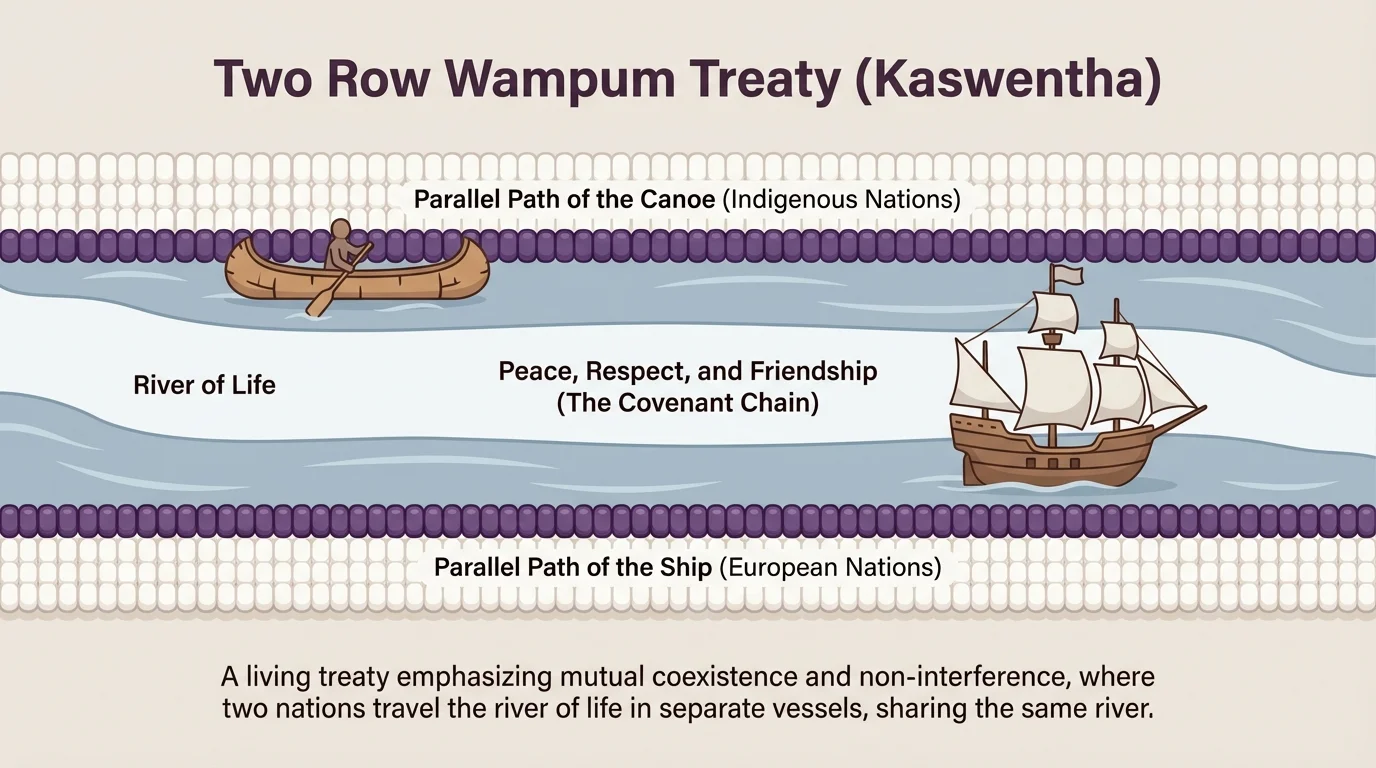
This treaty helps students understand that Indigenous Nations had their own diplomacy, political traditions, and international relationships. They were not simply background figures in early American history. They were active decision-makers who negotiated, defended land, and formed alliances.
Treaties are especially important because they are promises. Historians ask whether those promises were honored. In many cases, Indigenous Nations experienced broken treaties, land loss, and unfair treatment. That is one reason treaty history still matters today. It is not only about the past; it also connects to present-day discussions of rights, land, and sovereignty.
Understanding the Two Row Wampum Treaty
Step 1: Notice the two parallel rows.
The rows do not cross or crash into one another. This shows separate paths.
Step 2: Connect the symbols to meaning.
The canoe and the ship represent different peoples with different governments and traditions.
Step 3: Think about respect.
The agreement is about living in peace without one group ruling the other.
This is why treaty belts can be important historical sources as well as powerful symbols of meaning and memory.
The lesson of the treaty goes beyond one agreement. Peaceful relationships depend on mutual respect, not domination.
One of the most important skills in history is comparing perspectives. The Proclamation of 1763, the Stamp Act, the Declaration of Independence, the Constitution, and Indigenous treaties all look different depending on who is reading them. A law that seems helpful to one group may feel unfair to another. A declaration of freedom may leave some people out. A treaty may promise peace but later be ignored.
| Document | Main Purpose | One British View | One Colonial View | One Indigenous View |
|---|---|---|---|---|
| Proclamation of 1763 | Limit westward settlement | Keep order after war | Blocked opportunity | Partial protection of homelands |
| Stamp Act | Raise money through taxes | Fair way to pay war costs | Unfair taxation | Part of growing colonial-British conflict |
| Declaration of Independence | Announce separation from Britain | Rebellion | Liberty and self-rule | New risks and changing alliances |
| Constitution | Create national government | Britain was no longer in control | Needed stronger government | U.S. growth could threaten Indigenous lands |
| Two Row Wampum Treaty | Respectful coexistence | Agreement for relations and trade | Often not central in colonial memory | Statement of sovereignty and mutual respect |
Table 1. Comparison of major documents and how different groups may have understood them.
This comparison shows why history is not just memorizing dates. It is studying evidence and asking whose voice is being heard and whose voice may be missing.
Historians build understanding by combining many kinds of evidence. They may read a document itself, look at maps, study artwork, examine treaty belts, compare speeches, or read later books by historians. When several sources support the same idea, our understanding becomes stronger. When sources disagree, historians investigate why.
For example, if a textbook says colonists were united against the Stamp Act, a historian might test that statement by reading colonial newspapers, merchant letters, and government records. The evidence might show that many colonists protested, but not all for the same reasons. Some cared most about money. Others cared most about political rights. That makes the story more accurate.
Some historical documents became famous right away, but others gained meaning over time as later generations returned to them and argued about what they meant.
Studying major documents from early United States history helps us see how the nation developed through conflict, ideals, and negotiation. It also reminds us that history includes many voices. When we examine sources from multiple points of view, we move closer to the real complexity of the past.
