North America has been home to people for thousands of years longer than the United States has existed. That means if you made a giant timeline across a school hallway, the part showing the United States would take up only a small section at the end. To understand this history well, we need to look at a very long story that begins with the Indigenous Peoples of North America and continues through exploration, colonization, independence, and the building of a new government.
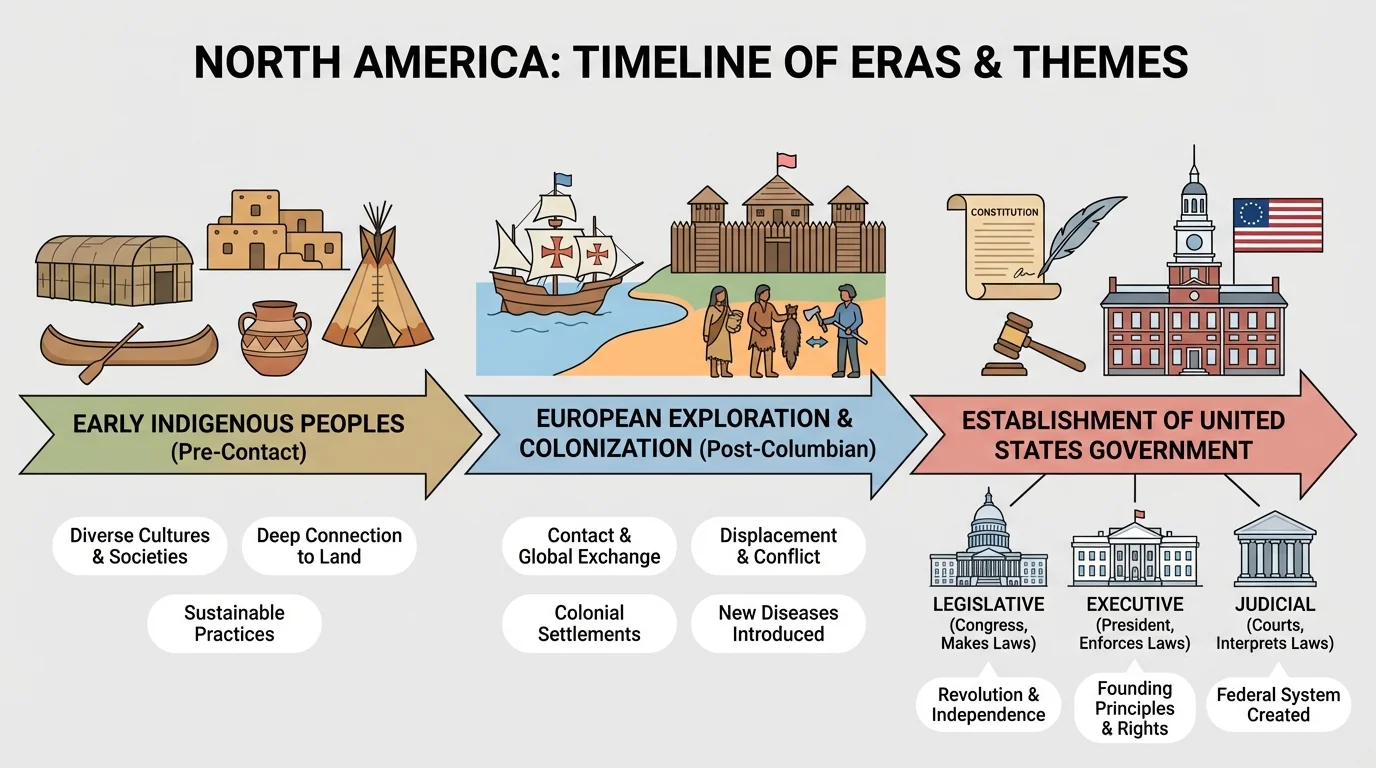
[Figure 1] Historians use a timeline to put events in order and to notice patterns over time. A timeline helps us answer questions such as: What happened first? What changed? What stayed the same? Which events happened close together, and which were separated by hundreds or thousands of years?
When we study North America, we can divide the past into eras, or long periods of time that share important features. For example, one era focuses on early Indigenous societies. Another centers on European exploration. Later eras include colonization, the American Revolution, and the creation of the United States government.
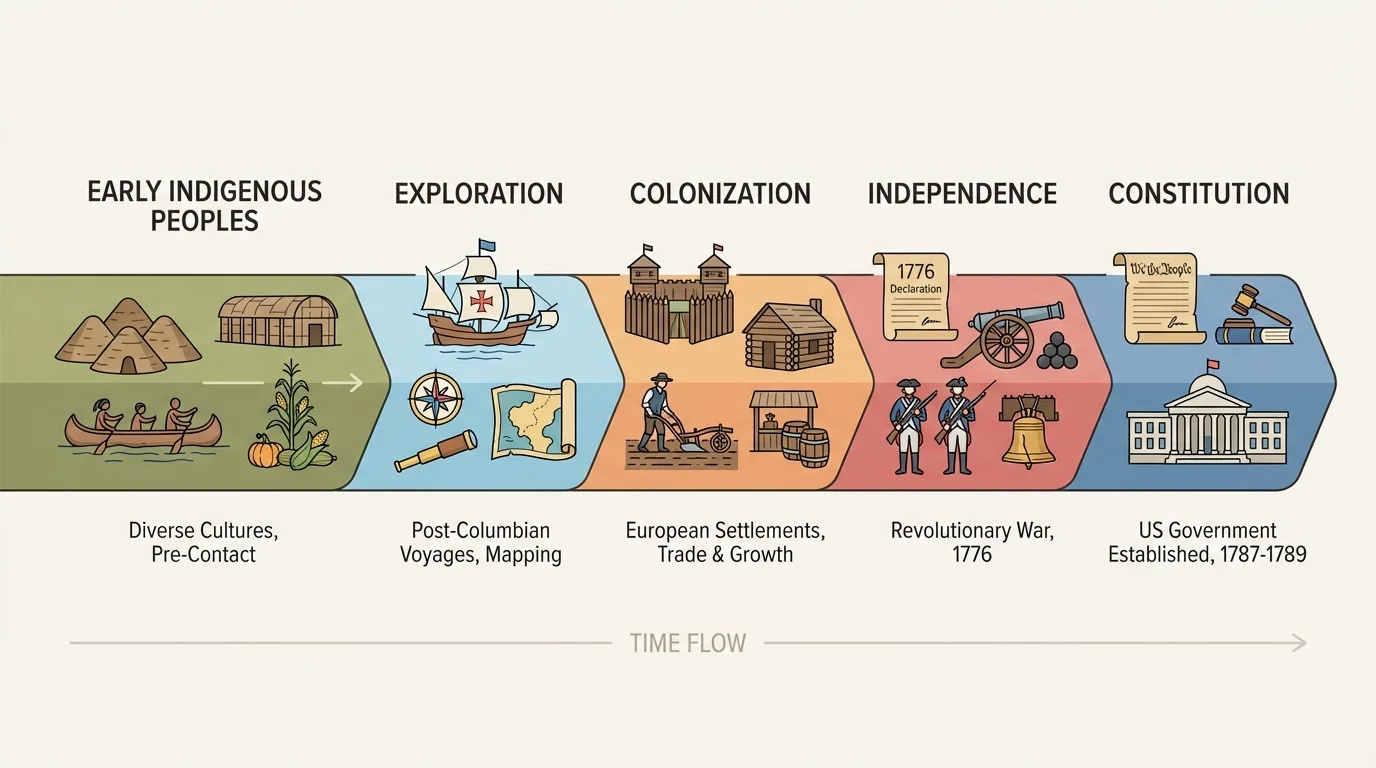
Timelines also help us study themes. A theme is a big idea that appears again and again. In this topic, important themes include movement, trade, cultural exchange, conflict, cooperation, and government. These themes connect events that happened in different places and at different times.
Primary source is a source created by a person who lived during the time being studied, such as a letter, map, diary, law, speech, tool, or artwork.
Secondary source is a source created later by someone studying the past, such as a textbook, article, documentary, or biography.
When you read history, it is important to ask who made the source, when it was made, and whose voice is missing. A Spanish explorer, an English colonist, and an Indigenous leader might describe the same event in very different ways. Looking at more than one point of view helps us build a fuller understanding.
Long before European ships crossed the Atlantic Ocean, people were living in North America. Scientists and historians use evidence from archaeology, oral histories, and artifacts to learn about these early communities. Indigenous nations developed ways of life that fit their environments, from icy Arctic lands to forests, deserts, rivers, and grasslands.
These early people were not all the same. They spoke different languages, built different homes, found food in different ways, and formed many nations and cultures. Some hunted large animals, others fished, others farmed, and many did a combination of these. Over time, communities created traditions, governments, trade systems, and spiritual beliefs.
Remember that history is not only about famous dates. It is also about how people lived every day, how they used resources, and how communities changed over time.
One important idea is that Indigenous history did not begin when Europeans arrived. Indigenous nations already had long histories. They had trade networks, knowledge of the land, and social systems that had grown over many generations.
North America includes many environments, and that is one reason Indigenous cultures were so diverse. People living in the Arctic adapted to freezing temperatures. People in the Southwest developed farming methods for dry lands. Nations in the Eastern Woodlands lived near forests and rivers, while Plains peoples lived on wide grasslands.
In the Arctic, peoples such as the Inuit adapted to cold climates by hunting sea animals and using snow, skin, and bone for shelter, clothing, and tools. In the Northwest Coast, abundant fish and forests supported communities known for woodworking, canoes, and rich artistic traditions.
On the Great Plains, many groups depended on the bison for food, clothing, shelter, and tools. In the Eastern Woodlands, nations such as the Haudenosaunee, also called the Iroquois Confederacy, formed powerful alliances and practiced farming, hunting, and trade. In the Southwest, Pueblo peoples built villages and used irrigation to grow crops. In the Southeast, Mississippian cultures built large earth mounds and complex towns.
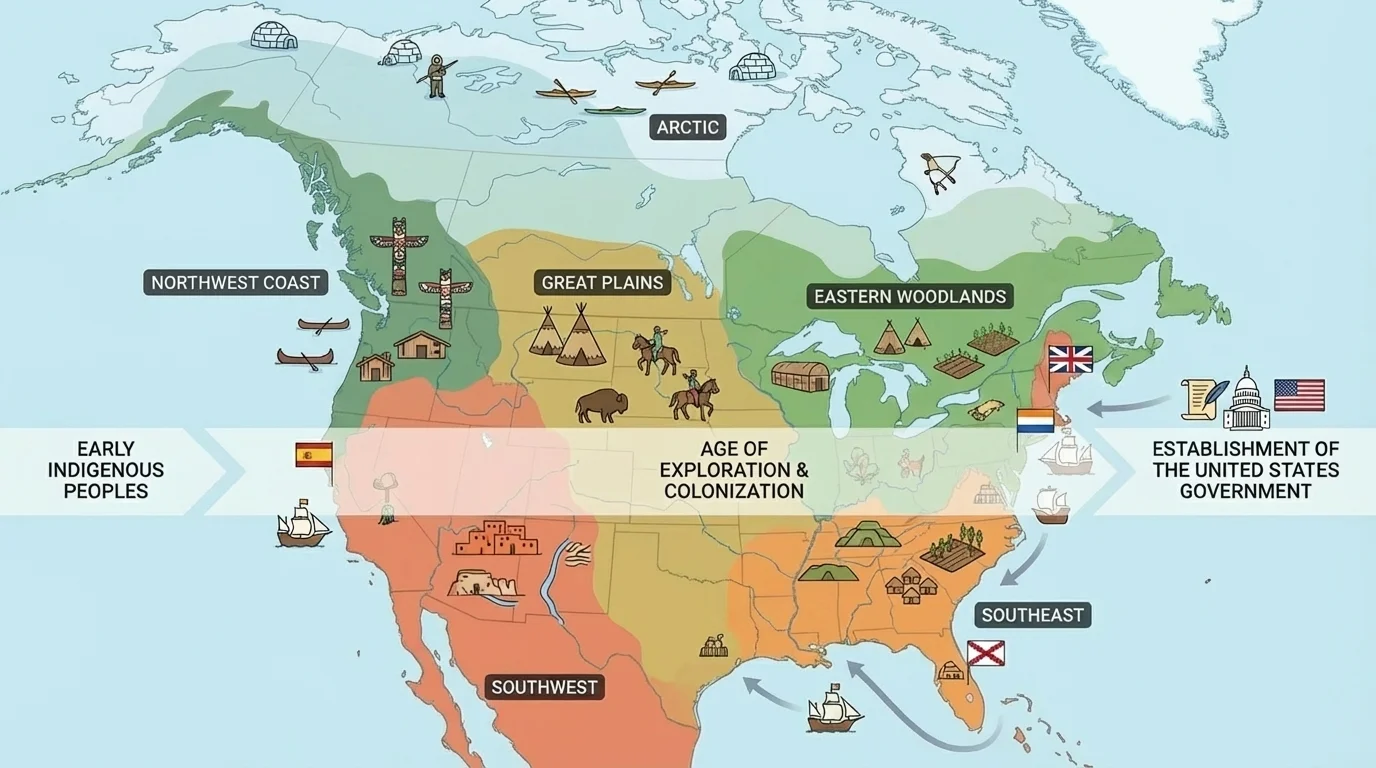
These regional examples show that there was no single "Indigenous culture." Instead, there were many cultures, nations, and languages. That matters when reading history because general statements can hide important differences.
Archaeologists have studied sites like Cahokia, a large Mississippian city near the Mississippi River. Cahokia had mounds, trade, organized labor, and a large population. This reminds us that complex societies existed in North America before European colonization.
Corn, also called maize, was first developed in the Americas and later became one of the world's most important foods.
When we place these societies on a timeline, we can see that many Indigenous nations rose, changed, traded, and governed long before the year 1492. That date is important, but it is not the beginning of North American history.
To understand early American history, historians compare sources. A carved tool or pottery piece can act like a clue from the past. Oral traditions passed down in Indigenous communities are also important sources of knowledge. European journals, maps, and letters offer information too, but they often reflect European goals and opinions.
Suppose a colonist writes that land was "empty." A historian should question that claim. Was the land truly empty, or did the writer ignore the people already living there? This is why point of view matters. Sources can include facts, but they can also include bias.
How point of view changes history
The same event can look very different depending on who is speaking. A European sailor might describe a landing as a discovery. An Indigenous community might describe the same moment as the arrival of strangers. Studying both views helps students understand that history is not just a list of events; it is also a record of human experiences.
A primary source from a ship captain may tell what he saw on a voyage, but it may leave out what local people thought. A secondary source written by a modern historian may compare many kinds of evidence and explain the larger picture. Both can be useful when read carefully.
[Figure 3] During the late 1400s and 1500s, European countries sent ships across the oceans. People often summarize the reasons for exploration as gold, glory, and God: the search for wealth, national pride, and the spread of Christianity. New navigation tools, improved ships, and growing competition between kingdoms also encouraged exploration.
Christopher Columbus sailed for Spain in 1492, hoping to reach Asia by traveling west across the Atlantic. Instead, he reached islands in the Caribbean. Although Columbus did not land in what is now the continental United States, his voyage connected Europe and the Americas in a powerful new way.
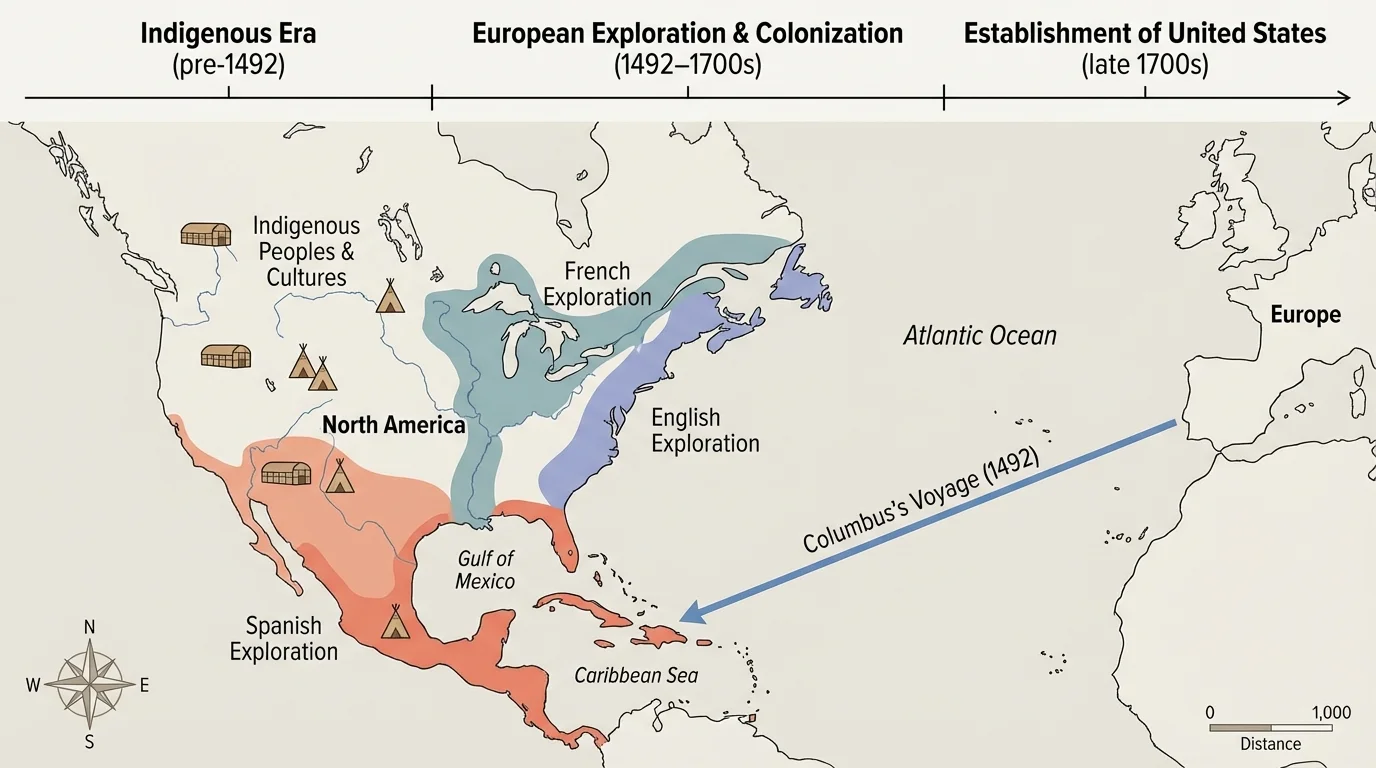
Other explorers followed. Juan Ponce de León explored in Florida for Spain. Hernando de Soto traveled through parts of the Southeast. Jacques Cartier explored for France in the St. Lawrence River region. Samuel de Champlain later helped establish New France. John Cabot sailed for England. Each voyage added to European maps and ambitions.
From a European point of view, these journeys were exciting chances for trade and empire. From many Indigenous points of view, they brought uncertainty, new trade partners, missionaries, soldiers, settlers, and diseases. The meaning of "exploration" depended greatly on who was telling the story.
"We must consider not only who arrived, but who was already there."
As we saw earlier in [Figure 1], exploration belongs in the middle of the larger story, not at the beginning. Indigenous peoples had already lived in North America for thousands of years before European explorers crossed the Atlantic.
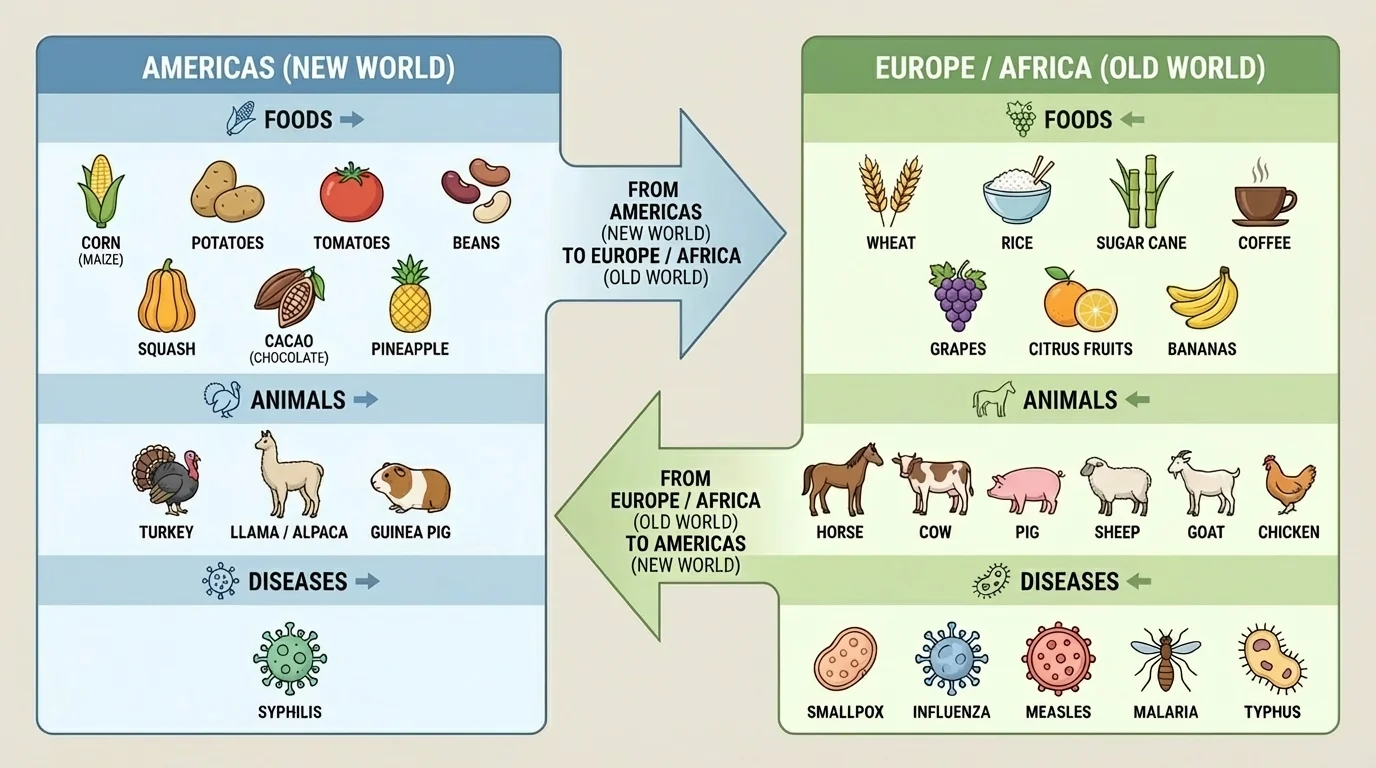
After contact between Europe and the Americas increased, plants, animals, ideas, and diseases moved between the Eastern and Western Hemispheres in what historians call the Columbian Exchange. This exchange changed diets, farming, transportation, population, and daily life on both sides of the ocean.
[Figure 4] From the Americas, Europeans, Africans, and Asians received crops such as corn, potatoes, tomatoes, cacao, and peppers, as shown in the chart. From Europe, Africa, and Asia, the Americas received horses, cattle, pigs, wheat, and other goods. But disease had one of the biggest effects. Smallpox and other illnesses killed large numbers of Indigenous people, who had no immunity to them.
European nations also began building colonies. A colony is a settlement ruled by another country. Spain built colonies in places such as Florida, the Southwest, Mexico, and parts of South America. France built settlements in Canada and along rivers important for trade. England established colonies along the Atlantic coast. The Dutch created New Netherland.
| European Power | Main Areas in North America | Main Goals |
|---|---|---|
| Spain | Florida, Southwest, Mexico | Empire, missions, wealth |
| France | Canada, Great Lakes, Mississippi region | Fur trade, alliances, empire |
| England | Atlantic coast colonies | Settlement, trade, farming, self-government |
| Netherlands | New Netherland | Trade and commerce |
Table 1. Major European powers in North America, where they settled, and their main goals.
Colonization brought major change. Forests were cleared, forts were built, and new laws were made. Enslaved Africans were forced across the Atlantic in terrible conditions, adding another painful part of this history. Colonization reshaped North America through settlement, labor systems, and control of land.
Contact between peoples did not lead only to fighting. There was also trade, cooperation, and cultural exchange. Indigenous nations traded furs, food, and local knowledge. Europeans traded metal tools, cloth, and weapons. Some groups became allies for military reasons. Others married across cultures or learned each other's languages.
At the same time, conflict over land and power increased. Mission systems tried to convert Indigenous peoples to Christianity and often forced changes in culture and labor. Colonists claimed land that Indigenous communities already used and valued. Resistance took many forms, from negotiation to organized warfare.
Case study: Jamestown and Powhatan peoples
Step 1: English settlers arrived at Jamestown in 1607.
They hoped to build a lasting colony and find wealth.
Step 2: The settlers depended on local help.
The Powhatan peoples knew the land, local foods, and travel routes.
Step 3: Relations changed over time.
There were moments of trade and cooperation, but also mistrust, competition, and violence.
This example shows that early encounters were complicated. They cannot be described accurately with only one word like "friendly" or "hostile."
The regional map in [Figure 2] helps explain why colonization looked different in different places. Europeans met many different Indigenous nations, not one single group, so events in Florida, New France, New England, and the Southwest often unfolded in different ways.
Over time, England's Atlantic coast colonies grew into the Thirteen Colonies. These colonies developed local assemblies and habits of self-government, even while remaining under British rule. Colonists were still connected to Britain by trade, law, and culture.
After the French and Indian War, Britain tried to raise money by taxing the colonies. Many colonists argued that taxes without representation were unfair. Tensions grew through events such as the Stamp Act, the Boston Massacre, and the Boston Tea Party.
In 1776, colonial leaders approved the Declaration of Independence. This document announced that the colonies were separating from Britain. It stated ideas about natural rights and government by consent. However, those ideals were not fully applied to everyone. Enslaved people, women, and many others did not enjoy equal rights.
Big theme: ideals and reality
One important theme in United States history is the difference between what documents say and what life was actually like. The Declaration spoke of liberty and equality, but many people were still denied freedom and political power. Historians study this gap carefully.
The American Revolution was both a war and a debate about government. Patriots wanted independence. Loyalists wanted to remain with Britain. Native nations made choices based on their own interests and survival, and those choices did not always match colonial goals. Again, more than one point of view matters.
After independence, the new nation first used the Articles of Confederation, a plan of government that was too weak to solve many national problems. Leaders then wrote the Constitution, which created a stronger national government with shared powers. This was a major turning point at the end of the timeline we are studying.
[Figure 5] The Constitution set up three branches of government. The legislative branch makes laws. The executive branch carries out laws. The judicial branch interprets laws. This system was designed so that no one branch would become too powerful.
The first ten amendments, called the Bill of Rights, were added to protect individual freedoms. These included freedom of speech, freedom of religion, and other protections. Even so, many rights were still limited in practice for different groups of people.
George Washington became the first president. The new government began putting the Constitution into action. This did not end political disagreement. Americans continued debating how much power the national government should have and who should fully participate in political life.
The Constitution written in 1787 is still the foundation of the United States government today, although it has been changed by amendments over time.
The branch diagram in [Figure 5] helps show that the formation of a government is not just one event on a timeline. It is also the start of a system that continues to shape the country.
Now we can place the major eras in order. First came the long history of Indigenous peoples in North America. Next came European exploration. After that came colonization and expanding contact among Indigenous peoples, Europeans, and Africans. Then came the movement toward independence, followed by the creation of the United States government.
Each era connects to major themes. Movement includes migration, exploration, and forced migration through slavery. Exchange includes trade, shared knowledge, and the Columbian Exchange. Conflict and cooperation appear in alliances, wars, missions, and daily interactions. Government appears in Indigenous political systems, colonial assemblies, and the Constitution.
The exchange chart in [Figure 4] reminds us that history is not only about battles and leaders. It is also about crops, animals, germs, and ideas that changed how people lived. Likewise, the broad era line in [Figure 1] shows that early U.S. history makes the most sense when we see the full story, not just one short part of it.
When historians study this timeline, they do more than memorize dates. They compare sources, ask whose voices are included, and look for patterns that explain how North America changed over time. That is how we build a deeper understanding of early United States history.
