If you wanted oranges in a cold northern colony, you could not just walk outside and pick them. If you needed a metal pot, but your community made only clay pottery, you had to get that pot from somewhere else. Early America grew through these exchanges. People traded food, tools, cloth, animals, and even skills. Trade helped people survive, but it also changed relationships, built cities, and created both opportunity and injustice.
Trade is the exchange of things people want or need. Sometimes people exchanged objects, such as corn for fish. Other times they exchanged work, such as repairing a wagon in return for food or money. Trade happens because different people and places have different resources, skills, and needs.
In Early America, not every region had the same climate, soil, forests, rivers, or materials. Some places were rich in fish and timber. Others grew tobacco or rice. Some communities were skilled at making pottery, tools, or woven cloth. Because of these differences, trade became an important part of everyday life.
Goods are items people make, grow, or use, such as food, clothing, tools, and wood.
Services are jobs or work people do for others, such as shipping, repairing, building, translating, or guiding.
Trade is the exchange of goods or services.
Barter is trading without money, by exchanging one good or service for another.
Today, stores get products from many places around the world. In Early America, trade often worked in a more direct but still very important way. Communities depended on one another. A farmer might need a blacksmith. A coastal town might need wheat from inland farms. A ship captain might depend on sailors, dock workers, and merchants to move goods from one port to another.
Economics is the study of how people use resources to meet their needs and wants. In a trade system, people often specialize. That means they focus on making or doing what they are best at, then trade for other things they need. A fishing village could catch fish and trade with a farming village for grain. Both sides benefited.
Two useful trade words are import and export. An import is a good brought into a place. An export is a good sent out to another place. For example, a colony might export tobacco and import cloth or metal tools. These words help us understand the direction of trade.
Specialization and exchange
When a region has the right land, climate, or skills for one kind of product, it often makes more of that product than it needs. Then it trades the extra amount for other goods and services. This pattern helps economies grow because people do not have to produce everything by themselves.
Trade can be helpful, but it can also become unfair. If one group has more power, it may control prices, land, or labor. In Early America, some trade relationships were cooperative, but others were harmful and forced. Understanding trade means looking at both success and injustice.
Many groups took part in trade, and they formed a connected world through routes linking Native American communities, colonial towns, and overseas ports. Trade was not only between Europeans and colonists. Native American peoples had trading networks long before Europeans arrived. Later, European settlers joined these systems, and enslaved Africans were forced into the economy as part of a cruel labor system that supported trade.
Native American nations traded across large distances. They exchanged crops, shells, furs, copper, salt, and crafted items. European colonists traded with Native American groups for food, furs, and local knowledge. Colonists also traded with Europe, the Caribbean, and Africa. Merchants, farmers, sailors, artisans, and laborers all played important roles.
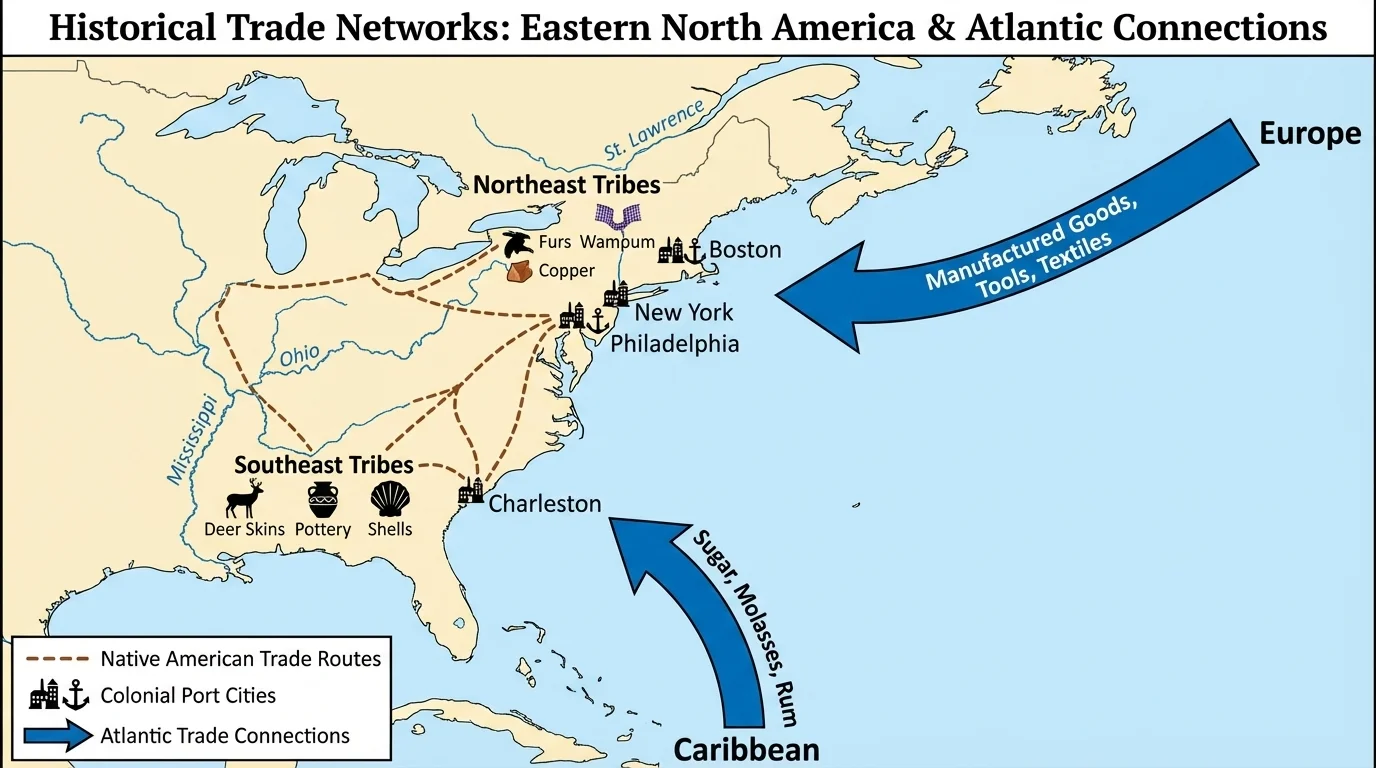
Trade connected people who lived very differently. A Native American hunter in the Great Lakes region, a farmer in Virginia, a merchant in Boston, and a shipbuilder in England might all be part of the same chain of exchange. This network helped goods move from forests and farms to docks, markets, and homes.
Some trade built friendships and alliances. Some brought competition over land and resources. As more colonists arrived, trade often became tied to conflict, broken promises, and loss for Native American peoples.
Different regions offered different products, and geography shaped what Native American peoples traded. Communities used the resources around them wisely and exchanged both everyday supplies and special items over short and long distances.
In the Northeast and Great Lakes regions, people traded furs, fish, maple sugar, and copper. Animal skins were especially important because they could be made into warm clothing and were also wanted by European traders. Along some coasts and waterways, shells were traded and used in belts and decorations. Wampum, made from shells, could be used in agreements and exchange.
In the Southeast, Native American groups traded crops such as corn, beans, and squash. These three crops are sometimes called the "Three Sisters" because they grow well together. They were a major food source. People also traded deerskins, baskets, and woven goods.
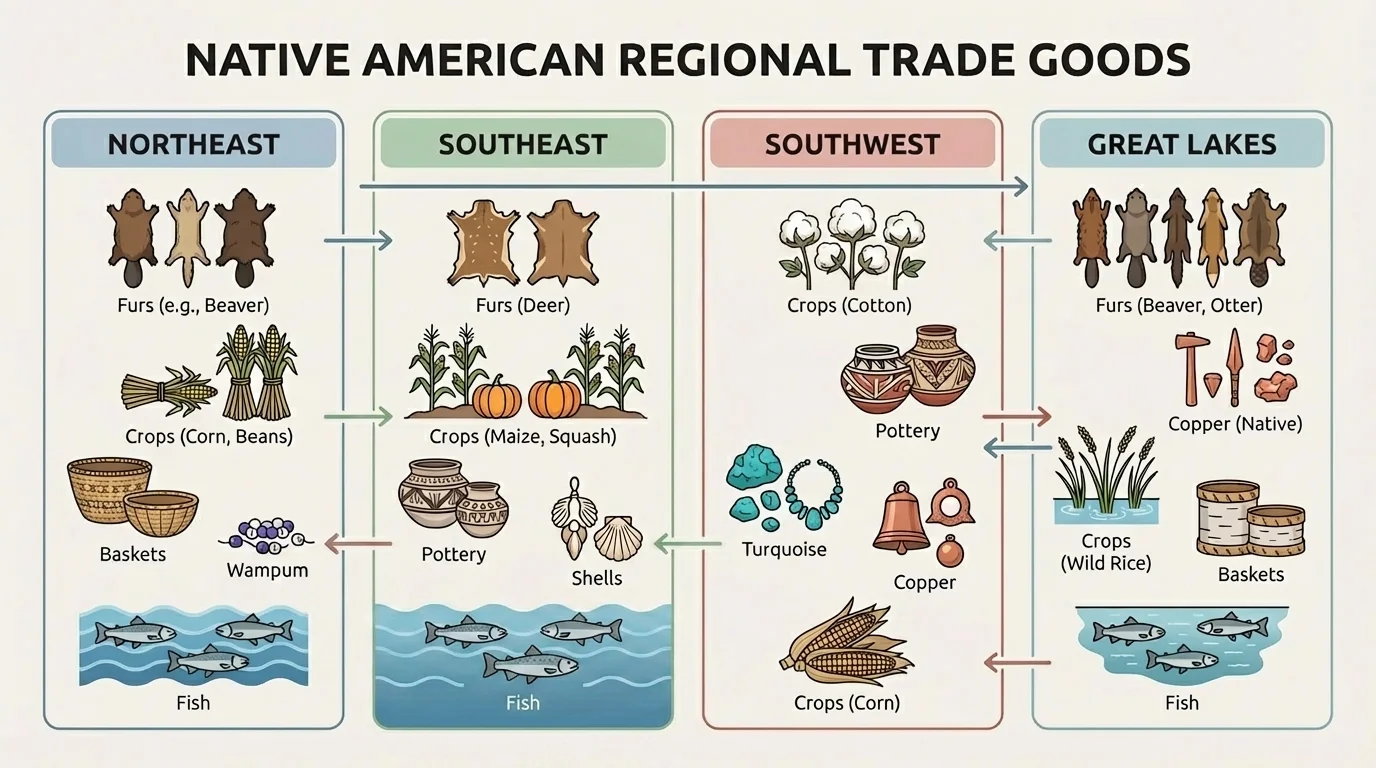
In the Southwest, communities traded pottery, woven textiles, turquoise, and food suited to dry lands. In areas near the Plains, people exchanged animal hides, meat, and horses later in history. Because environments differed, no one region had everything. Trade allowed communities to get what they lacked.
These exchanges were not random. They often followed regular routes and trusted relationships. Some traders became known for traveling long distances. Others met at trading centers where many groups came together. Looking again at regional patterns, it becomes clear that climate and natural resources strongly shaped the economy.
Long before European colonists built large port cities, Native American peoples already had extensive trade networks across North America. Some goods traveled hundreds of miles from where they were first gathered or made.
Native American trade involved more than objects. It also spread ideas, farming knowledge, artistic styles, and ways of making tools. Trade can move culture as well as materials.
When Europeans arrived, they brought new goods that many people in North America had not used before. These included metal knives, axes, kettles, cloth, needles, mirrors, guns, beads, and other manufactured items. Native American groups sometimes traded food, furs, or deerskins for these goods.
Metal tools changed daily life because they were strong and durable. Cloth could replace some animal-skin clothing. Glass beads were used in decoration and exchange. At the same time, European goods could increase dependence on colonial trade. If a community began relying on imported metal tools, it might need to keep trading for them.
European trade also connected the colonies to larger Atlantic markets. Colonists imported tea, sugar, molasses, books, furniture, and fine cloth. Wealthier families often bought goods made in Europe, while ordinary families might use both imported and local products.
Some colonial exports became very valuable. Tobacco from the Chesapeake region, rice and indigo from the Southern Colonies, and fish, timber, and ship parts from New England were all important. Wheat and flour from the Middle Colonies fed many people. Each region developed its own trade strengths.
Trade was not only about objects. A service is work done for someone else, and many services were necessary for Early America to function. A ship needed sailors to move goods. A port needed dock workers to load and unload cargo. Farmers needed millers to grind grain into flour.
Blacksmiths repaired tools, horseshoes, and farm equipment. Carpenters built houses, ships, barrels, and wagons. Coopers made barrels that held flour, fish, and liquids for shipping. Traders and interpreters helped people from different language groups communicate. Guides helped travelers and traders move through forests, rivers, and mountain paths.
Case study: How one barrel of flour reached another region
A simple food item could require many goods and services before it was traded.
Step 1: A farmer grew wheat in the Middle Colonies.
Step 2: A miller ground the wheat into flour.
Step 3: A cooper made a barrel to hold the flour.
Step 4: Teamsters or boat workers moved the barrel to a port.
Step 5: Sailors and merchants shipped and sold it in another colony or the Caribbean.
This example shows that trade depends on many kinds of work, not just on the final product.
Even financial work mattered. Merchants kept records, made agreements, and arranged shipments. It is important to know that organizing trade takes planning, trust, and communication.
[Figure 3] Trade followed pathways on land and sea, and routes connected the colonies with one another and with other parts of the Atlantic world. Rivers were like highways. Coastal shipping was often easier than traveling on rough inland roads. This helped make port cities very important.
New England exported fish, timber, and ships. The Middle Colonies exported wheat and flour. The Southern Colonies exported cash crops such as tobacco, rice, and indigo. These regional patterns developed because each area had different land, climate, and labor systems.
Trade also linked the colonies to the Caribbean and Europe. New England merchants sent fish, lumber, and other goods to the Caribbean. In return, they received molasses and sugar. Some goods then went to Europe, and European manufactured items came back to the colonies.
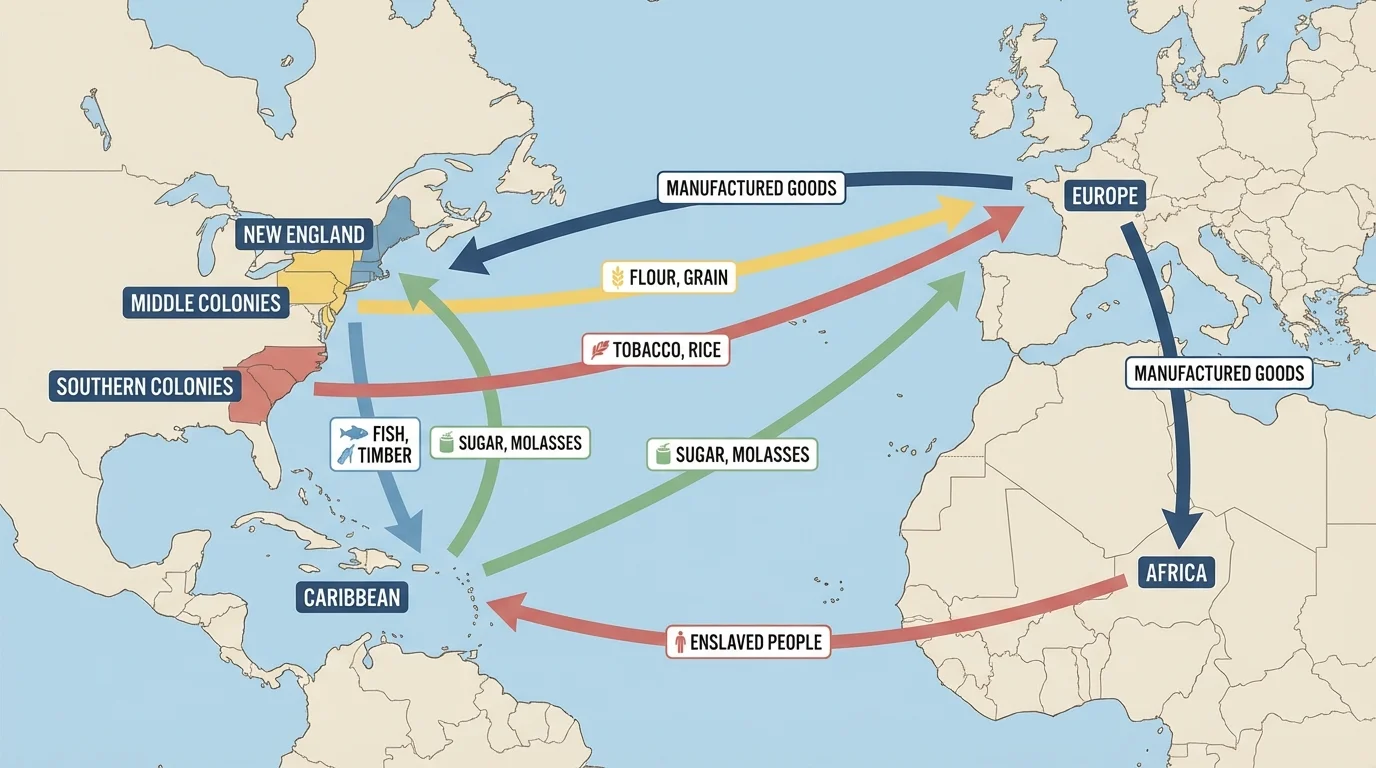
This ocean system is often described as triangular trade, though real trade routes were more complex than a single triangle. Ships did not all follow one exact path. Still, the idea helps students see that trade connected several regions in repeated patterns.
Port cities such as Boston, New York, Philadelphia, and Charleston grew because goods passed through them. Looking at route patterns, we can see why coastal locations mattered so much. Where goods moved, jobs, markets, and population often grew too.
| Region | Main Exports | Main Imports | Important Services |
|---|---|---|---|
| New England | Fish, timber, ships | Molasses, sugar, cloth | Shipbuilding, sailing, trading |
| Middle Colonies | Wheat, flour, livestock | Manufactured goods, tea | Milling, transport, selling |
| Southern Colonies | Tobacco, rice, indigo | Tools, cloth, furniture | Shipping, agricultural labor, storage |
Trade helped colonies grow by creating jobs, encouraging settlement, and connecting regions. If one colony produced extra food, it could sell or trade that food to places that needed it. If another colony had forests for shipbuilding, it could produce ships and wooden goods for trade. Over time, regions became more specialized.
This specialization led to economic growth. Merchants earned profits. Farmers expanded crops. Ports became busy centers. Roads, docks, warehouses, and markets were built to support exchange. Trade also encouraged communication between places and spread ideas, technology, and customs.
Trade as a force for change
Patterns of trade can shape where people live, what jobs they do, and which towns become powerful. In Early America, trade helped some places become rich and influential. It also increased competition for land and resources and supported unfair systems such as slavery.
One of the most important and painful truths about Early American trade is that enslaved Africans were forced into labor systems that produced valuable crops, especially in the Southern Colonies. Rice, tobacco, and other exports brought money to traders and plantation owners, but this wealth was built on cruelty and the denial of freedom. This was not fair trade. It was exploitation.
Trade with Native American peoples also changed over time. At first, some exchanges were mutually beneficial. Later, European expansion often damaged Native American economies and lands. Disease, war, and broken agreements weakened many Native communities.
One example is the fur trade. Native American hunters and traders supplied animal skins, especially beaver pelts. European traders wanted these furs to make hats and clothing. In return, Native American groups often received metal tools, cloth, and other manufactured goods. The fur trade connected inland forests to Atlantic markets.
Another example is food exchange. Native American peoples taught some colonists how to grow local crops such as corn and how to use regional resources. Colonists depended on this knowledge, especially in the early years when survival was difficult. Knowledge itself can be thought of as a valuable service or contribution.
Case study: New England and the Caribbean
Trade between regions often involved products that each place could not easily produce for itself.
Step 1: New England ships carried fish and lumber to Caribbean islands.
Step 2: Caribbean traders exchanged sugar and molasses.
Step 3: Some of those products were used in the colonies or sent to other markets.
This exchange shows how geography and climate shaped trade. Cold New England waters supported fishing, while warm Caribbean islands produced sugar crops.
A third example is intercolonial trade, or trade between colonies. Wheat from Pennsylvania could feed people in other colonies. Tobacco from Virginia could be shipped overseas. Fish from Massachusetts could be sold in the Caribbean. These repeated exchanges tied the colonies together economically even before the United States existed.
As seen earlier in [Figure 1], these connections were not isolated. Local trade, regional trade, and overseas trade all overlapped, creating a web of exchange across land and sea.
The trade patterns of Early America helped decide which places became farms, ports, market towns, or centers of government. They influenced what crops people planted, what jobs they did, and which routes became important. Many later American cities first grew because they were good places for trade.
Trade also left cultural effects. Foods, tools, languages, and customs spread between communities. Some exchanges were useful and creative. Others brought deep harm. To understand Early America, we need to see both sides: trade built connections, but it also helped create conflict, inequality, and forced labor.
When we identify the goods and services traded among different cultures and regions, we learn more than a list of products. We see how economies work, how geography matters, and how human choices shape history.
