What if your town said you had to own land, belong to the approved church, and be a man before you could vote or help make laws? In the early American colonies, that was normal. Today, many people think of citizenship as something broad that includes rights, duties, and belonging. But in colonial America, citizenship was much more limited. Over time, however, people in the colonies began to change how they thought about who belonged, who had a voice, and what rights people should have.
Citizenship means being a legal member of a country or community. A citizen usually has certain rights, such as protection under the law, and certain responsibilities, such as obeying laws and helping the community. In the colonial period, though, the idea of citizenship was not as clear as it is now. Many colonists were still thought of as subjects of the English king rather than citizens of an independent nation.
Rights are freedoms and protections people have. Responsibilities are duties people are expected to carry out. In the colonies, these ideas existed, but they were shared unevenly because not everyone was treated as a full member of the political community.
[Figure 1] That means early colonists often asked different questions than we ask today. Instead of asking, "Who is a citizen of the United States?" they asked, "Who may vote? Who may own land? Who may serve in government? Who has the protection of the law?" The answers changed over time, and those changes help us understand the beginnings of American civic life.
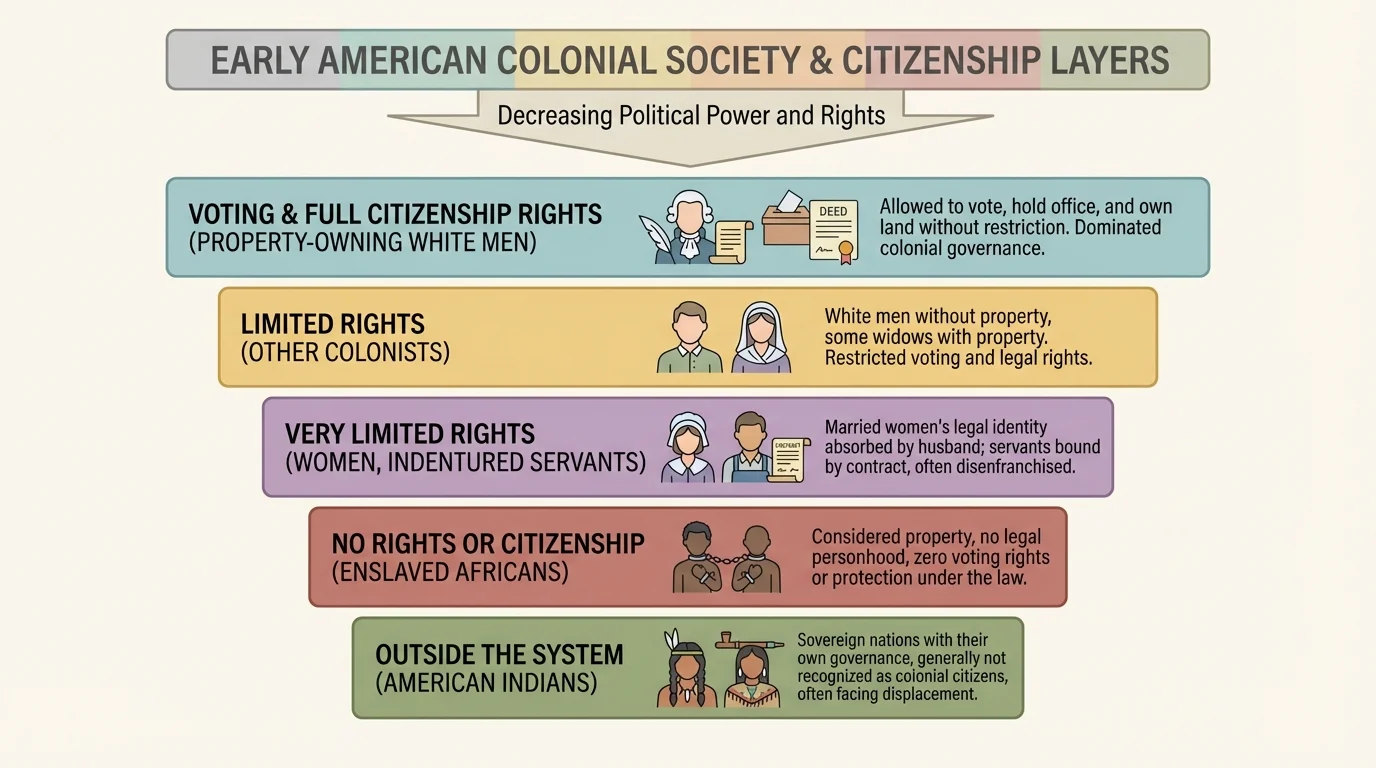
In the earliest colonies, belonging to the community did not automatically mean having a political voice. Colonial society was unequal, and full participation was usually reserved for a small group. In many places, the people with the most political power were white men who owned property. Property mattered because landowners were seen as independent and responsible enough to make decisions for the colony.
Some colonies added more rules. In parts of New England, especially in the early years, church membership could affect who had political power. Leaders believed the community should be guided by people they considered morally fit. This meant religion and government were closely connected.
Colonial governments often included elected assemblies, but elections were not open to all adults. For example, Virginia's House of Burgesses, founded in 1619, was an early representative assembly. That may sound representative, and in some ways it was. Yet only certain men could vote for representatives. So the colonies practiced self-government, but only for part of the population.
Being a property owner was very important in colonial politics. If a man owned land or enough property, he was more likely to be allowed to vote or hold office. Poorer white men sometimes had fewer rights at first, though in some places voting rules slowly became less strict for them over time.
The colonies had elected governments long before the United States became a country, but those governments were much less open than modern democratic systems. A colony could have voting and still exclude most people living there.
As colonial society grew, people began to argue more about fairness, representation, and who should count as a full member of the community. Those arguments helped expand political participation for some groups, even while many others remained excluded.
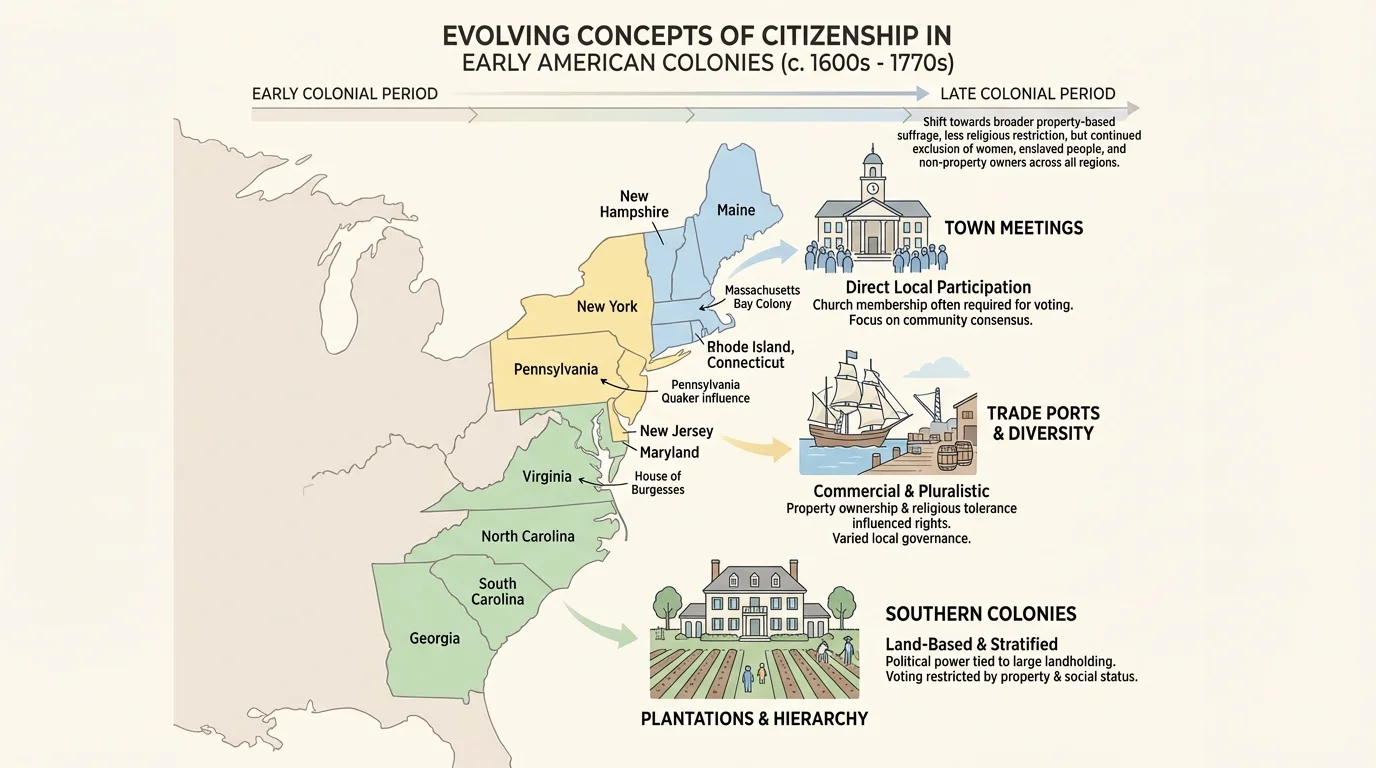
The colonies did not all follow the same model. Regional differences mattered, as [Figure 2] illustrates. New England colonies often had strong town governments and, in some places, close ties between religion and public life. The Middle Colonies were usually more diverse in religion and trade. The Southern Colonies often centered around large farms or plantations, where wealth and landownership strongly shaped power.
Because the colonies were different, the path toward citizenship was different too. In some areas, local meetings gave more white men a chance to take part in decisions. In others, wealthy families held more control. Some colonies became more tolerant of different religions, which slowly widened the idea of who could belong.
| Colonial Region | Important Features | How Citizenship Was Shaped |
|---|---|---|
| New England | Town meetings, smaller farms, strong religious influence | Political participation often tied to religion and community standing |
| Middle Colonies | Trade, cities, religious diversity | More varied populations sometimes led to broader ideas of belonging |
| Southern Colonies | Plantations, large landowners, enslaved labor | Power was often concentrated in wealthy landowning families |
Table 1. Comparison of how different colonial regions shaped citizenship and political participation.
These regional differences mattered because they showed that citizenship was not a fixed idea. It was influenced by religion, economics, land, labor, and local customs. We can see that geography and economy helped create different kinds of colonial communities, and those communities made different rules about power and belonging.
One of the most important parts of this topic is understanding exclusion. Early colonial ideas of citizenship did not include everyone. Women usually could not vote or hold office, even if they contributed greatly to family businesses, farms, and communities. Their work mattered, but the law usually treated political life as a male responsibility.
Indentured servants had few rights while they were under contract. They were not free to make many choices about their own lives. Poor colonists also faced limits, especially if they lacked property. In many places, freedom and independence were closely tied to land and wealth.
Enslaved people were denied basic human rights and treated as property, not as members of the political community. This was one of the cruelest and clearest limits on colonial citizenship. As slavery grew, especially in the Southern Colonies, the gap between those considered full participants and those denied freedom became larger.
Native Americans also stood outside colonial citizenship. They belonged to their own nations, communities, and systems of government. Colonists often treated them as outsiders or enemies rather than as people with equal rights. This exclusion led to conflict, unfair treatment, and loss of land for Native peoples.
Citizenship and exclusion
Citizenship is not only about who is included. It is also about who is kept out. In the colonies, laws and customs created clear lines between people with power and people without it. Studying those lines helps us understand why later Americans fought to expand rights to more groups.
Even among white colonists, not everyone had the same status. Some immigrants had to wait before they could fully join public life. Others had fewer opportunities because of religion or poverty. So colonial citizenship changed over time not because everyone became equal quickly, but because the rules of inclusion were challenged again and again.
Although early citizenship was narrow, several forces pushed it to grow. One major force was self-government. Colonists were used to making some local decisions through assemblies, county courts, and town meetings. The more they practiced governing themselves, the more they believed they deserved a voice.
Another force was the English tradition of rights. Colonists believed they should have the rights of English people, such as trial by jury and protection from unfair government actions. At first, they wanted these rights as loyal subjects of the king. Over time, however, many began to think rights did not come only from the king. They believed rights belonged to people more naturally and permanently.
Case study: A town meeting in New England
Town meetings gave some colonists direct experience with government. They did not include everyone, but they helped build habits of participation.
Step 1: Local men gathered to discuss problems such as roads, taxes, or schools.
Step 2: They debated what would help the community.
Step 3: They voted on decisions or chose local leaders.
Step 4: Over time, these experiences taught many colonists that government should listen to the people who were affected by its rules.
This local practice helped shape later American ideas about citizenship, representation, and civic duty.
[Figure 3] Religious change also mattered. During the Great Awakening in the 1730s and 1740s, preachers told ordinary people that each person could make important moral and spiritual choices. This message did not create equal citizenship by itself, but it encouraged people to question old authority. If ordinary people could think for themselves in religion, some began to ask whether they should have a stronger voice in public life too.
Several events changed how colonists thought about power and participation in a simple sequence. These events did not instantly create modern citizenship, but they pushed colonists to ask bigger questions about representation, fairness, and rights.
One early example was Bacon's Rebellion in 1676 in Virginia. The rebellion grew out of tensions involving land, safety, and anger against colonial leaders. It revealed deep divisions in colonial society and showed that many people were unhappy with how power was used.
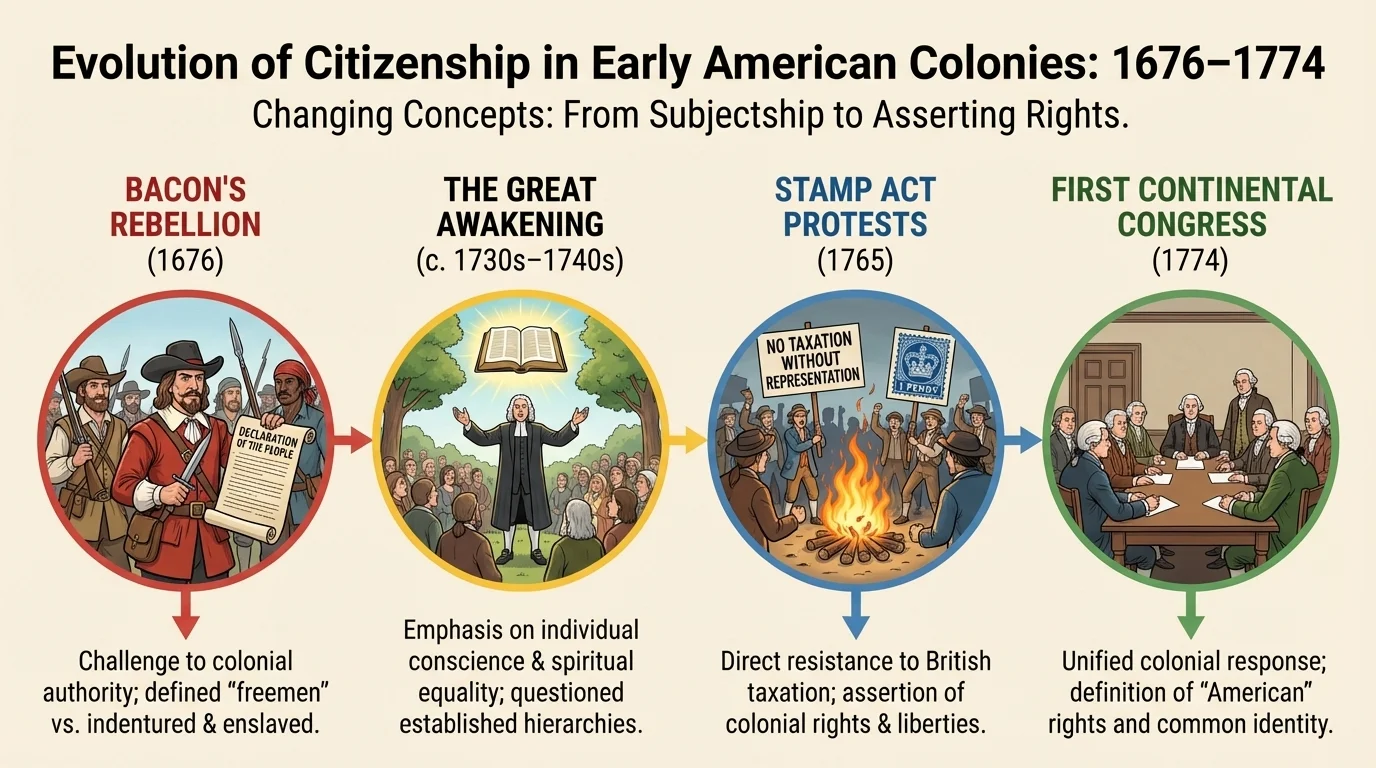
Later, the Great Awakening helped spread the idea that ordinary people mattered. Then, in the 1760s and 1770s, British taxes and laws such as the Stamp Act angered colonists because they had no representatives in Parliament. The famous slogan was "no taxation without representation." This idea linked money, government, and political voice.
Colonists organized protests, wrote pamphlets, and formed groups to resist British policies. These actions taught them to work together as political communities. Looking back at this sequence, we can see that events over many years slowly changed the colonists' understanding of who should have a say in government.
"No taxation without representation."
— A powerful colonial protest idea
The First Continental Congress in 1774 was another major step. Delegates from different colonies met to discuss common problems and responses. This was important because people started to think beyond their own colony. They were beginning to imagine a larger political community with shared rights and shared responsibilities.
This shift was one of the most important developments of the colonial period. At first, many colonists saw themselves mainly as subjects of the British king. A subject owes loyalty to a ruler. But as conflicts with Britain grew, many colonists started thinking of themselves as people who had rights that government must respect.
That was a huge shift. If people have rights by nature or by law, then government should serve them rather than simply command them. This idea opened the door to a new understanding of citizenship. Citizens are not just ruled; they also help rule. They take part in government, expect representation, and hold leaders accountable.
Still, this new idea developed unevenly. When colonists argued for liberty, they often meant liberty for themselves, not for everyone. Women, enslaved people, Native Americans, and many others still did not enjoy equal rights. So the movement from subject to citizen was real, but it was incomplete.
Earlier in U.S. history, students often learn that the American Revolution was about freedom from British rule. It was also about a changing idea of political membership: who belongs, who has rights, and who may help govern.
The Declaration of Independence later put some of these ideas into powerful words. It spoke about equality and rights, but colonial society had not yet made those promises true for all people. Even so, the document showed how much thinking had changed since the earliest colonies.
The colonial period laid the groundwork for American citizenship. It introduced ideas of local government, voting, public debate, and representation. It also showed the dangers of exclusion. The colonies built political habits that later shaped the United States, but they also built unfair systems that later generations had to challenge.
When we study colonial citizenship, we learn two things at once. First, people in the colonies developed important ideas about rights and participation. Second, those ideas were limited and often denied to large groups of people. Both parts are necessary to tell the full story.
That is why this topic still matters today. Modern American citizenship includes rights such as voting, equal protection under the law, and participation in civic life. Those ideas did not appear all at once. They grew slowly, through debate, conflict, and change. The early colonies were the beginning of that long story.
