How do you build a government for a brand-new country? That was the enormous challenge facing the American colonists in the late 1700s. They were breaking away from one of the most powerful kingdoms in the world, and they had to decide what rules, rights, and leaders would guide their future. The documents and events that led to the United States government were not created all at once. They grew out of arguments, meetings, problems, and bold ideas about freedom, fairness, and power.
To understand the United States government, it helps to think of it like building a house. First, people need a reason to build. Then they need a plan. Next, they test what works and what does not. Finally, they strengthen the house so the people inside are protected. In American history, the reason was the colonists' anger over British rule. The plans included the Declaration of Independence and the Articles of Confederation. The stronger design became the Constitution, and the protections for the people became the Bill of Rights.
Foundational documents are important writings that help create and guide a government. They explain ideas, set rules, and protect rights.
Government is the system people use to make laws, solve problems, and organize public life.
These documents matter because they answer big questions: Who has power? What is government allowed to do? What rights do people have? The answers shaped the United States and still guide leaders and citizens today.
Before the United States existed, the 13 colonies were ruled by Great Britain. Colonists were British subjects, but many felt they were treated unfairly. Britain taxed them and made laws for them, even though the colonists had no representatives in Parliament, Britain's lawmaking body. This led to the famous complaint: "No taxation without representation."
Events such as the Stamp Act, the Boston Massacre, and the Boston Tea Party increased anger. Colonists began to feel that a faraway king should not control their local lives. They wanted a government that listened to the people who lived in the colonies. Some still hoped to repair the relationship with Britain, but others began to argue that true liberty required independence.
Colonists also had experience with local self-government. Many towns held meetings, and colonial assemblies made rules close to home. These experiences taught people that government could be based on discussion and voting, not only on orders from a king. That idea became very important as Americans planned a new nation.
Many colonists did not immediately agree on independence. Some wanted a complete break from Britain, while others were nervous about leaving the protection of the British Empire.
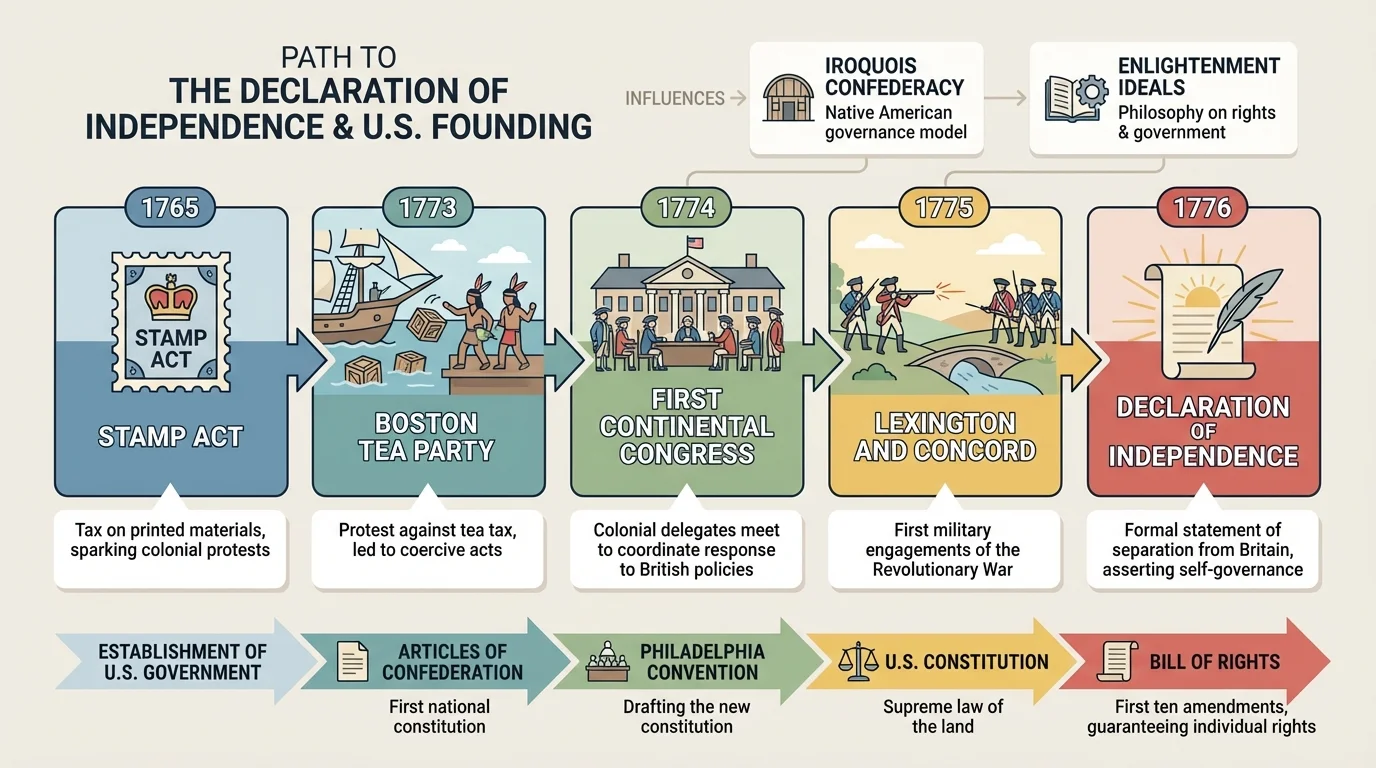
The road to independence unfolded step by step through key protests, meetings, and battles. Each event pushed more colonists to believe they needed not just better treatment, but an entirely new government of their own.
In July 1776, the Second Continental Congress approved the Declaration of Independence. [Figure 1] This document announced that the colonies were no longer part of Britain. It was drafted primarily by Thomas Jefferson, with help from other leaders such as John Adams and Benjamin Franklin.
The Declaration did more than say, "We are leaving." It explained why. It said that all people are created equal and have certain rights that cannot be taken away, including life, liberty, and the pursuit of happiness. It also said governments get their power from the consent of the governed. That means government should exist because people agree to it, not because a king claims power by birth.
Another powerful idea in the Declaration is that if a government becomes destructive of people's rights, the people can change it or replace it. This was a bold statement. It meant that government is supposed to serve the people, not the other way around.
The Declaration also listed complaints against King George III. These complaints were like evidence in an argument. The colonists wanted the world to understand that they were not rebelling for no reason. They believed the king had abused his power.
"Governments are instituted among Men, deriving their just powers from the consent of the governed."
— Declaration of Independence
The Declaration of Independence is important today because it introduced ideas that still shape American beliefs. Even though the country did not yet live up to those ideals for everyone, the words became a standard that later generations used to demand greater freedom and equality. Long after 1776, reformers pointed back to those promises.
When people talk about rights and freedom in the United States, they are still echoing ideas first clearly stated in the Declaration. The timeline in [Figure 1] helps show that independence was not one sudden event. It was the result of growing conflict and deep thinking about what government should be.
Long before the United States was created, Native American nations had developed their own governments. [Figure 2] One important example was the Haudenosaunee, also known as the Iroquois Confederacy. This union originally included the Mohawk, Oneida, Onondaga, Cayuga, and Seneca nations, and the Tuscarora later joined.
The Iroquois Confederacy showed that different nations could keep their own identities while also working together on shared concerns. They used discussion, councils, and agreed rules to make decisions. This system was based on cooperation and balance, not on one ruler controlling everyone.
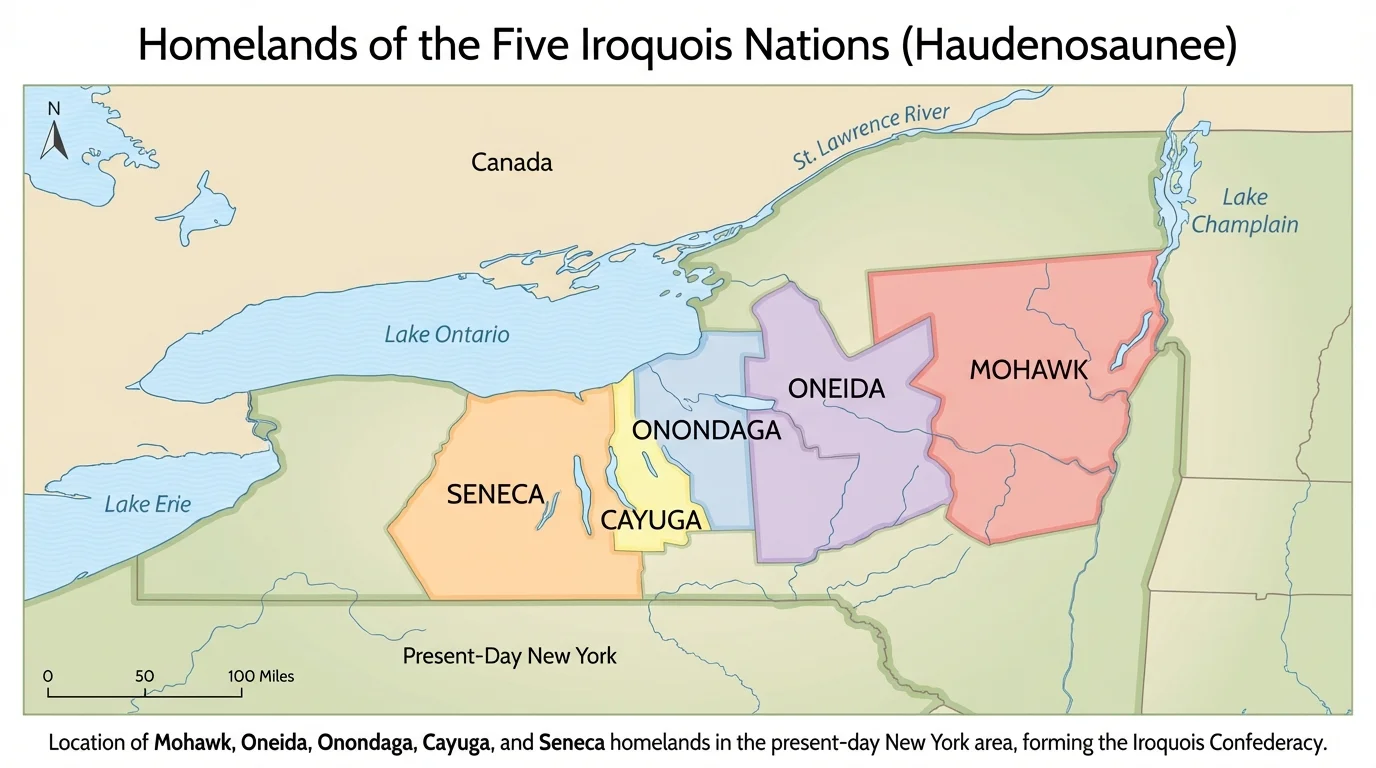
Historians continue to discuss exactly how much the Iroquois Confederacy influenced the framers of the United States government. However, many people agree that colonial leaders were aware of Native systems of unity and diplomacy. Benjamin Franklin, for example, admired the way the Iroquois nations could join together for common purposes.
This matters because it reminds us that the history of American government did not come only from Europe. Ideas about shared power, union, and council-based decision-making also existed in North America long before independence. The map in [Figure 2] helps show that these were real nations with organized political systems, not just groups on the edges of colonial history.
Shared government without losing local identity
A confederacy is a group of separate communities or states that join together for some common goals while keeping much of their own power. This idea became important later when Americans tried to unite the states.
Learning about the Iroquois Confederacy broadens our understanding of where government ideas come from. It also shows respect for Native American political knowledge and leadership.
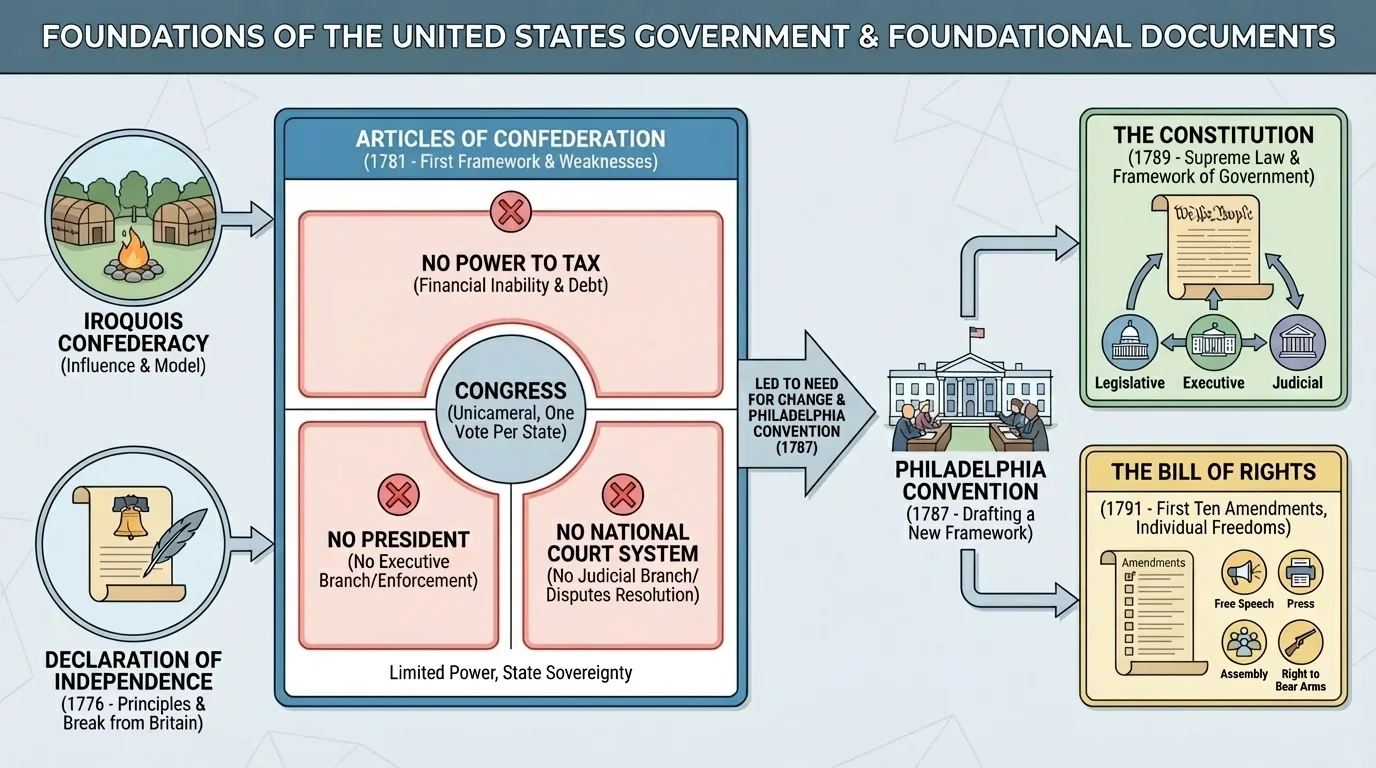
[Figure 3] After declaring independence, the new states needed a government. Their first plan was the Articles of Confederation, adopted in 1781. The states had just fought against a strong king, so they were afraid of creating another powerful central government. The national government under the Articles was intentionally weak.
Under the Articles, the states kept most of the power. The national government had a Congress, but there was no president to lead the executive branch and no national court system to settle disputes between states. Congress could make some decisions, especially about war and foreign relations, but it had major limits.
One huge weakness was that Congress could not collect taxes directly from the states. It could ask for money, but states could refuse. Congress also could not regulate trade well between states or with other countries. This made it difficult to pay debts, support the army, or solve economic problems.
Still, the Articles had some successes. They helped the states work together during the Revolutionary War. They also set up a process for adding new lands and future states through the Northwest Ordinance. That was important because it gave the young country a framework for expansion.
But serious problems soon appeared. Because the national government was so weak, it struggled to respond when states disagreed. Trade became messy, money problems grew, and unrest such as Shays' Rebellion frightened many leaders. Shays' Rebellion was an uprising of farmers in Massachusetts who were angry about debt and taxes. It showed that the government could not easily keep order.
Case study: Why the Articles were difficult to use
Step 1: Congress needed money to pay war debts.
It asked the states to contribute funds.
Step 2: Some states did not send enough money.
Because Congress could not tax people directly, it had no strong way to solve the problem.
Step 3: National problems remained unsolved.
This convinced many leaders that the country needed a stronger central government.
The weaknesses in [Figure 3] help explain why many Americans began to call for change. The first government had helped the country begin, but it was not strong enough to last in its original form.
[Figure 4] In 1787, delegates from most of the states met in Philadelphia to discuss how to fix the Articles of Confederation. This meeting is commonly called the Constitutional Convention and is also known as the Philadelphia Convention. Early in the meeting the delegates realized they were not just repairing the old system. They were designing a new one.
Important figures at the convention included George Washington, who presided over the meeting, James Madison, often called the "Father of the Constitution," and Benjamin Franklin. Not every famous founder was there. Thomas Jefferson and John Adams were away on diplomatic work, and Patrick Henry refused to attend because he distrusted the process.
The delegates argued over several major questions. One was representation: Should states with larger populations get more power, or should all states be equal? Another was slavery: How would enslaved people be counted, and what place would slavery have in the new nation? These were difficult and often painful debates.
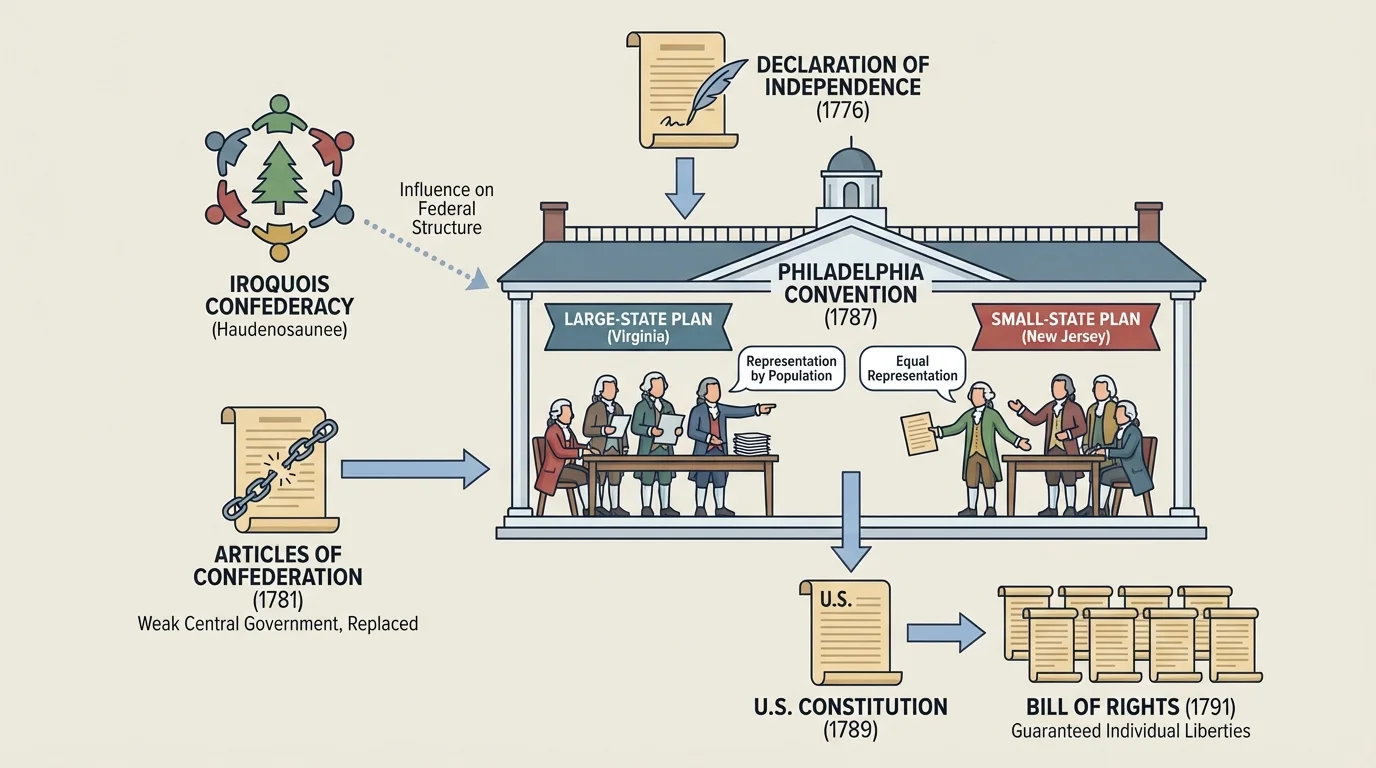
A major compromise was the Great Compromise. It created a two-part Congress. In the House of Representatives, larger states got more representatives because population mattered. In the Senate, each state got two senators, so smaller states had equal representation there. This balance helped both large and small states agree.
The convention was held in secret so delegates could debate freely. Windows were closed, and discussions were private. By the end, the delegates had created an entirely new plan of government: the Constitution.
George Washington's support gave the convention greater credibility. Many Americans respected him deeply because of his leadership during the Revolutionary War.
The debates shown by [Figure 4] remind us that the Constitution was not easy or automatic. It came from disagreement, compromise, and careful planning.
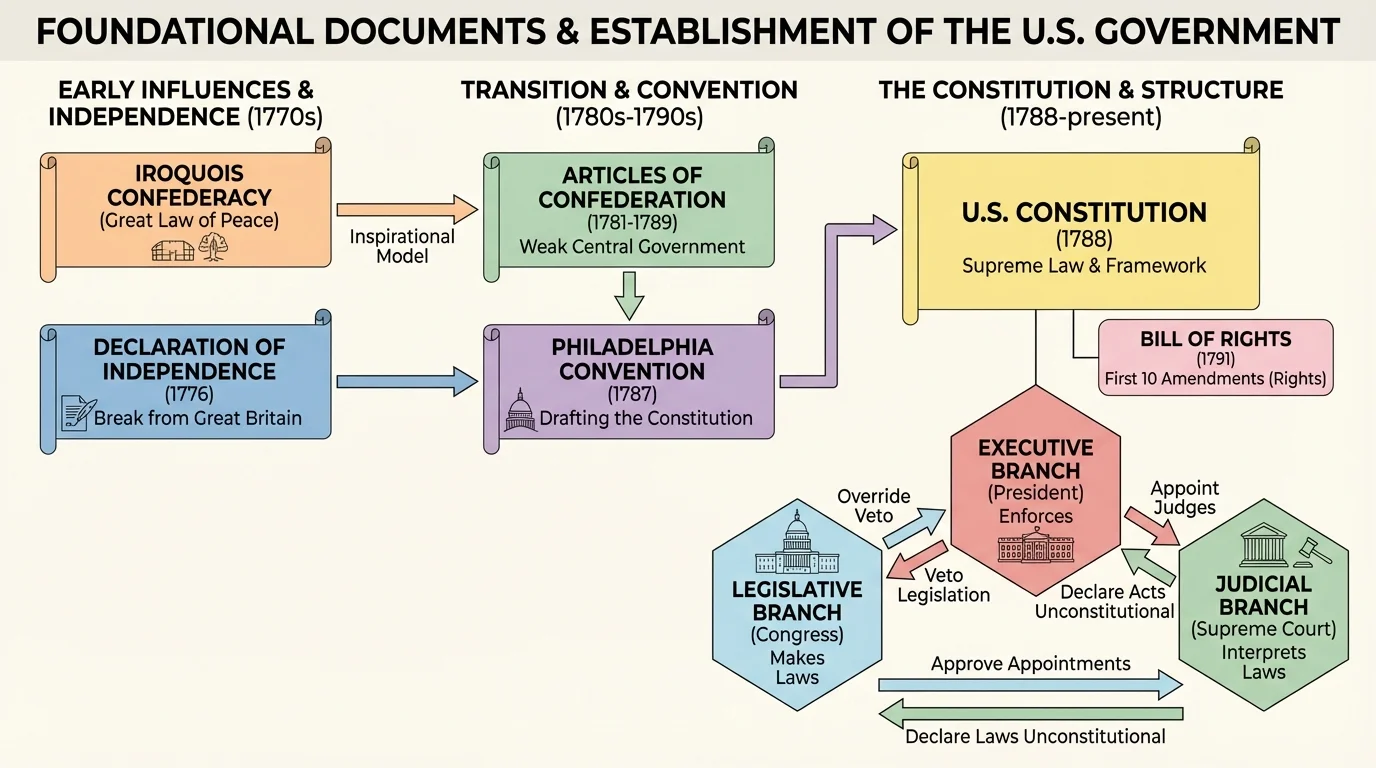
[Figure 5] The Constitution is the supreme law of the United States. It was written in 1787 and later ratified by the states. The Constitution created a stronger national government, but it also tried to prevent any one person or group from becoming too powerful. Its basic structure includes branches with clearly defined limits.
The Constitution begins with the Preamble, which starts with the famous words, "We the People." Those words are important because they show that the government's authority comes from the people. The Preamble also lists goals such as forming a more perfect union, establishing justice, ensuring domestic tranquility, providing for the common defense, promoting the general welfare, and securing liberty.
The Constitution created three branches of government. The legislative branch, or Congress, makes laws. The executive branch, led by the president, carries out laws. The judicial branch, led by the Supreme Court and other courts, interprets laws.
This system uses checks and balances. That means each branch has ways to limit the others. For example, Congress makes laws, but the president can veto a bill. Courts can decide whether a law follows the Constitution. Congress can impeach certain officials, and the Senate confirms many presidential appointments. No branch gets total control.
Another key idea is federalism. Federalism means power is shared between the national government and state governments. Some powers belong mostly to the national government, such as making treaties and printing money. Other powers belong mostly to the states, such as running many schools and holding local elections. Some powers are shared.
The Constitution also includes ways to change itself through amendments. This matters because no government plan is perfect forever. The amendment process allows the nation to improve the Constitution over time, while still making changes difficult enough that they must be carefully considered.
| Branch | Main Job | Example of Power |
|---|---|---|
| Legislative | Makes laws | Congress passes a bill |
| Executive | Enforces laws | The president signs or vetoes a bill |
| Judicial | Interprets laws | The Supreme Court decides whether a law fits the Constitution |
Table 1. The three branches of the United States government and their main roles.
The structure in [Figure 5] is one reason the Constitution has lasted so long. It spreads power around, which helps protect liberty while still allowing government to function.
Rules are stronger when they are clear, shared, and enforced fairly. The Constitution works like a rulebook for the whole country, but it also limits the people in power.
Even today, leaders, judges, and citizens turn to the Constitution when important questions arise. It remains the center of the American government system.
Some people supported the Constitution right away, but others worried it still gave the national government too much power. These people wanted stronger protections for individual freedom. To answer those concerns, the first ten amendments were added to the Constitution. These amendments are called the Bill of Rights.
The Bill of Rights protects many important freedoms. The First Amendment protects freedom of religion, speech, press, assembly, and petition. Other amendments protect the right to bear arms, guard people against unreasonable searches, promise fair treatment in court, and limit cruel and unusual punishment.
These protections matter because rights are not very safe if they exist only as promises from leaders. Writing them into the Constitution gave them stronger protection. The Bill of Rights says that government has limits and that people have freedoms the government must respect.
Real-life examples of the Bill of Rights
Example 1: A student writes an opinion in a school newspaper.
This connects to freedom of speech and freedom of the press, though schools may still have some reasonable rules.
Example 2: A person accused of a crime receives a fair trial.
This connects to rights that protect fair treatment in the justice system.
Example 3: A group peacefully gathers to support a cause.
This connects to the freedom of assembly.
At first, the Bill of Rights applied only to the national government, but over time many of those protections also came to limit state governments. That history is complicated, but the main idea is simple: these rights became central to American freedom.
The events that led to the establishment of the United States government are not just old stories. They still affect everyday life. When people vote, speak freely, go to court, protest peacefully, or debate what government should do, they are using ideas built into the nation's founding documents.
The Declaration of Independence gave the country a powerful statement of human equality and natural rights. The Articles of Confederation taught an important lesson about what happens when a national government is too weak. The Philadelphia Convention showed that leaders can argue, compromise, and create something new. The Constitution built a government strong enough to lead the country, but limited enough to protect freedom. The Bill of Rights made those protections clearer.
The influence of the Iroquois Confederacy is also important because it reminds us that government ideas in North America have many roots. Cooperation, council decision-making, and shared authority were not new in 1787. They were part of the political traditions of Native nations long before the United States existed.
Understanding these foundations helps students become informed citizens. A citizen who knows where rights come from, how laws are made, and why power is divided is better prepared to participate in government and protect freedom for others.
