What would happen if a country had leaders, laws, and courts, but no shared ideas about fairness, freedom, or power? It might have rules, but it would not have a strong democracy. The United States was built on important political principles, or big ideas, about how government should work. These principles help make sure the government serves the people and protects their rights.
A democracy is a system of government in which the people have power. In the United States, people do not all gather in one place to make every decision. Instead, they choose leaders to represent them, and they follow a written plan for government called the Constitution. This written plan helps prevent confusion and keeps government from becoming too powerful.
American democracy is built on both freedom and order. People have rights, such as the right to speak and worship freely, but they also have responsibilities, such as obeying laws and respecting the rights of others. A democracy works best when citizens understand the rules and take part in government.
Constitution means the written plan for a government. Bill of Rights means the first ten amendments to the Constitution, which protect important freedoms and rights. Amendment means an official change or addition to the Constitution.
The people who created the United States government had just broken away from British rule under a king. They wanted a government strong enough to keep order, but not so strong that it could take away liberty. That is why the Constitution and Bill of Rights are both so important. One sets up the government, and the other limits what the government can do.
The United States is guided by several major principles, and [Figure 1] shows how these ideas connect to form American democracy. These principles are not just words in history books. They shape elections, laws, courts, and the rights people use every day.
One key principle is popular sovereignty. This means the government gets its power from the people. In other words, the people are the source of authority. When citizens vote, speak out, or help choose leaders, they are using this principle.
Another principle is the rule of law. This means everyone must obey the law, including leaders. The president, judges, police officers, teachers, and private citizens all live under the law. No one is supposed to be above it.
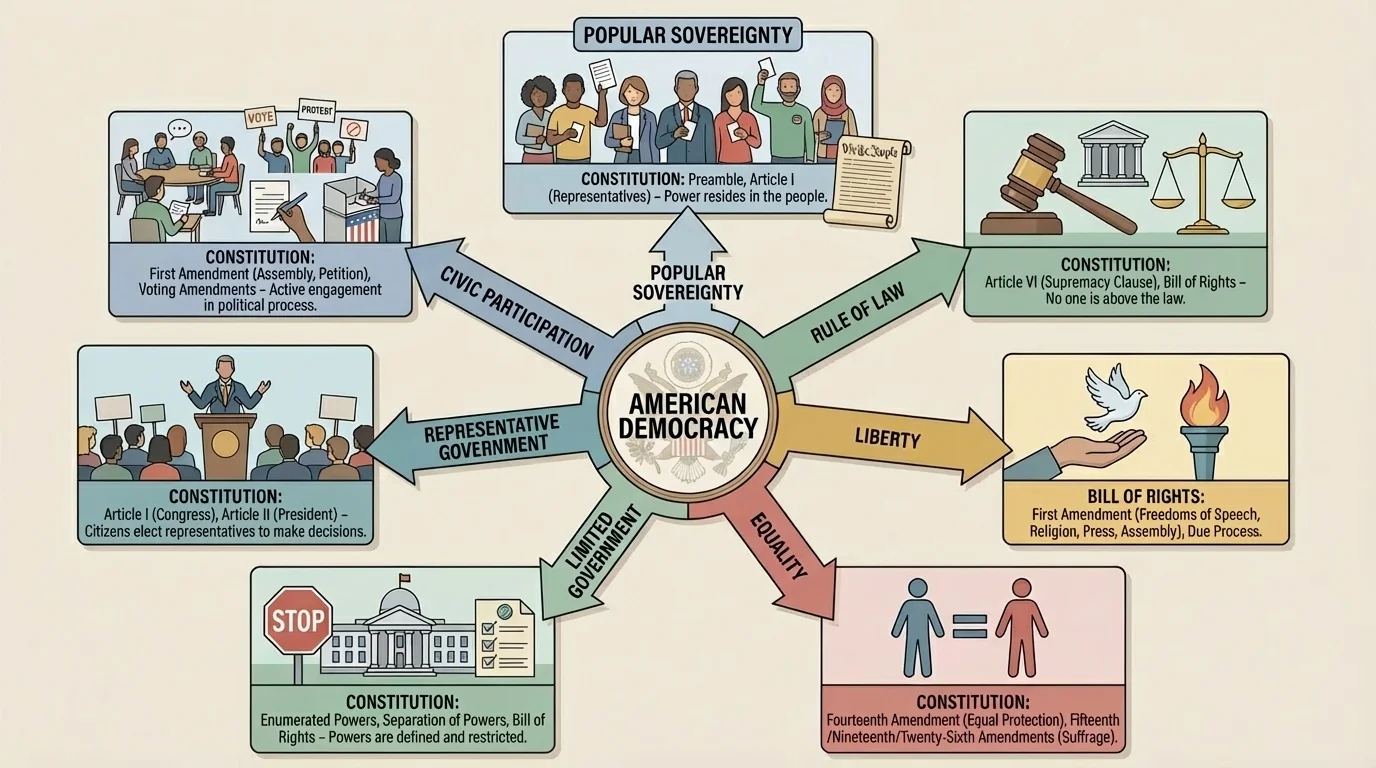
Liberty means freedom. In American democracy, liberty includes freedoms such as speaking, worshiping, reading, and gathering with others. These freedoms matter because they allow people to think for themselves and share their ideas.
Equality is the belief that all people should be treated fairly under the law. Equality does not mean everyone is exactly the same. It means each person deserves equal protection and equal respect. This principle has not always been fully achieved in American history, but it remains a central goal.
Limited government means government power has boundaries. Leaders cannot simply do whatever they want. The Constitution places limits on government power so that individual rights are protected. As we saw with the connected principles in [Figure 1], liberty and limited government support each other.
Representative government means people elect others to make decisions on their behalf. This is important in a large country. Citizens choose representatives in Congress, governors in states, mayors in cities, and many other leaders.
Civic participation is also a democratic principle. Citizens keep democracy strong when they vote, stay informed, discuss issues, serve on juries, and help in their communities. Democracy is not only about government officials. It also depends on people being involved.
The opening words of the Constitution are "We the People." Those three words show that the authority of the government comes from the people, not from a king or a small group of rulers.
These principles work together. If people have freedom but no laws, life becomes unfair and unsafe. If there are laws but no freedom, people can be controlled too much. American democracy tries to balance liberty, equality, order, and citizen power.
The Constitution sets up the national government, and [Figure 2] illustrates how it divides power among different parts. Written in 1787, it replaced an earlier system that was too weak. The Constitution begins with the Preamble, which explains the purposes of government, including forming a more perfect union, establishing justice, ensuring domestic tranquility, providing for the common defense, promoting the general welfare, and securing liberty.
The Constitution created three branches of government. The legislative branch, made up of Congress, makes laws. The executive branch, led by the president, carries out laws. The judicial branch, led by the Supreme Court and other courts, interprets laws.
This division of power is called separation of powers. Instead of giving all power to one person or group, the Constitution splits power into branches with different jobs. This protects democracy because it makes it harder for any one branch to control everything.
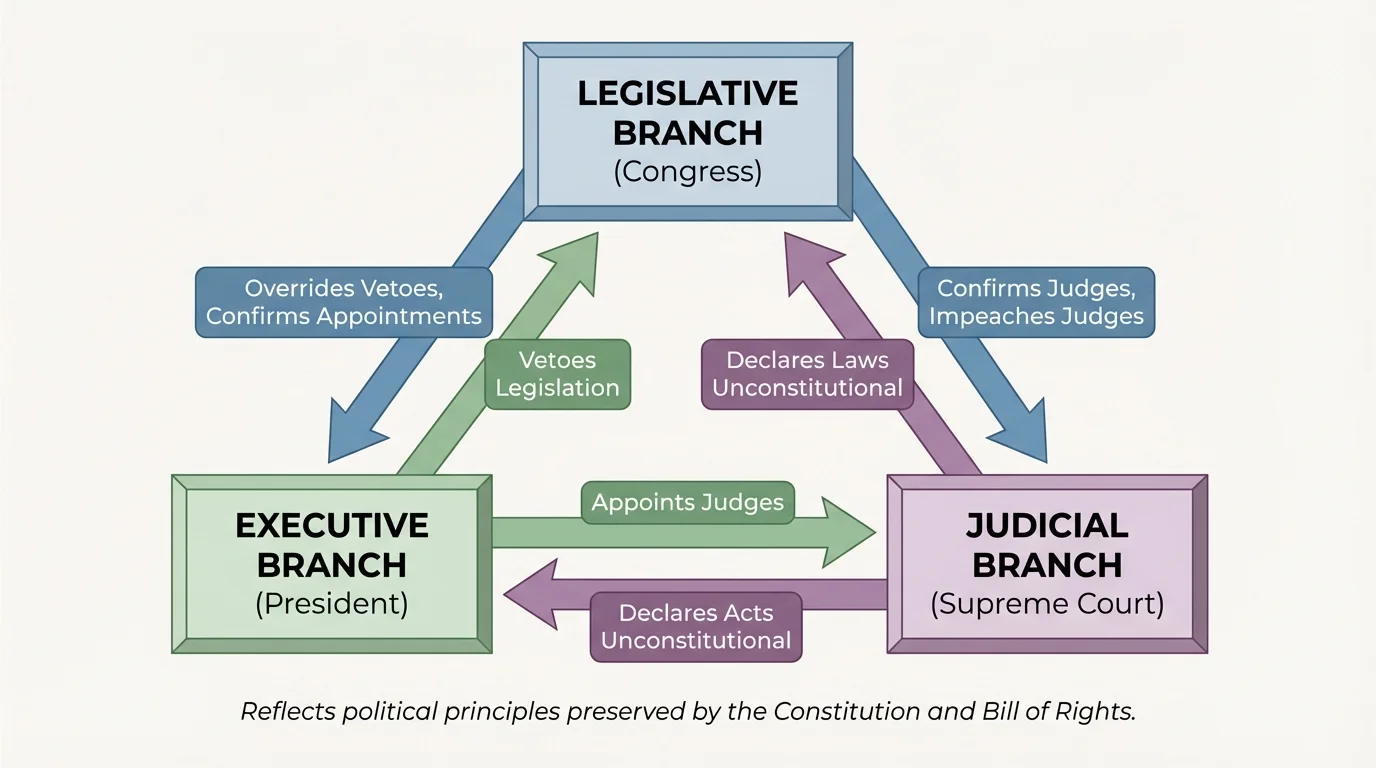
The branches also use checks and balances. This means each branch has ways to limit the power of the others. For example, Congress passes laws, but the president can veto a bill. Courts can decide whether a law follows the Constitution. The Senate approves many presidential appointments. This system intentionally slows decision-making so that government actions are more careful and balanced.
The Constitution also created federalism, a system in which power is shared between the national government and state governments. The national government handles issues for the whole country, such as printing money, making treaties, and national defense. State governments handle many local matters, such as public schools, driver's licenses, and many state laws.
Federalism matters because the United States is large and diverse. Different states may have different needs, but they are still part of one nation. The Constitution helps organize this balance of powers.
Why dividing power protects freedom
If one person made laws, enforced them, and judged them, that person could become too powerful. By dividing power among branches and levels of government, the Constitution makes it harder for anyone to abuse power. This structure helps preserve liberty and fairness.
The Constitution can also be amended, but not easily. That is important. If changing the Constitution were too easy, important protections could disappear quickly. If changing it were impossible, the nation could not grow. The amendment process allows change, but only when there is broad agreement.
The Constitution does more than describe offices and branches. It reflects democratic principles in its design. Popular sovereignty appears in elections and in the words "We the People." Limited government appears in the written powers and restrictions. The rule of law appears because leaders must follow the Constitution, which is the highest law of the land.
Representative government is seen in Congress, where elected officials make laws. Equality and justice are goals named in the Preamble. Liberty is protected by limits on government power and, later, by amendments that spell out individual rights.
Even the slower pace of government can protect democracy. Because branches must cooperate and because laws can be challenged in court, the system does not move by the will of one person alone. That can sometimes feel frustrating, but it helps guard against unfair or rushed decisions. The branch structure shown earlier in [Figure 2] helps explain why power in the United States is shared rather than concentrated.
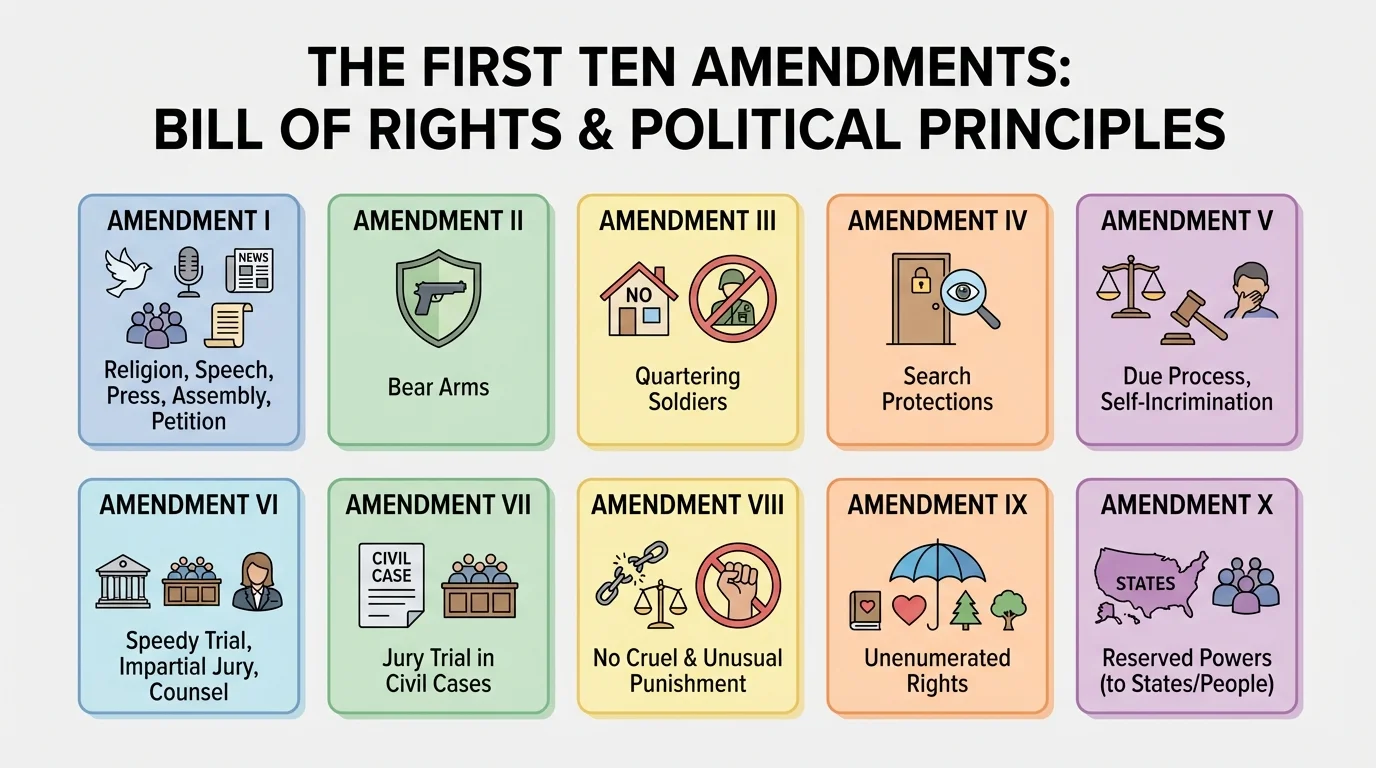
The Bill of Rights is the name for the first ten amendments to the Constitution, and [Figure 3] organizes these amendments as a group of key protections. Many people were worried that the original Constitution did not clearly protect individual freedoms. To solve that problem, these first ten amendments were added.
The First Amendment protects several essential freedoms: freedom of religion, speech, the press, assembly, and petition. These freedoms are at the heart of democracy because people must be able to think, speak, gather, and ask the government for change.
Other amendments protect people accused of crimes and make sure the government must act fairly. For example, some amendments protect against unreasonable searches, require due process, and guarantee a fair trial. These rights connect strongly to the rule of law and equality because government must follow fair procedures.
The Bill of Rights also shows limited government. It tells the government what it may not do. For example, the government cannot punish someone just for speaking an opinion. It cannot take away freedom without proper legal steps. This protects citizens from unfair treatment.
The Ninth and Tenth Amendments are especially interesting. They remind us that people have rights beyond those specifically listed, and that powers not given to the national government are reserved to the states or the people. That idea connects back to federalism and to the belief that government power should stay limited.
Example: How the Bill of Rights matters in school and community life
Step 1: A student wants to express an opinion in a respectful class discussion.
This connects to freedom of speech. In a democracy, people can share ideas, even when others disagree.
Step 2: A newspaper reports on a town problem.
This connects to freedom of the press. People need information to make wise choices.
Step 3: A court gives a person a lawyer and a fair trial.
This connects to due process and trial rights. The law must treat people fairly.
These examples show that constitutional rights are not just old words on paper. They affect real life.
The rights in the Bill of Rights are powerful, but they are not unlimited. People still must follow laws that protect safety and order. For example, freedom of speech does not mean a person may threaten others without consequences. In a democracy, rights and responsibilities go together.
Democracy depends on citizens using their rights wisely. Voting is one example, but it is not the only one. People also participate by learning about issues, discussing ideas respectfully, writing to leaders, attending public meetings, and helping solve community problems.
Citizens also have responsibilities. They should obey laws, respect the rights of others, pay taxes, and serve on juries when called. These responsibilities help keep government and communities working. A democracy cannot stay healthy if people expect rights but ignore responsibilities.
Think about a classroom. If everyone gets a voice, but no one follows the rules, learning becomes difficult. If only one student makes every choice, the class is unfair. A good classroom, like a good democracy, needs both participation and rules.
"We the People"
— Opening words of the Preamble to the Constitution
That short phrase matters because it reminds us that the nation belongs to its people. Government officials are public servants, not rulers above the law. This idea links back to popular sovereignty, one of the main principles shown earlier in [Figure 1].
[Figure 4] American democracy has strong principles, but the country has not always lived up to them. Over time, people have worked to make the nation fairer and more equal through important constitutional changes that expanded rights and participation.
For example, slavery existed in the United States for many years, even though the idea of equality was important. After the Civil War, the 13th Amendment ended slavery, the 14th Amendment strengthened citizenship and equal protection, and the 15th Amendment said states could not deny voting rights based on race. Later, the 19th Amendment gave women the right to vote, and the 26th Amendment lowered the voting age to 18.
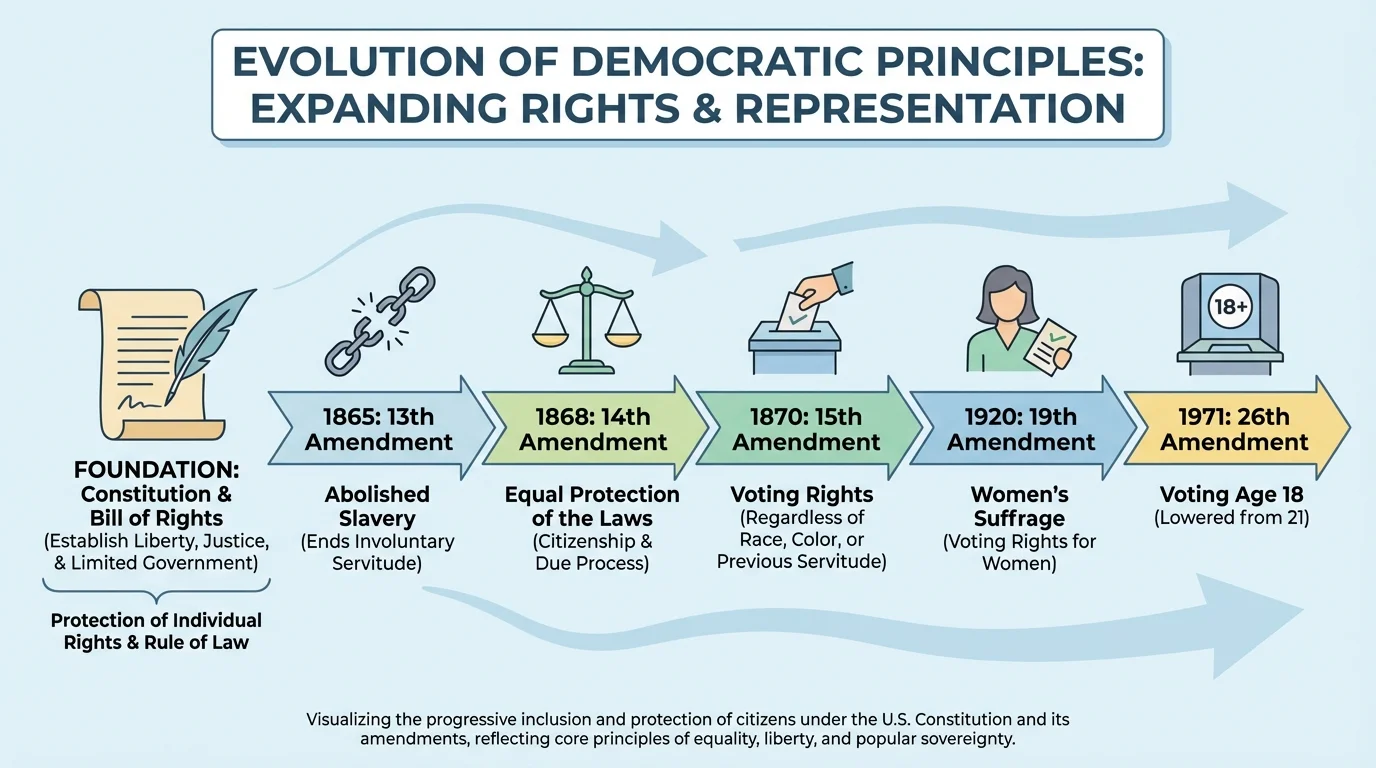
This history shows that democracy is not automatic. People must work to protect and expand its principles. The Constitution provides the framework, but citizens and leaders must keep striving to make liberty and equality real for everyone.
Primary sources such as the Constitution, amendments, speeches, letters, and court decisions help historians understand how democratic ideas developed. Secondary sources, such as textbooks and articles written later, help explain those events and connect them to larger patterns in history.
The amendments shown in [Figure 4] remind us that the Constitution is both strong and flexible. It keeps core principles in place while allowing the nation to correct problems and grow.
Today, the Constitution still guides how the United States government works. The Bill of Rights still protects speech, religion, press, fair trials, and other freedoms. Courts still use the Constitution to decide whether laws are fair and lawful. Elected leaders still take oaths to support it.
These documents matter because they preserve democratic principles over time. They protect popular sovereignty by connecting government to the people. They protect limited government by placing boundaries on power. They protect liberty and equality by recognizing rights and requiring fairness under the law.
When people debate issues, vote in elections, follow court decisions, or speak up for change, they are living inside the system created by the Constitution. When they defend the freedoms in the Bill of Rights, they help preserve democracy for the future.
American democracy is not only a set of ideas from the past. It is a living system that depends on structure, rights, and citizen action. The Constitution gives the nation its framework. The Bill of Rights protects individual freedoms. Together, they reflect and preserve the political principles that shape life in the United States.
