One voyage across the Atlantic Ocean changed millions of lives, but it did not mean the same thing to everyone. For some Europeans, ocean travel promised wealth and power. For many Indigenous communities in the Americas, it brought invasion, disease, and loss. History becomes much clearer when we ask not just what happened, but also what was happening around it, who was affected, and how different people saw it.
Historical context means the background conditions that help explain an event, person, or idea. It includes the time period, place, beliefs, technology, politics, economy, and social rules of that era. Without context, a fact can seem simple. With context, it becomes much more meaningful.
Historical context is the set of conditions that surround an event or person in the past. Perspective is the point of view from which someone experiences or understands an event. Cause and effect describes how one event or action leads to another.
For example, if we only say that Christopher Columbus sailed in 1492, that is a fact. But if we add that European kingdoms were competing for trade, searching for sea routes to Asia, and spreading Christianity, we begin to understand why that voyage happened. If we also add Indigenous perspectives, we understand that his arrival was not the "discovery" of an empty land. It was the arrival of outsiders in places where people already lived, governed, traded, and worshiped.
Historians look at many parts of the past at once. They study important people, turning-point events, large ideas, and the relationships between actions and results. They also ask who had power, who did not, and how groups interacted over time.
When studying colonization, historians might ask questions like these: Why did European kingdoms send explorers? How did Indigenous nations respond? What happened after contact? Which groups benefited, and which groups suffered? Those questions help move history beyond memorizing names and dates.
[Figure 1] Long before Europeans crossed the Atlantic, the Indigenous peoples of the Western Hemisphere lived in thousands of communities with different languages, governments, religions, and ways of life. The Western Hemisphere included North America, Central America, the Caribbean, and South America. It was home to farming villages, trading networks, cities, and empires.
In Mesoamerica, the Maya and later the Aztec built great cities and developed systems of writing, astronomy, and trade. In South America, the Inca created a vast empire connected by roads across the Andes Mountains. In North America, peoples such as the Haudenosaunee, Mississippian communities, Pueblo peoples, and many others built strong societies adapted to their environments. These cultures were not all the same. Some were large empires, while others were smaller nations or communities with their own traditions.
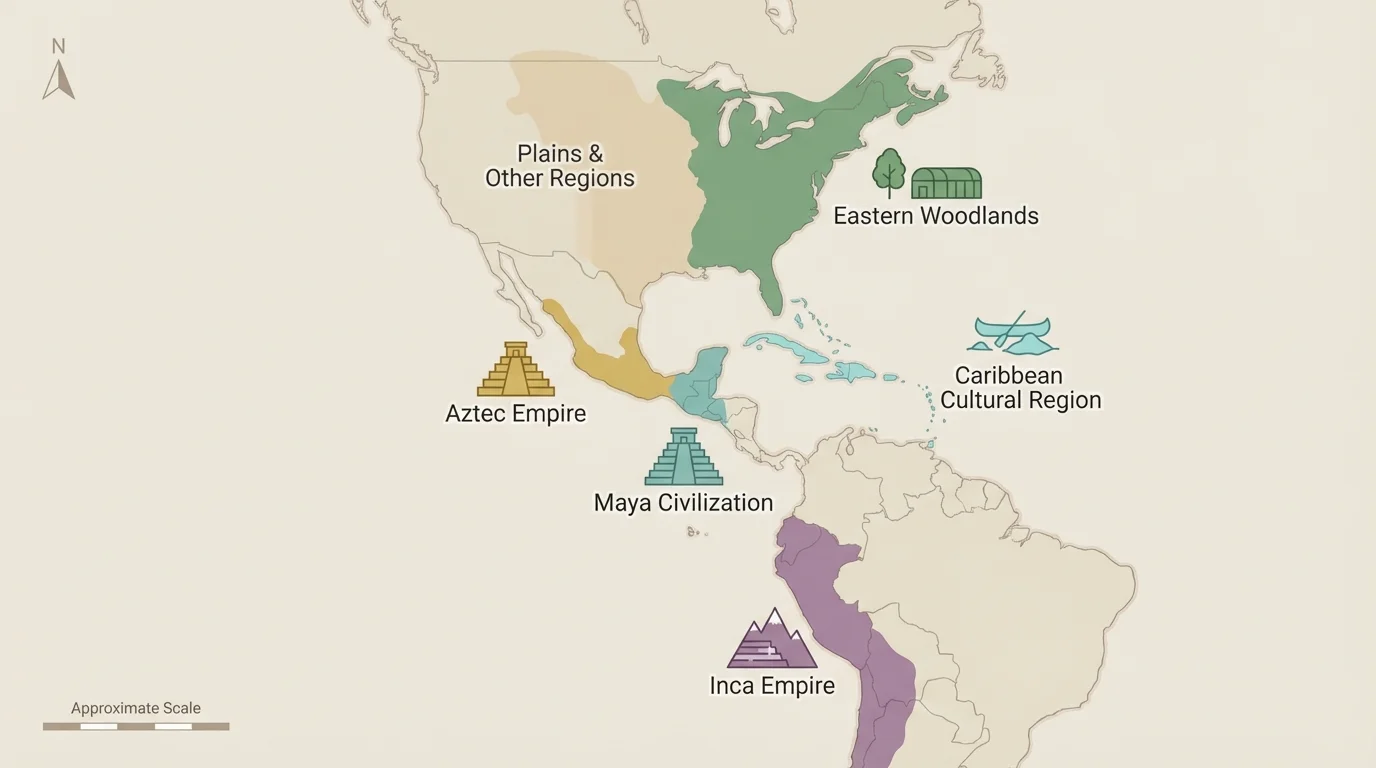
Understanding this background is important because colonization did not begin in a blank space. Europeans entered lands that were already occupied and organized. That fact changes how we interpret later events. It helps explain why some encounters began with trade, why others led quickly to war, and why different Indigenous groups made different choices.
The city of Tenochtitlan, capital of the Aztec Empire, amazed many Europeans with its size, markets, and canals. It was one of the largest cities in the world at the time the Spanish arrived.
The people of the Americas also had long-distance trade networks. Goods, ideas, and farming knowledge moved from place to place. So when Europeans arrived, they entered a world that was already connected, though in different ways from Europe, Africa, and Asia.
European exploration did not happen for only one reason. Several causes worked together. Kings and queens wanted wealth and stronger kingdoms. Merchants wanted new trade routes and valuable goods. Some explorers wanted fame. Some missionaries hoped to spread Christianity. European countries also competed with one another for power.
Technology mattered too. Improvements in ships, maps, and navigation made longer ocean voyages more possible than before. This does not mean voyages were easy or safe, but it does help explain why exploration increased in the late 1400s and 1500s.
Many causes can lead to one event
Historical events usually do not have just one cause. European colonization grew from economic goals, religious beliefs, political rivalry, curiosity, and new technology. Historians look at how these causes combine instead of searching for one simple answer.
Another important part of context is the ideology behind colonization itself. Many European leaders believed they had the right to claim distant lands. They often ignored the rights of the people already living there. This belief helped justify conquest, settlement, and control.
[Figure 2] When Europeans, Africans, and Native peoples came into contact, life changed across the Atlantic world through the movement of crops, animals, and diseases. Some meetings included trade and cooperation. Others led to violence, warfare, and conquest. The results were complex and often tragic.
One major change was the Columbian Exchange, the transfer of plants, animals, people, diseases, and ideas between the Eastern and Western Hemispheres. Europeans brought horses, cattle, and diseases such as smallpox. The Americas contributed crops such as corn, potatoes, tomatoes, and cacao. These exchanges transformed diets, economies, and environments around the world.
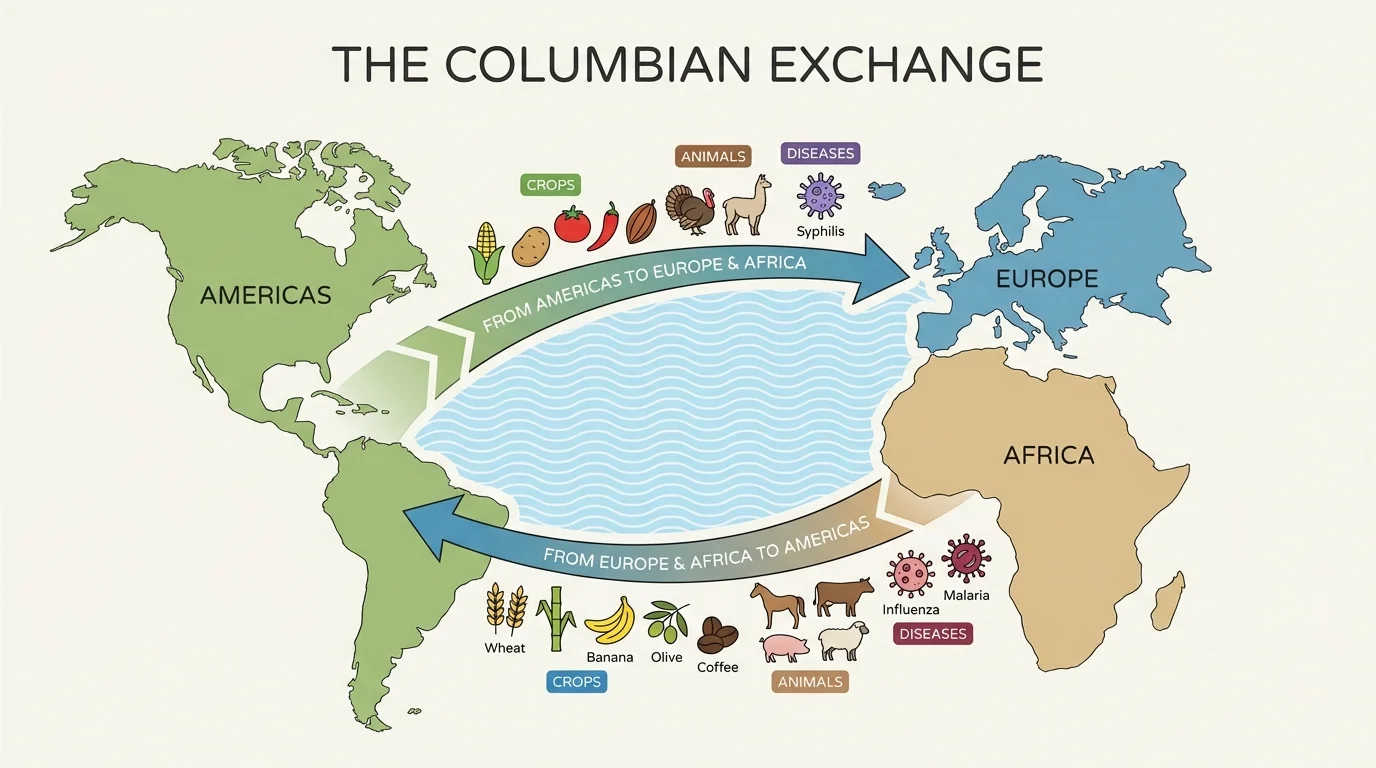
Disease had one of the most powerful effects. Indigenous peoples had not been exposed to many European diseases, so they had little immunity. Entire communities were devastated. This population loss made it harder for some societies to resist conquest. Here we can see a clear cause-and-effect relationship: contact brought disease, disease caused massive deaths, and those deaths weakened many Indigenous societies.
Still, Indigenous peoples were not just passive victims. Some resisted with force. Some formed alliances. Some adapted to new conditions. Some used European rivalries to protect their own interests. The outcomes varied depending on place, time, and leadership.
Colonization often created unequal relationships between majority groups and minority groups. A majority group is the group with more power or influence in a society, even if it is not always larger in number. A minority group has less power and often faces unfair treatment. In many colonies, European settlers and rulers became the dominant group, while Indigenous peoples and later enslaved Africans were placed lower in the system.
This imbalance affected laws, labor, land ownership, religion, and daily life. Europeans often claimed land, forced labor from Native peoples, and tried to replace local beliefs and traditions. In Spanish colonies, the encomienda system gave colonists control over Indigenous labor. In English colonies, settlement often pushed Native peoples off their lands. In plantation colonies, enslaved Africans were forced to work under brutal conditions.
Case study: unequal power in a colony
Consider a Spanish-controlled area after conquest.
Step 1: Spanish soldiers and officials take political control.
Step 2: Colonists receive land and labor rights through colonial systems.
Step 3: Indigenous communities lose freedom, resources, or land.
Step 4: Resistance, adaptation, and cultural change follow over time.
This example shows how power shaped the daily lives of different groups.
At the same time, colonial societies were never completely controlled from the top. Minority groups resisted in many ways, including armed conflict, escape, preserving languages, protecting traditions, forming alliances, and using the legal system when possible. Looking at both power and resistance gives a fuller picture of history.
To understand colonization, we must study different viewpoints. A Spanish conquistador might describe a campaign as a victory. An Indigenous survivor might describe the same event as destruction. A missionary might focus on conversion. A merchant might care most about profit. A king might think about empire. An enslaved African would experience the same colonial world through violence and loss of freedom.
Christopher Columbus is one example of why perspective matters. Some European writings praised him as a bold explorer. But many Indigenous perspectives remember his arrival as the beginning of conquest and suffering in the Caribbean. Both perspectives are part of the historical record, yet they do not have equal effects on people's lives. Historians must notice who had power to record events and whose voices were ignored.
Hernán Cortés and Francisco Pizarro led conquests that helped Spain defeat the Aztec and Inca Empires. From the Spanish point of view, these were military successes that brought wealth. From Indigenous points of view, they brought war, forced labor, and loss of political independence. Indigenous allies of the Spanish also had their own reasons for joining those conflicts, which reminds us that not every group chose the same side.
"Until the lions have their own historians, the history of the hunt will always glorify the hunter."
— African proverb
This proverb fits colonization well. For many years, history books often centered European voices. Today, historians work harder to include Native oral histories, Indigenous records, archaeology, and other evidence to build a more complete story.
Good historical thinking connects events across time. Colonization did not begin and end with one voyage. It started chains of effects that lasted for centuries. Some effects happened quickly, such as disease outbreaks and military conquest. Others developed over longer periods, such as racial hierarchies, blended cultures, and new trade systems.
One cause can also lead to many effects. European demand for labor, for example, helped expand the transatlantic slave trade. The forced transport of millions of Africans reshaped societies in Africa and the Americas. Colonial plantations grew wealthy, but that wealth depended on human suffering. This is another reason historians examine who benefits and who pays the price.
The Columbian Exchange also had long-term effects. As seen earlier, crops from the Americas changed diets in Europe, Africa, and Asia. Potatoes and corn helped feed growing populations in many places. Horses changed life for some Native groups in North America. At the same time, invasive species and disease disrupted existing environments and communities.
Historians learn about the past from evidence. A primary source is something created during the time being studied, such as a letter, diary, law, map, object, or oral account. A secondary source is created later and explains or interprets the past, such as a textbook or documentary.
Both kinds of sources are useful, but they must be examined carefully. A Spanish soldier's letter may tell us what he saw, but it may also exaggerate success or hide cruelty. An Indigenous oral tradition may preserve community memory that written colonial records ignored. Historians compare sources to find agreements, differences, and missing voices.
When you study any source, ask: Who made it? When was it made? Why was it made? What point of view does it show? What might it leave out?
Using multiple sources helps us understand perspective more accurately. It also helps us challenge older stories that treated colonization as simple progress instead of a complicated and often harmful process.
Putting events in order helps historians understand change over time. A timeline displays several turning points that shaped early colonization in the Western Hemisphere. It does not explain everything by itself, but it helps us track causes, effects, and connections between events.
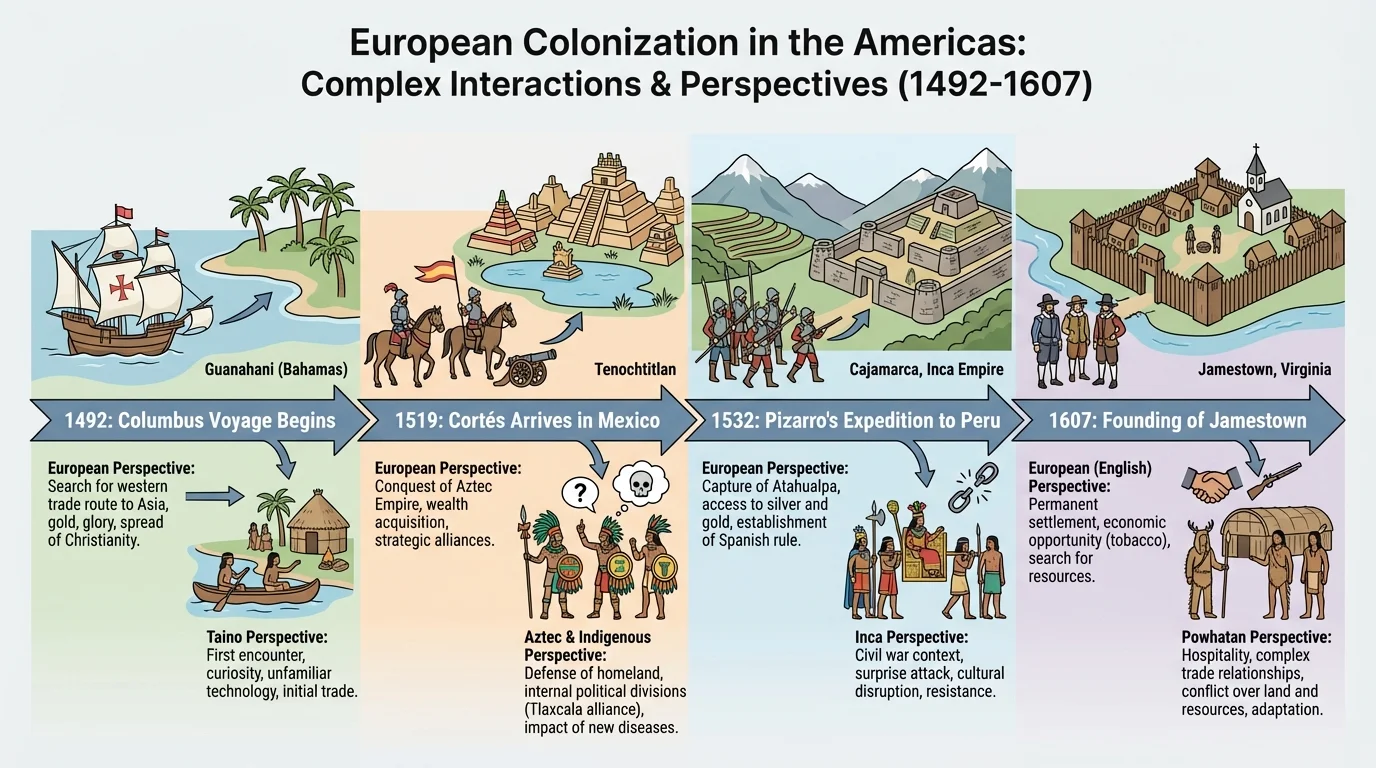
| Year | Event or Person | Why It Matters |
|---|---|---|
| 1492 | Christopher Columbus reaches the Caribbean | Begins lasting contact between Europe and the Americas |
| 1494 | Treaty of Tordesillas | Spain and Portugal divide claims to newly encountered lands |
| 1519–1521 | Hernán Cortés conquers the Aztec Empire | Shows how war, alliances, and disease helped Spain expand |
| 1532–1533 | Francisco Pizarro conquers the Inca Empire | Expands Spanish control in South America |
| 1500s | Columbian Exchange spreads | Changes food, animals, disease patterns, and environments |
| 1500s–1800s | Transatlantic slave trade grows | Forces millions of Africans into slavery in the Americas |
| 1607 | Jamestown founded | Marks a permanent English settlement in North America |
Notice that this timeline includes explorers, conquerors, systems, and long-term processes. That matters because history is not only about famous individuals. Larger patterns, such as trade, slavery, disease, and settlement, can be just as important as one person's decisions.
History is often more complicated than a single story makes it seem. European colonization included exploration, trade, mission work, settlement, violence, cooperation, resistance, and dramatic cultural change. Different groups experienced the same events in very different ways. That is why historical context and perspective are so important.
When we study the complex interactions between majority and minority groups, we learn that power shapes whose voices are heard, whose land is taken, and whose lives are valued. We also learn that people who faced oppression still made choices, fought back, and preserved their cultures. Looking at those details helps us understand the past with greater honesty and care.
The Americas were already filled with diverse societies before colonization. Events unfolded over time rather than all at once. Studying both geography and chronology helps us avoid oversimplified history.
