A message that once took months to cross an ocean can now travel in seconds. That huge change helps us understand a big idea in history: societies do not stay the same. Across the Western Hemisphere, people built cities, formed empires, traded goods, moved from place to place, shared ideas, fought over power, and created new cultures. When historians study these changes, they look at development, or how life changes over time in social, political, cultural, and economic ways.
The Western Hemisphere includes North America, Central America, the Caribbean, and South America. It is home to many different environments, from Arctic lands to tropical islands to mountain ranges such as the Andes. Because geography varies so much, people in different places developed different ways of living. Still, these regions were connected. Goods, people, and ideas moved within the hemisphere and across the Atlantic Ocean.
Long before Europeans arrived in the Americas, Indigenous peoples had already built organized societies with trade systems, governments, farming methods, and communication networks. The Maya, Aztec, and Inca are well-known examples, but many other nations and communities also shaped the hemisphere. They created roads, terraces, cities, markets, and systems of leadership. These early societies are an important part of the hemisphere's development.
Social development is change in the way people live together, including families, classes, communities, and daily life.
Political development is change in government, power, leadership, and laws.
Cultural development is change in language, religion, art, music, food, and traditions.
Economic development is change in how people produce, trade, and use goods and resources.
These four kinds of development often happen together. For example, when new trade routes open, economies grow, but cultures also mix, governments compete for control, and migration increases. A single event, such as the arrival of Europeans in the late 1400s, can cause social, political, cultural, and economic changes all at once.
Social development in the Western Hemisphere can be seen in the growth of cities, changes in family life, and the mixing of different peoples. In Indigenous civilizations, social systems often included farmers, craft workers, merchants, warriors, nobles, and priests. In the Aztec capital of Tenochtitlan, for example, many people lived in a busy urban center with markets, temples, and canals. This shows that social life could be highly organized and complex.
After European colonization began, social structures changed sharply. Colonies often created strict class systems. In Spanish America, people born in Spain usually held the most power. Below them were people of European ancestry born in the Americas, then people of mixed ancestry, Indigenous peoples, and enslaved Africans. These class systems affected jobs, education, land ownership, and political rights.
Forced labor and slavery deeply shaped social life. Millions of Africans were taken across the Atlantic against their will. This terrible process broke families apart and created societies in the Americas where enslaved labor became central to plantations and mines. At the same time, African communities preserved many traditions and built new ones in the Americas, helping shape languages, food, religion, and music.
Migration also changed societies. Some people moved by choice in search of land, religious freedom, or work. Others were forced to move by war, slavery, or colonial rule. Over time, port cities such as Havana, Lima, Mexico City, and later New York became diverse places where many cultures met. Social development often meant both opportunity and conflict.
The Inca built a road system stretching thousands of miles through mountains and valleys. Runners carried messages along these routes, allowing leaders to stay connected across a vast empire.
Social history is also the history of ordinary life. Historians ask what people ate, where they lived, how children were raised, what work people did, and how communities celebrated or mourned. Looking at social development helps us understand not just rulers and wars, but everyday human experience.
Political development includes the rise and fall of states, empires, colonies, and independent nations. In the Western Hemisphere, Indigenous states had their own systems of rule before European conquest. The Inca Empire used officials and roads to manage territory, while the Aztec Empire relied on tribute from conquered peoples. These were complex political systems with organized leadership.
European colonization brought new political structures. Spain and Portugal claimed enormous territories in Central and South America. Britain, France, and the Netherlands also founded colonies in North America and the Caribbean. Colonial governments ruled in the name of kings and queens across the ocean. That meant many major decisions were made far away from the people living in the colonies.
Over time, many colonial regions began to seek more control. In the late 1700s and early 1800s, independence movements transformed the hemisphere. The American Revolution led to the creation of the United States. In Haiti, enslaved people and free people of color led a revolution that ended French colonial rule. In Spanish South America, leaders such as Simón Bolívar and José de San Martín fought for independence.
Political development did not end with independence. New nations had to write constitutions, build armies, collect taxes, and decide who could vote. Some regions became republics, while others faced civil wars or strong military rulers. Even after colonies became independent countries, struggles over power continued.
Case study: Haiti and political change
Haiti provides a powerful example of political development in the hemisphere.
Step 1: Under French rule, Saint-Domingue was a rich sugar colony worked largely by enslaved Africans.
Step 2: In 1791, a major uprising of enslaved people began.
Step 3: Leaders such as Toussaint Louverture helped turn the uprising into a revolutionary movement.
Step 4: Haiti became independent in 1804, creating the first independent Black republic in the Americas.
This event changed politics across the hemisphere because it challenged slavery and colonial rule at the same time.
Political development is closely tied to geography and economics. Governments wanted to control land, ports, rivers, and resources because power often depended on them. This is one reason empire-building and trade were so closely connected.
Cultural development in the Western Hemisphere is one of the clearest signs that different groups influenced one another. Indigenous languages, European languages, and African languages all left marks on the hemisphere. Spanish and Portuguese spread widely in Latin America, while English became dominant in much of North America. French remained important in parts of Canada and the Caribbean. Many Indigenous languages also survived and continue today.
Religion changed too. European colonizers brought Christianity, especially Roman Catholicism and later Protestant traditions. But Indigenous and African beliefs did not simply disappear. In many places, people blended traditions. This cultural blending is called syncretism. It can be seen in religious practices, festivals, music, and art across the Caribbean and Latin America.
Foods also tell the story of cultural development. Crops native to the Americas, such as maize, potatoes, tomatoes, cacao, and peppers, spread around the world. Europeans brought animals such as horses, cattle, and pigs, along with crops like wheat and sugarcane. African knowledge contributed greatly to farming, cooking, and foodways in the Americas. Everyday meals became evidence of global exchange.
Music and art reveal cultural mixing as well. African rhythms influenced Caribbean and Latin American music. Indigenous designs appeared in textiles and crafts. European instruments and artistic styles mixed with local traditions. Cultural development means that people do not just keep old traditions; they also create new ones together.
"The history of the Americas is a history of meeting, mixing, conflict, and creativity."
Cultural change can happen slowly or quickly. War, migration, trade, religion, and technology all speed it up. A new port city, for example, can become a place where languages, clothing styles, songs, and ideas blend within just a few generations.
Economic development concerns how societies use land, labor, and resources to produce wealth. In the Western Hemisphere, economies changed greatly over time. Indigenous communities farmed, hunted, fished, and traded long before European colonization. The Inca used terraces to farm mountainsides, and many societies built markets where goods were exchanged.
Colonial empires reshaped the economy by focusing on valuable exports. Spanish colonies mined silver, especially in places such as Potosí. Portuguese Brazil became known for sugar plantations. British colonies in North America and the Caribbean produced tobacco, rice, indigo, and sugar. These goods were sold across the Atlantic and beyond.
Labor systems were central to economic development. Some colonizers forced Indigenous people to work through tribute or labor drafts. Others relied on enslaved Africans. Plantation agriculture and mining made some colonies very profitable, but that wealth often depended on exploitation and suffering. Economic growth for some came at a terrible human cost for others.
As trade expanded, towns and ports grew. Merchants, shipbuilders, dockworkers, and shopkeepers all became part of larger economies. Money, markets, and trade routes linked the Western Hemisphere to Europe, Africa, and Asia. Economic development therefore involved both local work and global connections.
Why trade changes societies
When a region produces goods that other places want, trade can bring wealth, jobs, and new technologies. But trade can also create inequality if only a small group controls the profits. In the Western Hemisphere, trade helped cities grow, yet it also encouraged slavery, empire-building, and competition for land and labor.
Economic choices also affected the environment. Forests were cut for shipbuilding and plantations. Mining changed landscapes. New animals and crops transformed fields and diets. Economics is not only about money; it is also about how human decisions shape land and people.
One way to measure development is to ask how quickly people can send information. As [Figure 1] shows, across the Americas, communication networks changed greatly over time. Early societies used roads, runners, signals, and oral traditions. The Inca used roads and relay runners. Some Indigenous societies used knotted cords called quipu to help record information.
European empires added ships, official letters, and colonial administrators who sent reports across the Atlantic. This was still slow. Storms, war, and distance could delay messages for weeks or months. Even so, these networks allowed empires to control colonies, collect taxes, and spread laws and religious teachings.
Printing presses made communication faster and broader. Newspapers and pamphlets spread new ideas, including revolutionary ideas about rights and independence. Later, canals, railroads, and the telegraph made the movement of information and goods much faster. By the 1800s, communication was transforming politics, trade, and daily life.
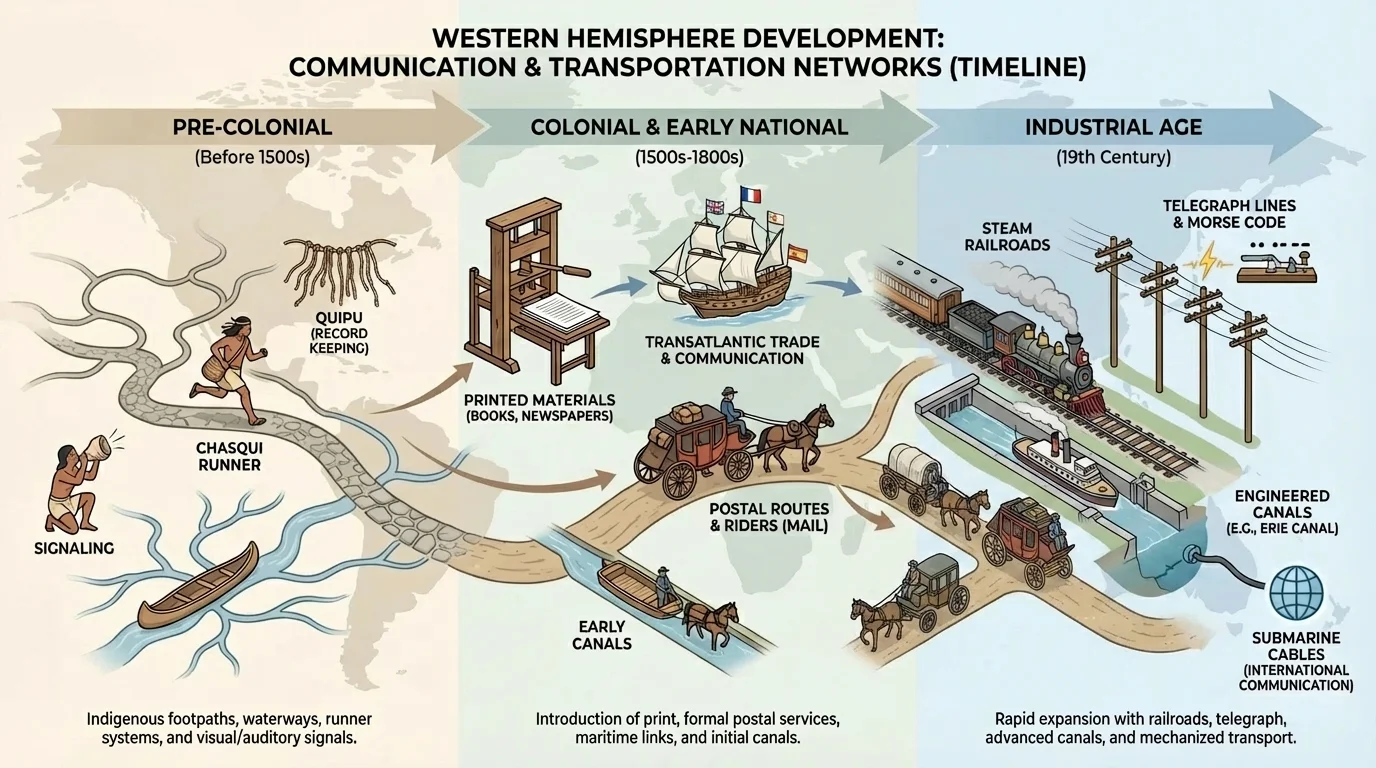
These changes mattered because better communication usually means stronger connections. A government can rule more effectively, merchants can react to prices more quickly, and people can learn news sooner. The same pattern still matters today when we think about phones, internet access, and transportation.
Later in the hemisphere's history, these expanding networks also made migration easier and tied distant regions together more closely, a point that connects directly to the movements seen in [Figure 3].
Colonial empires were a major force in hemisphere history, as [Figure 2] shows. Different European powers controlled different lands, and their regions can be compared clearly on a map. Spain controlled much of Mexico, Central America, the Caribbean, and large parts of South America. Portugal controlled Brazil. Britain built colonies along the Atlantic coast of North America and in the Caribbean. France controlled parts of Canada, Louisiana, and Caribbean islands. The Dutch also held Caribbean territories and trading posts.
Each empire had its own goals and methods, but most wanted land, labor, and wealth. They built forts, missions, plantations, mines, and port cities. They also imposed laws, taxes, and systems of rule. Colonization often harmed Indigenous peoples through war, forced labor, and disease, while also creating new mixed societies.
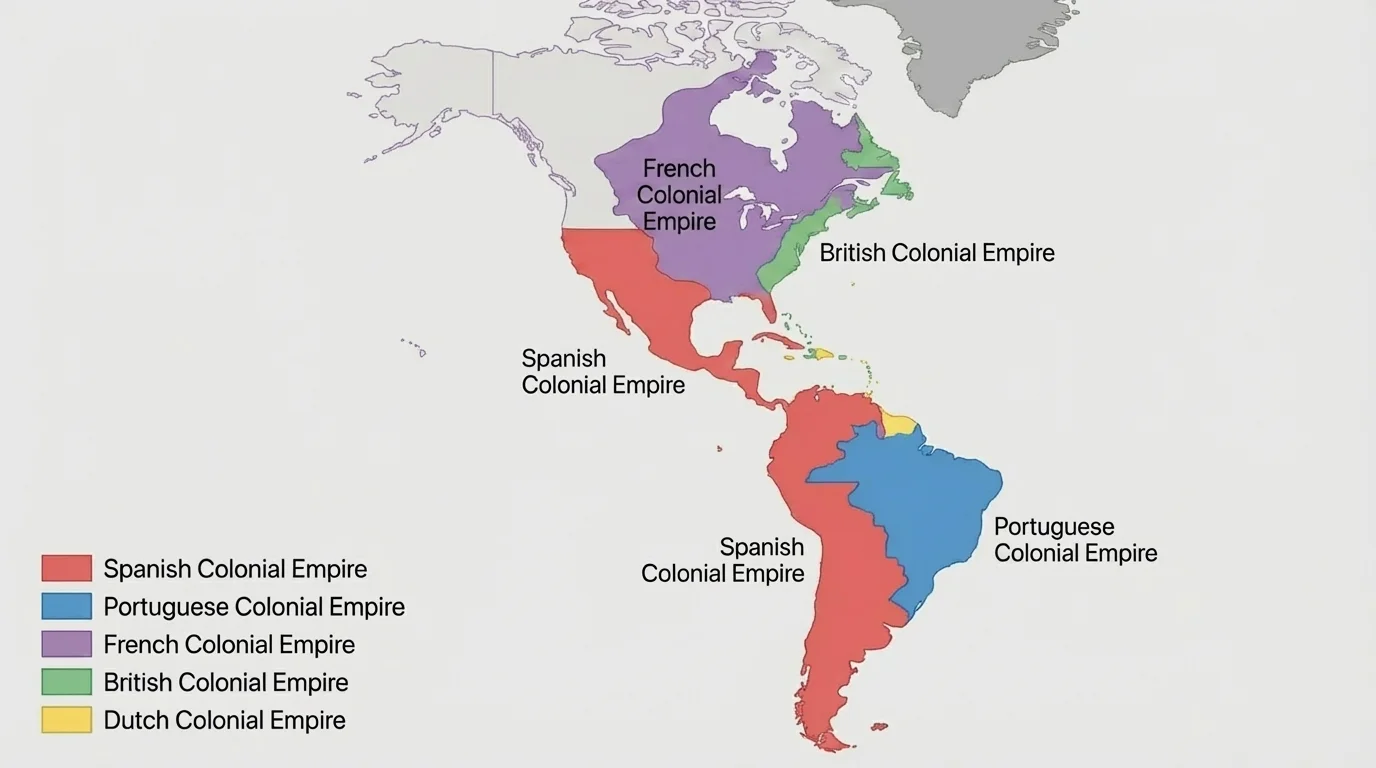
Colonial empires also competed with one another. They fought wars, signed treaties, and tried to control strategic coastlines and trade routes. This competition affected where settlements grew and which languages became dominant in different places.
| Empire | Main Areas in the Americas | Important Features |
|---|---|---|
| Spanish | Mexico, Caribbean, Central America, much of South America | Silver mining, missions, large viceroyalties |
| Portuguese | Brazil | Sugar plantations, later coffee, Portuguese language |
| British | Atlantic coast colonies, Canada, Caribbean islands | Settler colonies, trade, plantation systems in some regions |
| French | Canada, Louisiana, Caribbean islands | Fur trade, river routes, sugar colonies |
| Dutch | Caribbean territories and trade posts | Commercial trading interests |
Table 1. Comparison of major European colonial empires in the Western Hemisphere.
Even after independence, the colonial past remained important. Languages, borders, legal traditions, land patterns, and class systems often continued. These historical patterns help explain why neighboring countries today may have very different languages and historical experiences.
People have always moved, and the Western Hemisphere shows many kinds of migration over time. Indigenous peoples moved throughout the hemisphere long before European colonization, adapting to deserts, forests, plains, islands, and mountains. These movements helped spread crops, technologies, and trade connections.
After 1492, migration patterns changed dramatically. As [Figure 3] shows, Europeans crossed the Atlantic to settle, govern, trade, and seek wealth. At the same time, millions of Africans were forced across the ocean in the transatlantic slave trade. This was not voluntary migration. It was violent and coercive, and its effects are still felt today.
Within the Americas, people also moved from countryside to city, from colony to colony, and across frontiers. Some moved to missions or mining areas because they were forced. Others moved to farm new lands or join growing towns. In the 1800s, many immigrants from places such as Ireland, Germany, Italy, and China came to parts of the hemisphere.
Migration changes societies by bringing new skills, languages, and traditions. It can also create conflict over land, jobs, and power. Cities often grow where many migration routes meet, and those cities become important centers of culture and politics.
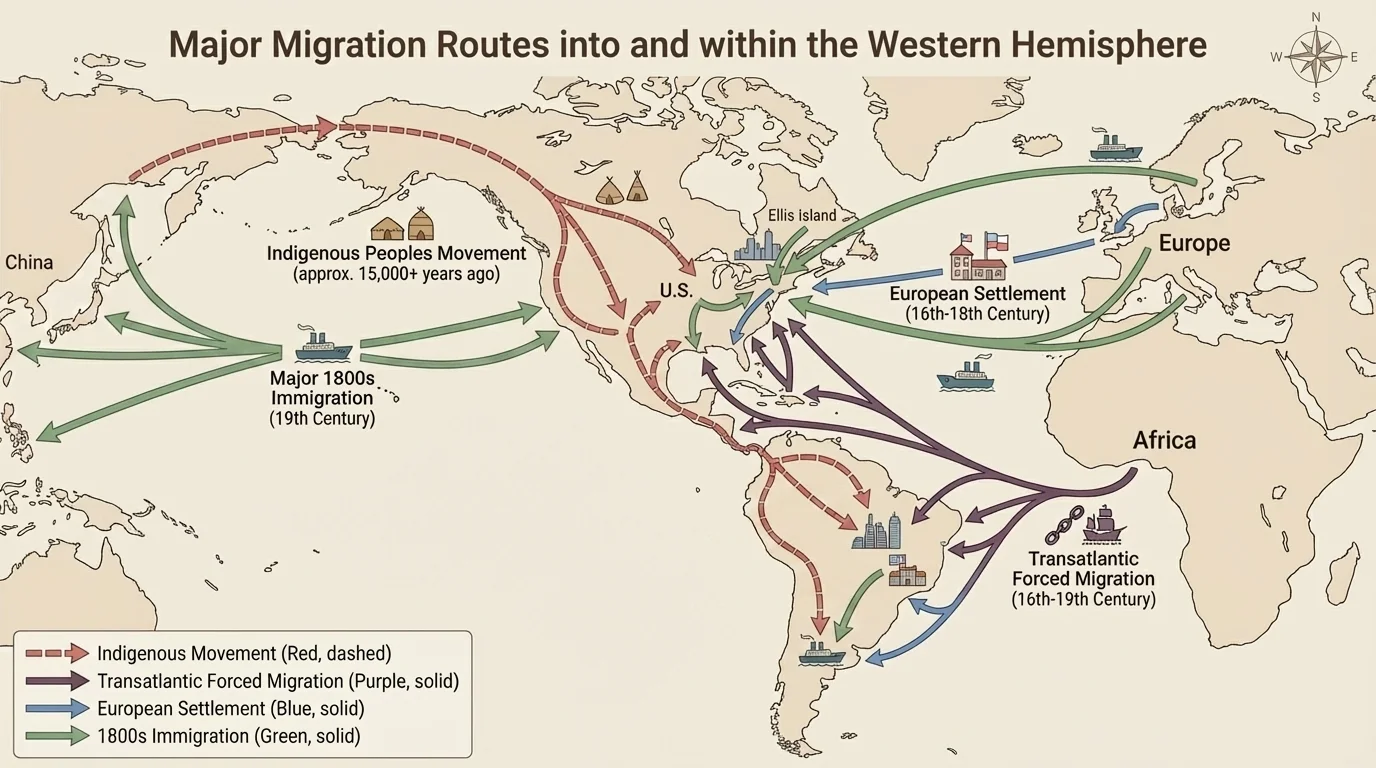
The migration map also helps us see that movement is not one single story. Some migration is chosen, some is forced, and some happens because communication and transportation networks make movement easier.
International trade linked the Western Hemisphere to the rest of the world. Silver from Spanish America reached Europe and Asia. Sugar from Caribbean plantations fed growing demand in Europe. Tobacco, coffee, cacao, furs, and timber also became major trade goods. Port cities grew rich by handling these products.
Trade encouraged specialization. A colony might focus on one main crop or resource because foreign buyers wanted it. This could bring profits, but it could also make a region dependent on a single product. If prices dropped or crops failed, the colony could suffer badly.
International trade also spread ideas. Merchants and sailors carried news, customs, and technologies. Revolutionary ideas crossed oceans along with goods. Because of expanding communication systems, especially those outlined in [Figure 1], information could support trade and political change at the same time.
Case study: silver from Potosí
The city of Potosí, in present-day Bolivia, became one of the most important silver-mining centers in the world.
Step 1: Spanish colonizers organized labor to extract silver from the mines.
Step 2: Silver was transported to ports and shipped across the Atlantic.
Step 3: From Europe, some silver continued into trade with Asia.
Step 4: Wealth from this trade strengthened the Spanish Empire, even though mine labor was often harsh and deadly.
This example shows how one place in the Americas could influence economies far beyond the hemisphere.
Trade therefore had mixed results. It brought wealth, connected continents, and helped cities grow. But it also increased slavery, environmental change, and imperial competition. Historians study trade by asking who benefited, who suffered, and how the system changed over time.
To understand development in the Western Hemisphere, historians use primary sources and secondary sources. A primary source is something created during the time being studied, such as a letter, map, law, diary, ship record, or painting. A secondary source is written later by someone analyzing the past, such as a textbook or history article.
A Spanish colonial map, an Inca artifact, or a newspaper from the age of revolution can all tell us something important. But no single source tells the whole story. Historians compare sources, ask who created them, and consider whose voices may be missing.
Important figures help historians connect ideas to real events. Simón Bolívar is linked to South American independence. Toussaint Louverture is central to the Haitian Revolution. Bartolomé de las Casas wrote about the mistreatment of Indigenous peoples. These individuals mattered, but they were also part of larger movements and systems.
When reading history, always ask three questions: Who made this source? Why was it created? What does it reveal, and what might it leave out?
Using evidence helps us move beyond simple stories. The history of the hemisphere includes winners and losers, cooperation and violence, creativity and resistance. Sources help us see those layers more clearly.
A timeline helps organize the many developments we have studied. It shows that social, political, cultural, and economic changes overlap rather than happening one at a time.
| Time Period | Major Developments |
|---|---|
| Before 1492 | Indigenous societies build cities, trade networks, governments, and farming systems. |
| Late 1400s to 1500s | European exploration and colonization expand; disease and conquest transform many regions. |
| 1500s to 1700s | Colonial empires grow; plantations, mines, slavery, and Atlantic trade expand. |
| 1700s | New ideas spread through print and trade; political unrest increases. |
| Late 1700s to early 1800s | Revolutions and independence movements reshape the hemisphere. |
| 1800s | Railroads, telegraphs, and new migration waves change communication, trade, and society. |
Table 2. Major periods of development and change in the Western Hemisphere.
Looking across time, we can see patterns. Communication becomes faster. Trade becomes wider. Migration becomes more complex. Governments rise, fall, and change form. Cultures blend and create new traditions. These patterns help explain why the Western Hemisphere is both diverse and deeply connected.
