Two countries can both call themselves free and democratic, yet still make very different choices about newspapers, religion, jobs, or the rights of minority groups. That is one of the most interesting parts of civics: governments are not only made of leaders and laws, but also of values. A nation's values help answer big questions. What matters most? Freedom? Safety? Fairness? Opportunity? Tradition? The answers shape daily life, from what students learn in school to what reporters can say on television.
A country's government reflects what many of its people believe is important. These beliefs become part of a constitution, its laws, and the way leaders make decisions. Some nations strongly emphasize personal freedom. Others place greater stress on order, community, or economic growth. Most countries try to support several important values at the same time, but they may not always do so equally.
In the Western Hemisphere, countries such as the United States, Canada, Mexico, Brazil, Chile, Costa Rica, and Cuba have different histories and different systems of government. Because of this, their citizens and leaders may not place the exact same importance on every issue. Still, many nations in the region say they support basic ideas such as dignity, justice, and participation in public life.
Nation means a country and the people who belong to it. Culture is the shared way of life of a group, including language, traditions, beliefs, and customs. Values are the ideas people believe are important and worth protecting.
Think of a school as an example. If a school values creativity, it may offer art, music, and student choice. If it values order most, it may have stricter rules and schedules. Governments work in a similar way. Their priorities shape what rights are protected, what services are funded, and how much freedom citizens have.
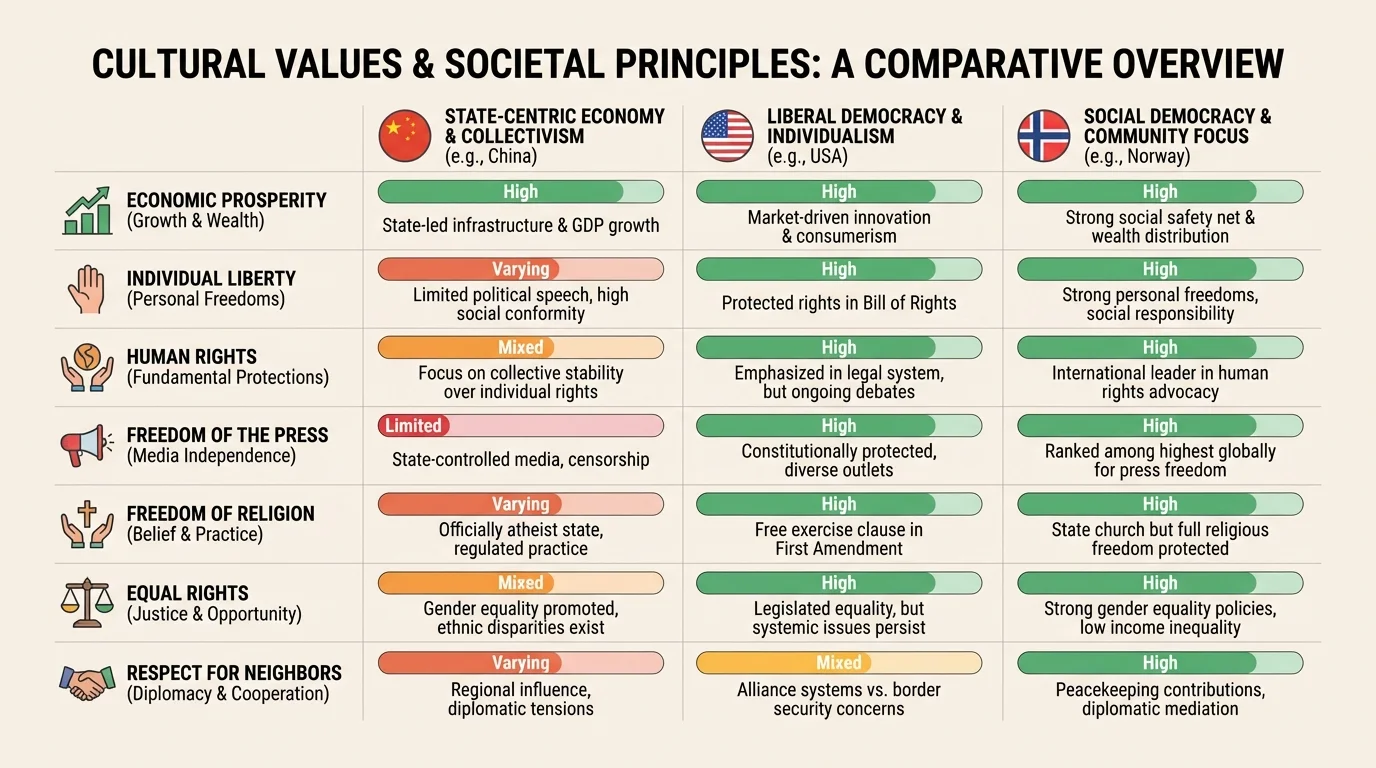
[Figure 1] When we compare countries, we can look at seven major civic values. These values are economic prosperity, individual liberty, human rights, freedom of the press, freedom of religion, equal rights, and respect for neighbors. Each one helps us understand what a nation believes makes a good society.
Economic prosperity means having a strong economy that gives people chances to work, earn money, start businesses, and improve their lives. A nation that values economic prosperity may invest in roads, trade, jobs, technology, and education. Citizens often connect prosperity to a better standard of living, but they may disagree about the best way to achieve it.
Individual liberty means people have the freedom to make many of their own choices. This can include freedom of speech, freedom to choose a job, freedom to move, and freedom to participate in politics. Nations that strongly value liberty often try to limit government power over private life.
Human rights are the basic rights all people should have simply because they are human. These include the right to life, safety, fair treatment, and freedom from torture or slavery. Many countries say they support human rights, but the level of protection can differ greatly.
Freedom of the press means newspapers, television, radio, and online news sources can report information and criticize leaders without unfair punishment from the government. This is important because citizens need reliable information to make decisions. A free press can also expose corruption.
Freedom of religion means people can practice a religion, change religions, or choose no religion at all. In countries that value this freedom, the government does not force everyone to believe the same thing.
Equal rights means all people should be treated fairly under the law, no matter their race, gender, religion, language, or background. A nation may claim to support equality, but real equality depends on whether laws are enforced fairly in everyday life.
Respect for neighbors can mean two things. Inside a country, it means treating other people and groups with fairness and peaceful cooperation. Between countries, it means respecting borders, working through disagreements peacefully, and cooperating on trade, migration, and the environment.
Some of the strongest protections for rights in the Western Hemisphere are written directly into national constitutions, but even strong words on paper do not guarantee that rights are always protected in real life.
These values are connected. For example, economic prosperity may be stronger when people can speak freely, share ideas, and trust the law. Equal rights can help a country use the talents of all its people. Respect for neighbors can support trade and peace. At the same time, leaders sometimes argue that one value should take priority over another, which can lead to conflict.
Values do not remain only ideas. Governments show them through institutions and actions. A country that values liberty may protect speech in its laws. A country that values prosperity may support business growth. A country that values equal rights may pass laws against discrimination. Looking at what a government actually does is often more useful than listening only to what leaders say.
Constitutions are a major place where values appear. They often list rights, explain the powers of government, and set limits on leaders. Courts also matter because judges decide whether laws follow the constitution. If a government punishes a journalist for honest reporting, courts in a country with strong press freedom may stop that action.
Elections are another sign of civic values. When citizens can vote fairly, they can influence how their nation balances freedom, equality, safety, and prosperity. Schools, public ceremonies, and national holidays also teach values. For example, a country may celebrate independence, democracy, or human dignity as part of its identity.
Values become visible through government systems. A democracy often gives citizens more ways to express opinions, vote, and criticize leaders. An authoritarian system usually gives leaders more control and citizens fewer freedoms. However, even democratic countries are not perfect, and they may still struggle to protect rights equally for everyone.
Media laws, religious laws, labor laws, and civil rights laws all reveal what a country considers important. If reporters are jailed, press freedom is weak. If people from minority groups cannot vote or get equal treatment, equal rights are weak. If people can start businesses but only a few wealthy groups benefit, economic prosperity may exist for some citizens but not for others.
The Western Hemisphere includes countries with different political systems, histories, and priorities. This means nations in the same hemisphere may share some values while placing different levels of emphasis on each one.
[Figure 2] The United States has long placed strong importance on individual liberty, freedom of the press, and freedom of religion. Its political culture often emphasizes limited government and personal rights. At the same time, Americans continue to debate how well the country protects equal rights and human rights for all groups. Economic prosperity is also a major national goal, and many public debates focus on jobs, wages, taxes, and business.
Canada also places high value on liberty, human rights, and freedom of religion, but its political culture often stresses balancing individual rights with the common good. Canada is known for multiculturalism, which encourages respect for people from many backgrounds. Equal rights and peaceful cooperation are often central to how Canadians think about government and national identity.
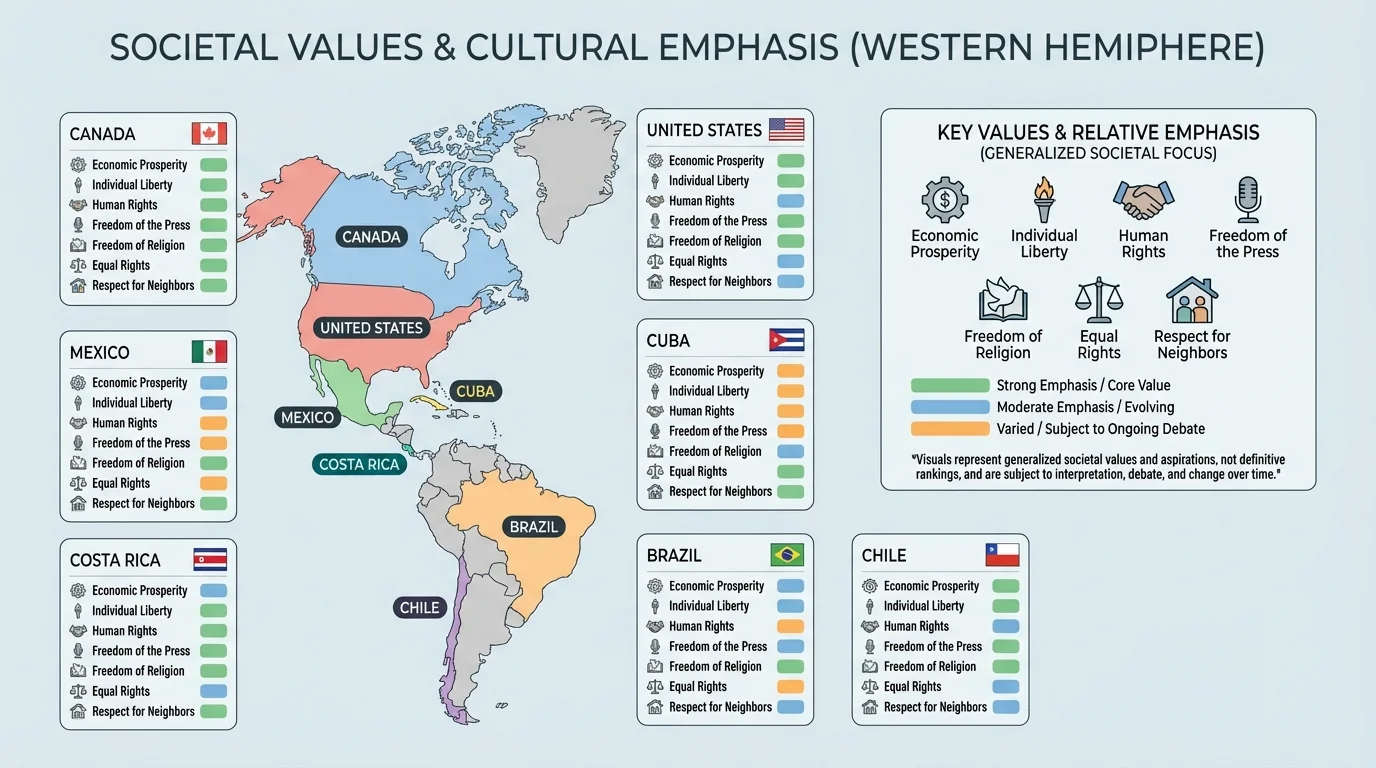
Mexico values national sovereignty, economic opportunity, and social rights. Its history includes struggles over democracy, inequality, and political reform. Mexicans may strongly support freedom and rights while also expecting the government to play an active role in improving economic conditions and social fairness.
Costa Rica is often noted for valuing democracy, education, and peaceful government. It does not have a standing army, and it has invested heavily in health and education. This shows how a country can place a high value on human well-being, stability, and cooperation.
Cuba presents a different example. Its government has often emphasized social services, education, health care, and national control over the economy. However, it has also been criticized for limiting individual liberty, freedom of the press, and open political competition. This shows that a government may claim to support equality or prosperity while restricting other freedoms.
Brazil and Chile are examples of South American countries where democratic government has developed alongside periods of political conflict and reform. In both countries, citizens have worked to strengthen human rights, elections, and press freedom after times when those rights were weaker. Their histories remind us that values can change over time.
| Country | Values often emphasized | Important notes |
|---|---|---|
| United States | Liberty, press freedom, religious freedom, economic opportunity | Ongoing debates about equality and rights in practice |
| Canada | Human rights, multiculturalism, equality, liberty | Often stresses both rights and community responsibility |
| Mexico | Sovereignty, reform, economic opportunity, social fairness | Works through challenges tied to inequality and corruption |
| Costa Rica | Peace, education, democracy, human well-being | Known for stable democratic traditions |
| Cuba | Social services, state control, national independence | Criticized for limits on political and press freedom |
| Brazil and Chile | Democracy, reform, civil rights, economic growth | Rights strengthened after difficult periods in history |
Table 1. Comparison of selected countries in the Western Hemisphere and the values often associated with their political cultures.
These examples are general patterns, not perfect descriptions of every person in each country. Within any nation, citizens disagree. One person may value economic growth most. Another may care most about equal rights. Another may believe press freedom is the key to protecting all the other rights. Nations are made of many voices, not just one.
Why do countries value different things? One reason is history. A country that fought against dictatorship may become especially protective of free elections and a free press. A country that suffered from poverty may focus heavily on economic prosperity and social programs. A country with many ethnic or language groups may place special importance on equal rights and coexistence.
Democracy grows differently in different places. Colonization, slavery, revolutions, military rule, immigration, and reform movements all leave lasting marks on how people think about government. For example, many Latin American countries experienced periods of strong rulers or military governments. Because of that history, many citizens in those countries care deeply about restoring and protecting civil freedoms.
Religion and cultural tradition also matter. In some societies, religious faith plays a strong role in public life. In others, government stays more separate from religion. Neither pattern automatically tells us whether freedom is strong or weak. What matters is whether people are allowed to choose their beliefs freely and whether the law treats everyone fairly.
Case study: How history shapes values
Chile offers a useful example of how a nation's history can affect what its people value.
Step 1: Chile experienced a period of dictatorship in the late twentieth century.
Step 2: During that period, many people worried about political violence and the loss of rights.
Step 3: After returning to democratic government, many citizens placed strong importance on elections, civil liberties, and human rights protections.
This helps explain why historical experience often changes what a society wants its government to protect most carefully.
Economic conditions shape values too. If jobs are scarce, people may strongly support leaders who promise growth and stability. If corruption is common, citizens may demand a freer press and more honest courts. As we saw earlier with the comparison in [Figure 1], one civic value can influence several others at once.
[Figure 3] Rights sound simple when we list them, but in real life governments must balance them carefully. A nation may support press freedom and still argue about whether certain information should be limited during a war or emergency. A country may support religious freedom while also requiring that religious practices do not violate other people's equal rights.
For example, a newspaper may publish criticism of government officials. In a country that values press freedom, that criticism is usually protected. But leaders may say some reports spread dangerous falsehoods or threaten public safety. The hard question becomes: who decides where the line is? In democratic systems, courts, laws, and public debate help answer that question.
Another example involves equality and liberty. A business owner may claim the liberty to run a business in a certain way. Workers or customers may argue that equal rights protect them from unfair treatment. Governments have to decide how liberty and equality can both be respected.
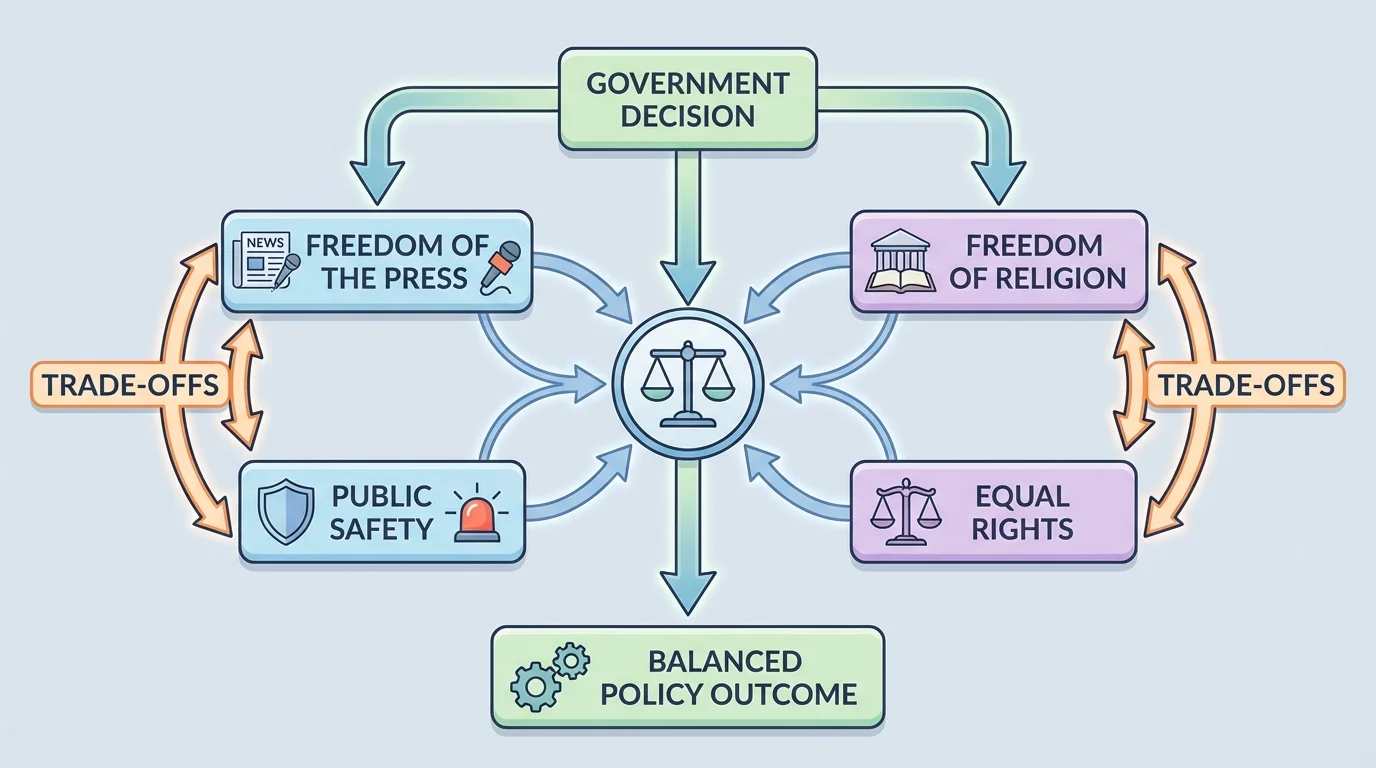
These conflicts do not mean rights are bad. They mean rights are powerful and important. In a healthy civic system, people can debate these questions peacefully, use courts and elections, and work toward fair solutions.
"The price of freedom is eternal vigilance."
— Often attributed to Thomas Jefferson and later civic tradition
This quote reminds citizens that rights must be protected actively. Freedom of the press matters because it helps people notice abuse of power. Equal rights matter because liberty is incomplete if only some people enjoy it. Human rights matter because every person has dignity, not just the most powerful.
Respect for neighbors is not just about being polite. Inside a country, it means listening to people who are different from us, settling disagreements peacefully, and following fair rules. In a democracy, citizens do not have to agree on everything, but they do need to respect one another's rights.
Between nations, respect for neighbors means diplomacy, cooperation, and peaceful problem-solving. Countries in the Western Hemisphere work together on trade, environmental issues, migration, and disaster relief. If one country ignores others or uses force unfairly, trust becomes weaker. Good neighbor relations can help economies grow and can reduce conflict.
For example, countries may share information during hurricanes, work together to stop disease outbreaks, or negotiate trade agreements. These actions show that prosperity and respect are often linked. A country that cooperates with neighbors may create more stability and more opportunity for its citizens.
Governments have different structures, such as democracies, republics, and authoritarian systems. Those structures affect how much power citizens have and how well rights are protected.
Respect for neighbors also matters in diverse communities. In many countries of the Americas, people come from Indigenous, African, European, Asian, and mixed backgrounds. A government that respects this diversity is more likely to protect equal rights and human dignity. A government that favors only one group can create division and injustice.
As countries change, their values can change too. Citizens, journalists, religious leaders, teachers, activists, and voters all help shape what their nation stands for. That is why civics matters: understanding values helps us understand not only how governments work, but also what kind of society people are trying to build.
