A single social media post, a vote in an election, a neighborhood cleanup, or a protest in a city square can all shape public life. That may sound surprising, but civic participation is not just something adults do in government buildings. It happens whenever people try to improve their community, influence leaders, or speak up about public issues. In the Eastern Hemisphere, people live under many kinds of governments, so the chances they have to participate—and the limits they face—can be very different.
When people take part in public life, they help decide what their communities value. Citizens may push for cleaner water, better schools, safer roads, fair laws, or more freedom. In some societies, leaders are expected to listen because citizens can vote them out of office. In other societies, leaders control political life more tightly, so public participation may be restricted or risky.
Civic participation matters because governments make decisions that affect daily life. Think about school schedules, transportation, health rules, public parks, and internet access. These are not abstract ideas. They shape the world people wake up to every day. The more people can communicate with leaders and organize with one another, the more likely a government is to understand public needs.
Civic participation is the way people take part in the life of their community and government. It includes actions such as voting, volunteering, joining groups, speaking about issues, contacting leaders, and working to solve public problems.
Citizen usually means a legal member of a country who has certain rights and responsibilities. In some places, noncitizens may also participate in community life, but political rights are often more limited.
Public policy is a plan or action taken by a government to deal with issues in society.
Civic participation includes both formal and informal actions. Formal participation happens through official systems, such as voting, running for office, or joining a political party. Informal participation includes peaceful marches, community service, online campaigns, and public discussions. Both kinds can matter, but their effectiveness depends on the rules of the society.
In everyday life, people may not use the phrase civic participation, but they often practice it. A family might sign a petition to improve a dangerous road. Students might organize a recycling drive. Workers might ask the government to change labor laws. Journalists may investigate corruption. Religious groups, environmental organizations, and youth clubs can also influence public life.
Participation also involves rights and responsibilities. Rights protect people's ability to speak, gather, vote, or publish ideas. Responsibilities include following laws, staying informed, respecting others, and contributing to the community. A healthy civic life usually depends on both.
Rights on paper versus rights in real life
Some countries write strong freedoms into their laws or constitutions, but real life may look different. People may still face pressure from officials, fear of arrest, or lack of access to fair courts. To understand civic participation, it is important to look at both the official rules and what actually happens in society.
This is why studying civic participation means more than listing rights. We also have to ask whether those rights are protected, whether citizens trust the system, and whether different groups—such as women, minorities, or rural communities—have equal chances to take part.
[Figure 1] People across the Eastern Hemisphere live under different political systems, and citizen influence changes depending on the system. Some countries are democracies, where citizens choose leaders in competitive elections. Others are constitutional monarchies, where a king or queen serves as head of state but elected officials usually run the government. Still others are authoritarian systems, where leaders hold strong control and public opposition is restricted.
A democracy gives citizens a direct role in choosing leaders and shaping laws. India, Japan, South Korea, Indonesia, and South Africa all have democratic systems, although they do not work in exactly the same way. Some use parliamentary systems, where voters choose lawmakers and the legislature helps choose the head of government. Others use presidential systems, where citizens elect a president directly or indirectly.
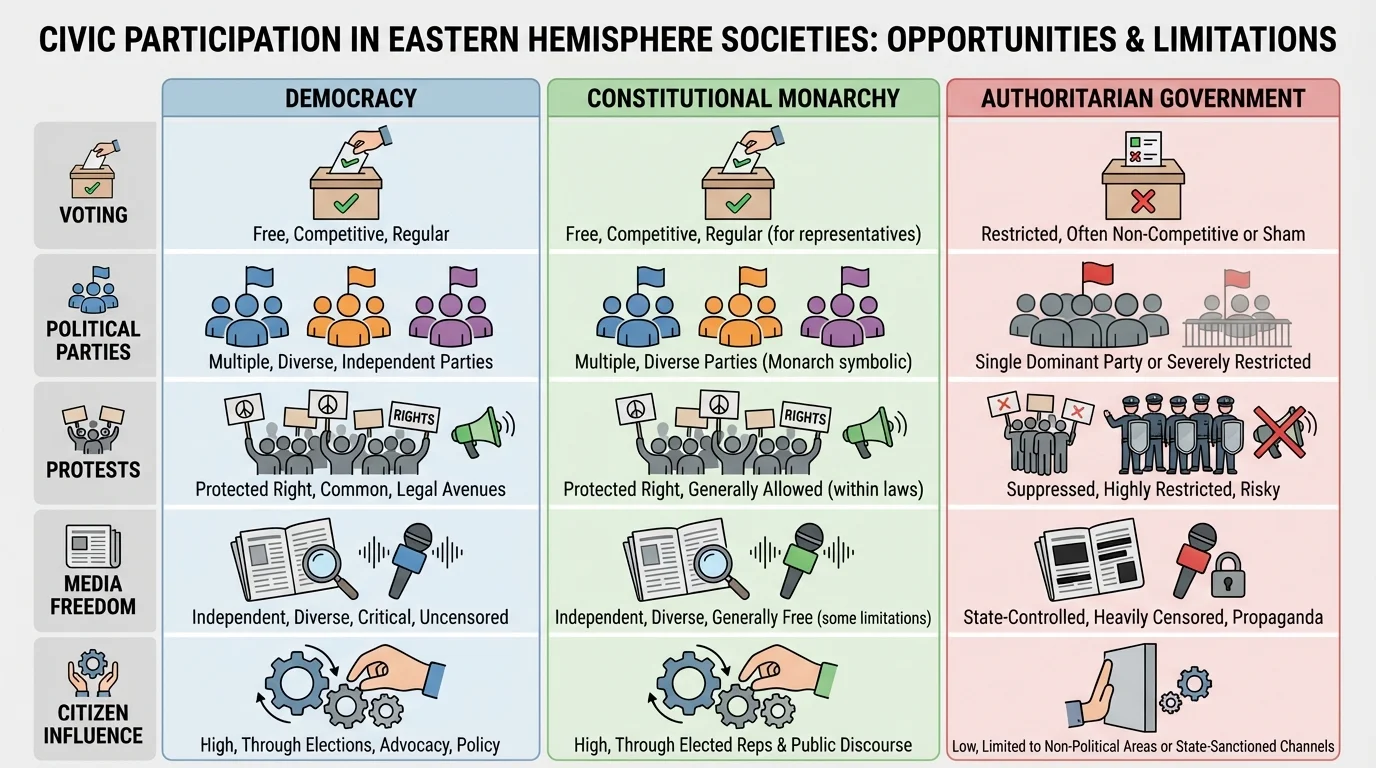
In a constitutional monarchy with a parliamentary system, such as Japan, the monarch is a symbolic head of state, while elected representatives make most political decisions. This system allows civic participation through democratic institutions such as elections, political parties, and public discussion. The monarchy remains important culturally, but it does not usually control lawmaking.
An authoritarian government limits political competition and often concentrates power in one leader, one ruling group, or one party. In these systems, citizens may still participate in local projects or public campaigns, but they often have fewer ways to challenge leaders or demand major political change. State control over media, political parties, and public assembly can make participation much narrower.
Some governments combine features in complicated ways. For example, a country might hold elections but still restrict opposition parties or the press. That means civic participation is not simply "free" or "not free." It exists on a spectrum.
[Figure 2] Participation happens in many forms, not just elections, and this figure helps organize these different paths. In societies with stronger protections for rights, people can vote, speak openly, form groups, campaign for laws, and criticize public officials. Even in places with fewer political freedoms, people may still join charities, local organizations, or issue-based campaigns.
One major opportunity is elections. Elections allow citizens to choose leaders, support political parties, and influence government policy. In India, for example, large national elections involve millions of voters across many languages, religions, and regions. This gives citizens a powerful way to shape leadership in one of the world's largest democracies.
Another opportunity is joining a political party or civic organization. Political parties connect people to government by promoting ideas, choosing candidates, and organizing campaigns. Civic groups work on issues such as environmental protection, women's rights, housing, or education. In South Korea, citizen activism has played an important role in defending democratic institutions and demanding accountability from leaders.
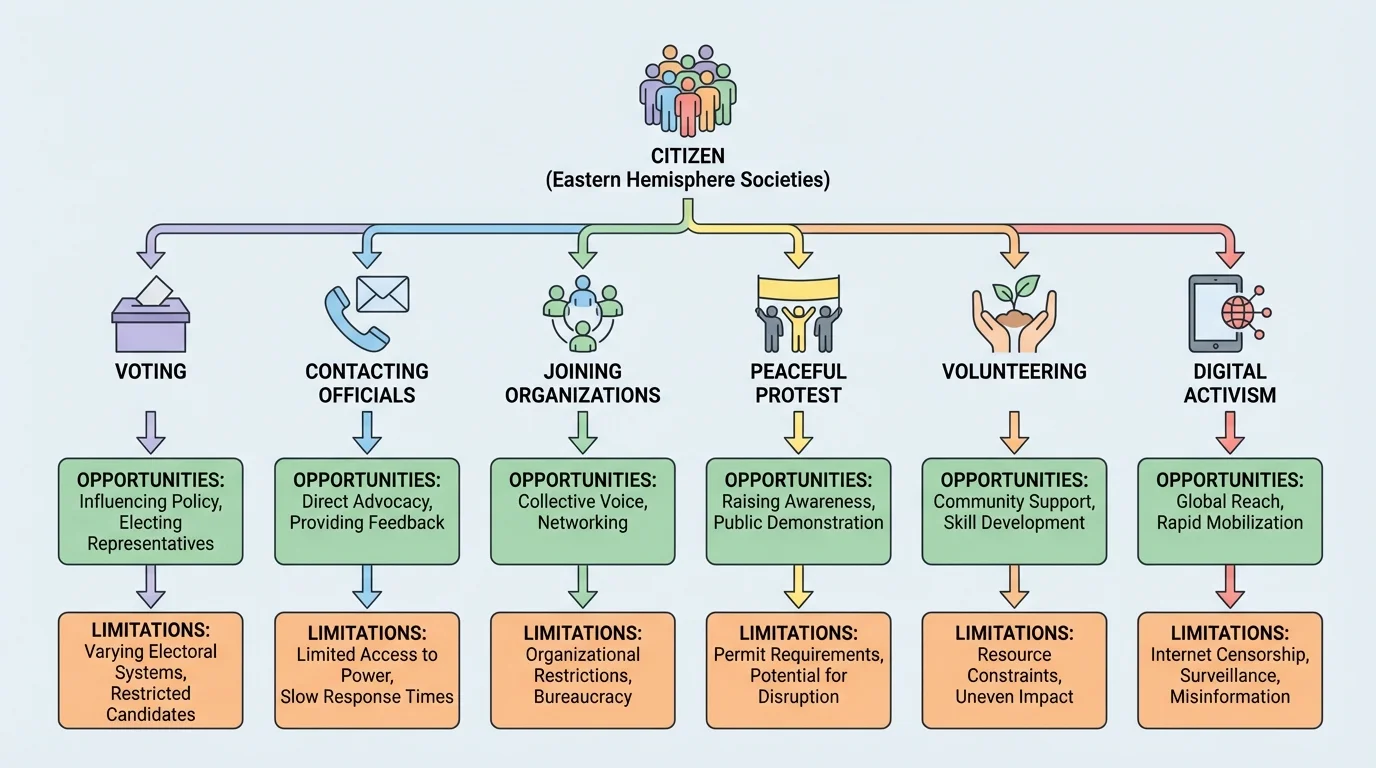
Citizens may also sign petitions, write to lawmakers, attend public meetings, volunteer, or take part in peaceful protests. Peaceful protest is a way to show public opinion clearly and visibly. In democratic societies, protest can pressure leaders to respond. In less open systems, protest may still happen, but it can bring greater danger.
Digital activism has become especially important. People use phones and the internet to share information, organize events, and build support quickly. A video, hashtag, or online petition can spread far beyond one city. This can amplify voices that are ignored by traditional media. At the same time, digital spaces can be monitored, censored, or flooded with false information.
Case study: India and community participation
India shows how civic participation can happen at several levels at once.
Step 1: Citizens vote in national and state elections.
This gives people a formal way to influence who makes laws and leads the country.
Step 2: People join local councils, neighborhood groups, and advocacy campaigns.
These groups focus on issues such as sanitation, water access, transportation, and education.
Step 3: Journalists, courts, and civil society organizations help check government power.
These institutions can increase accountability when they work independently.
India offers many opportunities for participation, but those opportunities are not always equal in every region or for every social group.
Young people can also participate, even before they are old enough to vote. They can join student councils, volunteer, debate issues, create awareness campaigns, and learn to evaluate information carefully. These habits build the skills needed for adult citizenship.
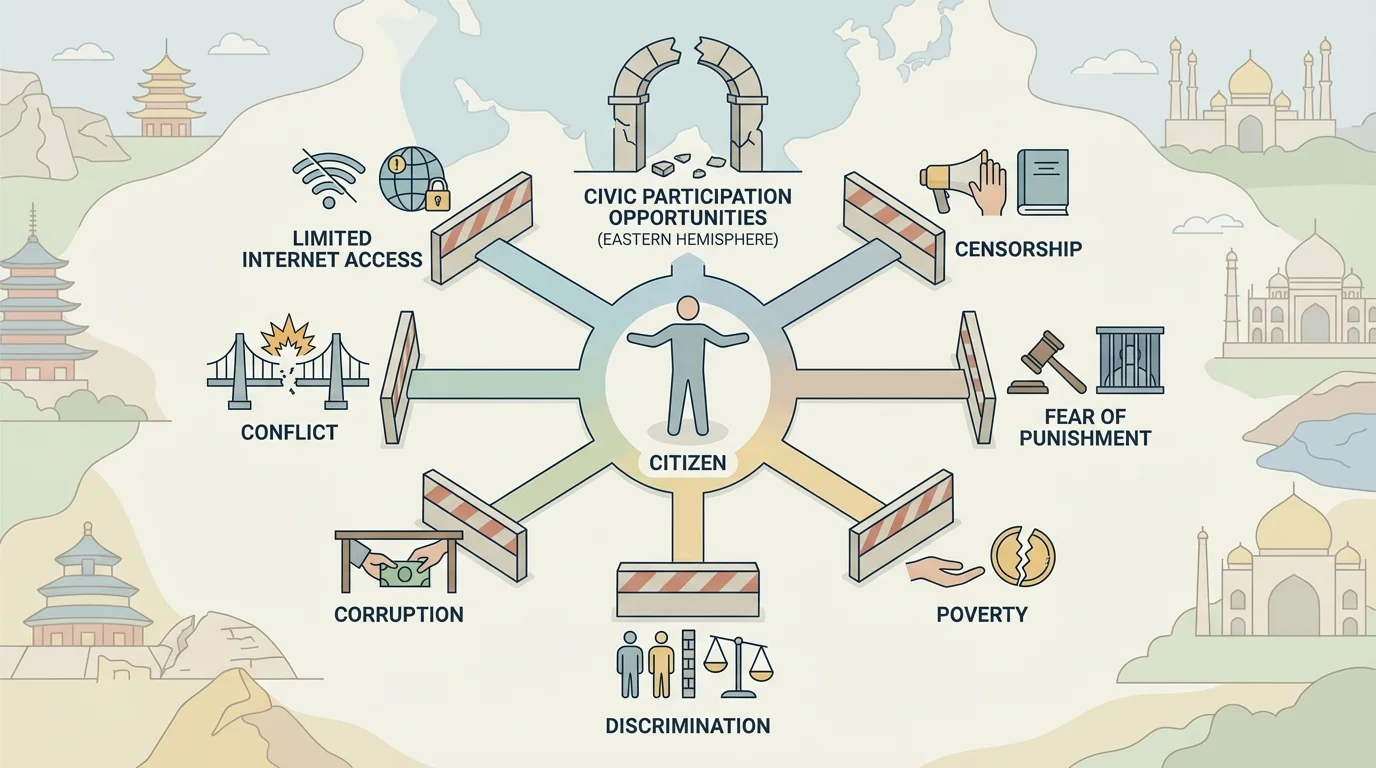
[Figure 3] Rights on paper may be weakened by barriers in real life, and this figure shows how political, social, and economic obstacles can block citizen action. In some countries, the main limitation is legal restriction. In others, the law may look open, but corruption, fear, or unfair treatment still discourage participation.
Censorship is one major barrier. When governments control news, remove online posts, or punish criticism, citizens have less information and fewer safe ways to express opinions. In heavily controlled systems, journalists and activists may face arrest, intimidation, or surveillance. That can make people afraid to speak up.
Another barrier is lack of fair competition in politics. If opposition parties are banned or weakened, elections may exist without giving citizens a real choice. When votes are manipulated or candidates are not allowed to campaign freely, participation loses much of its meaning.
Corruption also limits civic participation. If officials misuse power or accept bribes, citizens may believe their voice does not matter. Trust falls, and fewer people may bother to vote, contact leaders, or join public projects.
Economic inequality can be another limitation. A person working long hours just to survive may have little time to attend meetings or follow public issues. In rural areas, people may lack internet access, transportation, or education about political processes. This means some groups have much stronger civic voices than others.
Discrimination matters too. Women, ethnic minorities, religious minorities, migrants, and lower-income groups may face special barriers. Even where laws promise equal rights, social pressure or unequal treatment can reduce participation. In some societies, girls and women have had fewer opportunities to hold office, speak publicly, or move freely in political spaces.
Conflict and instability can make civic participation even harder. In places affected by war or unrest, security concerns may limit elections, public gatherings, and free discussion. People may focus first on survival, leaving less room for public debate and long-term reform.
Some governments allow community service and local volunteering while still tightly controlling national politics. This means citizens may be encouraged to improve neighborhoods but discouraged from criticizing top leaders.
These limitations remind us that civic participation is not only about what citizens want to do. It is also about what the system allows, protects, and respects.
[Figure 4] The Eastern Hemisphere includes a wide range of societies across Asia, the Middle East, and Africa. Looking at examples helps us see that civic participation changes from place to place, even when countries share the same region.
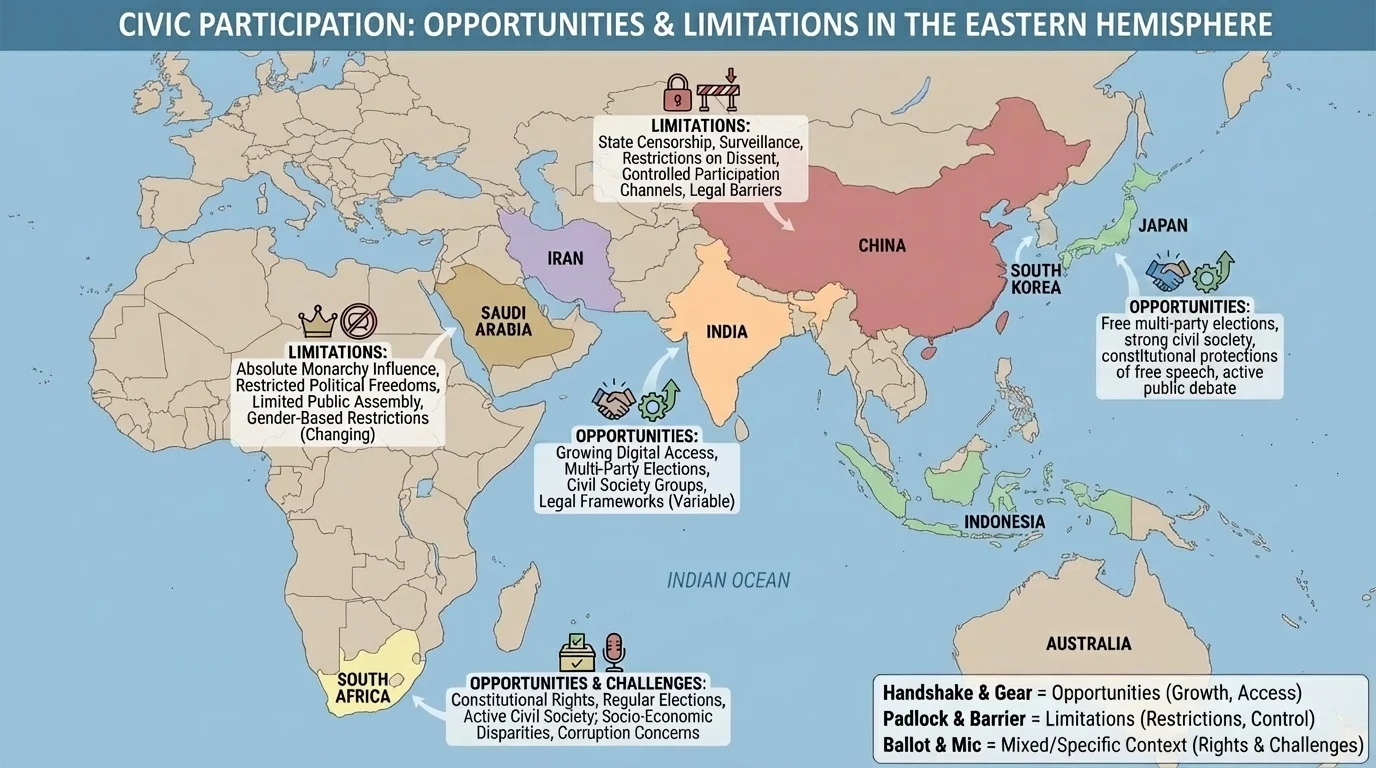
India is a federal democracy with regular elections and many political parties. Citizens have major opportunities to vote, campaign, organize, and challenge policies in court. At the same time, problems such as inequality, misinformation, and occasional pressure on journalists can limit participation for some groups.
Japan is a constitutional monarchy with a parliamentary system. Citizens vote, join parties, follow public debate, and influence policy through civic organizations. Political participation is generally protected, though, as in many democracies, some people may feel that politics is distant or dominated by established groups.
South Korea has a strong democratic system and a history of public protest helping to shape national politics. Citizens can vote, speak out, and organize. South Korea shows that active civil society can help defend democratic values over time.
Indonesia is a democracy with direct elections and growing civic participation after decades of authoritarian rule in the past. Citizens have important opportunities, but differences in wealth, geography, and local power structures can affect how equal those opportunities are.
China provides an example of a one-party state. Citizens may participate in local community efforts, public campaigns, or some limited local feedback systems, but organized opposition to the ruling party is restricted. Media control and censorship reduce open political debate, which connects back to the barriers shown in [Figure 3].
Iran has elections, but political participation is shaped by powerful religious and state institutions that limit who can run and how far dissent can go. Citizens may vote and engage in public life, yet restrictions on protest, speech, and opposition narrow political choice.
Saudi Arabia has changed in some ways over time, including expanded public roles for women in certain areas, but political participation remains more limited than in full democracies. Citizens do not participate in national politics in the same way they do in countries with competitive multiparty elections.
South Africa, while located in the Southern Hemisphere geographically, is often included in broader studies of Africa within the Eastern Hemisphere framework. It is a constitutional democracy with strong protections for rights. Citizens can vote, organize, protest, and use courts to defend freedoms, though poverty and inequality still affect how equally people can participate.
Despite major differences, there are also similarities. In almost every society, people care about issues such as safety, jobs, education, health, and fairness. In almost every society, leaders try to gain support, shape public opinion, and maintain order. Citizens everywhere look for ways to make their voices heard, whether through official politics or community action.
The biggest differences usually involve how much freedom people have, how safe participation is, and whether leaders must respond. As we saw earlier in [Figure 1], democratic systems usually provide more channels for citizen input, while authoritarian systems tend to narrow or control those channels.
| Government system | Common opportunities | Common limitations |
|---|---|---|
| Democracy | Voting, multiple parties, protests, petitions, civic groups, freer media | Misinformation, unequal access, low participation, corruption |
| Constitutional monarchy | Elections, party membership, public debate, community action | Political apathy, influence of established elites, unequal access |
| Authoritarian system | Community involvement, approved organizations, local problem-solving | Fear of punishment, restricted speech, limited assembly, weak political choice |
This comparison shows that civic participation is not absent in less democratic societies, but it is often narrower, less independent, and more closely watched by the state.
News media and technology can either widen or shrink civic participation. Independent news helps citizens understand issues and evaluate leaders. Controlled media can hide problems or spread one-sided messages. Social media can help citizens organize quickly, as seen in many countries, but it can also spread rumors and extreme opinions at high speed.
Meaningful participation
Participation is most meaningful when citizens can act freely, gain accurate information, and expect that their voices may influence decisions. If people can only participate in approved ways that never challenge power, participation may exist, but it is limited.
Youth participation matters because democratic habits start early. Students who learn how to discuss issues respectfully, check sources, volunteer in their community, and understand laws are better prepared to become active citizens later. Even when students cannot vote yet, they can practice listening, speaking, cooperating, and solving public problems.
At the same time, young people must learn to spot misinformation. A powerful message online is not always true. Responsible civic participation requires evidence, careful thinking, and respect for others' rights.
To analyze civic participation in any country, ask a few key questions. Can citizens vote in fair elections? Can they criticize leaders without fear? Can they join groups freely? Is the media independent? Are all groups treated equally? Do leaders respond to public demands?
These questions help us move beyond labels. A country may call itself democratic, but if journalists are silenced and opposition candidates are blocked, participation is limited. Another country may tightly control national politics but still allow local volunteering and service. Careful analysis means noticing both the opportunities and the limitations.
How to compare two countries
Suppose you compare Japan and China.
Step 1: Look at elections.
Japan has competitive elections with multiple parties. China does not allow national multiparty competition in the same way.
Step 2: Look at speech and media.
Japan generally protects open criticism more strongly. China uses more censorship and media control.
Step 3: Look at community action.
Citizens in both countries can take part in local and social activities, but the political independence of those activities differs.
This comparison shows both a similarity—people can contribute to society in both places—and a major difference—the freedom to challenge government power.
That is the heart of the topic: civic participation exists in many forms, but its strength depends on freedom, fairness, safety, and access. Across the Eastern Hemisphere, people continue to shape society in ways both large and small, from elections to local service projects, from court cases to digital campaigns.
