A country does not engage in trade with the world automatically. Ships, ports, factories, farms, prices, and jobs are all affected by decisions made at home. When a government changes a tax, sets a rule, or blocks a foreign product, that choice can ripple far beyond its borders. A farmer in one state, a merchant at a port, and a family shopping for clothes may all feel the effects. Understanding trade means understanding those choices.
International trade is the buying and selling of goods and services between countries. But trade is not shaped only by geography or natural resources. It is also shaped by domestic policies, which are laws, rules, taxes, spending decisions, and government actions made inside a country. A domestic policy may seem local, but it can change what the country imports, what it exports, and how much things cost.
International trade is exchange between countries. A country imports goods it buys from abroad and exports goods it sells to other countries.
Economic freedom means people and businesses have room to make choices about producing, buying, selling, and trading with limited government interference.
One big idea in economics is that people usually trade because both sides expect to gain. If one region grows wheat well and another region makes tools efficiently, both can benefit by specializing and trading. This idea becomes even more powerful across oceans and borders. In early American history, trade helped connect local producers to larger markets, and greater economic freedom often encouraged growth.
Governments influence trade in many ways. They can make foreign goods more expensive, make domestic industries cheaper to run, limit how much can be imported, or stop trade altogether. They can also improve trade by building roads, canals, and ports, protecting property rights, and creating stable laws that help merchants trust the system.
Think about a simple example. If imported shoes cost \(\$40\) and the government adds a tax of \(\$10\) to each pair, the price becomes \(\$50\). That change may lead some people to buy domestically produced shoes instead. A small policy change at home can shift purchasing decisions across the whole country.
Governments matter because trade is not only about goods. It is also about power, security, jobs, and money. Leaders may want to protect workers, punish another country, raise revenue, or help a new industry grow. Sometimes these goals conflict with each other, which is why trade policy can be controversial.
A tariff is a tax placed on imported goods. A tariff usually raises the price of foreign products. A subsidy is government money given to support a business or industry, helping it lower costs or stay competitive. A quota is a limit on the amount of a good that can be imported. An embargo is an official ban on trade with a country.
Another important term is regulation. Regulations are rules about safety, quality, labor, transportation, or the environment. Some regulations protect people and improve products, but they can also increase costs. Higher costs at home may make a country's goods more expensive in world markets.
Finally, economists often discuss economic freedom. In trade, this means buyers and sellers have fewer barriers when exchanging goods. In general, more trade freedom can increase competition, lower prices, and create more choices. However, it can also create hardship for industries that struggle to compete.
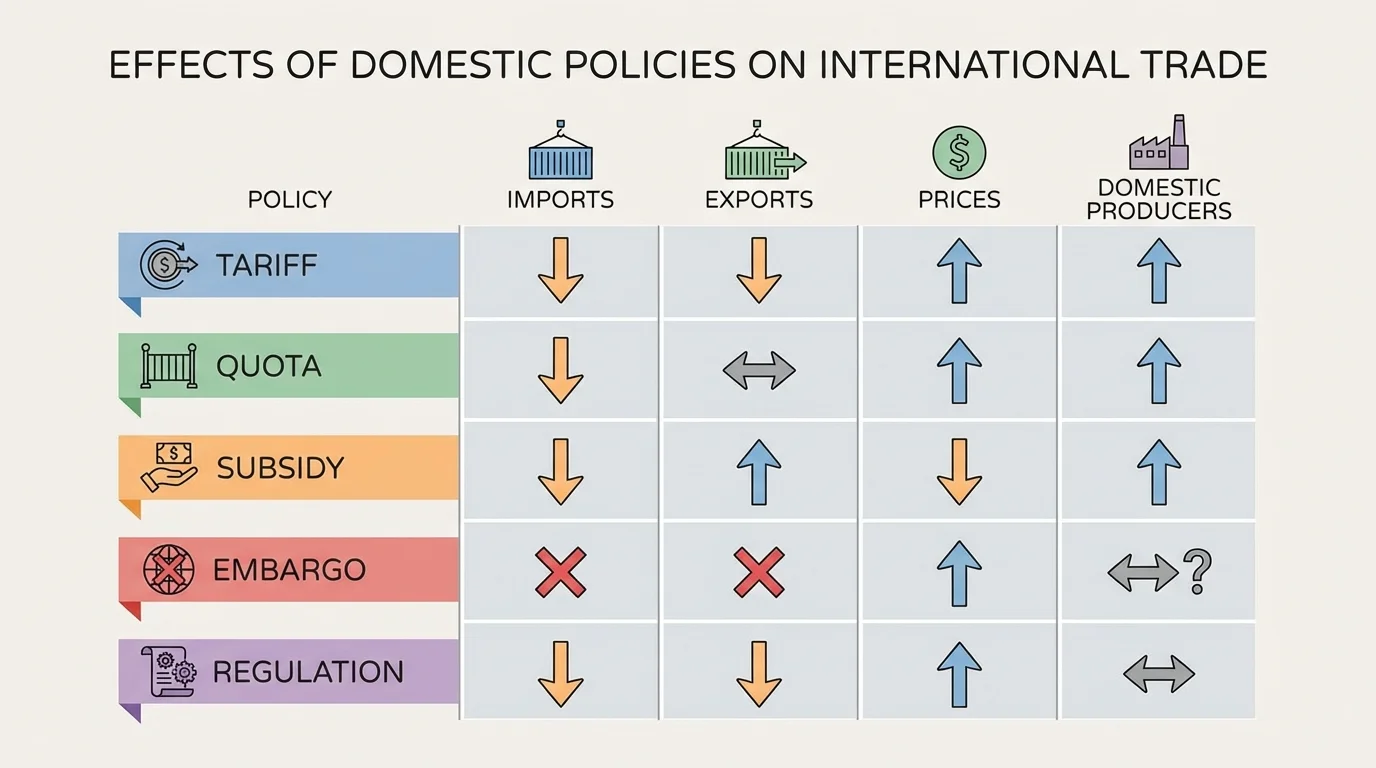
The main trade-related domestic policies can be compared clearly, as [Figure 1] shows, because each one changes the movement of goods in a different way. A tariff raises the cost of imports. A quota limits the number of imports. A subsidy helps domestic producers. An embargo stops trade completely with a certain place. Regulations set rules that products or businesses must follow.
Domestic policies also include government spending. If a government builds better roads, bridges, railways, or ports, businesses can move goods faster and more cheaply. That can increase exports because domestic products become easier to deliver. In early America, improved transportation mattered enormously because farms and workshops needed reliable paths to markets.
Taxes on businesses can affect trade too. If domestic companies face high taxes, they may have less money to invest in machinery, workers, or shipping. If taxes are lower, companies may expand production and sell more abroad. The same is true for banking rules and access to credit. Merchants who can borrow money more easily can buy ships, stock goods, and take part in foreign trade.
Labor laws and environmental laws also matter. Requiring safer working conditions and cleaner production can be good for society, but such rules may raise production costs. This does not automatically mean the rules are bad. It means there is a trade-off: protecting workers and the environment may make some goods cost more, which can influence trade patterns.
Cause and effect in trade policy
When a domestic policy changes the cost of making or buying a product, it often changes trade. If imports become more expensive, people may buy more domestic goods. If domestic producers get financial help, they may sell more at home and abroad. If rules make production slower or costlier, exports may drop. Economists track these chains of cause and effect to understand policy results.
Currency policy can matter as well, even though it is more advanced. If a country's money becomes stronger, imports may seem cheaper to its people, but its exports may seem more expensive to foreign buyers. Introductory economics often focuses more on tariffs and taxes because they are easier to observe directly.
Domestic policies affect consumers, producers, and governments in different ways. Consumers are people who buy goods. Producers are businesses or workers who make goods. A tariff may help domestic producers by reducing foreign competition, but it may hurt consumers by raising prices.
Suppose imported steel becomes more expensive because of a tariff. American steel companies may sell more steel. But companies that use steel to make cars, tools, or appliances may now pay more. They may raise their prices too. So one policy can help one industry and make life harder for another.
This is why trade policy often creates both winners and losers. A subsidy can keep farms or factories competitive, but taxpayers help fund it. A quota can protect local businesses, but shoppers may have fewer choices. An embargo may support a foreign-policy goal, but merchants at home can lose important customers.
Case study: a tariff on imported cloth
A government places a tariff on cloth made in another country.
Step 1: Imported cloth becomes more expensive in local stores.
Step 2: Some buyers switch to cloth made by domestic factories.
Step 3: Domestic cloth producers may hire more workers or increase production.
Step 4: Consumers may pay more overall, especially if domestic cloth also becomes pricier because competition has decreased.
The policy protects one industry, but it may reduce consumer choice and raise costs.
As seen earlier in [Figure 1], each policy tool pushes trade in a slightly different direction. The important habit is to ask three questions: What happens to prices? What happens to supply? Who gains and who loses?
In the early United States, trade was not just a side activity. It was a major source of growth. American farmers sold crops overseas. Merchants carried goods to Europe, the Caribbean, and other regions. Port cities expanded because they connected inland producers to foreign markets. These trade connections helped the young nation earn money, attract shipping, and build stronger commercial networks.
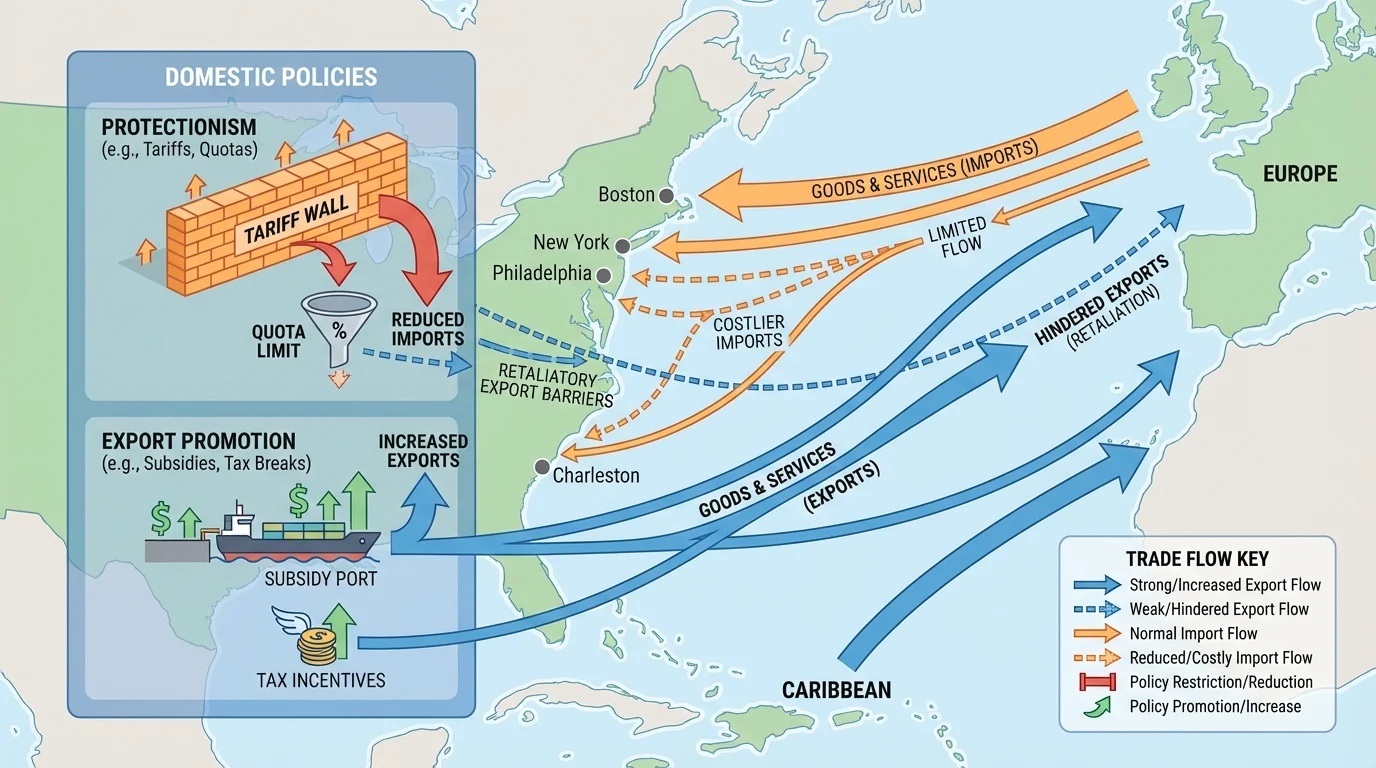
As [Figure 2] illustrates, economic freedom played an important role in this growth. When people were able to start businesses, ship goods, and respond to market demand, trade expanded. Property rights and contracts gave merchants confidence. Fewer internal barriers between states also made it easier to move goods to ports. Although the federal government did set tariffs and trade rules, many Americans believed that freer exchange encouraged prosperity.
Early port cities such as Boston, New York, Philadelphia, and Charleston became centers of commerce. Farmers far from the coast depended on roads, rivers, and eventually canals to send products toward those ports. If transportation improved, exports became easier. If trade restrictions tightened, merchants and producers often suffered.
At the same time, Americans debated how much government should intervene. Some leaders wanted stronger support for manufacturing. Others favored fewer restrictions and more reliance on agriculture and open trade. This disagreement shaped many early policy debates.
Many early American cities grew rich not just from what they produced themselves, but from serving as trading hubs where goods were bought, stored, shipped, insured, and sold again.
The map shows why location mattered so much. A port connected local workers and businesses to distant markets. When domestic policy supported transportation, legal stability, and commerce, international trade became a powerful engine of economic growth.
Governments usually do not create trade policies randomly. One reason is protection. Leaders may believe an important domestic industry, such as iron, textiles, or farming, needs time to grow before facing foreign competition. This is sometimes called protecting an infant industry, meaning a new industry that is still developing.
Another reason is revenue. In early American history, tariffs were a major way for the federal government to collect money. Before income taxes became common, taxing imports was an important source of funds.
A third reason is national security. A country may want to produce certain goods at home, especially materials needed in war or emergencies. Leaders may fear depending too much on other countries for vital supplies.
Governments also use trade policies for foreign policy. If a country wants to pressure another government, it may restrict trade. But those restrictions can hurt its own merchants and citizens too. That makes policy decisions difficult.
Supporters of trade barriers argue that they can save jobs, help key industries survive, and prevent unfair foreign competition. If another country produces goods very cheaply because of lower wages or weaker rules, domestic businesses may struggle. Tariffs or quotas can give them breathing room.
Critics argue that trade barriers often raise prices, reduce choices, and weaken competition. When businesses face less competition, they may have less reason to improve quality or lower costs. Consumers, especially families with lower incomes, may pay the price.
Free trade, which means fewer barriers to trade, often encourages specialization and efficiency. Countries can focus on the goods they make well and trade for others. This can increase total wealth and create more variety in the marketplace. But free trade can also cause job losses in industries that cannot compete, so transitions can be painful.
Remember that scarcity means resources are limited, so choices have costs. Trade policy is about choosing which costs a country is willing to accept: higher prices, weaker industries, job changes, or less economic independence.
There is rarely a perfect answer for everyone. The same policy can help one group, hurt another, and have mixed long-term effects. That is why economists and historians study trade policy so carefully.
Several important events in early U.S. history show how domestic policy affected international trade. Looking at them in sequence makes it easier to see how each decision changed the economy and influenced later choices.
[Figure 3] Alexander Hamilton, the first Secretary of the Treasury, argued that the United States should encourage manufacturing. He believed tariffs and government support could help American industries grow stronger. Hamilton thought a nation needed a diverse economy, not just farming, to become powerful and stable.
Thomas Jefferson often favored agriculture and was more suspicious of concentrated federal power, though his views also changed in response to events. The tension between manufacturing and farming, and between government action and economic freedom, became a lasting issue in American history.
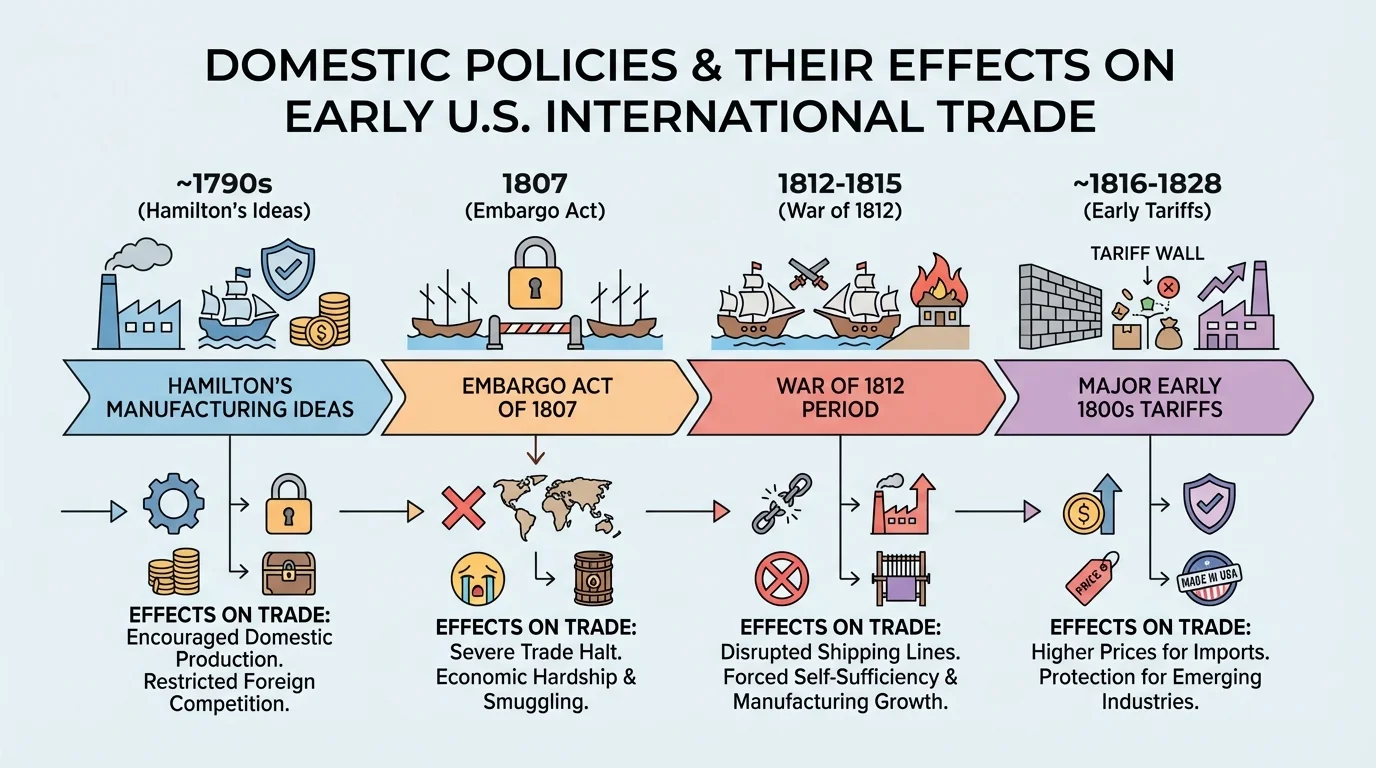
One dramatic example was the Embargo Act of 1807. The United States tried to avoid war and pressure Britain and France by stopping American trade with foreign nations. The result was severe harm to American merchants and port cities. Instead of helping the economy, the embargo reduced exports and hurt many workers whose jobs depended on shipping and trade.
During and after the War of 1812, Americans saw the danger of relying too heavily on foreign manufactured goods. This helped build support for tariffs that protected domestic industry. In the early 1800s, tariffs became a major political issue because different regions of the country had different economic interests.
The timeline in [Figure 3] shows that trade policy was not a single decision but a series of responses to war, growth, and political debate. Over time, domestic policies shaped whether the United States leaned more toward open exchange or more toward protection.
| Policy | Main Goal | Likely Effect on Trade | Possible Result at Home |
|---|---|---|---|
| Tariff | Protect domestic producers or raise revenue | Reduces some imports | Higher prices, support for local industry |
| Subsidy | Help domestic businesses compete | May increase exports | Industry growth, taxpayer cost |
| Quota | Limit foreign competition | Caps imports | Fewer choices, possible higher prices |
| Embargo | Punish or pressure another country | Stops trade with that country | Major losses for traders and ports |
| Infrastructure spending | Improve transport and commerce | Can increase exports and trade volume | Faster movement of goods |
Table 1. Comparison of major domestic policies and their common effects on international trade.
Even today, domestic policies affect what appears on store shelves, how much it costs, and where products come from. A tariff on electronics parts may raise the cost of phones or game systems. A subsidy to farmers may affect food prices. Shipping rules can influence how fast products arrive.
Trade also affects jobs. If a company can export more goods because transportation improves or foreign markets open up, it may hire more workers. If imports become cheaper and local factories cannot compete, some workers may lose jobs. Modern economies are connected through supply chains, so one policy can travel through many industries.
This is why economists pay attention to both short-term and long-term effects. A policy that protects jobs today may reduce competition and innovation later. A policy that lowers prices today may create job losses in some sectors. Trade policy is always about balancing goals.
Modern example: imported fruit
A country places new restrictions on imported fruit.
Step 1: Imported fruit becomes harder or more expensive to bring in.
Step 2: Domestic fruit growers may sell more.
Step 3: Stores may offer fewer fruit choices in certain seasons.
Step 4: Families may pay more for fruit when local supply is limited.
The policy helps some producers but may reduce variety and increase prices for consumers.
To analyze any domestic policy, start by identifying the policy itself. Is it a tariff, subsidy, quota, regulation, spending project, or embargo? Then ask what it changes first: price, supply, transportation, or legal access to markets.
Next, trace the chain of effects. If the policy raises import prices, consumers may switch to local goods. If local firms gain customers, they may hire more workers. But if prices rise too much, households may buy less overall. If foreign countries respond with their own barriers, exporters may be hurt. Trade policy often creates a chain reaction.
Finally, think about time. Some policies produce quick effects, but others shape an economy slowly. Better ports, stable laws, and greater economic freedom may not create instant change, but over years they can help trade grow and support economic development. This was especially true in early American history, when access to markets helped the young nation expand.
Domestic policies affect international trade because they shape the rules under which people produce, buy, sell, and ship goods. They can open opportunities or close them, lower prices or raise them, and encourage growth or slow it down. The history of the United States shows that trade and domestic policy have always been closely linked.
