Early in U.S. history, many people lived under laws they had little power to shape. That may sound strange in a country built on ideas of liberty and self-government, but it was true. Women could not vote for most of the nation's history. Most African Americans were enslaved at the founding. American Indians were pushed off their lands and treated as separate from full U.S. citizenship. People living in territories often had limited political power compared with people in states. The story of American government is not only about presidents and members of Congress. It is also about leaders from excluded groups who forced the nation to answer a difficult question: Who counts as a full member of the democracy?
These leaders changed the country in many ways. Some gave speeches, wrote newspapers, and organized meetings. Others challenged unfair laws in court, led marches, negotiated with federal officials, or ran for office. Their leadership influenced how the United States defines citizenship, protects rights, and distributes political power. By comparing women, American Indians, African Americans, and people in western territories and U.S. territories, we can see both different paths to change and a shared struggle for equal treatment under government.
Leadership in politics means more than holding a high office. A leader can be anyone who helps others recognize a problem, imagine change, and take action. In a democracy, leadership matters because laws and rights do not usually change on their own. People have to speak, organize, vote, protest, write, and sometimes challenge the government directly.
Many important American leaders started with very little formal power. Susan B. Anthony could not vote for years, yet she became one of the country's most famous voices for women's suffrage. Frederick Douglass was born enslaved, yet he became one of the most powerful writers and speakers in the fight against slavery. Wilma Mankiller, principal chief of the Cherokee Nation, showed that Native leadership could strengthen tribal communities and influence national conversations. Their examples remind us that political influence is not limited to elected officials.
Citizenship is legal membership in a country, including rights and responsibilities. Suffrage is the right to vote. Representation means having people in government who speak and act for the people they serve. Sovereignty means the authority to govern oneself.
When groups are denied citizenship, voting rights, or representation, they often must fight twice: first to be heard, and second to change the laws. That is why the changing definition of citizenship is closely connected to leadership. The people who were left out became some of the strongest forces pushing the government to become more democratic.
American citizenship has never been a fixed idea. It has changed through amendments, court decisions, laws, and social movements, as [Figure 1] shows through major turning points across U.S. history. At first, political rights were mostly limited to white men who met state voting rules. Over time, groups that had been excluded demanded inclusion, and their leaders reshaped the nation's laws and politics.
Several major constitutional changes mattered especially much. The 14th Amendment, ratified after the Civil War, defined national citizenship and promised equal protection of the laws. The 15th Amendment said voting rights could not be denied based on race, color, or previous condition of servitude. The 19th Amendment prohibited denying the vote based on sex. Later laws, especially the Voting Rights Act of 1965, gave stronger federal protection against discrimination in voting.
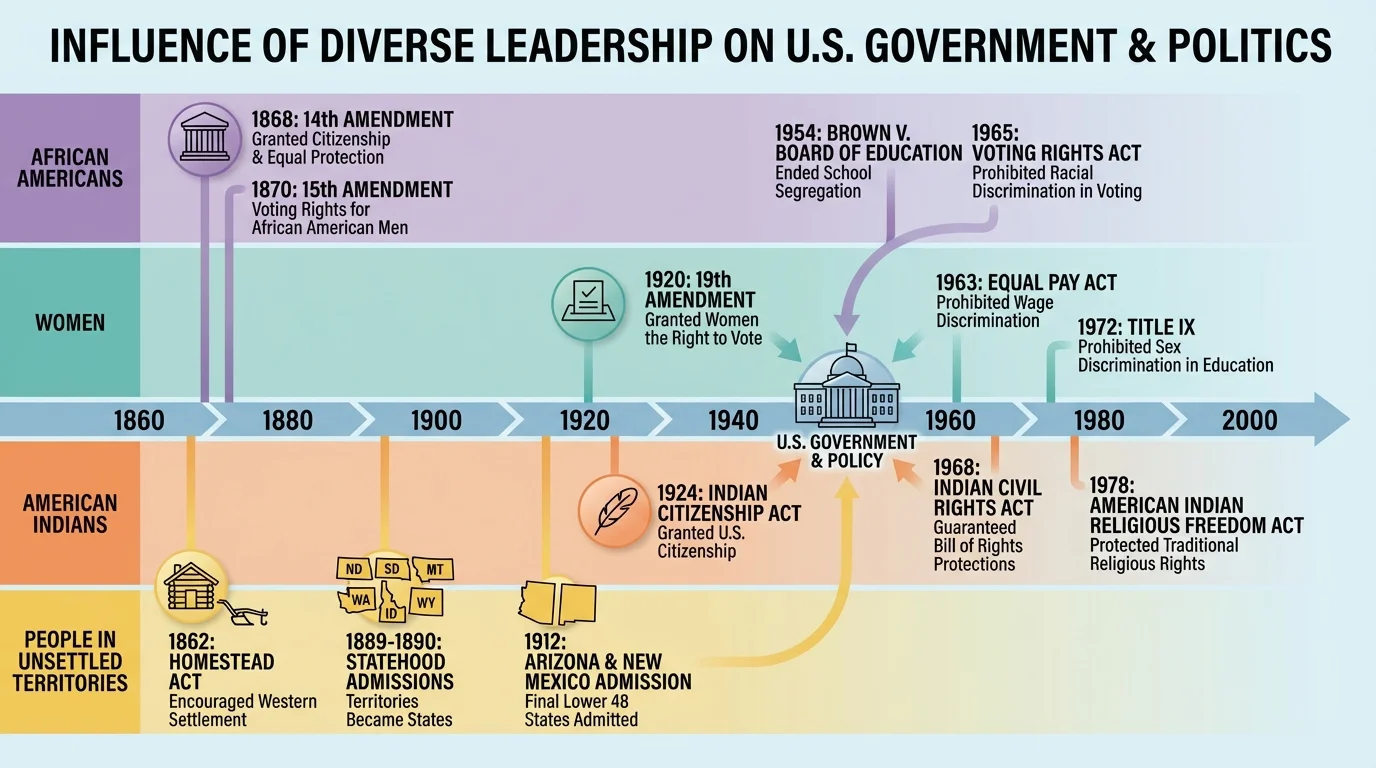
These changes did not happen automatically. Each one came after years, and sometimes generations, of organizing and conflict. For example, the 15th Amendment promised voting rights for African American men, but Southern states later used poll taxes, literacy tests, violence, and intimidation to block that right. Women won the 19th Amendment in 1920, but many women of color still faced barriers at the local level. American Indians gained U.S. citizenship under the Indian Citizenship Act of 1924, yet some states still prevented Native people from voting for years afterward.
Looking back at [Figure 1], one pattern stands out: rights often expand in stages. A law may recognize a right, but more leadership is often needed to make that right real in everyday life. That pattern appears again and again in the history of women, African Americans, American Indians, and territorial residents.
Women's leadership transformed American politics through petitions, conventions, speeches, journalism, court cases, marches, and elections. In the early republic, women were expected to influence politics indirectly, usually through family or reform work. Over time, women leaders challenged the idea that citizenship could exist without the vote.
A major starting point was the Seneca Falls Convention in 1848. Elizabeth Cady Stanton and Lucretia Mott helped organize the meeting, where activists issued the Declaration of Sentiments. This document copied the language of the Declaration of Independence and argued that women deserved equal rights, including the right to vote. That was a bold political move because it said women were not just asking for kindness or respect; they were demanding full citizenship.
Susan B. Anthony became one of the best-known suffrage leaders. She traveled widely, gave speeches, and organized campaigns. In 1872 she voted illegally to test the law and was arrested. Her action showed how some leaders used civil disobedience to expose injustice. At the same time, Sojourner Truth connected women's rights to abolition and racial equality. Her speech, often remembered as "Ain't I a Woman?", challenged the country to think about both gender and race.
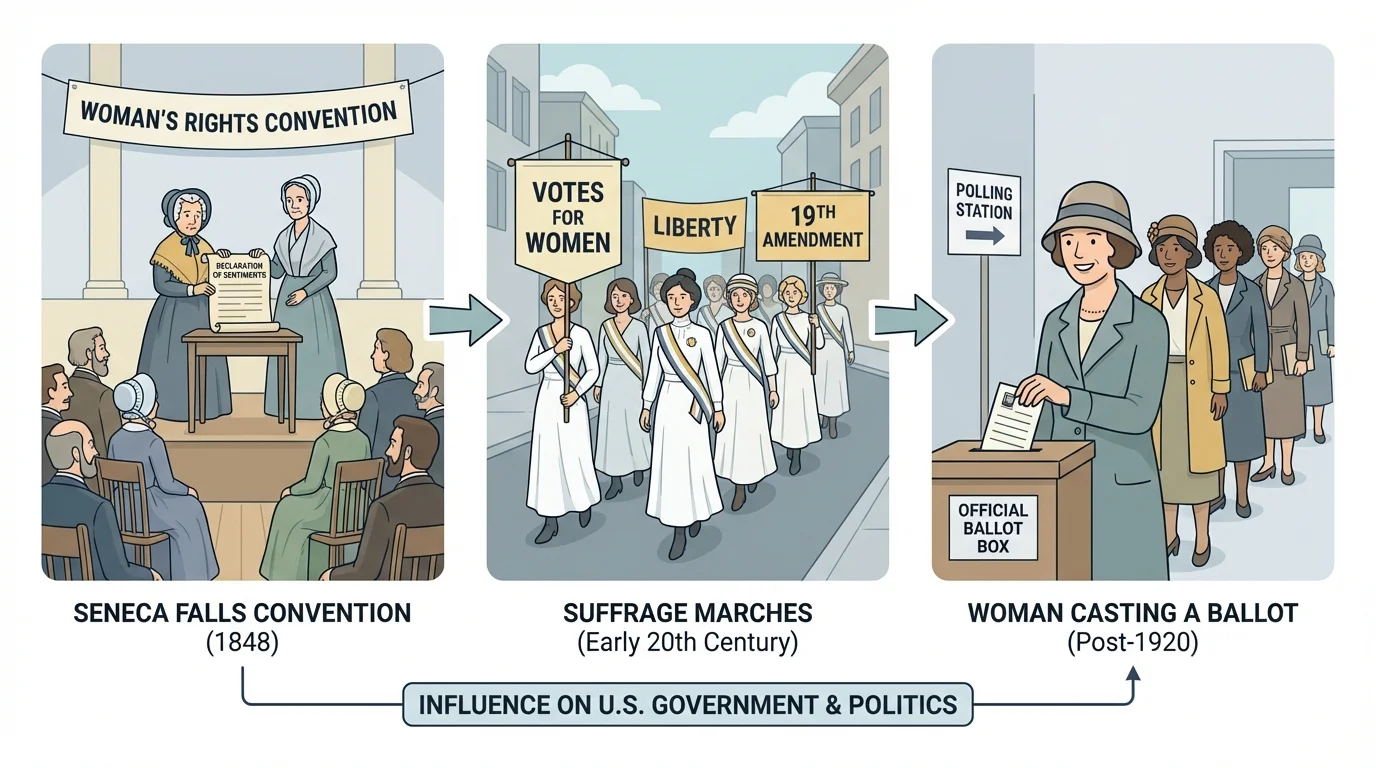
Women leaders did not all agree on strategy. Some focused on changing state laws first; others pushed for a national amendment. Ida B. Wells fought both sexism and racism and challenged white suffrage groups when they ignored the needs of Black women. Alice Paul organized dramatic marches and protests in Washington, D.C. Jeannette Rankin of Montana became the first woman elected to Congress in 1916, even before women nationwide could vote. Her election proved that women's political leadership was already reshaping government before the 19th Amendment passed.
After 1920, women continued to expand their influence. Leadership shifted from winning suffrage to using political power. Women ran for office, joined reform movements, and worked on issues such as labor laws, education, public health, and civil rights. Shirley Chisholm, elected in 1968 as the first Black woman in Congress, showed how women's leadership could also challenge racial barriers. When she ran for president in 1972, she expanded ideas about who could seek the nation's highest office.
Case study: How women changed politics
Step 1: Women leaders built networks.
They created organizations, newspapers, and conventions to spread ideas and recruit supporters.
Step 2: They changed public opinion.
Speeches, marches, and campaigns helped many Americans see voting as a citizenship issue, not just a women's issue.
Step 3: They changed law and government.
The 19th Amendment expanded voting rights, and later women in office shaped policy from inside government.
This shows that leadership can move from protest outside government to influence within government.
Much later in the century, leaders such as Sandra Day O'Connor and Geraldine Ferraro showed new forms of political power through national office and judicial leadership. Looking back at [Figure 2], we can see that women's leadership worked on several levels at once: persuading the public, pressuring lawmakers, and eventually serving in government themselves.
African American leadership pushed the nation through several connected stages of change, from abolition to Reconstruction to the modern civil rights movement. Few groups have had a deeper impact on the meaning of citizenship in the United States because African Americans fought some of the most basic injustices: slavery, segregation, disenfranchisement, and unequal protection under the law.
Before the Civil War, leaders such as Frederick Douglass and Harriet Tubman challenged slavery directly. Douglass used newspapers, speeches, and political arguments to expose the contradiction between American ideals and human bondage. Tubman not only escaped slavery herself but also led others to freedom through the Underground Railroad and later served the Union cause during the Civil War. Their leadership helped build support for emancipation and equal rights.
After the Civil War, African Americans briefly gained new political power during Reconstruction. Black men voted, held office, and helped rewrite state constitutions in the South. Hiram Revels and Blanche K. Bruce served in the U.S. Senate. This was a dramatic shift in American politics: men who would have been enslaved only a few years earlier were now helping govern the nation. But white supremacist violence and discriminatory laws later rolled back many of these gains.
Leaders then fought a long battle against segregation and voter suppression. Ida B. Wells investigated and exposed lynching. W. E. B. Du Bois helped found the NAACP, which challenged injustice through writing, activism, and court cases. Thurgood Marshall, working through the legal system, argued cases that attacked segregation. His work helped lead to Brown v. Board of Education in 1954, in which the Supreme Court ruled that segregated public schools were unconstitutional.
The civil rights movement showed leadership in many forms. Rosa Parks' refusal to give up her bus seat became a spark for the Montgomery Bus Boycott. Martin Luther King Jr. used speeches and nonviolent protest to demand equal citizenship. Ella Baker emphasized grassroots organizing, reminding people that ordinary citizens could become powerful political actors. John Lewis, as a young activist and later as a member of Congress, connected protest to lawmaking across decades.
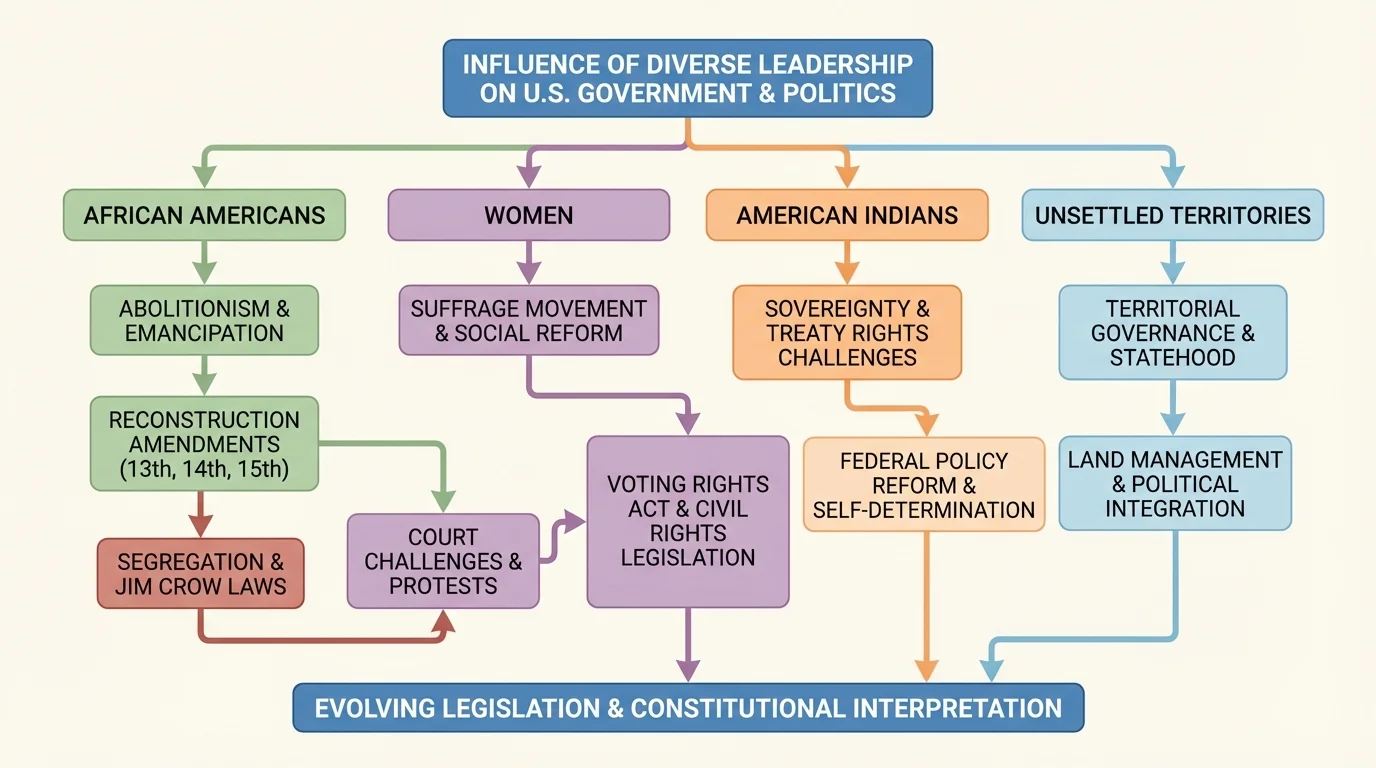
The movement produced major federal action. The Civil Rights Act of 1964 attacked discrimination in public life, and the Voting Rights Act of 1965 targeted unfair voting barriers. Seen again through [Figure 3], African American leadership shaped all three branches of government: Congress passed laws, courts issued decisions, and the executive branch enforced them. That broad influence is one reason African American leaders played such a central role in redefining American democracy.
Voting has often been described as a powerful tool for political change.
This idea reflects the importance of civic participation in a democracy.
African American leadership also changed who Americans imagined as political leaders. From local activists to Supreme Court Justice Thurgood Marshall to President Barack Obama, that influence extended beyond specific laws. It changed the nation's political expectations and expanded the meaning of belonging.
American Indian leadership was closely tied to land, treaties, and self-government across different regions. Native nations were here long before the United States existed, so their relationship to American government has always been different from that of immigrant groups or formerly enslaved groups. Native leaders often had to defend both individual rights and the collective rights of their nations.
In the early United States, leaders such as Tecumseh tried to unite Native peoples against U.S. expansion. Tecumseh argued that Native land should be defended collectively, not sold away one piece at a time. Chief Joseph of the Nez Perce became known for resisting forced removal and for his powerful statements about justice and survival. These leaders influenced U.S. politics by forcing the government to confront the consequences of westward expansion.
American Indian leadership also included diplomacy, writing, education, and reform. Sarah Winnemucca wrote and spoke publicly about the mistreatment of Native people. Her leadership helped non-Native Americans hear Native perspectives in a period when federal policy often tried to silence them. Native leaders repeatedly challenged unfair treaties, removal, reservation policies, and forced assimilation.
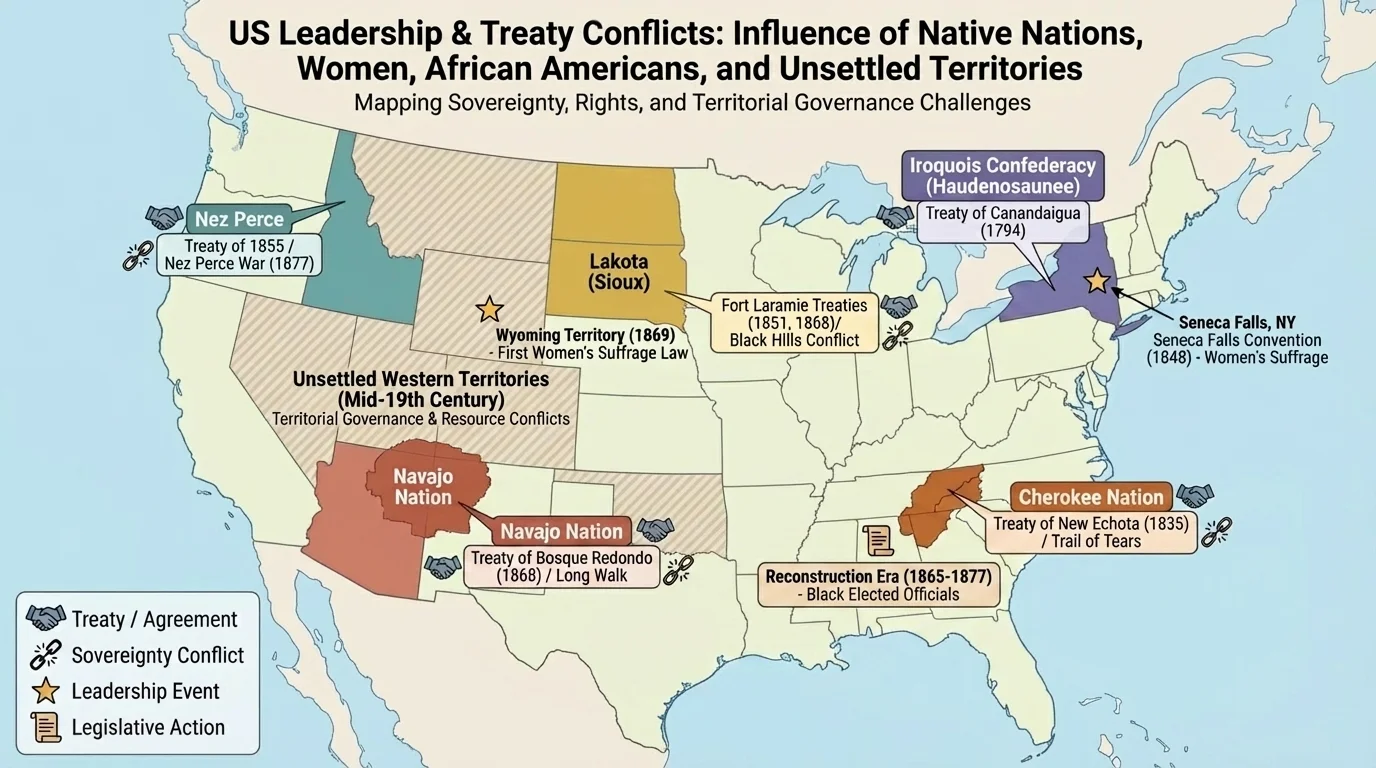
One key idea is tribal sovereignty. Native nations are not simply ethnic groups; they are political communities with their own governments. That makes Native leadership especially important in civics because it raises questions about how federal, state, and tribal governments share power. Tribal leaders have influenced policies on land, education, natural resources, and law enforcement.
The Indian Citizenship Act of 1924 made all Native Americans born in the United States citizens, but citizenship did not erase tribal identity or tribal governments. In fact, Native leaders often had to fight on two levels at once: for rights as U.S. citizens and for respect for tribal self-rule. Later, leaders in the American Indian Movement and tribal governments pushed for greater self-determination. Wilma Mankiller, elected principal chief of the Cherokee Nation in 1985, demonstrated modern Native leadership focused on community development, health, and effective self-government.
Why sovereignty matters
Sovereignty helps explain why American Indian leadership does not fit neatly into the same pattern as other groups. Many Native leaders were not asking only to be included inside U.S. institutions. They were also defending the right of their own nations to make decisions, preserve culture, and govern their communities.
As [Figure 4] makes clear, geography mattered deeply. Removal, reservation boundaries, and treaty lands affected political power. Native leadership influenced the United States by challenging federal policy and by insisting that democracy must account for peoples whose political identity existed before the U.S. government itself.
People living in western regions and U.S. territories influenced the nation even before they had full statehood rights. This group was diverse. It included settlers moving west, Hispanic residents in lands gained by the United States, Native peoples already living there, and later residents of organized territories such as New Mexico, Utah, Oklahoma, Alaska, and Hawaii. Their leadership mattered because territories were places where the nation had to decide who would be represented, who could vote, and how new states would enter the Union.
Territorial residents often faced a frustrating problem: they were governed by the United States but did not enjoy the same political voice as state residents. They might have delegates in Congress with limited power or no voting representation at all. That meant local leaders had to fight for roads, schools, courts, land rights, and eventually statehood.
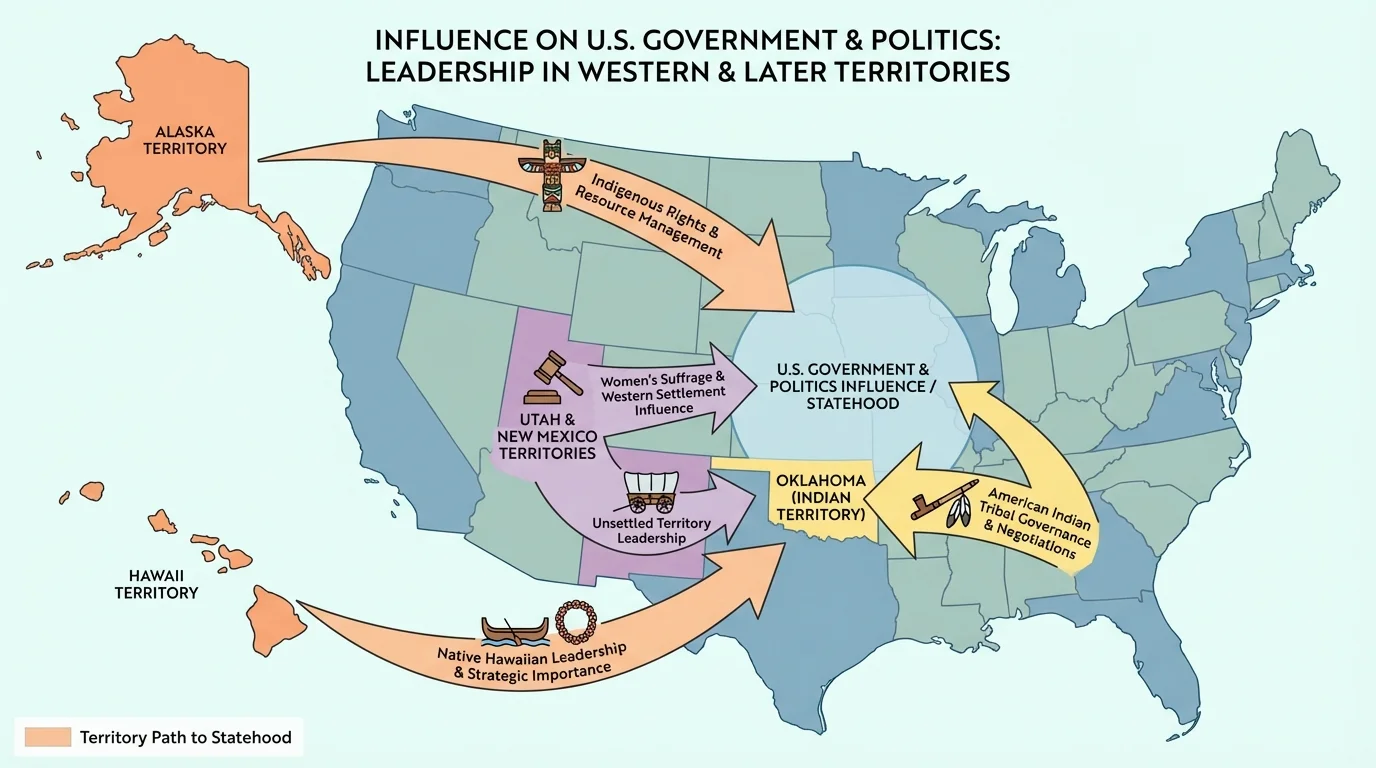
In the Southwest, leaders in territories with large Hispanic populations worked to protect property, language, and political influence after the Mexican-American War. In Utah Territory, debates over religion, federal authority, and statehood shaped politics for decades. In Oklahoma, the story was even more complex because it involved Native nations, settlers, and federal land policies. Territorial leadership often involved negotiation with Congress and the executive branch over when and how people in these regions would gain fuller rights.
These struggles influenced national politics because each new territory raised difficult questions. Would it become a slave state or a free state before the Civil War? Who counted as a citizen there? How would land be divided? Who could participate in elections? Those questions affected the balance of power in Congress and helped drive major conflicts between regions.
Seen through [Figure 5], territorial leadership also reminds us that American democracy spread unevenly across space. People in territories were part of the United States, but often not fully represented within it. Their demands for statehood and equality pushed the nation to extend its political system beyond the original states.
Some people in U.S. territories today still debate representation and political status. This means the question of how government should treat people outside the fifty states is not just a historical issue.
Leaders from unsettled territories influenced politics by showing that expansion was never just about land on a map. It was about whether the people living on that land would have rights, representation, and a real voice in government.
These groups had different histories, but their leadership can be compared in useful ways. Women leaders often focused on suffrage, legal equality, and access to office. African American leaders fought slavery, segregation, and voting discrimination. American Indian leaders defended land, treaty rights, and tribal sovereignty. Territorial leaders pushed for representation, recognition, and statehood.
They also used different methods. Some relied on speeches and writing. Others turned to court challenges, marches, boycotts, negotiation, or electoral politics. Women's suffrage activists organized conventions and public campaigns. African American leaders combined protest with court cases and federal legislation. American Indian leaders often had to combine diplomacy with resistance and tribal governance. Territorial leaders worked through petitions, local government, and negotiations with Congress.
At the same time, they shared key obstacles. Each group faced laws and customs that treated them as less important than others. Each had to convince the nation that American ideals should apply more broadly. Each showed that citizenship is not only a legal label but also a question of power: who gets heard, who gets protected, and who gets to help make the rules.
| Group | Main Goals | Common Methods | Major Impact on Government |
|---|---|---|---|
| Women | Suffrage, equal rights, officeholding | Conventions, speeches, protests, elections | Expanded voting rights and representation |
| African Americans | End slavery, gain equal protection, protect voting rights | Abolition work, court cases, boycotts, marches, legislation | Reconstruction amendments, civil rights laws, voting protections |
| American Indians | Protect land, treaty rights, and self-government | Diplomacy, resistance, writing, tribal leadership | Shaped federal Indian policy and debates over sovereignty |
| Territorial leaders | Representation, statehood, local rights | Petitions, negotiations, local politics | Influenced admission of states and national power balance |
Table 1. Comparison of leadership goals, methods, and effects on U.S. government and politics.
A useful way to think about these differences is to ask what each group was trying to change. Some wanted entry into existing institutions, such as voting in elections or serving in office. Others also wanted recognition of a distinct political identity, especially Native nations seeking respect for tribal sovereignty. Comparing them helps us see that equality in American history has taken more than one form.
The influence of these leaders is still visible today. Women serve at every level of government and shape debates on education, healthcare, economics, and national security. African American leadership remains central to discussions of voting access, criminal justice, and representation. American Indian leaders continue to shape law and policy through tribal governments, court cases, and negotiations over land and natural resources. People in territories still raise important questions about citizenship and political voice.
Modern political life shows that the expansion of rights is not a finished story. Debates continue over voter access, equal protection, representation, and the relationship between federal and local power. Historical leaders matter because they created tools that later generations still use: protest, organization, coalition-building, litigation, and elections.
One of the biggest lessons from this history is that democracy grows when more people participate in it. The United States government and political system were strongly shaped by individuals who had to fight for recognition before they could influence policy. Their leadership changed not just particular laws but also the nation's understanding of who belongs and whose voice matters.
Rights written on paper are important, but they often need leaders, movements, and enforcement to become real in everyday life. That idea connects many different periods of U.S. history.
When we compare women, African Americans, American Indians, and people in western territories and U.S. territories, we see a larger pattern. The United States became more democratic not because power was easily shared, but because determined leaders pushed the government to live up more fully to its own principles.
