What happens if a government official, a state legislature, or even Congress passes a law that goes against the Constitution? In the United States, the answer is powerful: courts can step in and say that the law or action is invalid. That power, called judicial review, is one of the most important ways the Constitution remains meaningful instead of becoming just words on paper.
The United States is a constitutional government. That means government power is limited by a constitution, and all public officials must follow it. The Constitution is the nation's highest law, so no president, governor, judge, legislature, or agency is permitted to act above it. Judicial review helps enforce that idea by allowing courts to decide whether laws and government actions fit the Constitution.
Constitutional government is a system in which government power is limited by a constitution. Rule of law means everyone, including leaders and government officials, must follow the law. Judicial review is the power of courts to examine laws and government actions and decide whether they violate the Constitution.
Judicial review reflects the basic design of American government. The Framers did not want one branch to become too strong. They divided power among the legislative, executive, and judicial branches and also divided power between the national government and the states. Courts play a special role in this system because they interpret the law and, as [Figure 1] shows, help keep government within constitutional limits.
In a country governed by the rule of law, power does not depend only on who is strongest, richest, or most popular. Instead, power is supposed to follow agreed-upon rules. That idea may sound simple, but it is a major protection for freedom. If leaders could ignore the Constitution whenever they wanted, rights such as freedom of speech, due process, and equal protection would be much less secure.
The rule of law also means that government decisions can be challenged. If a student is punished unfairly by a school in a way that violates constitutional rights, or if a state passes a law that treats people unequally, courts can hear the case. This does not mean courts solve every problem, but it does mean there is a legal process for deciding whether the government has crossed a constitutional line.
Why courts matter in a constitutional system
Legislatures make laws and executives carry them out, but courts interpret what those laws mean and whether they fit the Constitution. Without courts able to review government action, limits on power would be much harder to enforce. Judicial review turns constitutional promises into rules that government must obey.
This is why the power of judicial review is closely connected to liberty. Rights are strongest when there is an institution that can protect them, even when a majority, a powerful official, or a temporary political movement wants to ignore them.
Judicial review is the process courts use to compare government actions with the Constitution. If a court decides that a law or action conflicts with the Constitution, the court can declare it unconstitutional and refuse to enforce it in that case.
This power does not mean judges can rewrite the Constitution whenever they want. Instead, it means they must interpret the Constitution and apply it to real disputes. Courts usually become involved only when someone brings a case. A person, group, or government unit claims that a law or action violates the Constitution, and judges must decide the issue.
Judicial review applies to more than one kind of government action. Courts may review laws passed by legislatures, actions taken by presidents or governors, rules made by agencies, and even decisions made by lower courts. In every case, the key question is whether the action fits within constitutional limits.
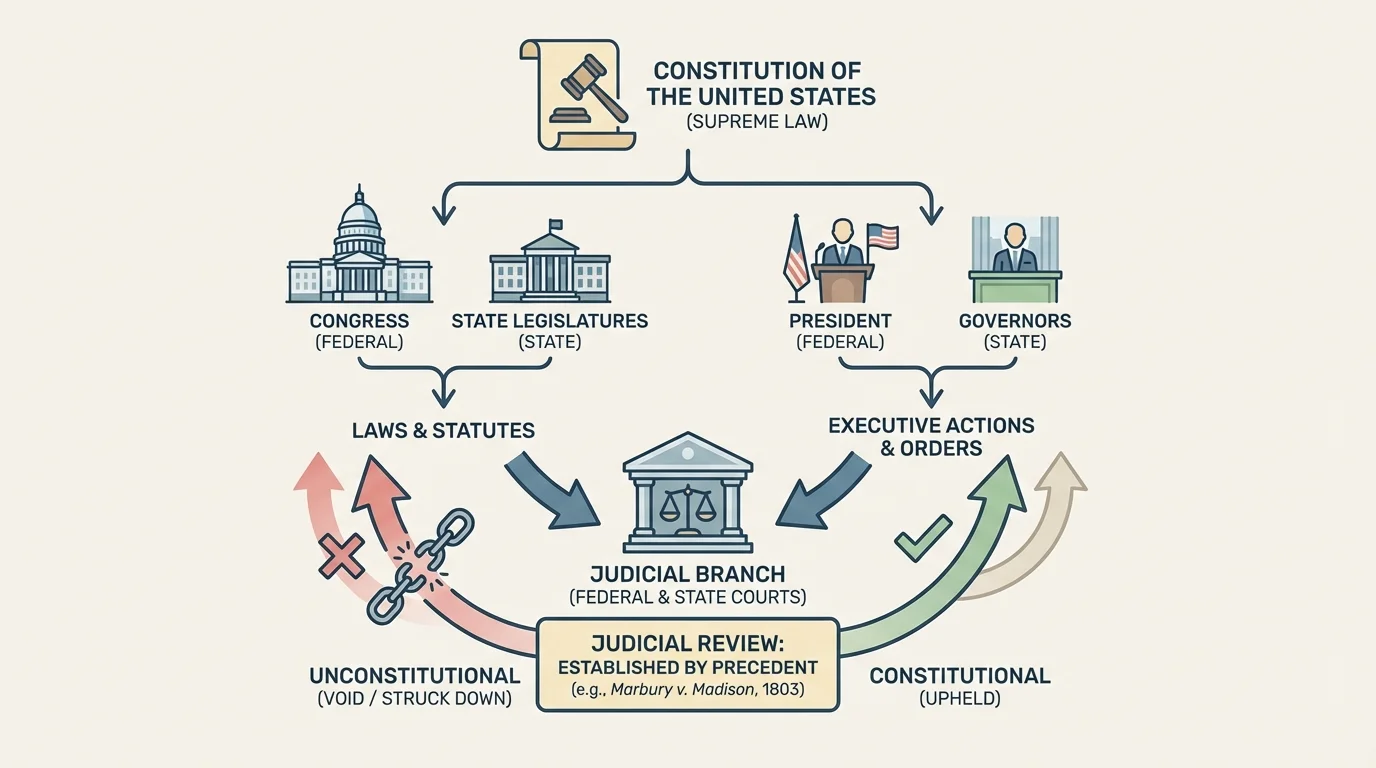
Because the Constitution is the supreme law of the land, ordinary laws must agree with it. If there is a conflict, the Constitution wins. This idea is sometimes called constitutional supremacy, meaning the Constitution stands above regular laws and government decisions.
Judicial review is not the same as making policy. Judges do not vote on whether a law is a good idea in general. Their job is to decide whether the law is allowed under the Constitution. A law might be popular and still unconstitutional, or unpopular and still constitutional.
One of the most famous Supreme Court cases in American history, Marbury v. Madison, established judicial review at the federal level. The case began during a tense political transition after the election of 1800.
President John Adams, a Federalist, was leaving office after losing to Thomas Jefferson, a Democratic-Republican. Before Adams left office, Congress created new judgeships, and Adams appointed several judges. As [Figure 2] shows, these last-minute appointees were sometimes called the "midnight judges." One of them was William Marbury.
Marbury had been appointed a justice of the peace in the District of Columbia, but his official commission was not delivered before Jefferson took office.
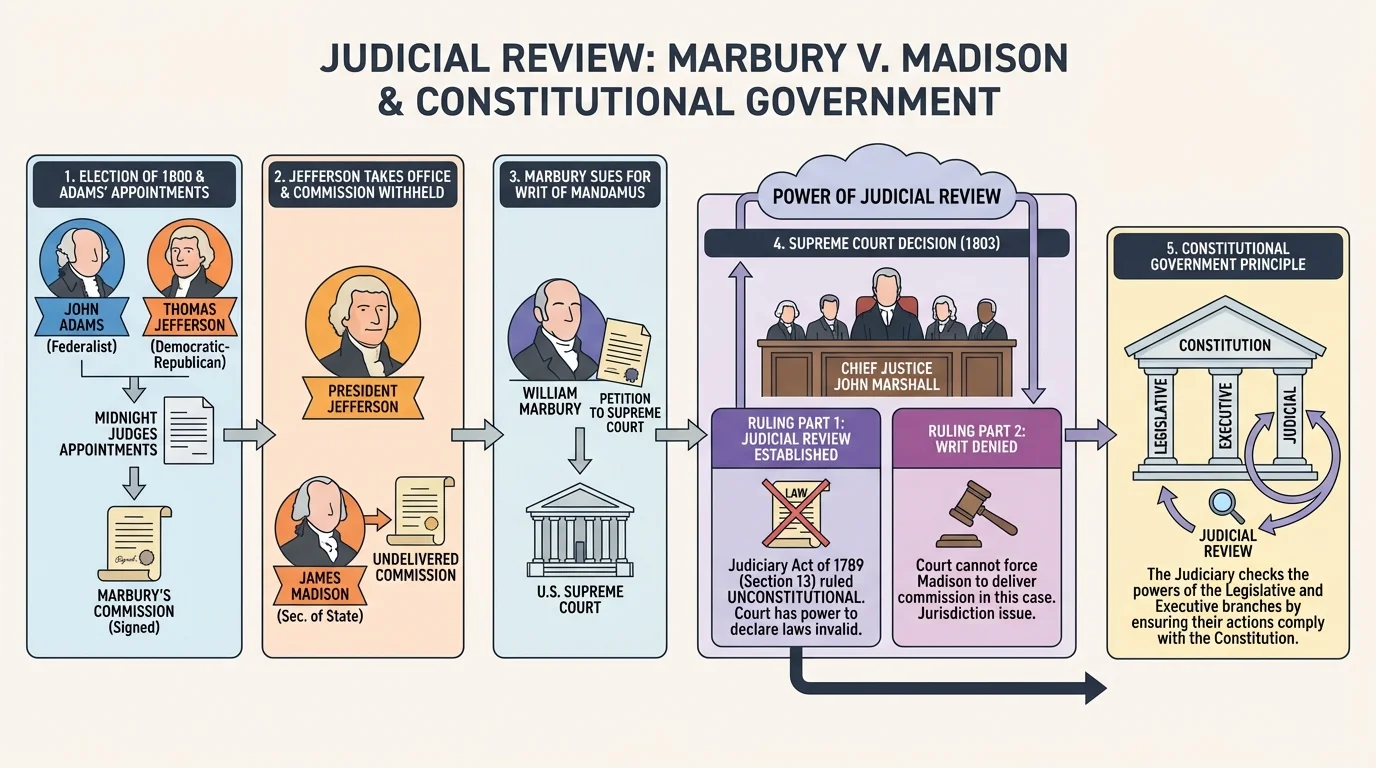
Chief Justice John Marshall faced a difficult problem. If the Court ordered Madison to deliver the commission, Jefferson might ignore the order, making the Court look weak. But if the Court refused to act, it might seem powerless. Marshall's opinion created a brilliant solution.
The Court decided that Marbury did deserve his commission. However, the Court also ruled that the law Marbury relied on, part of the Judiciary Act of 1789, gave the Supreme Court power that the Constitution did not give it in that type of case. Because the Constitution is higher than an act of Congress, that part of the law was unconstitutional.
Case study: Why the decision mattered
Step 1: The Court examined the conflict.
Marbury asked the Court to use a federal law to force Madison to act.
Step 2: The Court compared the law to the Constitution.
Chief Justice Marshall concluded that the law expanded the Court's original jurisdiction beyond what the Constitution allowed.
Step 3: The Court chose the Constitution over the conflicting law.
That decision established that courts can strike down laws that violate the Constitution.
The Court did not give Marbury the commission, but it gained something much larger: the authority to say what the law is when the Constitution and a statute conflict.
This case is a turning point because it clearly announced the principle that federal courts can declare acts of Congress unconstitutional. As later generations looked back, they saw Marbury v. Madison as a foundation of American constitutional law. The timeline in [Figure 2] highlights how a political conflict became a lasting constitutional principle.
"It is emphatically the province and duty of the judicial department to say what the law is."
— Chief Justice John Marshall, Marbury v. Madison
That statement does not mean courts are above the Constitution. It means that when courts decide cases, they must interpret and apply the Constitution faithfully. Their power comes from the constitutional system, not from personal opinion.
After Marbury v. Madison, federal courts continued to use judicial review in many important cases. Sometimes the issue involves the powers of Congress. Sometimes it involves presidential actions. Other times it involves individual rights protected by the Bill of Rights or later amendments.
For example, the Supreme Court has struck down laws that violated freedom of speech, denied equal protection, or went beyond Congress's constitutional powers. It has also reviewed executive actions taken by presidents. In each situation, the Court asks whether the government stayed within constitutional boundaries.
This role reflects the system of checks and balances. Congress can pass laws, but courts can review them. The president can enforce laws, but courts can review executive actions too. At the same time, courts are also checked. Presidents nominate federal judges, the Senate confirms them, and the Constitution itself limits judicial power to actual cases and controversies.
Federal judicial review can shape history. Cases involving segregation, voting rights, religion, criminal procedure, and free expression have changed everyday life for millions of people. When courts interpret the Constitution, their decisions influence schools, elections, policing, and public policy across the country.
The Supreme Court did not gain the power of judicial review because one sentence in the Constitution says, "The Court may strike down laws." Instead, that authority developed from the idea that the Constitution is the highest law and from the Court's reasoning in Marbury v. Madison.
Still, federal courts do not supervise everything. They cannot simply answer any political question they find interesting. A real case must come before them, and they must work within the limits of judicial power.
Many students first hear about judicial review in connection with the U.S. Supreme Court, but state courts also exercise this power. As [Figure 3] shows, every state has its own constitution, and state courts interpret those constitutions just as federal courts interpret the U.S. Constitution.
If a state legislature passes a law that violates the state constitution, state courts can strike it down. If a city or state official acts in a way that violates either the state constitution or the U.S. Constitution, state courts may review that action as well. This makes state courts an important part of American constitutional government.
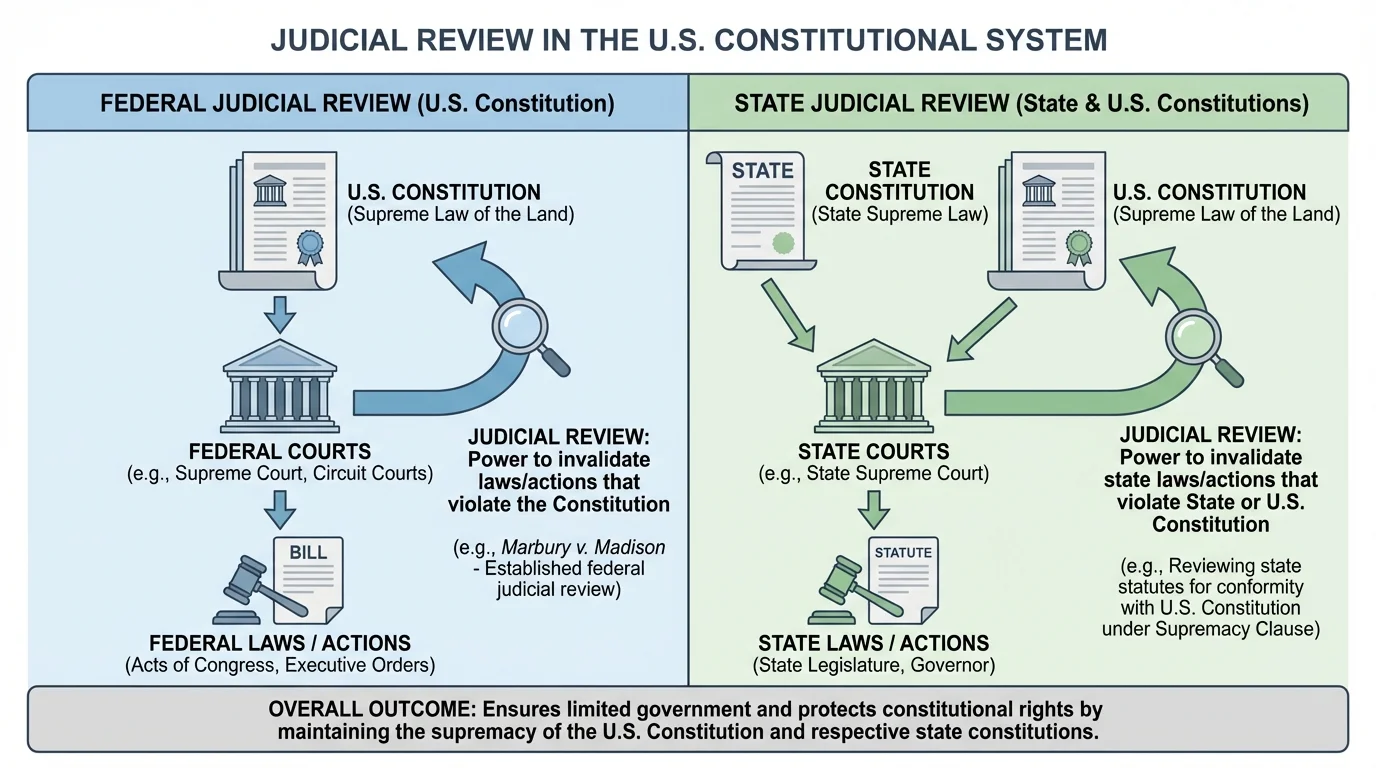
State judicial review reflects the principle of federalism, the division of power between the national government and the states. Because states are not just local branches of the national government, they have their own constitutions, courts, and legal systems. At the same time, state courts must still respect the U.S. Constitution as the supreme law.
Suppose a state passed a law limiting peaceful protest in a way that violated the First Amendment. A state court could review that law. If the case raised a federal constitutional issue, it could possibly move through appeals and eventually reach the U.S. Supreme Court. In that way, state and federal courts are connected but not identical.
State constitutions sometimes protect rights even more broadly than the U.S. Constitution does. That means a state court may strike down a state law based on stronger protections in the state constitution, even when the U.S. Constitution would not require the same result. The chart in [Figure 3] makes this layered system easier to understand.
| Court system | Main source of constitutional review | What it can review | Possible result |
|---|---|---|---|
| Federal courts | U.S. Constitution | Federal laws, federal executive actions, lower federal court decisions, some state actions involving federal issues | Can declare actions unconstitutional |
| State courts | State constitutions and the U.S. Constitution | State laws, local rules, state and local government actions | Can declare actions unconstitutional under state or federal law |
Table 1. Comparison of how federal and state courts use judicial review in the American constitutional system.
Judicial review reflects constitutional government because it shows that government power is limited, not unlimited. If legislatures or executives had the final word in every dispute, they could become judges of their own power. Judicial review creates an independent check.
It also reflects the idea that the Constitution is more durable than ordinary politics. Elections matter greatly, and lawmakers represent the people, but constitutional rights are not supposed to disappear just because a temporary majority wants a different result. Courts help protect that stability.
Another reason judicial review fits constitutional government is that it supports the separation of powers. Each branch has a job. Legislatures make laws. Executives enforce laws. Courts interpret laws and resolve disputes. Although these jobs overlap at times, judicial review reinforces the idea that no branch has total control.
The Constitution created a government of limited powers. Separation of powers divides authority among branches, and federalism divides authority between national and state governments. Judicial review works inside both of those structures.
Judicial review also protects rights. When people claim that government violated freedom of religion, freedom of speech, due process, or equal protection, courts can evaluate the claim using constitutional standards. This does not guarantee that every person wins, but it does provide a lawful process for deciding serious disputes.
There is also a civic lesson here: constitutional government depends on institutions, but it also depends on citizens understanding those institutions. People vote for lawmakers and presidents, but they should also understand why courts matter. A system of liberty needs both democratic participation and constitutional limits.
Judicial review is powerful, but it is not unlimited. Courts rely on cases being brought to them. They usually cannot begin investigations on their own. They also depend on other branches and the public to respect court decisions, which is one reason legitimacy and trust in the legal system matter so much.
Americans have debated judicial review for more than two centuries. Some people argue that courts sometimes become too powerful and interfere with democratic choices. Others argue that strong judicial review is necessary to protect minority rights and prevent abuses of power. Both sides are really debating the same important question: how to preserve liberty while still respecting self-government.
Why debate over judicial review is normal
In a constitutional democracy, people value both majority rule and individual rights. Tension between those values is not a mistake; it is built into the system. Judicial review exists to help manage that tension by making sure majority decisions still fit constitutional limits.
Even when people disagree with particular court decisions, the broader principle remains central: the Constitution must be higher than ordinary politics. That principle helps prevent sudden changes in power from erasing basic rights or weakening the structure of government.
When you study judicial review, you are really studying a bigger idea: how a free society controls power. The United States does not rely only on good intentions. It uses written limits, separate branches, state and federal systems, and courts able to enforce the Constitution. That is why judicial review is such a clear reflection of America's form of constitutional government.
