One of the most striking features of U.S. history is that the names of the two major political parties stayed the same while many of their ideas, coalitions, and priorities changed dramatically. A voter who supported Republicans in the 1860s because of opposition to slavery would not automatically recognize the party's positions today, and the same is true for Democrats. That is why studying political thought is not just about memorizing elections. It is about asking how Americans have argued over power, freedom, equality, and the role of government—and how those arguments changed the nation.
Political history includes more than presidents and laws. It includes political thought, or the ideas people develop about how government should work; suffrage, or the right to vote; and the actions of citizens, parties, reformers, judges, and social movements. From Reconstruction to the present, Americans have debated who counts as a full citizen, how much power the federal government should have, and whether the nation should focus more on individual liberty, equality, tradition, or reform. Those debates produced both major change and striking continuity.
Political thought refers to ideas about government, rights, authority, and citizenship. Political theory is the more systematic study of those ideas, often asking what government should do and why. Political action includes the practical ways people try to put ideas into effect, such as voting, organizing, lobbying, protesting, legislating, and litigating in courts.
To evaluate political development well, historians look for patterns. They ask what changed, what stayed the same, what caused a shift, and why outcomes were often more complex than reformers expected. They also examine unity and diversity: the United States has often claimed common ideals such as liberty and democracy, yet different groups have experienced those ideals very differently.
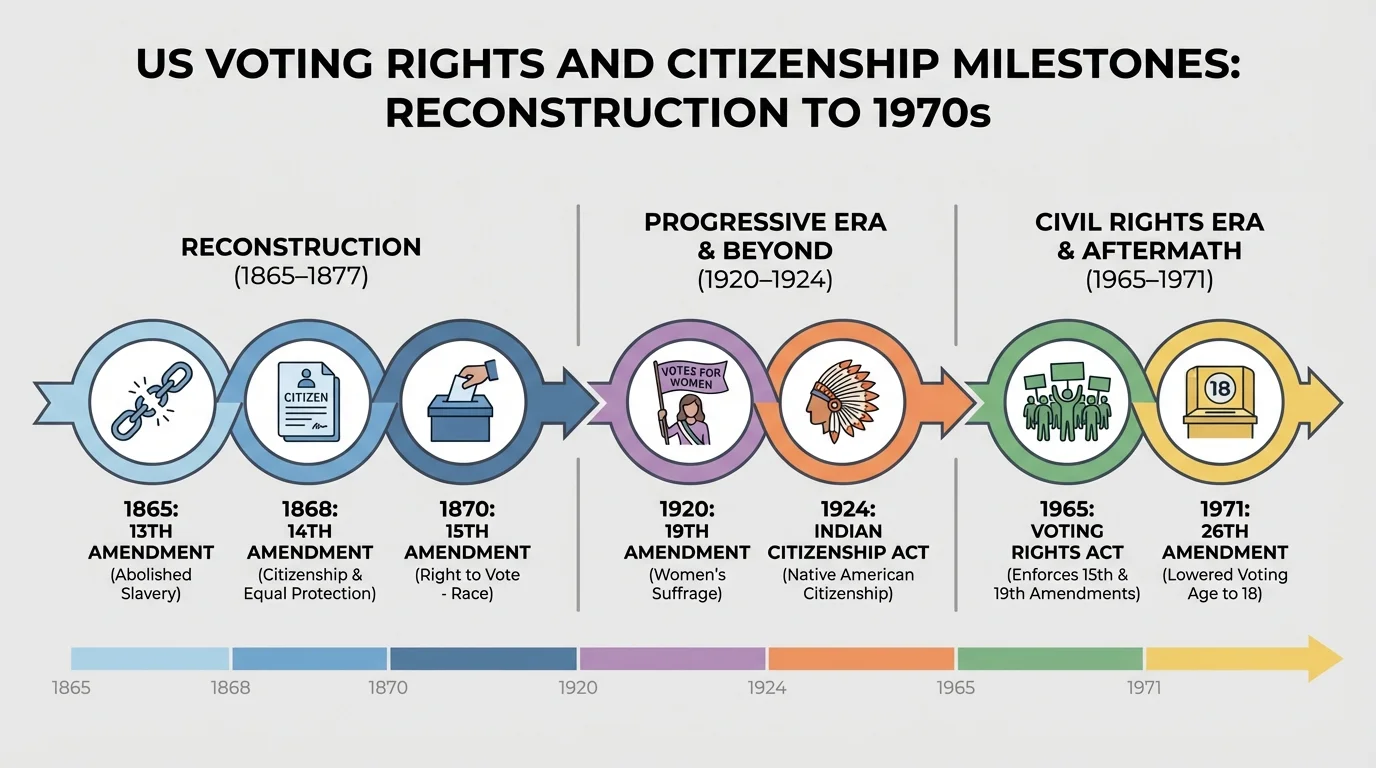
After the Civil War, the United States faced a basic question: what did freedom actually mean? The struggle over that question, outlined across major milestones in [Figure 1], shaped political thought for the next century and beyond. The Reconstruction era brought the 13th Amendment, which ended slavery, the 14th Amendment, which defined citizenship and promised equal protection, and the 15th Amendment, which barred denying voting rights on the basis of race. On paper, these changes suggested a revolutionary expansion of democracy.
For a time, Black Americans voted, held office, built institutions, and participated directly in public life. Men such as Hiram Revels and Blanche K. Bruce served in the U.S. Senate, while many others served in state governments. This was a major break from the past. Yet Reconstruction also revealed how fragile political gains can be when law is not backed by sustained enforcement.
White supremacist violence, economic coercion, and political compromise undermined these reforms. Groups such as the Ku Klux Klan used terror to suppress Black political participation. By the late 1870s, federal commitment to Reconstruction weakened. Southern states then created Jim Crow systems that used segregation, literacy tests, poll taxes, and intimidation to strip many Black citizens of rights they were supposed to have. This shows a key historical pattern: legal change does not automatically produce social equality.
The period also reveals continuity and change at the same time. Citizenship expanded in constitutional language, but old hierarchies adapted rather than disappearing. The nation became more democratic in theory while remaining deeply unequal in practice.
Primary sources from the period make this conflict clear. Frederick Douglass argued that freedom without political power was incomplete. In speeches and writings, he insisted that voting rights were essential to real citizenship. Later, Supreme Court decisions such as Plessy v. Ferguson in 1896 showed how political and legal institutions could reinforce inequality by approving "separate but equal," even when that principle was unequal in reality.
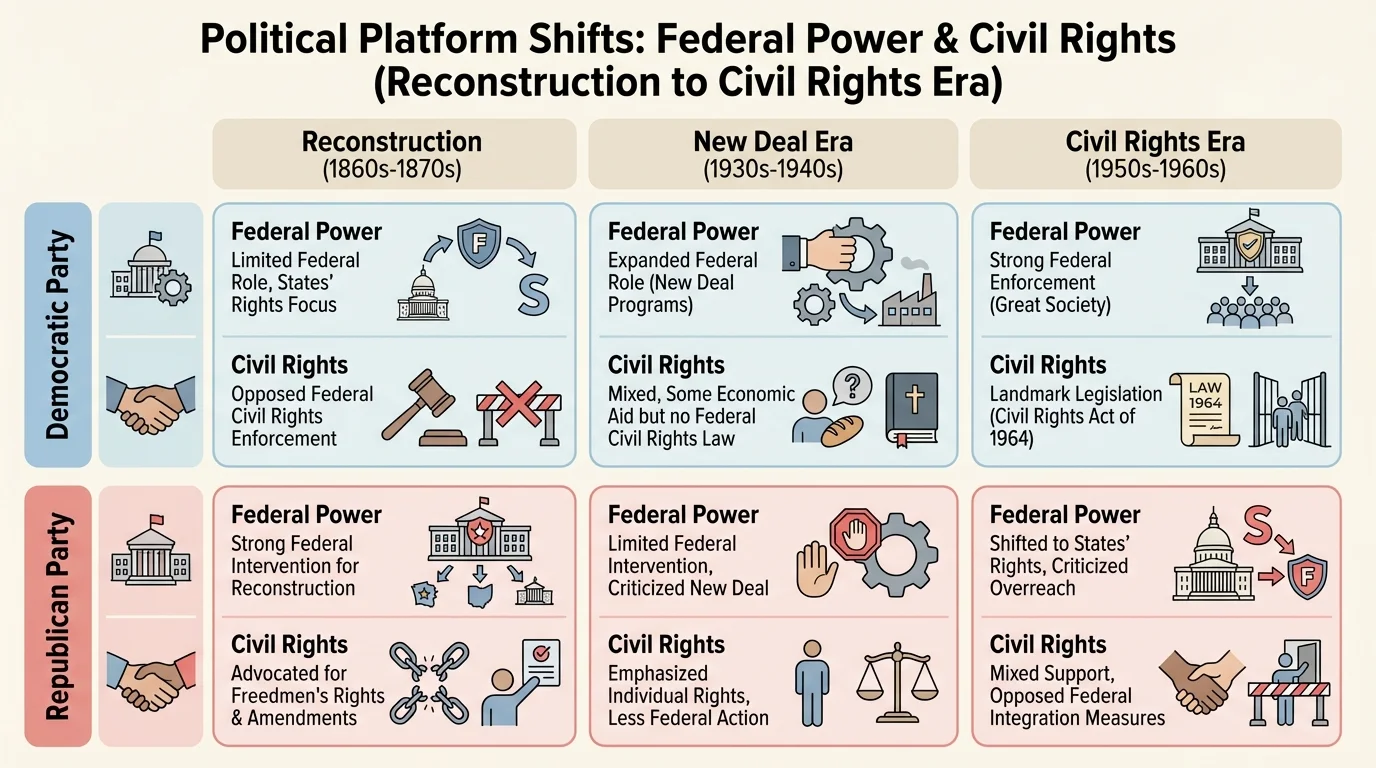
Political parties are not fixed ideological groups; they are coalitions shaped by voters, crises, leaders, and social change, as [Figure 2] shows through major shifts in priorities. During Reconstruction, Republicans were broadly associated with Union victory, federal action, and Black civil rights, while Democrats—especially in the South—were more associated with states' rights and white supremacy. But that alignment did not remain stable.
In the late 19th century, debates over tariffs, currency, business regulation, and labor rights reshaped party priorities. Industrialization created enormous wealth for some Americans and harsh conditions for many workers. Farmers and laborers often believed the political system favored railroads, banks, and corporations. This dissatisfaction fed the rise of the Populist movement and pressured both parties to address economic inequality.
The realignment of the 1930s marked one of the most important changes in party history. During the Great Depression, Franklin D. Roosevelt's New Deal expanded the federal government's role in economic life. Democrats increasingly became associated with social welfare programs, labor protections, and federal responsibility for economic recovery. Many urban immigrants, industrial workers, and Black voters in northern cities shifted toward the Democratic Party.
Another major shift came during the civil rights era. Democratic leaders such as Harry Truman, John F. Kennedy, and Lyndon B. Johnson increasingly supported federal civil rights action. Many white southern conservatives moved away from the Democratic Party, while many Black voters became more firmly aligned with it. Republicans, meanwhile, increasingly attracted voters who emphasized limited government, anti-communism, law and order, and later conservative social issues. The names of the parties stayed the same, but their platforms and voter coalitions changed profoundly.
| Era | Democratic Party trends | Republican Party trends |
|---|---|---|
| Reconstruction era | Strong in white South; often defended states' rights | Associated with Union, Reconstruction, and federal civil rights enforcement |
| New Deal era | Supported stronger federal economic action and welfare programs | More divided over New Deal expansion of government |
| Civil rights era and after | Increasingly linked to civil rights, social programs, and diverse urban coalitions | Increasingly linked to conservatism, limited government rhetoric, and southern realignment |
Table 1. Broad shifts in party platforms and coalitions across major periods of U.S. history.
These changes matter because they show that political identity is historical, not permanent. When students hear that one party "has always" stood for a certain principle, historical evidence usually reveals a more complicated story. Party platforms are shaped by conflict, strategy, demographic change, and responses to national crises.
The election of 1936 helped demonstrate the scale of New Deal realignment. Roosevelt won an overwhelming electoral victory, and the coalition supporting him included workers, many immigrants, and a growing share of Black voters in northern cities.
As later decades show, the pattern in [Figure 2] did not end in the 1960s. Political debate continued to shift around issues such as abortion, taxes, regulation, national security, and immigration, proving again that parties adapt as the nation changes.
The history of voting rights is often described as steady progress, but the reality is more uneven. Suffrage expanded over time, yet every gain faced resistance, and new barriers often appeared after old ones were removed. This is one of the clearest examples of both cause and effect and continuity and change in American history.
After Reconstruction, Black men were theoretically protected by the 15th Amendment, but in much of the South they were effectively disenfranchised. Women's suffrage activists, including Susan B. Anthony, Elizabeth Cady Stanton, Ida B. Wells, and Alice Paul, argued that democracy was incomplete if half the adult population could not vote. Their movement used speeches, petitions, state-level campaigns, and public protest. In 1920, the 19th Amendment prohibited denying the vote on the basis of sex.
Even then, not all women could vote freely. Black women in the South still faced racial discrimination. Native Americans were not universally recognized as U.S. citizens until the Indian Citizenship Act of 1924, and even then many states kept barriers in place. Asian immigrants also faced exclusion through citizenship restrictions. The expansion of suffrage was real, but it was not equally experienced by all groups.
The modern breakthrough came with the civil rights movement. Activists exposed the violence and injustice used to block Black voting in the South. Events in Selma, Alabama, in 1965 pushed national attention toward voting rights. The Voting Rights Act of 1965 outlawed many discriminatory practices and gave the federal government stronger enforcement power. A few years later, the 26th Amendment lowered the voting age to 18, partly because many Americans argued that if 18-year-olds could be drafted to fight in Vietnam, they should be able to vote.
Why suffrage matters beyond elections
Voting rights shape who gets heard in government. When a group gains access to the ballot, it becomes harder for leaders to ignore that group's interests. Expanded suffrage can affect school funding, labor laws, civil rights, welfare policy, policing, and representation. That is why battles over voting rules often become battles over political power itself.
Debates over voter identification laws, district boundaries, felony disenfranchisement, and access to early or mail voting show that voting rights remain contested. The central issue has not disappeared: who can participate fully in democracy, and under what conditions? The long arc shown in [Figure 1] makes clear that rights can expand, but they also require defense.
Reform movements often begin when people conclude that existing institutions are not solving major problems. In the late 19th and early 20th centuries, industrial capitalism generated huge fortunes but also unsafe factories, child labor, urban poverty, and political corruption. Reformers challenged the idea that government should simply stay out of economic and social life.
The Progressivism movement included journalists, middle-class reformers, labor activists, social workers, and some politicians. They did not all agree, but many supported regulation of big business, safer workplaces, consumer protection, and more democratic government. Muckraking journalists such as Upton Sinclair and Ida Tarbell exposed abuses and influenced public opinion. Settlement house leaders like Jane Addams worked directly with poor urban communities.
Progressive reforms produced important changes: antitrust action, food and drug regulation, direct election of senators through the 17th Amendment, and some protections for workers. At the same time, Progressivism had serious limits. Some reformers supported racist policies, immigration restriction, or the paternalistic belief that elite experts should manage society without fully respecting democratic participation by all groups.
This complexity matters. A movement can expand democracy in one area while limiting it in another. For example, Progressives often promoted government reform and public health, but some also backed eugenics or segregation. Historical evaluation requires students to resist simple labels such as "good" or "bad" and instead examine multiple effects.
Case study: The Populists and the Progressives
Step 1: Identify the problem.
Farmers and workers believed railroads, banks, and monopolies had too much power over the economy and politics.
Step 2: Compare responses.
Populists pushed for measures such as currency reform and greater political power for ordinary people. Progressives later focused more on regulation, expertise, and anti-corruption reforms.
Step 3: Evaluate impact.
Both movements pressured government to respond to industrial society, but neither fully solved inequality or eliminated exclusion based on race, class, or gender.
That pattern appears repeatedly in U.S. political history: reform grows out of real injustice, achieves meaningful change, and still leaves unresolved problems behind.
The Great Depression transformed political expectations. Before the 1930s, many Americans believed the federal government should play a limited role in economic life. Mass unemployment and bank failures made that older view seem inadequate to many citizens. Roosevelt's New Deal did not create the modern federal state by itself, but it greatly expanded the belief that government should provide economic security.
Programs such as Social Security, banking regulation, public works, and labor protections changed the relationship between citizens and the state. Government was increasingly expected to reduce risk, stabilize the economy, and provide a safety net. Supporters argued that this protected democracy by preventing desperation and unrest. Critics argued that it concentrated too much power in Washington and threatened individual freedom or free enterprise.
The New Deal's impact was long-lasting. Even later leaders who criticized "big government" usually operated in a political world where citizens still expected some federal responsibility for retirement, unemployment, disaster response, and economic management. This is a strong example of continuity within change: debates over government power continued, but the baseline expectations had shifted.
"The only thing we have to fear is fear itself."
— Franklin D. Roosevelt, 1933
That famous line did not solve the Depression, but it captured a new political style: government as an active force meant to reassure, mobilize, and intervene in crisis.
[Figure 3] After World War II, a wave of overlapping movements pressed the nation to live up more fully to its democratic ideals. These movements unfolded across multiple issues over time and show how political change often comes from sustained pressure outside formal government. The Black freedom struggle challenged segregation, disenfranchisement, and racial violence through court cases, boycotts, mass protest, grassroots organizing, and federal lobbying.
Key figures included Martin Luther King Jr., Rosa Parks, Ella Baker, Fannie Lou Hamer, Malcolm X, and many local activists whose names are less widely known but whose work was essential. Major landmarks included Brown v. Board of Education in 1954, the Civil Rights Act of 1964, and the Voting Rights Act of 1965. These events reshaped law, party politics, and national political language.
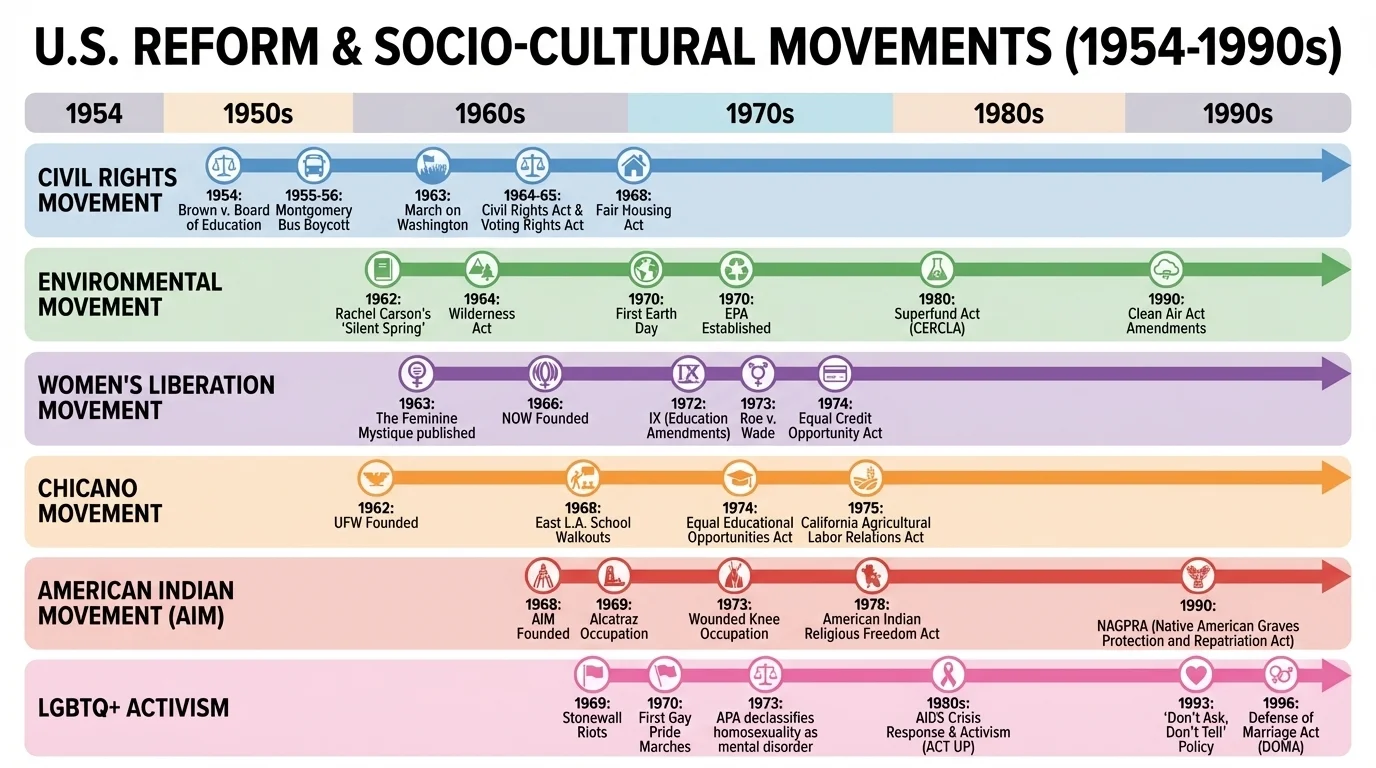
Other movements expanded the political agenda. The women's movement pushed for equal pay, reproductive rights, protection from discrimination, and wider opportunities in education and work. The Chicano movement demanded labor rights, educational justice, and political representation. Native activists challenged broken treaties and demanded sovereignty and cultural recognition. The environmental movement led to legislation such as the Clean Air Act and the creation of the Environmental Protection Agency. LGBTQ+ activism, especially after Stonewall in 1969, pushed issues of identity, dignity, privacy, and equal protection into national politics.
These movements did not simply add new policies. They changed how many Americans understood rights, identity, and citizenship. They made the political sphere more inclusive in some ways, but they also intensified conflict. Conservative movements grew in response, defending traditional social structures, free-market economics, religious values, or a narrower view of federal intervention. Politics became more ideologically charged.
The interaction among these movements reveals complexity. Reformers sometimes cooperated, but they also disagreed over priorities and strategy. Some activists focused on legal equality; others argued that deeper economic and cultural change was necessary. Some Americans saw these movements as fulfilling national ideals, while others saw them as disruptive. The same event could inspire hope, fear, resistance, and backlash all at once.
Many of the most effective civil rights campaigns were organized at the local level by ordinary people—students, church members, domestic workers, and sharecroppers—not only by nationally famous leaders.
Later debates over affirmative action, busing, bilingual education, same-sex marriage, and environmental regulation show how these mid- and late-20th-century movements continued to shape political thought long after their first major victories.
Since the late 20th century, Americans have continued to debate familiar questions in new forms. How much should government regulate the economy? What rights belong to individuals? How should the country respond to racial inequality, immigration, religious pluralism, gender identity, and globalization? New technologies changed the speed of politics, but not the basic struggle over values and power.
Modern political life reflects both unity and diversity. Many Americans still appeal to shared ideals such as liberty, equality, democracy, and constitutional rights. At the same time, different communities bring different histories and experiences to political debate. This diversity can strengthen democracy by broadening representation, but it can also deepen conflict when groups disagree over what national ideals require.
Media transformations amplified these tensions. Television changed campaigning in the 20th century; the internet and social media reshaped it again in the 21st. Information now travels instantly, helping social movements organize quickly, but also spreading misinformation and encouraging polarization. Political thought today is influenced not only by parties and institutions, but also by algorithms, viral messaging, and fragmented media environments.
Yet there is continuity beneath these changes. Arguments over federal versus state power, majority rule versus minority rights, order versus liberty, and equality versus hierarchy have existed since the nation's beginning. What changes are the people involved, the historical context, and the specific issues through which those arguments are expressed.
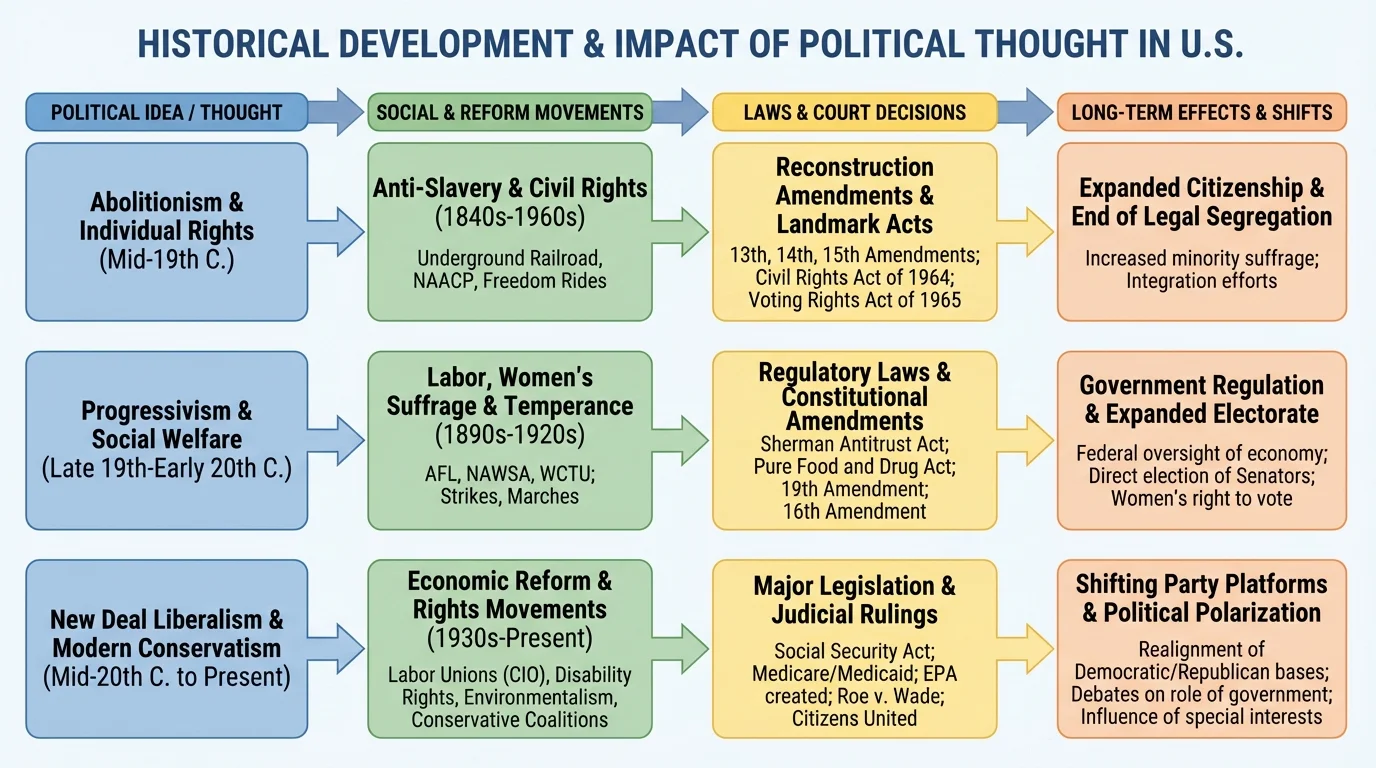
To evaluate political thought well, historians trace relationships among ideas, institutions, laws, and lived experience, as [Figure 4] illustrates. They do not just ask whether a reform passed. They ask who pushed for it, who resisted it, what conditions made it possible, and what consequences followed.
Cause and effect helps explain why change happens. For example, the Great Depression helped cause the New Deal, while the violence against civil rights activists helped build national support for stronger federal voting protections. But causes are rarely simple. Economic crisis, leadership, media coverage, court decisions, and grassroots activism often work together.
Continuity and change helps reveal what is truly new. The United States expanded voting rights over time, but conflict over who belongs in the political community never fully disappeared. Complexity reminds us that reforms can help some groups while excluding others, or solve one problem while creating another. Significant ideas such as equality before the law, popular sovereignty, individual rights, and federal responsibility have repeatedly shaped national debate.
Historians also use primary and secondary sources to build interpretations. A primary source might be a speech by Sojourner Truth, a campaign poster, a party platform, or a Supreme Court ruling. A secondary source might be a historian's book explaining why party realignment occurred. Good historical evaluation compares evidence, identifies perspective, and recognizes that political development is rarely inevitable.
Seen this way, U.S. political history since Reconstruction is not a straight march toward freedom or a simple story of decline. It is a contested process in which Americans repeatedly redefined citizenship, government power, party identity, and social justice. The flow of action in [Figure 4] makes one point especially clear: ideas matter most when people organize to turn them into institutions, rights, and laws.
When evaluating any political era, connect ideas to action. Ask what people believed, how they tried to make those beliefs real, who benefited, who was excluded, and what changed over time.
This approach helps explain why elections alone cannot tell the whole story. Major political change often begins before a law is passed and continues long after headlines fade. Reform movements, party shifts, court cases, protests, and ordinary citizens all shape the meaning of democracy.
