A nation can claim it wants peace and still send millions of soldiers overseas. It can condemn genocide and still hesitate to intervene. It can defend liberty abroad while restricting it at home. That tension has shaped United States history for more than a century. To understand America's role in the world, we have to look not only at what the country did, but also at why leaders acted, what choices they rejected, and how those decisions changed both the world and the United States itself.
From World War I to Darfur, U.S. responses to international crises reveal major themes in modern history: continuity and change, cause and effect, moral complexity, and the balance between national interest and human rights. Sometimes the United States acted quickly and decisively. At other times it delayed, debated, or stood back. These patterns matter because they help explain how the United States became a global power and why its decisions still influence international politics today.
Isolationism is the belief that a country should avoid deep involvement in foreign conflicts. Intervention means direct involvement in another country or international crisis through diplomacy, aid, military action, or other measures. Containment was the Cold War strategy of preventing the spread of communism. Genocide is the deliberate attempt to destroy, in whole or in part, a national, ethnic, racial, or religious group.
The story is not a simple march from isolation to global leadership. Instead, it is a series of choices made under pressure: war, economic collapse, ideological rivalry, and humanitarian disaster. Public opinion, geography, technology, race, fear, and political leadership all shaped those choices.
American foreign policy is often described as a struggle between ideals and interests. U.S. leaders have spoken about democracy, self-determination, freedom, and human rights. At the same time, they have also worried about trade, military security, global influence, and domestic politics. These goals sometimes worked together and sometimes clashed. For example, fighting Nazi Germany served both a moral purpose and a strategic one, while Cold War interventions sometimes supported anti-communist goals but harmed America's image as a defender of liberty.
Another important theme is selective action. The United States has never responded equally to every crisis. Distance, alliances, public support, military risk, and economic concerns all affected whether the country acted. That selective pattern helps explain why the United States intervened strongly in some places, such as Korea or Bosnia, but much more cautiously in others, such as Darfur.
[Figure 1] At the start of World War I in 1914, many Americans wanted neutrality. The United States had strong economic ties to Europe, but it also had a long tradition of avoiding European wars. Yet neutrality became harder to maintain as the war expanded. German unrestricted submarine warfare threatened American ships, and the Zimmermann Telegram, in which Germany tried to encourage Mexico to join a war against the United States, increased outrage.
President Woodrow Wilson asked Congress for a declaration of war in 1917, arguing that the world must be made "safe for democracy." This marked a major change. The United States was no longer only protecting its own borders; it was now claiming a role in shaping the international order. American troops and resources helped tip the balance in favor of the Allies.
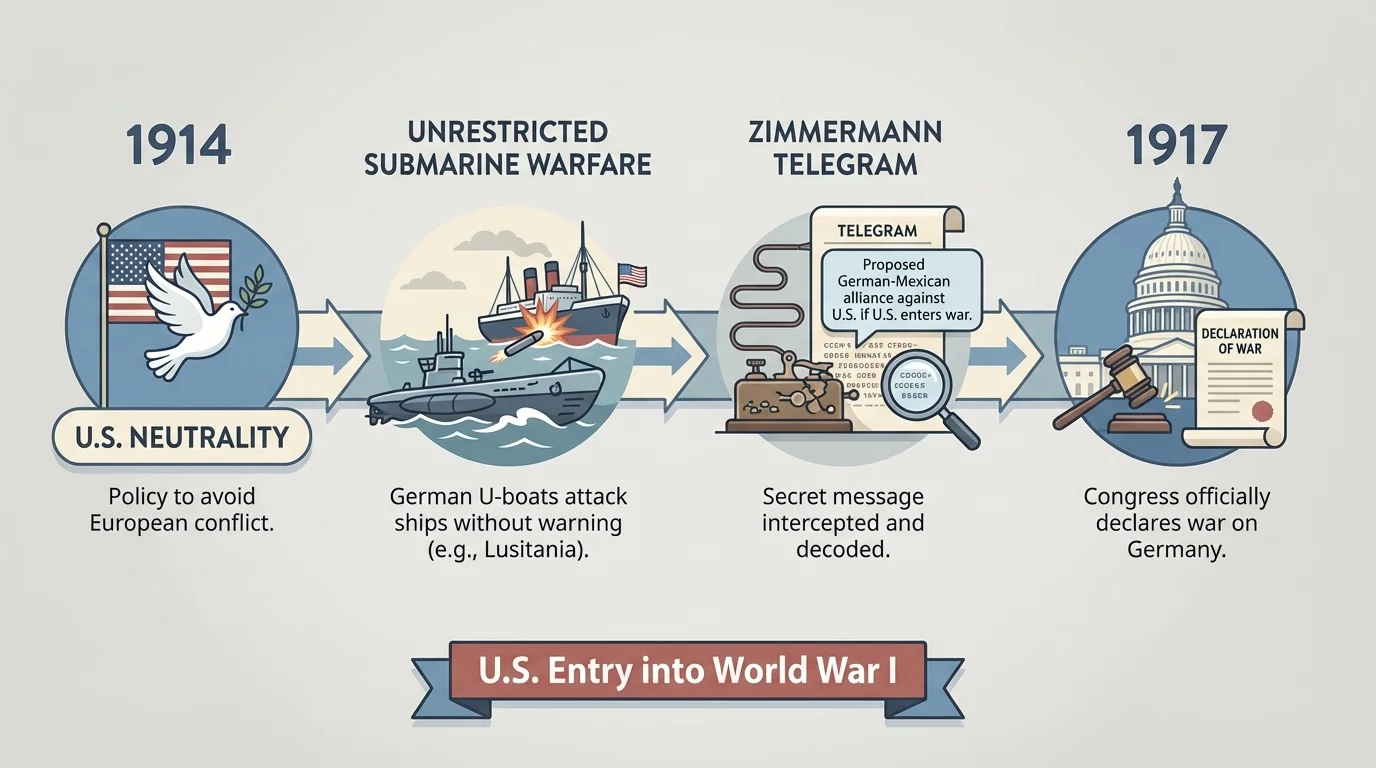
World War I also showed the limits of idealism. Wilson promoted his Fourteen Points and the League of Nations, hoping to create a system that would prevent future wars. But the U.S. Senate rejected joining the League. This reflected a continuing strand of isolationism even after intervention. In other words, there was change in America's international role, but also continuity in its hesitation to commit fully to global institutions.
That tension remained important in later decades. U.S. entry into war did not mean Americans had fully abandoned caution. The debate over whether the United States should lead internationally or stay more distant continued into the 1930s and beyond.
After the trauma of World War I and during the Great Depression, many Americans wanted to avoid another overseas war. Congress passed Neutrality Acts in the 1930s. However, the rise of aggressive dictatorships in Germany, Italy, and Japan made complete detachment difficult. President Franklin D. Roosevelt gradually moved the nation away from strict neutrality by supporting Britain and other Allies through programs such as Lend-Lease.
The Japanese attack on Pearl Harbor in December 1941 ended the debate. The United States entered World War II against Japan, and soon against Germany and Italy as well. This was a turning point in world history. The war required full national mobilization: factories shifted to wartime production, women entered defense industries in greater numbers, and millions of Americans served in the armed forces.
World War II transformed the United States into a true global power. The country fought on multiple continents and oceans, worked closely with allies such as Britain and the Soviet Union, and played a central role in defeating the Axis powers. By the war's end, the United States had immense military strength, industrial power, and influence over the postwar world.
The United States produced such enormous amounts of military equipment during World War II that it was called the Arsenal of Democracy. American factories turned out ships, planes, tanks, and supplies on a scale few nations could match.
Yet even this war revealed contradictions. The U.S. fought racist regimes abroad while segregation and discrimination remained strong at home. Japanese Americans were interned during the war, showing how fear could lead to violations of civil liberties even in a nation fighting for freedom.
[Figure 2] The Holocaust was the systematic murder of six million Jews by Nazi Germany, along with millions of others including Romani people, disabled people, political prisoners, and Slavic civilians. Its scale and geography across Nazi-controlled Europe make clear that this was not random wartime violence but an organized campaign of destruction.
The United States knew some information about Nazi persecution before the camps were liberated, but its response was limited. Immigration quotas remained restrictive, and many Jewish refugees were denied entry. Fear of foreigners, antisemitism, economic anxiety, and political caution all shaped policy. One well-known example is the St. Louis, a ship carrying Jewish refugees that was turned away from the United States in 1939.
During the war, the U.S. government focused mainly on defeating Germany as the fastest way to stop Nazi crimes. Some critics argued that the United States should have done more, such as bombing rail lines to camps or opening immigration more widely. Others argued that military victory had to come first. This debate continues among historians because it raises difficult questions about what governments owe civilians facing mass murder.
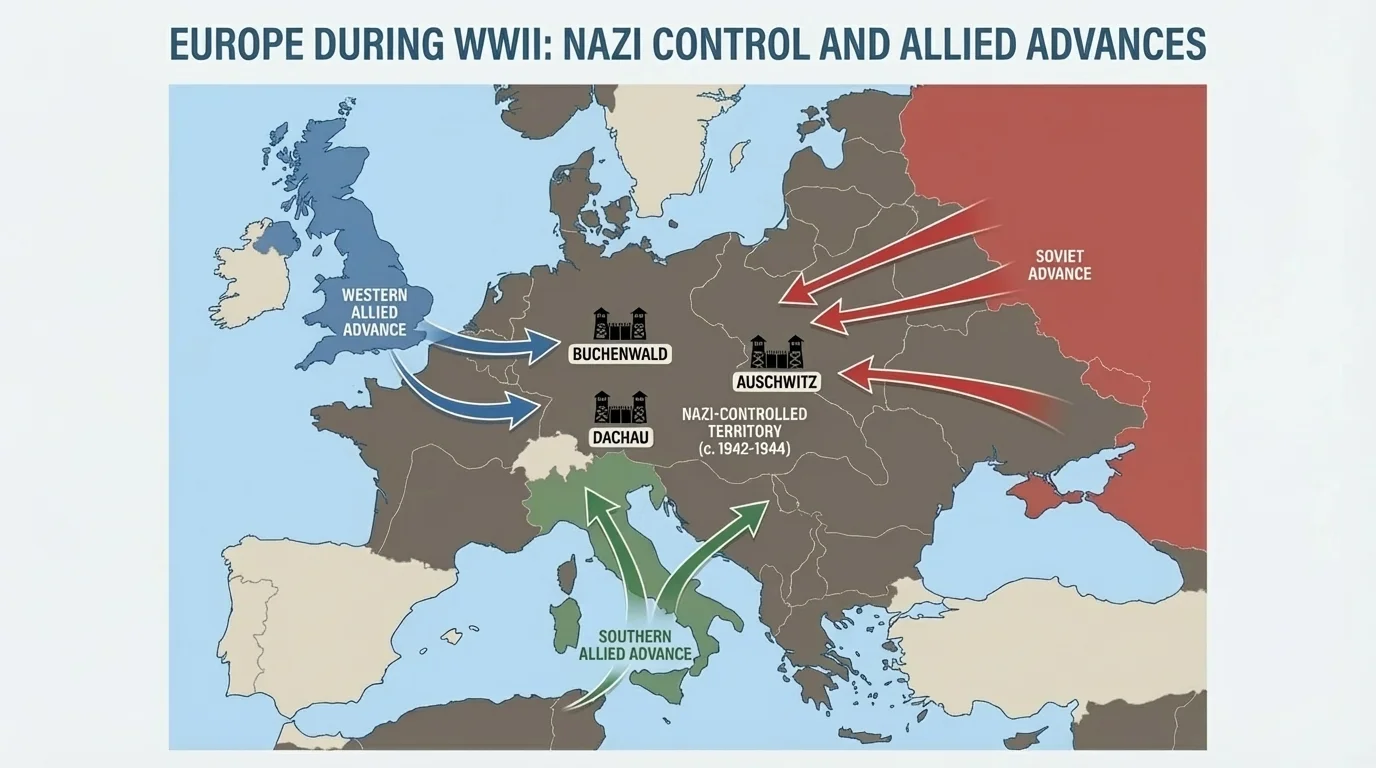
When American troops helped liberate camps such as Buchenwald and Dachau, they encountered overwhelming evidence of starvation, disease, and mass death. These scenes shocked soldiers, journalists, and the public. The liberation of camps changed American understanding of the war and strengthened support for punishing Nazi leaders afterward.
"The world must know what happened, and never forget."
— Idea reflected in many survivor testimonies and liberation reports
The Holocaust also reshaped global thinking about human rights. It influenced support for the United Nations, the Genocide Convention, and later human rights law. Even so, later genocides showed that remembering one atrocity does not automatically prevent another. The moral lesson is not just about the past; it is also about the danger of delayed response.
After World War II, the Allied powers put leading Nazis on trial in the Nuremberg Trials. These trials were significant because they established that individuals, including government leaders, could be held legally responsible for war crimes, crimes against humanity, and aggressive war.
This was a major development in international law. Before Nuremberg, leaders often claimed that actions taken in war were beyond legal judgment or were justified because they followed orders. The trials rejected that idea. "Just following orders" was not accepted as a complete defense for crimes against humanity.
Why Nuremberg mattered
The trials did more than punish Nazi leaders. They helped create the idea that states and individuals can be judged by international standards, not only by their own national laws. This principle later influenced war crimes tribunals for Bosnia and Rwanda and the development of the International Criminal Court.
At the same time, critics note that Nuremberg was shaped by power politics: the victors judged the defeated. That criticism does not erase the trials' importance, but it reminds us that justice in international affairs is often entangled with politics.
After World War II, the alliance between the United States and the Soviet Union collapsed into the Cold War, a global struggle between capitalist democracy and Soviet-style communism. Although the two superpowers rarely fought each other directly, they competed through military buildups, espionage, propaganda, and proxy wars.
The central U.S. strategy was containment. President Harry Truman announced the Truman Doctrine in 1947, promising aid to countries resisting communism. The Marshall Plan followed, sending economic assistance to rebuild Western Europe. The idea was practical and ideological at the same time: stronger economies were less likely to turn to communist movements.
Cold War policy showed both unity and division in American society. Many people supported resisting Soviet power, but fear of communism also fueled suspicion at home. McCarthyism led to accusations, blacklists, and attacks on civil liberties. This is another pattern in U.S. history: foreign threats can reshape domestic life.
| Policy | Main Goal | Example of U.S. Response | Historical Impact |
|---|---|---|---|
| Truman Doctrine | Support nations resisting communism | Aid to Greece and Turkey | Made containment official policy |
| Marshall Plan | Rebuild Europe economically | Financial aid to Western Europe | Strengthened allies and reduced instability |
| NATO | Collective security alliance | Military cooperation with Western Europe | Created long-term alliance system |
Table 1. Major early Cold War policies and their effects on U.S. international involvement.
[Figure 3] One of the earliest Cold War tests came in Berlin. Germany had been divided after World War II, and Berlin itself was split into sectors. In 1948 the Soviet Union blockaded land routes to West Berlin. The city's strategic geography and the air corridors into it help explain why Berlin became such a powerful symbol of Cold War conflict.
Instead of abandoning West Berlin or launching a direct military attack, the United States and its allies organized the Berlin Airlift. For nearly a year, planes delivered food, coal, and other supplies to the city. This was a remarkable response because it used logistics and persistence rather than open combat.
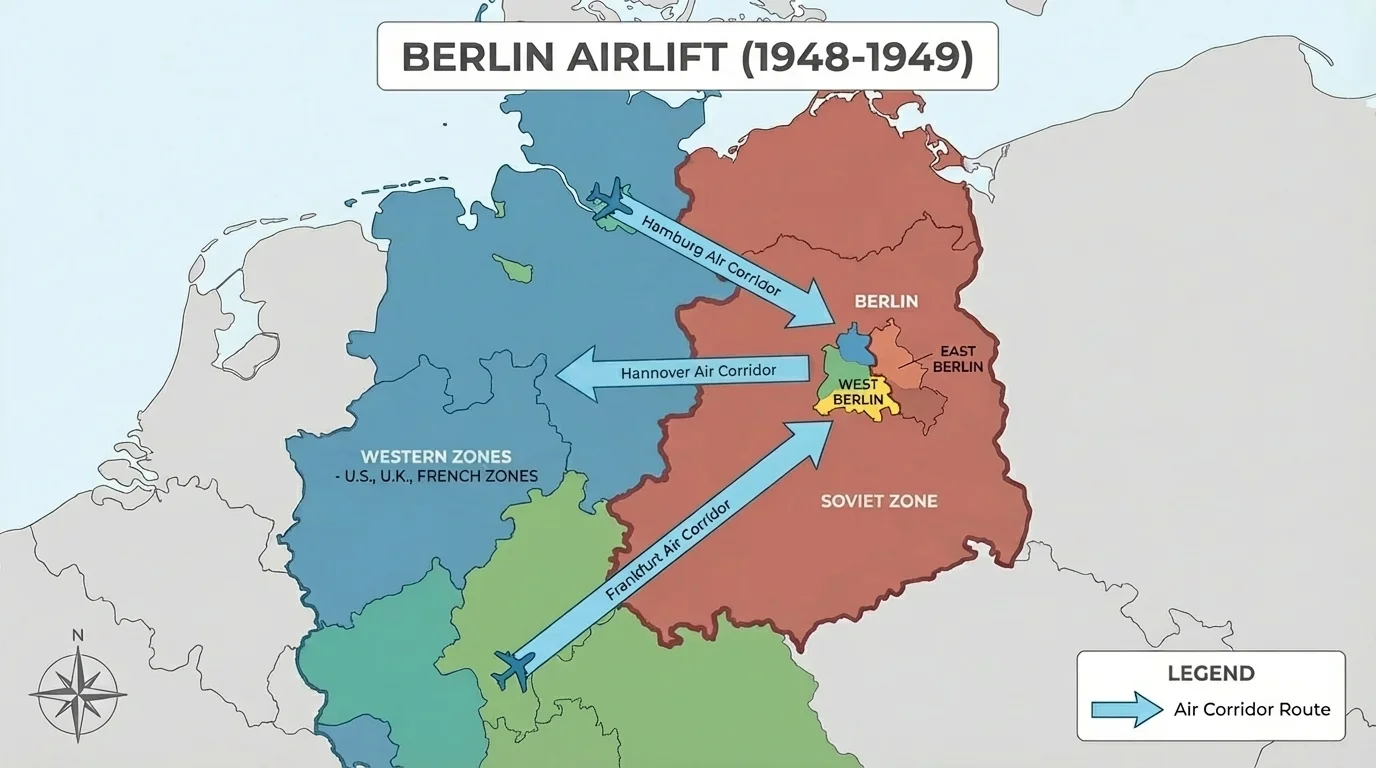
The airlift succeeded. The Soviet blockade failed, and the United States demonstrated commitment to containment without triggering a larger war. This event strengthened Western morale and increased support for alliances like NATO.
Later Cold War crises were often more dangerous, but this episode still captures a key point: the United States was now deeply committed to defending allies far from its own shores. That was a major change from earlier traditions of limited involvement.
When North Korea invaded South Korea in 1950, the United States responded under the authority of the United Nations. This was significant because it showed that Cold War conflict could be framed as collective security, not just unilateral U.S. action. President Truman believed that failing to act would encourage further communist expansion.
The Korean War became a brutal conflict with rapid advances and retreats. After U.S.-led forces pushed north, China entered the war, and the fighting settled into stalemate. The war ended in 1953 with an armistice, not a peace treaty. Korea remained divided.
Korea demonstrated the concept of limited war. In the nuclear age, U.S. leaders tried to contain communism without letting regional conflict become world war. The result was frustrating: enormous sacrifice without clear victory. Yet to many policymakers, the defense of South Korea proved that containment could work.
Case study: Evaluating the Korean War
Step 1: Identify the goal.
The main U.S. goal was to prevent communist control of South Korea.
Step 2: Compare the outcome to the goal.
South Korea remained independent, so the immediate containment goal was achieved.
Step 3: Consider the costs.
The war caused massive casualties, destruction, and a long-term military standoff.
The Korean War can therefore be viewed as a strategic success in containment but a human and political tragedy.
This mixed result would matter in Vietnam, where leaders feared another loss to communism but faced very different conditions.
[Figure 4] The Vietnam War exposed how cause and effect in foreign policy can build into a crisis. The chain of decisions began with Cold War fears, especially the domino theory, the belief that if one country fell to communism, others nearby would follow. U.S. leaders increased support for South Vietnam over time, especially after the Gulf of Tonkin incident in 1964.
American involvement escalated under President Lyndon B. Johnson. Hundreds of thousands of U.S. troops were sent to Vietnam, and bombing campaigns expanded. But military technology and firepower did not produce a decisive victory. Guerrilla warfare, difficult terrain, and political weakness in South Vietnam all limited American success.
Vietnam also became a media war. Graphic television coverage brought combat and civilian suffering into American homes. As casualties rose and official claims of progress seemed less believable, public trust weakened. Antiwar protests grew, especially among students, veterans, and civil rights activists.
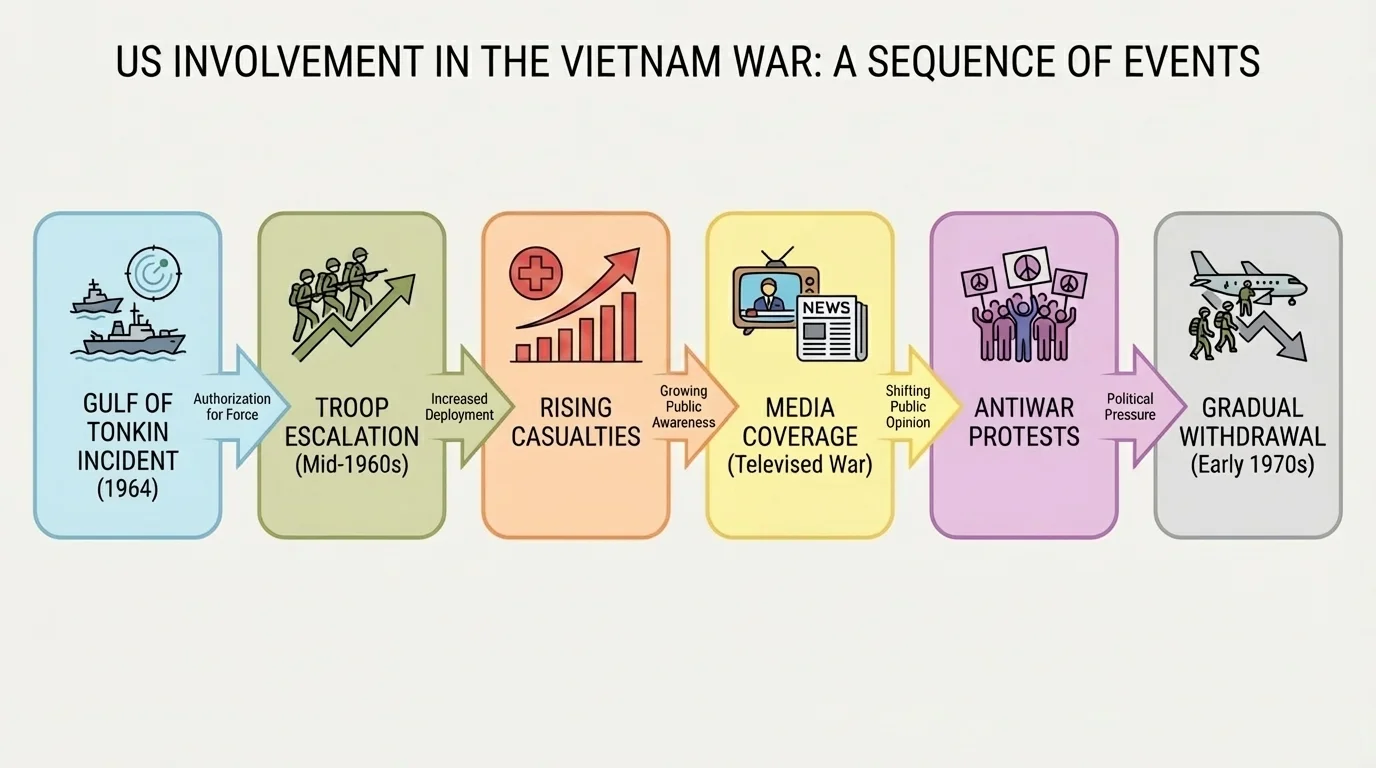
The war's turning point came with the Tet Offensive in 1968. Although communist forces suffered heavy losses, the offensive shocked the American public because it contradicted claims that victory was near. President Richard Nixon later pursued "Vietnamization," shifting more fighting responsibility to South Vietnamese forces while gradually withdrawing U.S. troops.
The United States left Vietnam, and in 1975 South Vietnam fell to the North. For many Americans, this was proof that military power has limits. The war was not just a battlefield struggle; it was also shaped by politics, media, protest, and credibility.
From World War I through Vietnam, one recurring pattern is that presidents often justified intervention by claiming it was necessary for long-term peace or security. The debate usually centered not on whether the world mattered, but on what level of U.S. involvement was wise, moral, and sustainable.
Vietnam changed American attitudes toward war powers and government trust. Congress passed the War Powers Resolution in an effort to limit presidential military action without legislative approval. The conflict also made later leaders more cautious about prolonged ground wars.
After Vietnam, U.S. foreign policy did not become isolationist again, but it did become more cautious and more publicly debated. Human rights became a more visible part of diplomatic language, especially under President Jimmy Carter, yet Cold War competition still shaped many decisions.
During the later Cold War, the United States supported anti-communist movements in some regions, even when allies had poor human rights records. This showed the continuing tension between ideals and strategy. The end of the Cold War in 1991 raised a new question: if the Soviet threat was gone, would the United States now respond more consistently to humanitarian crises?
[Figure 5] The post-Cold War era tested whether the world had learned from the Holocaust. A comparison of Bosnia and Darfur reveals both similarities and differences in violence and in the U.S. response. In Bosnia during the 1990s, the breakup of Yugoslavia led to ethnic conflict, mass killing, and the policy known as ethnic cleansing, especially against Bosnian Muslims.
At first, the international response to Bosnia was slow and hesitant. The United States was reluctant to commit troops after failures elsewhere, including in Somalia. But after atrocities such as the Srebrenica massacre in 1995, U.S. leadership within NATO helped carry out airstrikes against Bosnian Serb forces. American diplomacy also contributed to the Dayton Accords, which ended the war.
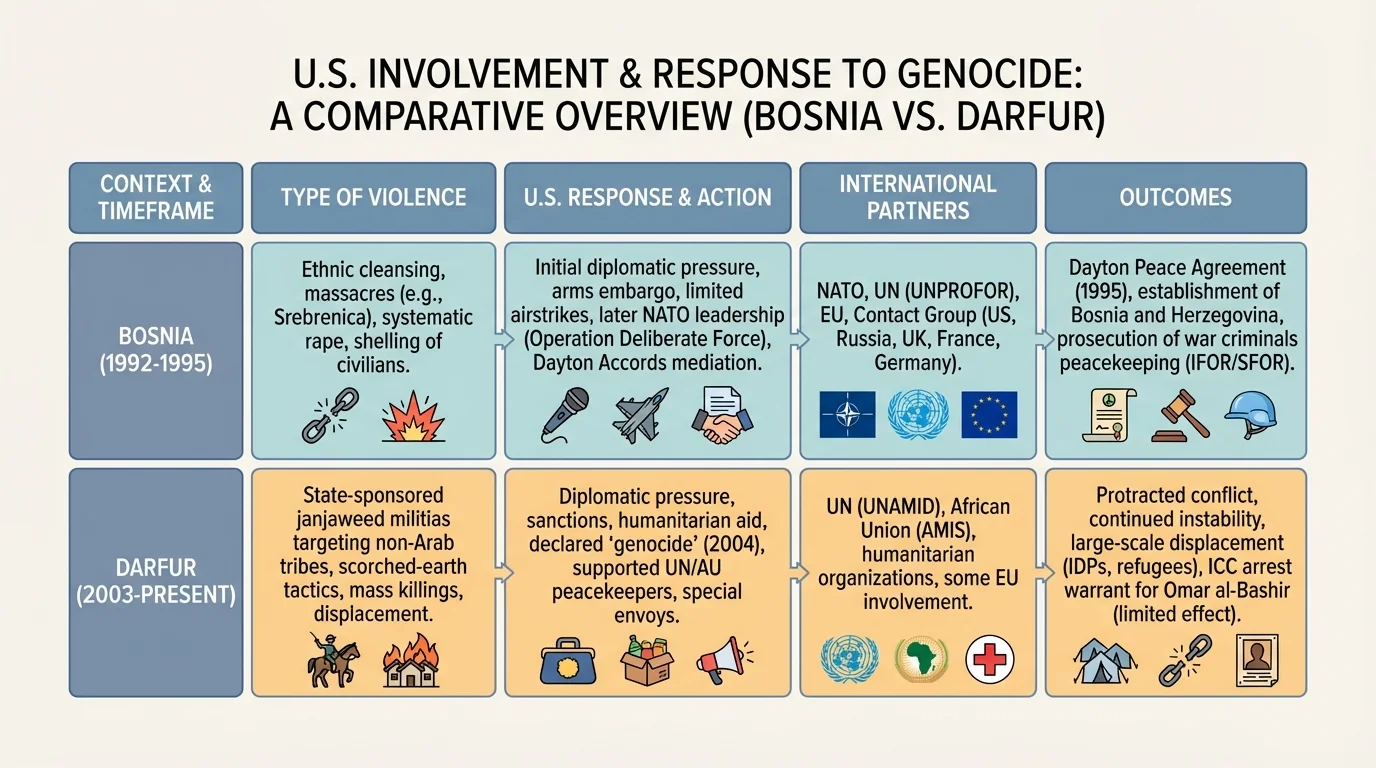
Bosnia showed that the United States could play a decisive role in stopping mass violence when it chose to act with allies. It also led to international tribunals that echoed the legal legacy of Nuremberg by prosecuting war crimes and genocide.
Darfur, a region in Sudan, presented another test in the early 2000s. Violence by Sudanese government-backed militias against civilian groups caused mass death, displacement, and widespread suffering. The U.S. government officially labeled the violence in Darfur as genocide in 2004. That was historically significant because the term carried powerful legal and moral meaning.
However, naming genocide did not produce rapid military intervention. The U.S. response relied more on sanctions, diplomacy, humanitarian aid, and support for international peacekeeping efforts. Critics argued that this response was too weak given the scale of suffering. Supporters said direct intervention was difficult because of geography, political constraints, and the need for multilateral cooperation.
The comparison highlights a major lesson: recognition does not guarantee action. The United States often responds more forcefully when strategic interests, allied support, and public attention align with humanitarian concerns.
Why some interventions happen and others do not
U.S. decisions about intervention usually depend on several factors at once: military risk, alliance commitments, economic interests, media attention, domestic politics, and how leaders define national interest. Humanitarian need matters, but it is rarely the only factor.
This reality can be frustrating, but understanding it is essential for evaluating policy honestly. Nations do not act as purely moral actors. They act within systems of power, fear, law, and public opinion.
Across the twentieth and early twenty-first centuries, the United States changed from a nation wary of foreign entanglements into a superpower deeply involved in global affairs. That is a major historical change. Yet important continuities remained: Americans repeatedly argued over intervention, distrusted long wars, and struggled to balance national interest with moral principle.
There is also a clear pattern of expanding international responsibility. The World Wars drew the United States into major global conflict. The Cold War made international engagement nearly constant. Later crises such as Bosnia and Darfur pushed the United States to confront questions about genocide, human rights, and the responsibility to protect civilians.
Key figures shaped these responses: Woodrow Wilson promoted international idealism; Franklin Roosevelt led the nation through global war; Harry Truman defined containment; military and political leaders in Korea and Vietnam wrestled with limited war; and later presidents faced the challenge of responding to genocide in a world where action was possible but never simple.
Evaluating U.S. involvement requires judgment, not slogans. The United States helped defeat fascism, supported reconstruction, defended allies, and contributed to international law. It also delayed action in the face of atrocity, made destructive mistakes, and sometimes acted inconsistently. History is not just a record of victories or failures. It is a study of choices, consequences, and responsibilities.
