A single invention, a protest, or even the price of bread can help trigger changes that reshape the world. Historians study these moments not as isolated episodes, but as connected events with deep causes and wide effects. From Renaissance artists challenging old ways of seeing, to reformers questioning religious authority, to modern protesters organizing through social media, world history since the late medieval period has been shaped by people responding to new ideas, inequality, technology, and power.
When historians investigate major events, they ask several questions: What caused this to happen? Were the causes short-term or long-term? Who benefited, and who suffered? What changed, and what stayed the same? This helps historians analyze continuity and change. For example, a revolution may overthrow a king, but social inequality may continue. A war may destroy old empires, yet nationalism may grow even stronger afterward.
Historians also look for complexity. Important events almost never have a single cause. The French Revolution was not caused only by hunger, and World War I was not caused only by one assassination. Economic pressures, political conflicts, ideas, and individual decisions often interact. Historians use primary sources, such as speeches, letters, laws, diaries, posters, and photographs, along with secondary sources, such as textbooks and scholarly articles, to compare perspectives and build interpretations.
Cause is something that helps bring about an event. Effect is the result or consequence of that event. A turning point is a moment when important change becomes more likely or more visible. Continuity means things that remain relatively stable over time, while change means significant transformation.
Another important idea is that effects can be intended or unintended. Reformers may seek freedom and produce conflict. New technology may increase wealth and also deepen inequality. Keeping that complexity in mind makes world history more accurate and more interesting.
The Renaissance began in Italian city-states such as Florence, Venice, and Milan in the late 1300s and spread through Europe over the next several centuries. It grew out of several causes, including increased trade, the wealth of merchant families such as the Medici, contact with classical Greek and Roman ideas, and the rise of urban centers. Trade routes and strong city economies helped ideas travel as people, books, and artistic techniques moved across Europe.
[Figure 1] One major feature of the Renaissance was humanism, an intellectual movement that emphasized human potential, classical learning, and careful study of texts. Renaissance thinkers did not usually reject religion, but they often focused more on human achievement in this world. Artists such as Leonardo da Vinci and Michelangelo used observation, proportion, and perspective to create more realistic works. Writers such as Petrarch and Erasmus studied ancient texts and encouraged critical thinking.
The invention of the printing press by Johannes Gutenberg around 1450 accelerated the spread of ideas. Books became cheaper and more available, allowing literacy to expand. This was a major cause of later changes because new ideas could now circulate faster than ever before.
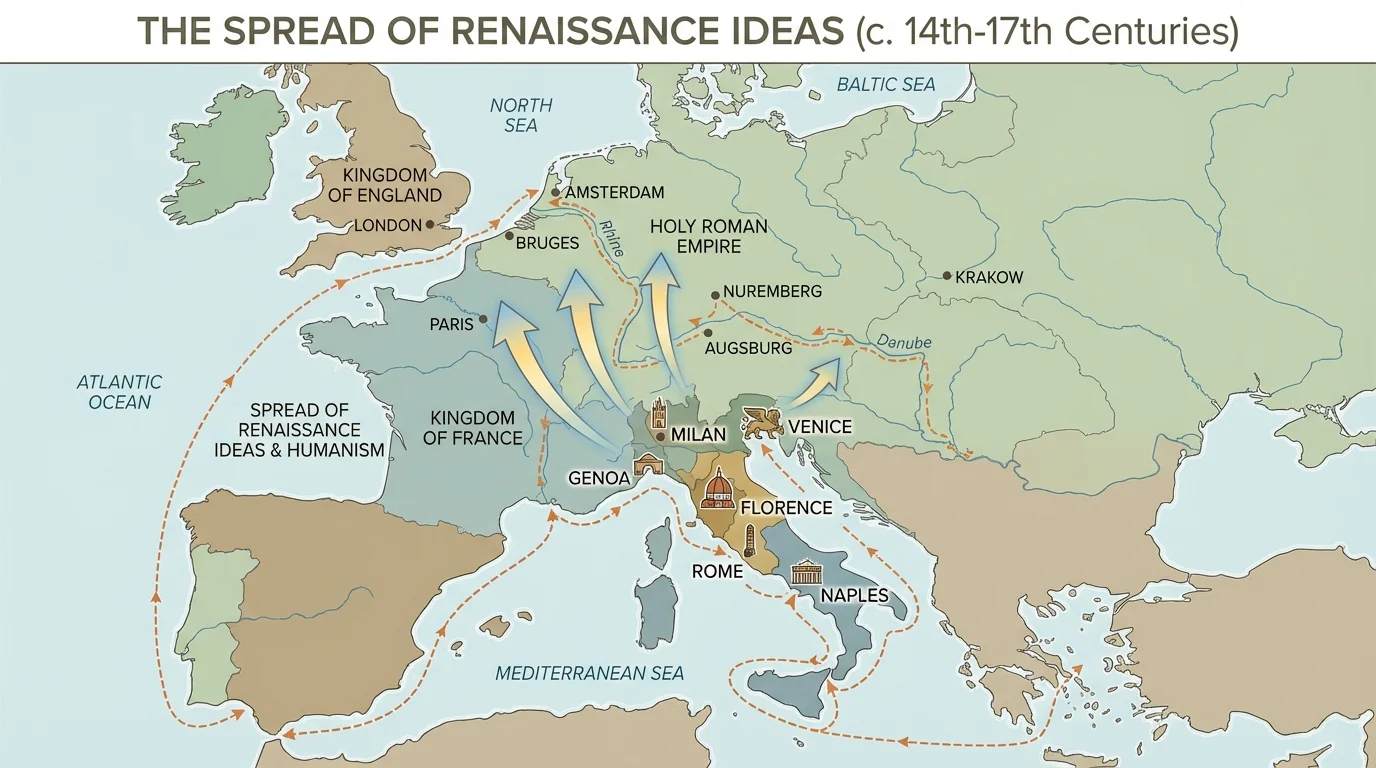
The effects of the Renaissance were enormous. It encouraged scientific observation, inspired educational reform, and challenged Europeans to think differently about politics, religion, and the individual. It also helped lay the groundwork for the Scientific Revolution and the Reformation. Yet continuity remained: most people still lived in rural communities, and political power remained concentrated in elites. The Renaissance changed culture and thought first, and social change spread unevenly.
Some Renaissance artists studied anatomy by examining human bodies so they could paint muscles and movement more accurately. Their work linked art and science in ways that still influence medicine and design today.
Primary sources from the period include paintings, architecture, notebooks by Leonardo da Vinci, and printed editions of classical texts. Secondary sources help historians debate how far the Renaissance truly reached beyond elite circles.
[Figure 2] The Protestant Reformation began in 1517, when Martin Luther challenged practices of the Roman Catholic Church, especially the sale of indulgences. What began as criticism of Church corruption quickly expanded into a broad religious and political movement that transformed Europe for more than a century.
The causes of the Reformation included resentment toward Church wealth and corruption, growing nationalism, frustration with papal authority, and the spread of literacy and print culture. Luther's Ninety-Five Theses, originally intended for academic debate, spread rapidly because of the printing press. Other reformers, such as John Calvin and Huldrych Zwingli, developed their own teachings, creating multiple Protestant traditions.
The Reformation had both religious and political effects. It broke the religious unity of Western Europe, led to wars of religion, and increased the power of some rulers who used Protestantism to reduce Church influence. In England, Henry VIII separated from the Catholic Church and created the Church of England. The Catholic Church responded through the Counter-Reformation, including reforms from the Council of Trent and renewed missionary activity.
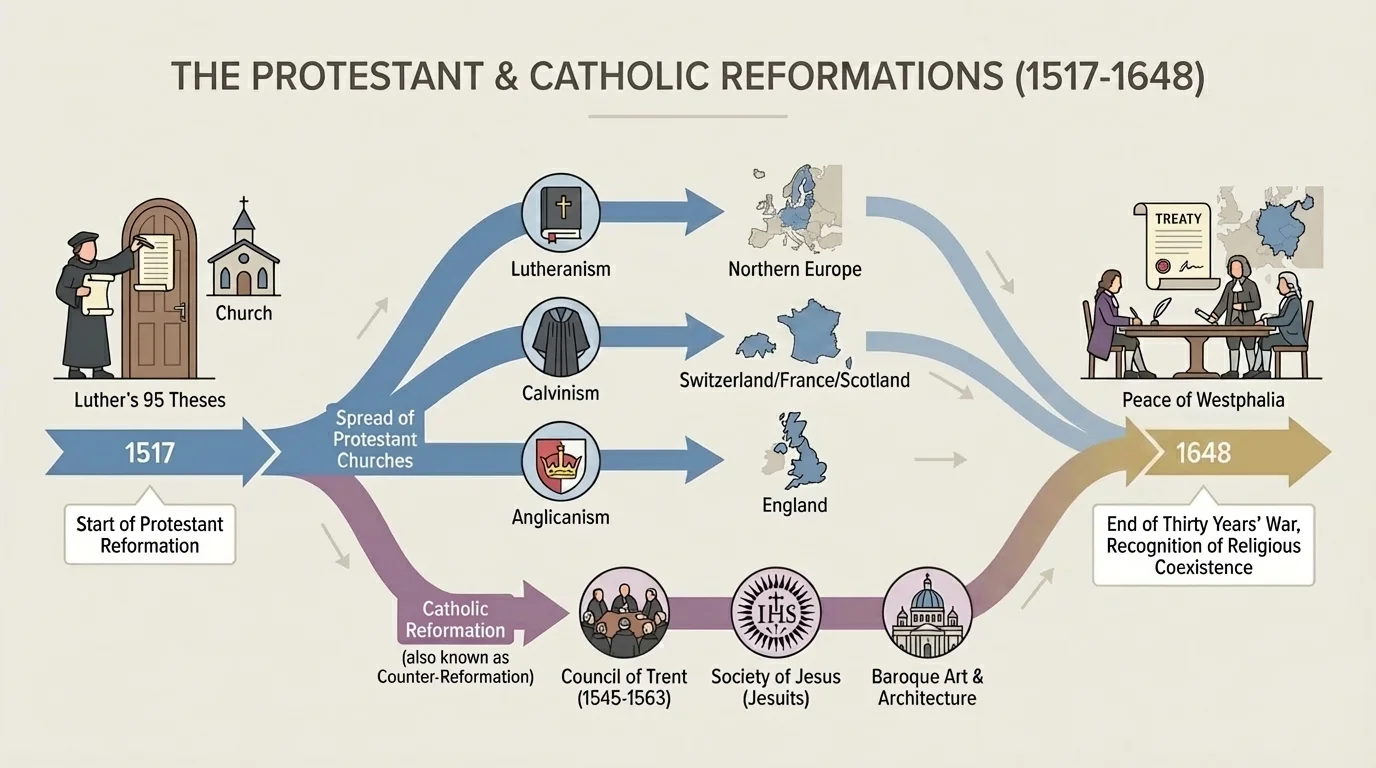
One major long-term effect was the strengthening of state power. In some regions, rulers gained more control over religion within their territories. Another effect was increased emphasis on reading religious texts, which encouraged literacy and education. However, the Reformation also brought violence, persecution, and deep social division. The Peace of Westphalia in 1648 helped end major religious wars in Europe and weakened the dream of a single Christian political order.
When historians revisit the spread shown in [Figure 2], they see how technology, belief, and politics combined. The Reformation was not only about theology; it was also about authority, communication, and the power to shape society.
The changes of the Renaissance and Reformation helped create conditions for the Scientific Revolution and the Enlightenment. Thinkers such as Copernicus, Galileo, Kepler, and Newton used observation and mathematics to explain the natural world. Philosophers such as John Locke, Voltaire, Montesquieu, and Rousseau applied reason to government and society.
These movements challenged the idea that truth should come only from tradition or authority. Instead, they promoted evidence, debate, natural rights, and the idea that government should serve the people. These ideas became major causes of later revolutions, especially in France and Latin America.
Ideas as historical forces
Not all causes are material, such as hunger or taxes. Some causes are intellectual. Ideas about rights, liberty, sovereignty, and equality can motivate people to resist rulers, write constitutions, or demand reforms. Once ideas spread through schools, pamphlets, newspapers, and speeches, they can become powerful agents of change.
At the same time, continuity remained. Many Enlightenment thinkers spoke of universal rights while women, enslaved people, and colonized populations were denied those rights. This tension between ideals and reality appears repeatedly in modern history.
[Figure 3] The Industrial Revolution began in Britain in the late 1700s and spread to Europe, the United States, Japan, and beyond. It was caused by several factors: agricultural improvements, population growth, access to coal and iron, investment capital, expanding markets, imperial resources, and inventions such as the spinning jenny, steam engine, and mechanized loom. The dramatic shift from hand production to machine production transformed daily life through the contrast between rural life and industrial cities.
Factories increased production and lowered costs, but they also changed labor. People moved from villages to cities in large numbers, creating rapid urbanization. Cities grew faster than housing and sanitation systems, leading to overcrowding, disease, and pollution. Men, women, and children often worked long hours in dangerous conditions.
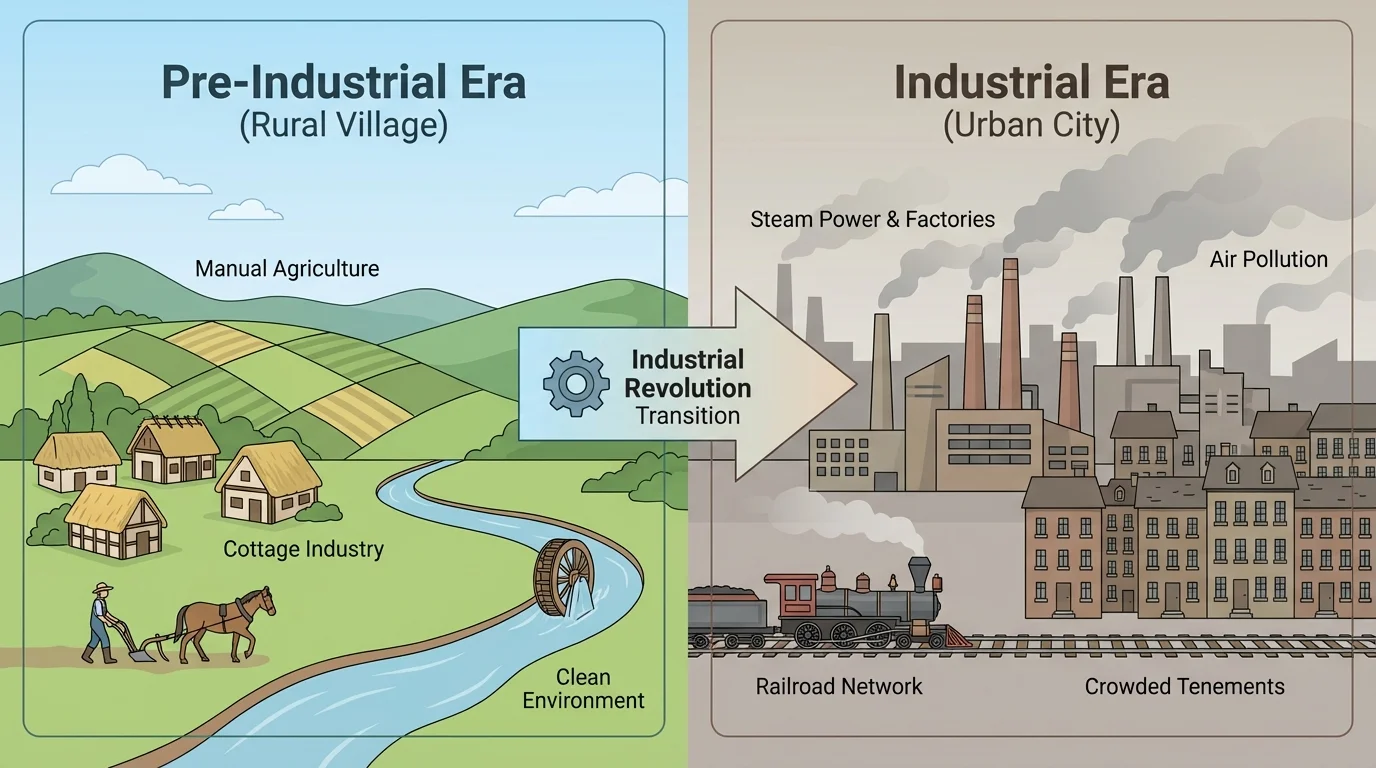
The effects of industrialization were both positive and negative. It increased wealth, expanded transportation through railroads and steamships, and helped create a larger middle class. It also sharpened class divisions between industrial owners and workers. New ideologies emerged in response, including liberalism, socialism, and Marxism. Karl Marx argued that industrial capitalism created exploitation and class conflict.
Industrial power also affected global history. Industrialized nations often sought raw materials and markets overseas, which intensified imperialism in Africa and Asia. That means the Industrial Revolution was not only a European event; it reshaped the entire world economy. The environmental costs, including polluted air and water, also introduced problems that still matter today.
Case study: Why Britain industrialized first
Britain was the first major industrial nation because several causes came together at the same time.
Step 1: Natural resources and geography
Britain had accessible coal and iron, plus rivers and ports that made transport easier.
Step 2: Agricultural change
Improved farming methods increased food production, helping the population grow and freeing some workers for factory labor.
Step 3: Capital and markets
Profits from trade and empire provided investment money, while colonial markets increased demand for manufactured goods.
Step 4: Political stability
Compared with some rivals, Britain had institutions that protected investment and encouraged business expansion.
This combination produced a powerful chain of effects: mechanization, urban growth, social conflict, and global influence.
The contrast in [Figure 3] also helps explain why industrialization sparked reform movements. Labor unions, public health laws, and education reforms grew partly because industrial society created new problems that older systems could not manage.
Between the late 1700s and the mid-1900s, revolutions reshaped governments across the world. Although they happened in different places and under different conditions, many shared common causes: inequality, weak leadership, financial crisis, new political ideas, war pressures, and rising expectations. The sequence highlights how revolutionary change unfolded across time, even as each movement developed its own goals and outcomes.
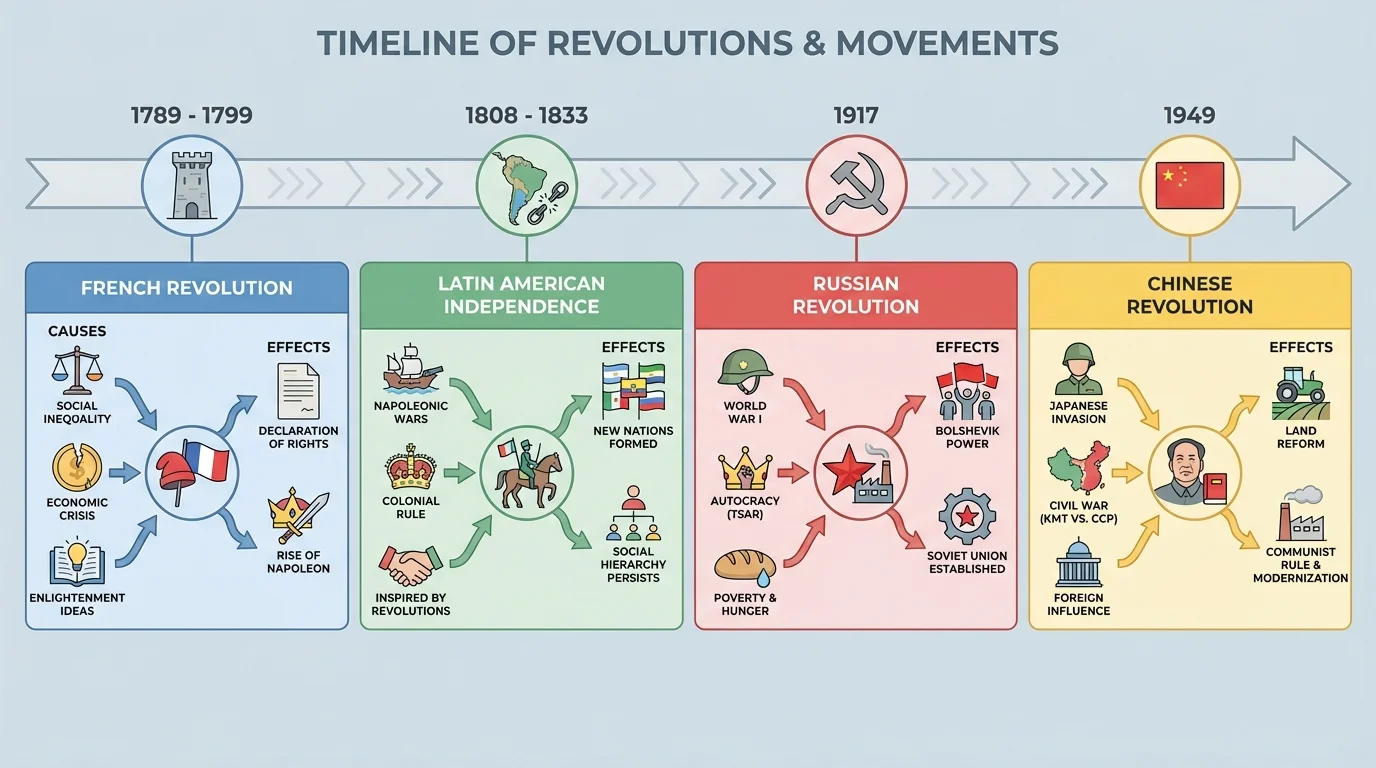
The French Revolution began in 1789. Its long-term causes included social inequality under the Old Regime, resentment of aristocratic privilege, Enlightenment ideas, and financial problems worsened by war debt. The immediate crisis included food shortages and rising bread prices. When King Louis XVI called the Estates-General, political conflict intensified.
The effects were dramatic. The monarchy fell, the Declaration of the Rights of Man and of the Citizen promoted new political ideals, and France entered a period of radicalization, including the Reign of Terror under Maximilien Robespierre. Eventually, Napoleon Bonaparte rose to power. The revolution weakened feudal privilege and spread nationalist and liberal ideas across Europe, but it also showed how revolutions can produce violence, dictatorship, and war.
The Creole elites of Latin America were influenced by Enlightenment ideas, the American Revolution, the French Revolution, and resentment of Spanish and Portuguese control. Leaders such as Simón Bolívar, José de San Martín, Miguel Hidalgo, and José Morelos played major roles in independence movements during the early 1800s.
These revolutions weakened colonial rule and created new nations, but continuity remained in many places. Political instability, military caudillos, economic dependence, and social inequality often persisted. Independence did not automatically produce full democracy or equality for Indigenous peoples, enslaved people, or the poor.
The Bolshevik Revolution of 1917 was caused by autocratic rule under Tsar Nicholas II, industrial unrest, peasant hardship, military failure in World War I, and the appeal of socialist ideas. Lenin and the Bolsheviks promised "peace, land, and bread."
The effects included the collapse of the Romanov dynasty, civil war, and the creation of the Soviet Union. The revolution inspired communist movements around the world but also led to one-party rule, censorship, forced economic change, and political repression. Under Joseph Stalin, the Soviet state became highly centralized and authoritarian.
The Chinese Revolution unfolded over decades rather than in a single year. Its causes included the decline of the Qing dynasty, foreign interference, internal rebellion, warlordism, nationalism, and social inequality. Sun Yat-sen promoted republican ideas, while Mao Zedong and the Chinese Communist Party gained support among peasants during the long civil war and the struggle against Japanese invasion.
In 1949, the Communists won and established the People's Republic of China. The revolution ended one phase of civil conflict and transformed land ownership and political authority. Later campaigns such as the Great Leap Forward and the Cultural Revolution brought massive upheaval, suffering, and state-driven social transformation. China's revolution, like Russia's, showed how calls for equality could create highly centralized political systems.
[Figure 4] Looking back at the sequence, historians can compare patterns across revolutions: inequality often sparks unrest, ideas help justify change, and the results rarely match the hopes of every group involved.
World War I began in 1914, but its roots ran deep. The long-term causes are often summarized as militarism, alliances, imperialism, and nationalism. The assassination of Archduke Franz Ferdinand in Sarajevo was the immediate trigger, but the war became global because alliance systems pulled many states into conflict.
World War I introduced trench warfare, machine guns, poison gas, and industrial-scale destruction. It caused the collapse of the Ottoman, Austro-Hungarian, German, and Russian empires. The Treaty of Versailles ended the war but punished Germany harshly, creating resentment that later contributed to World War II. The war also redrew borders and encouraged anti-colonial movements, because colonized soldiers had fought and demanded greater rights afterward.
World War II had several causes: unresolved tensions from World War I, the global economic crisis of the Great Depression, the rise of fascist leaders such as Adolf Hitler and Benito Mussolini, militarism in Japan, and the failure of appeasement and collective security. It became the deadliest conflict in history.
| War | Key Causes | Major Effects |
|---|---|---|
| World War I | Militarism, alliances, imperialism, nationalism, assassination in Sarajevo | Mass casualties, collapse of empires, Treaty of Versailles, League of Nations |
| World War II | Versailles resentment, economic crisis, fascism, aggression by Germany, Italy, and Japan | Holocaust, atomic bombings, United Nations, Cold War, decolonization pressure |
Table 1. Comparison of major causes and effects of the two World Wars.
The effects of World War II were global. The Holocaust exposed the terrifying consequences of racism, antisemitism, and totalitarianism. The United States used atomic bombs on Hiroshima and Nagasaki, introducing the nuclear age. The United Nations was created to prevent future global war. At the same time, Europe's old colonial powers were weakened, helping accelerate decolonization in Asia, Africa, and the Middle East.
"Never in the field of human conflict was so much owed by so many to so few."
— Winston Churchill, during World War II
Primary sources for the World Wars include soldiers' letters, propaganda posters, treaty documents, photographs, and survivor testimonies. Secondary sources help historians debate responsibility, memory, and the meaning of total war.
After 1945, the world was shaped by rivalry between the United States and the Soviet Union. The Cold War was not a direct full-scale war between these superpowers, but a global struggle involving ideology, nuclear competition, proxy wars, espionage, and political influence. It affected revolutions and reform movements from Cuba to Vietnam to Afghanistan.
Decolonization transformed global politics as countries in Asia, Africa, and the Middle East won independence. Yet independence often came with major challenges: border disputes, economic dependency, ethnic tensions, and pressure to align with one Cold War bloc or the other. This shows how one era's "ending" often becomes the cause of another era's conflicts.
Nationalism, industrialization, and imperial competition did not disappear after the nineteenth century. They continued into the twentieth century and shaped both the World Wars and later independence movements.
The Cold War also showed continuity and change in global power. Empires declined, but powerful states still competed for influence. Colonies became nations, but inequality in the world system remained.
The Arab Spring began in 2010 and spread across North Africa and the Middle East. It was triggered by the self-immolation of Mohamed Bouazizi, a Tunisian street vendor protesting state harassment and economic humiliation. However, the movement did not produce one single regional result. Different countries experienced reform, repression, regime change, or civil war.
[Figure 5] The causes included authoritarian rule, corruption, youth unemployment, rising food prices, lack of political freedom, and frustration with inequality. Social media and mobile technology helped activists organize, share videos, and spread protest messages quickly. This was a modern example of an old historical pattern: new communication tools can accelerate political change, just as print had done during earlier centuries.
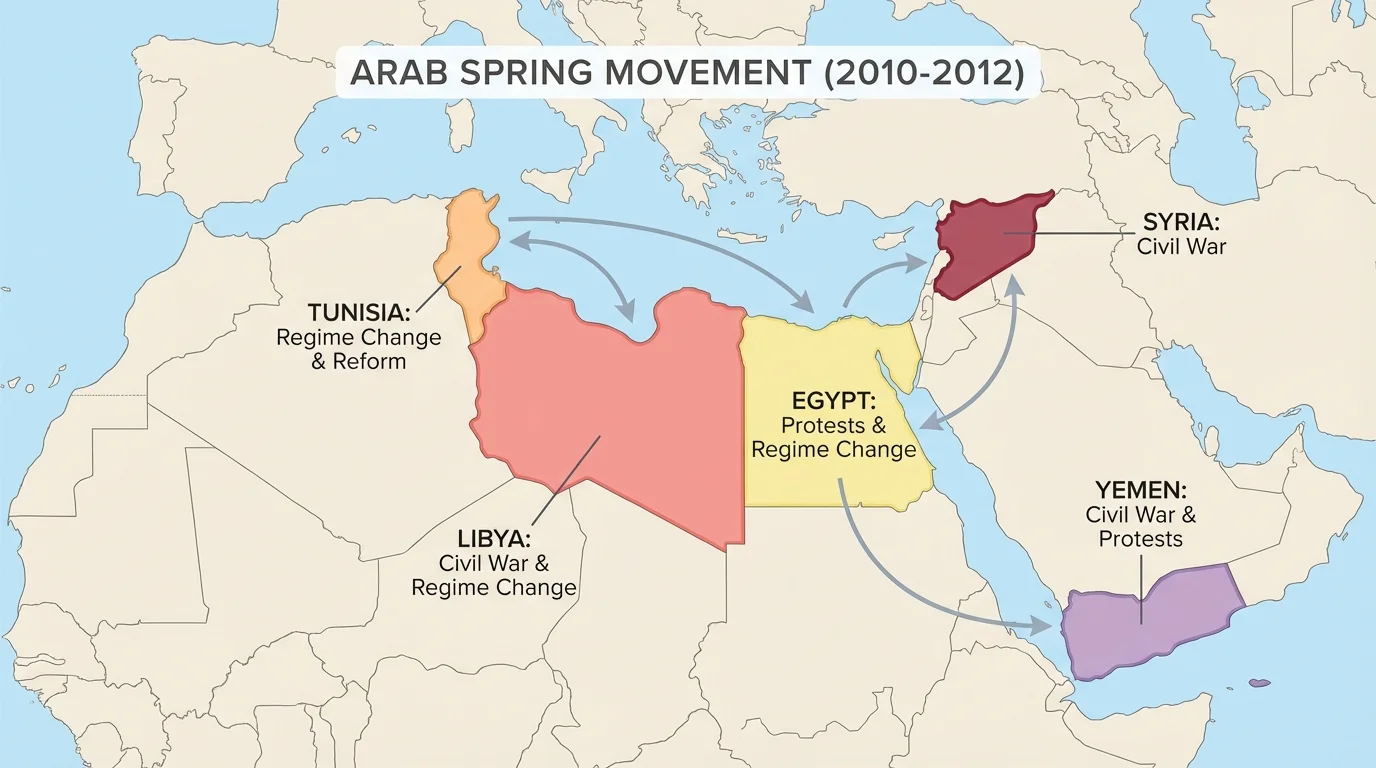
Tunisia achieved the most successful democratic transition in the short term, although it later faced renewed political strain. Egypt saw mass protests that removed Hosni Mubarak, but the military later regained strong control. Libya and Yemen experienced state collapse and conflict. Syria descended into a devastating civil war with major regional and global involvement. These different outcomes show that similar causes do not always lead to the same effects. Institutions, military loyalty, foreign intervention, and social divisions all matter.
Viewed across the region in [Figure 5], the Arab Spring demonstrates both unity and diversity. A shared demand for dignity and political voice linked protesters across borders, yet local histories shaped very different paths.
Case study: Why the Arab Spring produced different outcomes
Countries across the region shared some common grievances, but results varied because conditions inside each state were different.
Step 1: Compare institutions
Where state institutions were somewhat flexible, limited reform was more possible. Where regimes relied heavily on force, violence escalated more quickly.
Step 2: Consider the military
If the military withdrew support from a ruler, governments could fall rapidly. If the military remained loyal, protests were more likely to be crushed.
Step 3: Add foreign involvement
Outside intervention often intensified conflicts, especially in Libya, Syria, and Yemen.
This case shows why historians avoid simple explanations. Shared causes can still produce different effects.
Primary sources for the Arab Spring include protest videos, tweets, speeches, interviews, and news footage. Future historians will continue debating how digital evidence changes the study of history.
Across all these events, several patterns appear again and again. First, ideas matter. Humanism, religious reform, nationalism, liberalism, socialism, and demands for rights all shaped action. Second, technology matters. Printing presses, steam engines, railroads, radio, tanks, nuclear weapons, and social media changed both how people lived and how power worked.
Third, inequality often fuels change. When people believe that systems are unjust and that alternatives are possible, pressure builds. Fourth, effects are rarely simple. A movement for freedom may lead to war. A revolution may remove one elite and create another. Industrial growth may increase wealth while also deepening exploitation.
There is also a constant tension between unity and diversity. Similar ideas can spread globally, but local conditions shape outcomes. The Renaissance looked different in Italy than in northern Europe. Reformation movements varied by kingdom. Industrialization changed Britain differently than it changed Japan or India. The Arab Spring united protesters in anger, but not in result.
Finally, historians study these events to understand the present. Debates about religious freedom, state power, inequality, labor rights, nationalism, and technology did not begin yesterday. They are part of a long historical story that links the Renaissance world to our own.
