One of the biggest paradoxes in history is this: the more connected the world became, the more clearly its differences appeared. Since the Renaissance, trade, empire, migration, war, diplomacy, and technology have linked distant societies in powerful ways. At the same time, those connections often produced conflict over identity, race, religion, language, territory, and power. To study world history from the Renaissance to the present is to examine how people tried to create larger systems of unity while also protecting, reshaping, or resisting diversity.
Unity in history does not mean that everyone became the same. It refers to the forces that connect people: shared political systems, global trade, empires, religions, international law, diplomacy, and common ideas such as citizenship or human rights. Diversity refers to the many differences among human societies, including culture, language, ethnicity, belief, class, and political experience. World history is shaped by both.
Unity and diversity are not opposites that cancel each other out. In history, they often develop together. A larger empire, trade network, or international institution may connect many groups, but it can also intensify debates over who belongs, who has power, and whose culture is valued.
Historians also look at continuity and change. Some patterns continue over centuries, such as migration, competition for resources, and struggles over political power. Other conditions change dramatically, such as the speed of travel, the spread of industrial technology, or the rise of international organizations. Looking at cause and effect helps explain why events happened and what consequences followed. Looking at complexity reminds us that history rarely has a single cause or a simple result.
During the Renaissance, beginning in Italy in the fourteenth century and spreading across Europe, scholars, artists, and political leaders emphasized human inquiry, classical learning, and innovation. The Renaissance did not create global history by itself, but it helped encourage exploration, scientific observation, and new forms of state power. As [Figure 1] shows, the period after 1492 linked Europe, Africa, and the Americas in new and lasting ways.
European voyages across the Atlantic and around Africa connected regions that had previously been separated by oceans. The arrival of Christopher Columbus in the Americas in 1492 began a vast exchange of plants, animals, diseases, peoples, and ideas called the Columbian Exchange. Crops such as potatoes, maize, and tomatoes moved from the Americas to Europe, Africa, and Asia, while horses, wheat, and new diseases moved in the opposite direction. This exchange increased global unity by linking ecosystems and economies, but it also caused devastation, especially for Indigenous peoples who had no immunity to diseases such as smallpox.
The early modern world became more interconnected through trade networks and empire. Spanish and Portuguese overseas empires were followed by Dutch, British, and French expansion. These empires brought peoples of different continents into direct contact, often violently. The result was not a single world culture, but a more tightly linked world with growing cultural mixing, conflict, and inequality.
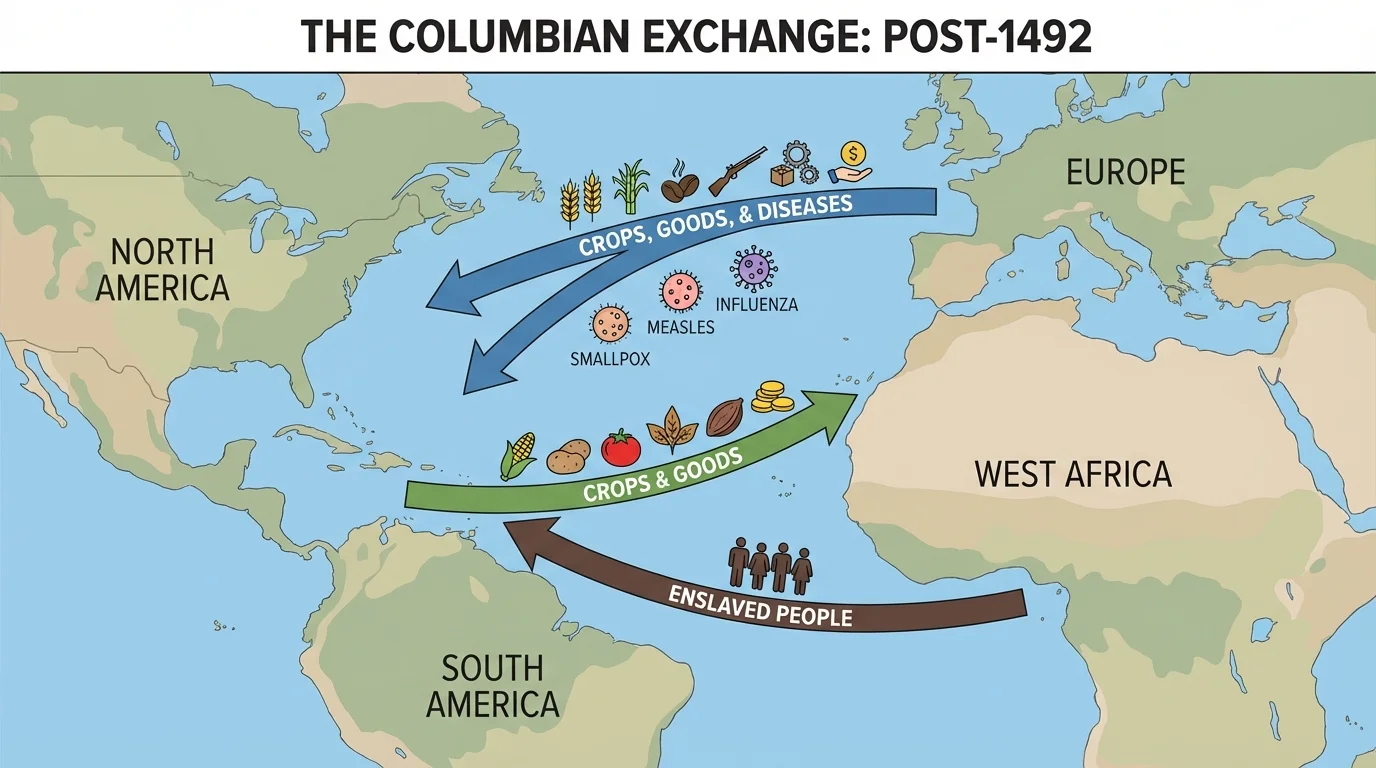
Potatoes from the Americas became so important in Europe that they helped support population growth there. A crop first cultivated by Indigenous peoples in the Andes ended up reshaping diets and demographics far away.
These developments reveal a major historical pattern: global connection often creates both integration and disruption. The same ocean routes that spread crops and wealth also spread conquest and enslavement. When historians evaluate unity and diversity, they ask not only whether societies became connected, but also who benefited and who suffered.
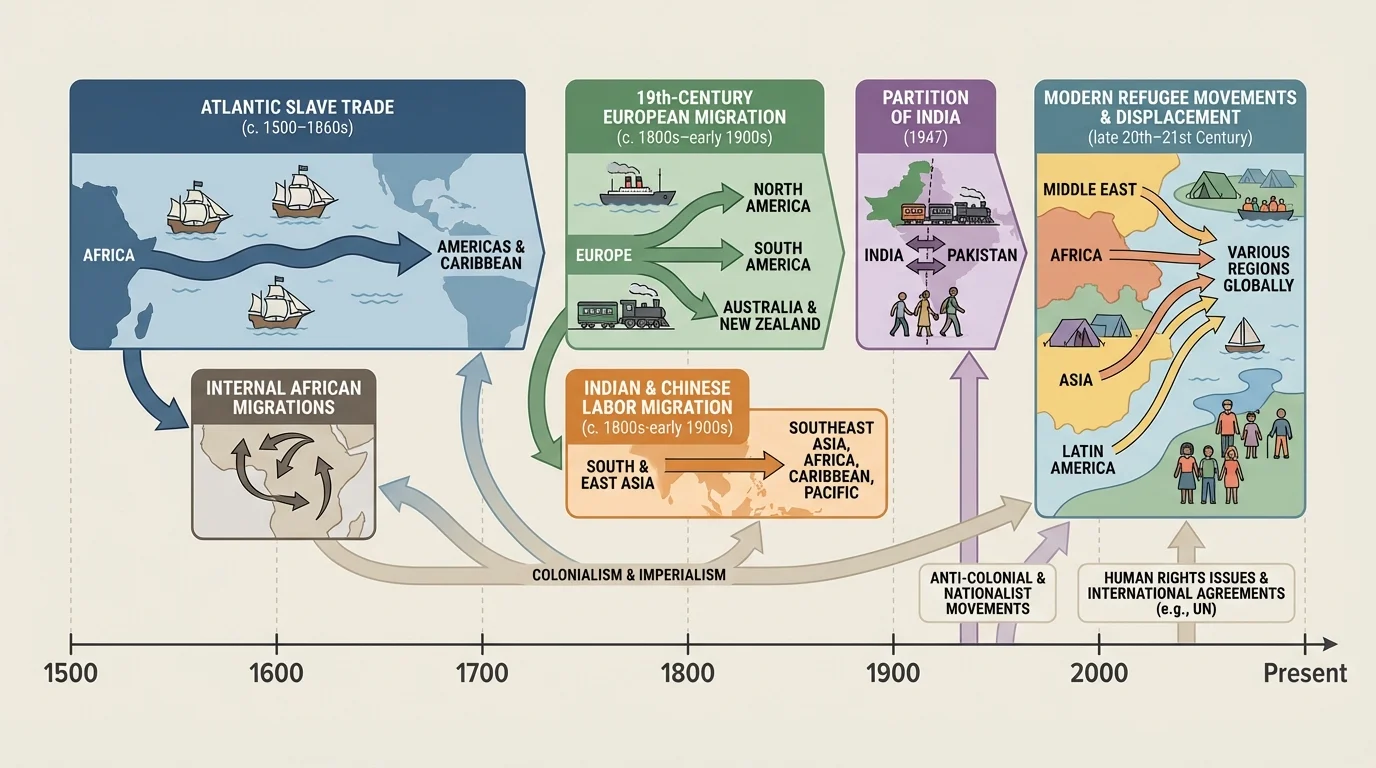
Migration is one of the most important ways diversity develops within societies. As [Figure 2] illustrates, world history since 1500 includes repeated waves of both voluntary and forced movement. People migrate for work, safety, land, family, trade, religion, and political freedom. Others are pushed out by war, slavery, persecution, famine, or environmental crisis.
One of the largest forced migrations in history was the transatlantic slave trade. Between the sixteenth and nineteenth centuries, millions of Africans were captured, sold, and transported to the Americas. This system enriched European empires and plantation economies while causing enormous suffering and social destruction in Africa and the Americas. It also created new cultural forms through resistance, adaptation, and survival. African languages, foodways, music, and religious traditions deeply shaped societies in Brazil, the Caribbean, and North America.
In the nineteenth century, industrialization and empire accelerated migration. Europeans moved in large numbers to the Americas, Australia, New Zealand, and parts of Africa. Chinese and Indian laborers migrated across the British Empire and beyond, often under harsh conditions. These migrations increased ethnic and cultural diversity in many places, but they also led to racist laws and exclusion. In the United States, for example, the Chinese Exclusion Act of 1882 restricted immigration based on ethnicity. In South Africa and other colonial societies, labor systems were organized by racial hierarchy.
The twentieth and twenty-first centuries saw even larger migration flows. World wars, decolonization, partition, genocide, and economic globalization displaced millions. The partition of India in 1947 caused one of the largest migrations in history as Hindus, Muslims, and Sikhs crossed new borders between India and Pakistan. More recently, refugees from Syria, Afghanistan, Sudan, and other conflict zones have sought safety across borders. Rapid global population growth has made these movements even more significant in urban areas, where cities become centers of both cultural exchange and tension.
Migration creates both opportunity and conflict. New populations can contribute labor, ideas, languages, entrepreneurship, and cultural creativity. At the same time, migration can trigger fears about jobs, identity, religion, or citizenship. Governments often respond with policies that either encourage inclusion or enforce exclusion. This is why migration is central to understanding both unity and diversity.
The long-term continuity is clear: humans have always moved. The change lies in scale and speed. Steamships, railroads, airplanes, and digital communication made migration faster and more global. As seen earlier in [Figure 2], migration patterns also reflect changing power structures, from slave empires to industrial labor markets to refugee crises shaped by modern warfare.
Colonialism is the practice by which one power controls another land and its people, usually for economic, strategic, or political advantage. Colonial rule changed political geography on a massive scale. It redrew borders, replaced local leadership, reorganized economies, and often ranked populations by race or ethnicity.
In Africa, Asia, and the Americas, European empires often imposed borders without regard for existing communities. As [Figure 3] shows, the partition of Africa by European powers ignored many ethnic, linguistic, and political realities on the ground. This increased imperial unity from the European point of view, but it often fractured local societies and laid foundations for later conflict.
Settler colonialism created another pattern of change. In places such as the United States, Canada, Australia, and New Zealand, colonizers did not simply rule existing populations; they also settled permanently, seized land, and displaced Indigenous peoples. The result was the growth of new states built partly on the destruction or marginalization of earlier societies. Indigenous resistance remained a constant, showing continuity in the struggle for land, sovereignty, and cultural survival.
Colonialism also transformed economies. Colonized regions were often pushed to produce raw materials such as cotton, rubber, sugar, tea, and minerals for imperial markets. Railroads and ports were built, but usually to serve colonial extraction rather than local development. This helps explain why some colonies entered independence with weak infrastructure for broad-based growth, even if they had rich natural resources.
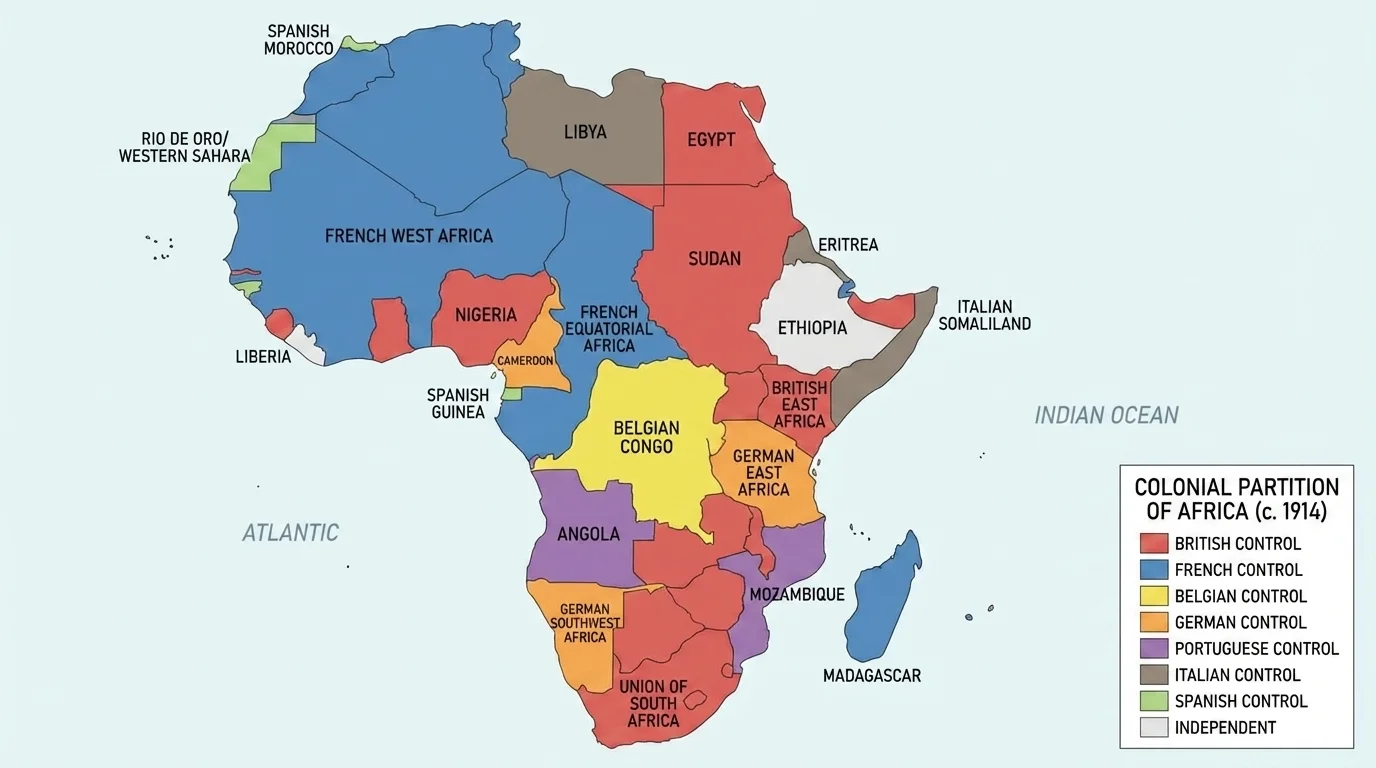
Case study: The Berlin Conference and Africa
Step 1: European leaders met in Berlin in 1884-1885 to discuss claims in Africa.
Step 2: Africans were not meaningfully represented in decisions about their own lands.
Step 3: European powers divided territory according to imperial competition, not local history.
Step 4: The resulting borders remained influential even after independence, contributing in some places to political instability and conflict.
This example shows how a diplomatic effort that created imperial order for some also created long-term injustice for others.
Political geography changed because colonialism changed who ruled, where boundaries were drawn, and how states were imagined. Even after decolonization, many postcolonial states retained colonial borders. That continuity helps explain why colonialism remains central to world politics today.
Imperialism is broader than colonialism. It refers to the extension of a state's power over other regions through military force, political pressure, or economic dominance. In the nineteenth century, industrial powers sought raw materials, new markets, naval bases, and prestige. Ideas of racial superiority and the so-called "civilizing mission" were often used to justify conquest.
Examples from this period include British control in India, French expansion in Indochina and North Africa, Belgian brutality in the Congo, and pressure by Western powers on China after the Opium Wars. Japan also became an imperial power, expanding into Korea, Taiwan, and later parts of China. Imperialism was therefore not only a European story; it became a global system of competition among powerful states.
Resistance was constant. In India, the Rebellion of 1857 challenged British rule. In southern Africa, the Zulu fought British expansion. In China, anti-foreign uprisings such as the Boxer Rebellion expressed anger at outside domination. Resistance did not always succeed immediately, but it demonstrated that imperialism never produced simple obedience. Diversity remained politically active, not passive.
"The old order changeth, yielding place to new."
— Alfred, Lord Tennyson
The quote fits this period because empires often believed they were bringing progress, yet many colonized peoples saw conquest, exploitation, and humiliation. Evaluating imperialism requires weighing competing claims while recognizing unequal power. It also requires attention to complexity: railroads, schools, or legal systems introduced under empire did not erase the violence and coercion that made imperial rule possible.
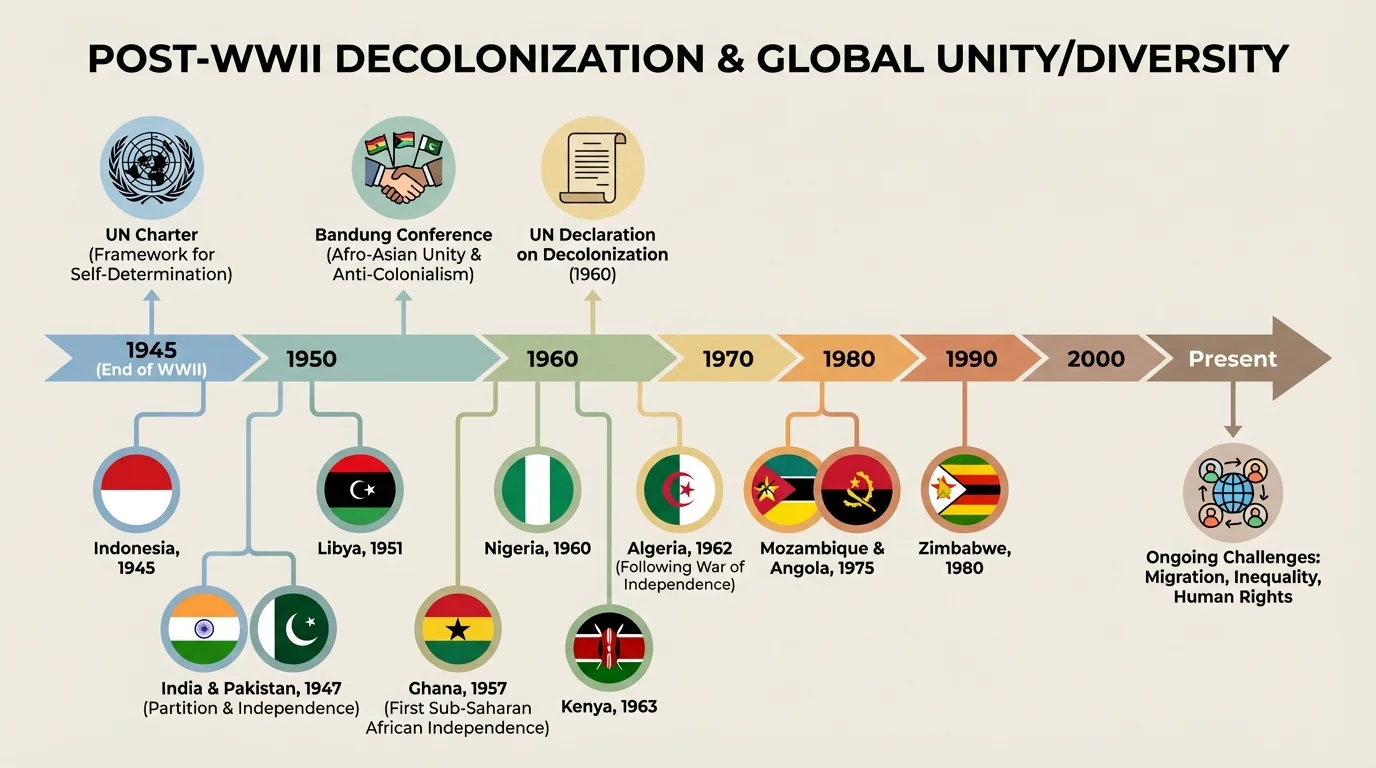
Nationalism is the belief that a people with a shared identity should have political self-rule. In colonized regions, nationalism often became a powerful force for independence. As [Figure 4] shows, decolonization occurred in waves, especially after World War II, when European empires were weakened and anti-colonial movements gained momentum.
India offers one of the most important examples. Under leaders such as Mohandas Gandhi and Jawaharlal Nehru, Indian nationalists challenged British rule through protest, negotiation, and mass political mobilization. India gained independence in 1947, but partition created India and Pakistan and led to violence and migration. This shows how one movement for unity against colonial rule could also produce division along religious and political lines.
In Ghana, Kwame Nkrumah led a movement that won independence from Britain in 1957, inspiring other African nationalists. In Algeria, a brutal war against France ended in independence in 1962. In Vietnam, anti-colonial struggle against France became entangled with the Cold War, leading to longer conflict. These cases remind us that anti-colonial movements were not all alike. Some were relatively negotiated; others were intensely violent.
The term Third World originally referred not simply to poverty but to countries that were not aligned with either the United States or the Soviet Union during the Cold War. Many newly independent nations used that space to seek their own path.
Anti-colonial movements increased political diversity by creating many new states, but they also sought unity through national identity. Later, leaders of newly independent countries sometimes promoted pan-Africanism, Arab nationalism, or nonalignment, showing that unity could be imagined at more than one level. The spread of independence also changed the balance of power in international institutions, where former colonies increasingly demanded equal voice.
When we compare independence movements, we see continuity in the desire for self-determination, but change in methods, leadership, and outcomes. Some movements emphasized nonviolence; others turned to armed struggle. Some produced stable governments; others were followed by coups, civil wars, or outside intervention. As seen earlier in [Figure 4], the overall pattern is a global shift away from formal empire, even though economic and political inequalities often remained.
International meetings can create rules for the world, but they also reveal who has power to make those rules. As [Figure 5] illustrates, the Berlin Conference, the United Nations, and the Bandung Conference represent very different models of global decision-making. Some conferences imposed order from above; others tried to build more inclusive cooperation.
The Berlin Conference of 1884-1885 is a clear example of exclusion. European powers negotiated claims in Africa largely without African participation. The conference did not begin the scramble for Africa by itself, but it formalized imperial competition and accelerated territorial division.
After the destruction of World War II, world leaders created the United Nations in 1945 to reduce war, promote diplomacy, and support international cooperation. The UN represented a new kind of global unity: a forum where sovereign states could debate common problems. However, this unity was limited. The Security Council gave special power to a few major states, and Cold War rivalry often blocked collective action.
The Bandung Conference of 1955, held in Indonesia, brought together leaders from Asian and African countries, many of them newly independent. Bandung was significant because it challenged the idea that world politics had to be dominated only by former colonial powers or Cold War superpowers. It affirmed anti-colonialism, sovereignty, racial equality, and economic cooperation among formerly colonized nations.
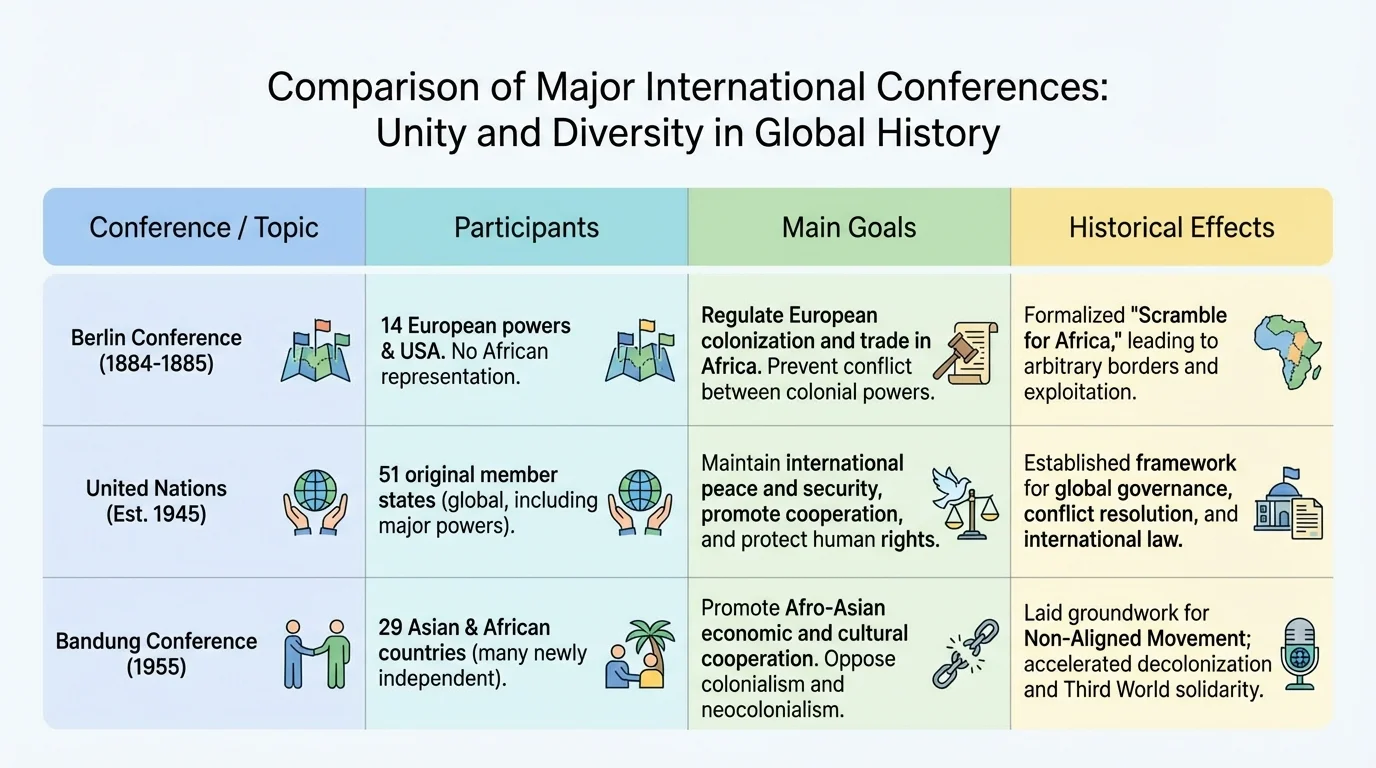
| Conference or Organization | Date | Main Participants | Major Goal | Historical Significance |
|---|---|---|---|---|
| Berlin Conference | 1884-1885 | European powers | Manage claims in Africa | Accelerated colonial partition |
| United Nations | 1945-present | Sovereign states worldwide | Promote peace and cooperation | Created a global diplomatic forum |
| Bandung Conference | 1955 | Asian and African states | Support anti-colonial solidarity | Strengthened nonaligned and postcolonial voices |
Table 1. Comparison of major international conferences and institutions that shaped global relations.
These examples show cause and effect clearly. Conferences can reshape borders, redefine legitimacy, and create new norms. Yet they also reveal complexity: agreements that appear universal may reflect unequal power. Later debates about climate change, migration, trade, and war continue this pattern. International unity is real, but it is always negotiated.
The twentieth century forced the world to confront the consequences of racism, genocide, total war, and state violence. The Holocaust, in which Nazi Germany murdered six million Jews along with millions of other victims, became a turning point in thinking about international responsibility. After World War II, the Universal Declaration of Human Rights was adopted in 1948. It declared that all human beings are born free and equal in dignity and rights.
Rights language existed before 1948 in documents such as the English Bill of Rights, the United States Bill of Rights, and the French Declaration of the Rights of Man and of the Citizen. What changed after World War II was the effort to frame rights as universal rather than belonging only to particular nations.
Human rights movements have since addressed racial discrimination, political repression, women's rights, children's rights, Indigenous rights, disability rights, and the rights of refugees. In South Africa, opponents of apartheid challenged a system of legalized racial segregation and inequality. Leaders such as Nelson Mandela helped turn a national struggle into a global moral issue. In the United States, the civil rights movement inspired other movements around the world.
Still, human rights remain contested. Governments may sign treaties while violating rights in practice. Some leaders argue that universal rights conflict with local traditions or national sovereignty. Others respond that cultural difference cannot justify oppression. This debate itself shows the tension between unity and diversity: can humanity agree on universal standards while respecting cultural difference?
Case study: Apartheid and international pressure
Step 1: South Africa's apartheid system classified people by race and denied the majority political rights.
Step 2: Internal resistance grew through protest, strikes, and political organizing.
Step 3: Other countries and international groups imposed sanctions and boycotts.
Step 4: The apartheid system ended, and democratic elections were held in 1994.
This example shows how global unity around human rights can influence national change, although usually only after long struggle.
Modern debates over immigration, asylum, religious freedom, and minority protections continue to test these principles. The same world that speaks of universal rights still struggles with unequal enforcement. That is one of the defining continuities of recent history.
From the Renaissance to the present, one continuous pattern is the movement of people, goods, and ideas across larger spaces. Another continuity is the unequal distribution of power. Empires, states, and economic systems repeatedly attempted to organize diversity into larger units of rule. Yet another continuity is resistance: people consistently defended autonomy, identity, and justice.
The major changes are also striking. The scale of global interaction expanded dramatically. Political geography shifted from empires toward a world of nation-states. International organizations became more important. Ideas about race, citizenship, sovereignty, and rights changed over time, even if not evenly or completely.
Cause and effect are visible throughout this history. Exploration helped produce empires; empire helped produce resistance; resistance helped produce nationalism; world war helped produce decolonization and international institutions; genocide and conflict helped produce modern human rights frameworks. But every effect generated new causes. Independence could lead to unity, conflict, or both. Migration could enrich societies and also provoke backlash. International institutions could reduce violence in one case and fail dramatically in another.
That is why historical interpretation must account for complexity. Unity can be cooperative or coercive. Diversity can be celebrated or suppressed. A border can bring order to one group while dividing another. A conference can promise peace while reinforcing hierarchy. World history is not a story of the world becoming simply more united or more divided. It is a story of both processes unfolding at the same time.
