Why does one neighborhood have ten burger restaurants fighting for your attention, while one electric company may be the only legal seller in town? That contrast is not random. It comes from market structure, the way a market is organized based on the number of firms, the type of product sold, and how easy or hard it is for new firms to enter. Market structure helps explain why some businesses compete fiercely on price, why others spend huge amounts on advertising, and why some can charge more because consumers have few alternatives.
In economics, market outcomes include things such as price, quantity produced, quality, variety, profit, efficiency, and innovation. Different structures do not simply change who earns profits. They shape everyday life. They influence what prescription drugs cost, how many streaming services compete for your subscription, and whether consumers get many choices or only one.
Economists compare markets by asking several important questions. How many sellers are there? Are the products identical or different? Can new firms enter easily? Do sellers have market power, meaning the ability to influence price? The answers determine whether a market behaves more competitively or more like a concentrated market controlled by a few firms.
Market structure is the organization of a market based on the number of firms, the kind of product they sell, and the ease of entry.
Barriers to entry are obstacles that make it hard for new firms to join a market. These may include very high startup costs, patents, government licenses, or control of key resources.
Product differentiation means firms make their products seem different from competitors' products through design, quality, location, service, or branding.
At one end of the spectrum, competition pushes firms toward lower prices and greater efficiency. At the other end, firms with greater control over supply can often charge higher prices and limit output. But the story is not as simple as saying "more competition is always better." Some concentrated markets can support expensive research, nationwide infrastructure, or major technological development. That is why economists compare both the benefits and the costs of each structure.
A useful way to think about market outcomes is to compare a firm's pricing power. In a highly competitive setting, a firm has very little power over price. In a monopoly, the seller has much more control. In between are structures where firms have some power, but not complete power. Monopolistic competition and oligopoly fall in this middle range.
In monopolistic competition, many firms sell similar but not identical products. Each firm tries to stand out through flavor, style, location, customer service, or brand image. Think about coffee shops, hair salons, restaurants, shoe brands, or fast-casual food chains. Each seller faces competition, but each also tries to persuade consumers that its product is a little different.
This structure has relatively low barriers to entry compared with oligopoly or monopoly. If a local market is profitable, new firms can often enter. A student who notices that a town lacks a healthy lunch café may not be able to start one immediately, but entry is usually far more realistic than starting a national railroad company or a power grid. Because entry is possible, monopolistic competition tends to limit long-run economic profits.
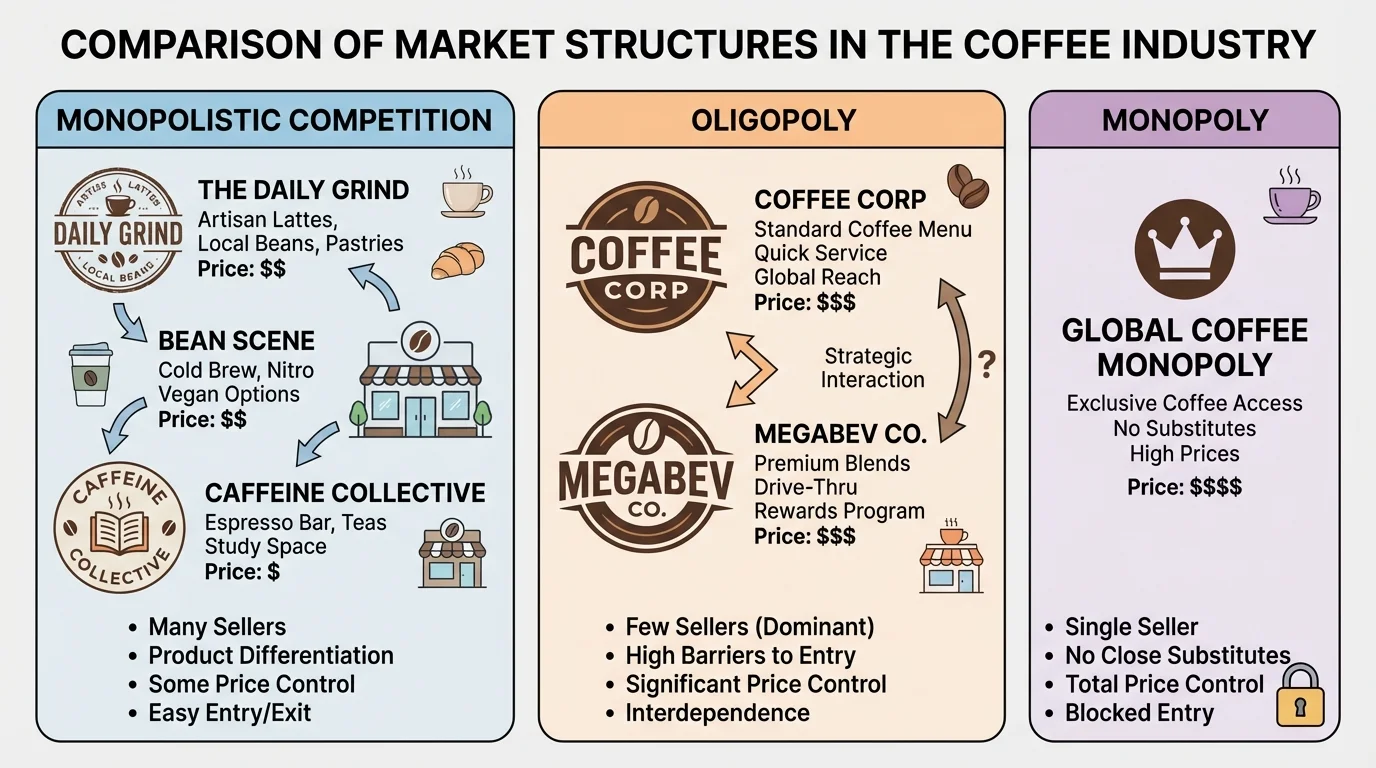
Monopolistic competition creates several important market outcomes. First, prices are usually higher than in perfect competition because firms have some market power over their own version of the product. If one café has a strong reputation, it may charge slightly more for a latte than a less popular café nearby. Second, output is spread across many firms rather than concentrated in one producer. Third, consumers benefit from variety. You can choose based on atmosphere, taste, convenience, or image, not just price.
However, this structure is not perfectly efficient. Because firms spend money on branding, packaging, store design, and advertising, some resources go toward convincing consumers rather than reducing costs. Economists sometimes say firms in monopolistic competition produce with excess capacity, meaning they do not produce at the lowest possible average cost in the long run. They stay in business because enough consumers value the differences among products.
Real-world example: athletic shoes
Many companies sell athletic shoes. The basic function is similar, but firms differentiate through design, endorsements, comfort technology, and brand identity.
Step 1: Firms make the product seem unique.
One brand markets durability, another markets fashion, and another markets performance for a specific sport.
Step 2: Consumers compare more than price.
A buyer may choose a $120 pair over a $90 pair because of perceived comfort or brand reputation.
Step 3: Entry limits profits over time.
If high profits continue, new brands or smaller niche firms may enter the market and increase competition.
The outcome is higher variety and active competition, but not the lowest possible price.
The tradeoff is clear. Monopolistic competition gives consumers many choices and encourages creativity, but it usually does not give the absolute lowest price. When students compare cell phone cases, clothing labels, or local restaurants, they are often looking at markets shaped by this structure.
Later, when comparing all structures, keep [Figure 1] in mind: firms in monopolistic competition compete less by destroying rivals with huge price cuts and more by making their own version feel distinctive.
An oligopoly exists when a small number of large firms dominate a market. Each firm must pay close attention to the others, because one company's decisions can quickly trigger a reaction from rivals. Common examples include wireless carriers, commercial aircraft manufacturing, major soft drink producers, and some digital platform markets.
The defining feature of oligopoly is strategic interdependence. This means each firm's choice about price, advertising, product features, or output depends on what it thinks competing firms will do. If one airline lowers fares on a major route, other airlines may match the cut. If one smartphone company adds a new camera feature, rivals may rush to offer something similar.
Oligopolies usually have significant barriers to entry. These can include high startup costs, expensive technology, large-scale production requirements, patents, or strong brand loyalty. Starting a small restaurant is difficult but possible. Starting a company to compete with a global aircraft manufacturer is far harder.
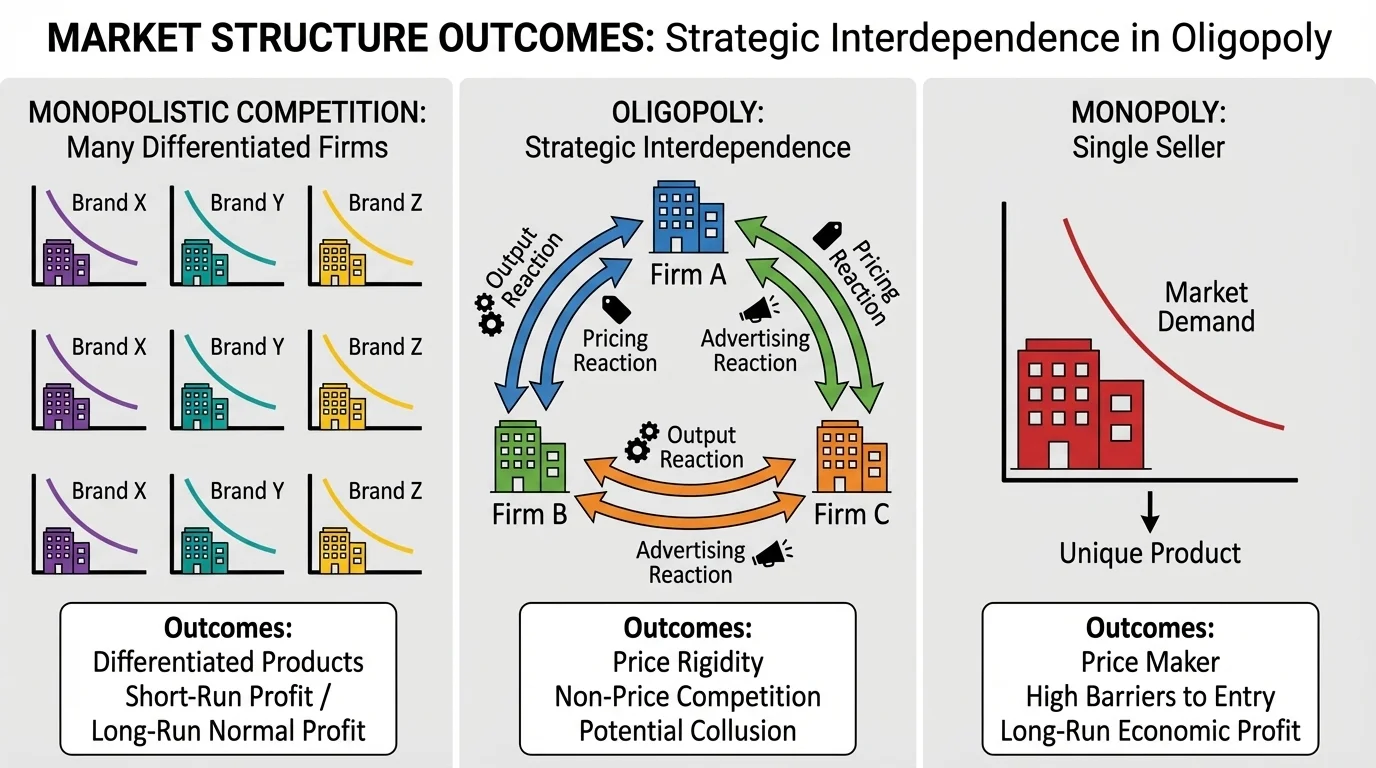
Because only a few firms control most of the market, prices in oligopoly are often higher than they would be under stronger competition. Yet oligopolies do not always behave the same way. Sometimes firms compete aggressively. Sometimes they avoid price wars and focus on advertising, customer loyalty programs, technology, or product upgrades. This is called nonprice competition.
One major concern in oligopoly is collusion, when firms cooperate to reduce competition, often by agreeing on price or output. If firms collude successfully, the market can begin to act more like a monopoly. Consumers usually lose because prices rise and output falls. In many countries, collusion is illegal because it harms competition.
Why oligopoly is hard to predict
Unlike markets with many small firms, oligopoly requires firms to think strategically. A price cut may attract customers, but it may also trigger matching price cuts by rivals, reducing profits for everyone. Because firms constantly anticipate one another's moves, oligopoly outcomes can vary widely from one industry to another.
Oligopoly can produce both positive and negative outcomes. On the positive side, large firms may have enough revenue to invest heavily in research and development. This can lead to innovation in medicine, transportation, electronics, and communications. On the negative side, limited competition can mean higher prices, fewer choices than in more competitive markets, and a greater risk that firms use their power to block new entrants.
Consider the market for commercial airplanes. Designing and building large aircraft requires enormous engineering skill, safety testing, and capital investment. Only a few firms can compete. This concentrated structure can support advanced innovation, but it also means airlines have fewer suppliers to choose from, and the market is vulnerable when one major producer faces trouble.
The strategic relationships shown earlier in [Figure 2] help explain why oligopolies often appear stable on the surface while intense competition is happening underneath through patents, advertising, technology, and timing.
A monopoly occurs when one firm is the only seller of a product or service with no close substitutes. Because consumers cannot easily switch to another provider, the monopolist has strong power over price and output. A monopoly often restricts output in order to charge a higher price. Examples can include a patented drug with no equivalent alternative, a local water utility, or exclusive control over a rare resource.
Monopolies usually exist because barriers to entry are extremely high. These barriers may come from legal protection, control of a necessary resource, economies of scale, or government approval. A natural monopoly is a special case in which one large firm can supply the entire market at a lower cost than multiple smaller firms could. Utilities such as electricity distribution and water systems are common examples because building overlapping networks of pipes or power lines would be expensive and inefficient.
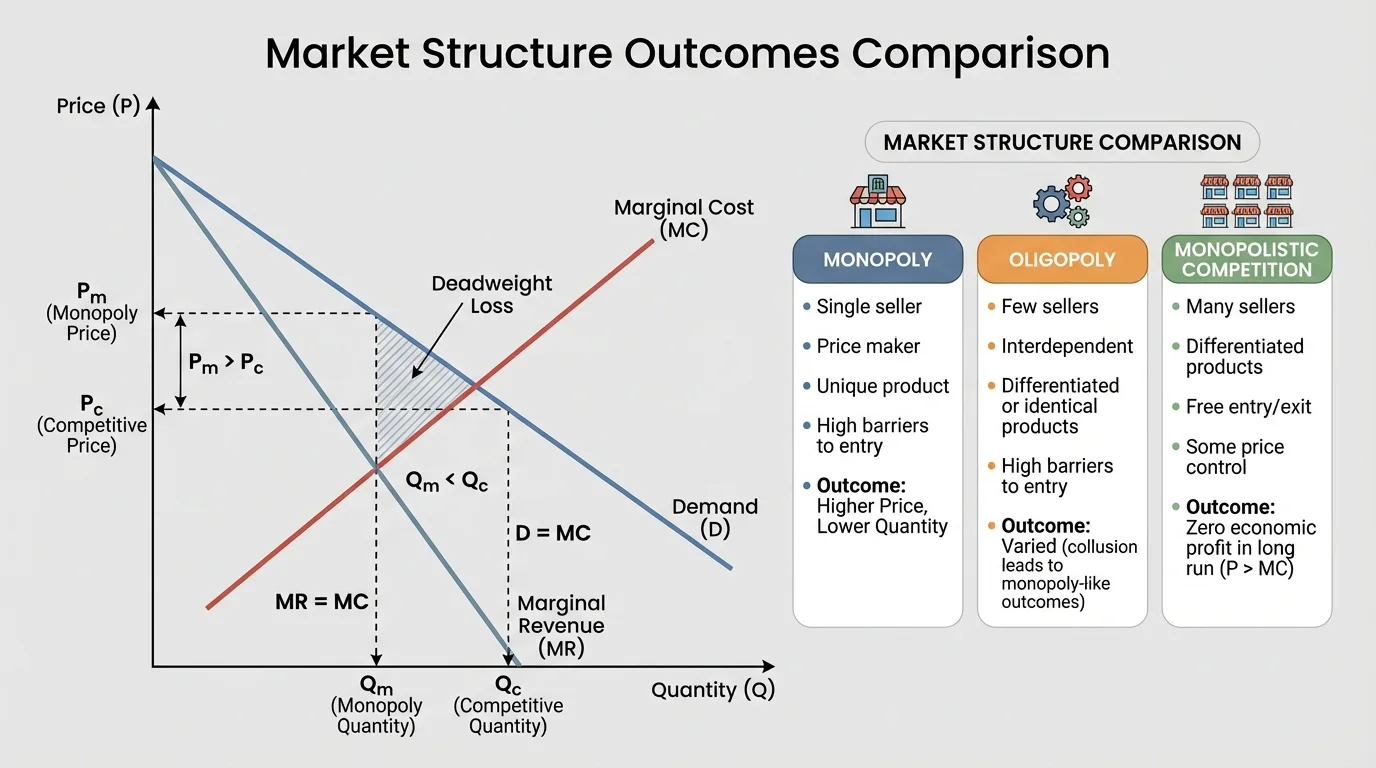
Compared with more competitive market structures, monopoly tends to produce higher prices and lower output. The monopolist does not face direct rivals in the market, so it can choose the output level that maximizes profit and then charge the price consumers are willing to pay for that quantity, based on the demand curve. In economic models, this often occurs where marginal revenue equals marginal cost, written as \(MR = MC\). The price is then determined from the demand curve, which leads to a price above marginal cost.
This outcome creates a loss of efficiency. Some consumers who would have bought the product at a lower competitive price are left out of the market. The value of those missed transactions is called deadweight loss. In simple terms, monopoly prevents some mutually beneficial exchanges from happening.
Monopoly can also weaken incentives to improve service or lower costs, especially if customers have nowhere else to go. If your local utility is the only provider and switching is impossible, the pressure to satisfy consumers may be weaker than in a market filled with rivals. However, monopoly is not always entirely negative. Some monopolies arise because innovation, patents, or large-scale infrastructure require strong rewards or centralized systems.
Real-world example: patented medicine
A pharmaceutical company that invents a new drug may receive a patent for a limited time.
Step 1: The patent blocks direct imitation.
Other firms cannot legally produce the exact same drug during the patent period.
Step 2: The firm gains temporary monopoly power.
It can charge a higher price than would exist in a fully competitive generic market.
Step 3: Society faces a tradeoff.
Higher prices can reduce access for consumers, but the temporary monopoly may encourage firms to invest in costly medical research.
This example shows why economists evaluate monopoly not only by price but also by incentives for innovation.
The graph in [Figure 3] highlights the central contrast: a monopolist can earn profits by limiting output, while competitive pressure in other structures pushes firms closer to serving more consumers at lower prices.
The three structures differ not just in how many firms exist, but in the outcomes they create for society. A direct comparison makes the contrasts clearer.
| Feature | Monopolistic Competition | Oligopoly | Monopoly |
|---|---|---|---|
| Number of firms | Many | Few | One |
| Type of product | Differentiated | May be similar or differentiated | No close substitutes |
| Barriers to entry | Low to moderate | High | Very high |
| Pricing power | Some | Considerable | Strong |
| Price level | Above highly competitive level | Often above competitive level | Usually highest |
| Consumer choice | High variety | Moderate | Low |
| Efficiency | Less than perfect competition | Varies | Often lowest allocative efficiency |
| Innovation | Moderate through branding and design | Can be high | Can be high or low depending on incentives |
Table 1. Comparison of major features and likely market outcomes in monopolistic competition, oligopoly, and monopoly.
Monopolistic competition usually provides the greatest product variety. If you enjoy choosing among many clothing styles, restaurants, or cosmetic brands, that variety is one of its advantages. Oligopoly often provides fewer choices, but the products may involve advanced technology and major research spending. Monopoly usually offers the fewest choices because no direct competitor is present.
When economists refer to efficiency, they often mean whether resources are allocated to produce what consumers want at the lowest reasonable cost. Monopoly tends to be least efficient in the allocative sense because price is above marginal cost. Monopolistic competition is also less than fully efficient because firms maintain some market power and excess capacity. Oligopoly sits in the middle but can lean toward efficiency or inefficiency depending on how strongly firms compete.
Some of the world's most recognizable brands operate in markets that are not monopolies at all. Their power often comes from product differentiation and consumer loyalty rather than complete control of supply.
Another key difference involves advertising. In monopolistic competition, advertising is often used to make products feel distinct. In oligopoly, advertising can be extremely intense because each major firm is trying to protect market share from a small number of powerful rivals. In monopoly, advertising may be less important if consumers have no close alternative, though a monopolist may still advertise to maintain public support or expand demand.
Most countries today have mixed economies, meaning they use both market forces and government action. In such systems, governments do not leave every market completely alone. Instead, they decide when competition should be protected, when monopoly should be regulated, and when temporary market power may serve a public purpose.
One major policy tool is antitrust law. Antitrust policies are designed to preserve competition by blocking mergers that would create too much concentration, stopping collusion, and preventing firms from using unfair tactics to eliminate rivals. These policies are especially important in oligopolies, where a few firms may be tempted to coordinate rather than compete.
Another tool is regulation. Governments often regulate natural monopolies because allowing multiple overlapping providers may waste resources, but leaving one private firm completely unregulated could lead to very high prices. Regulators may set price limits, establish service standards, or monitor profits. This is common in electricity, water, and transportation infrastructure.
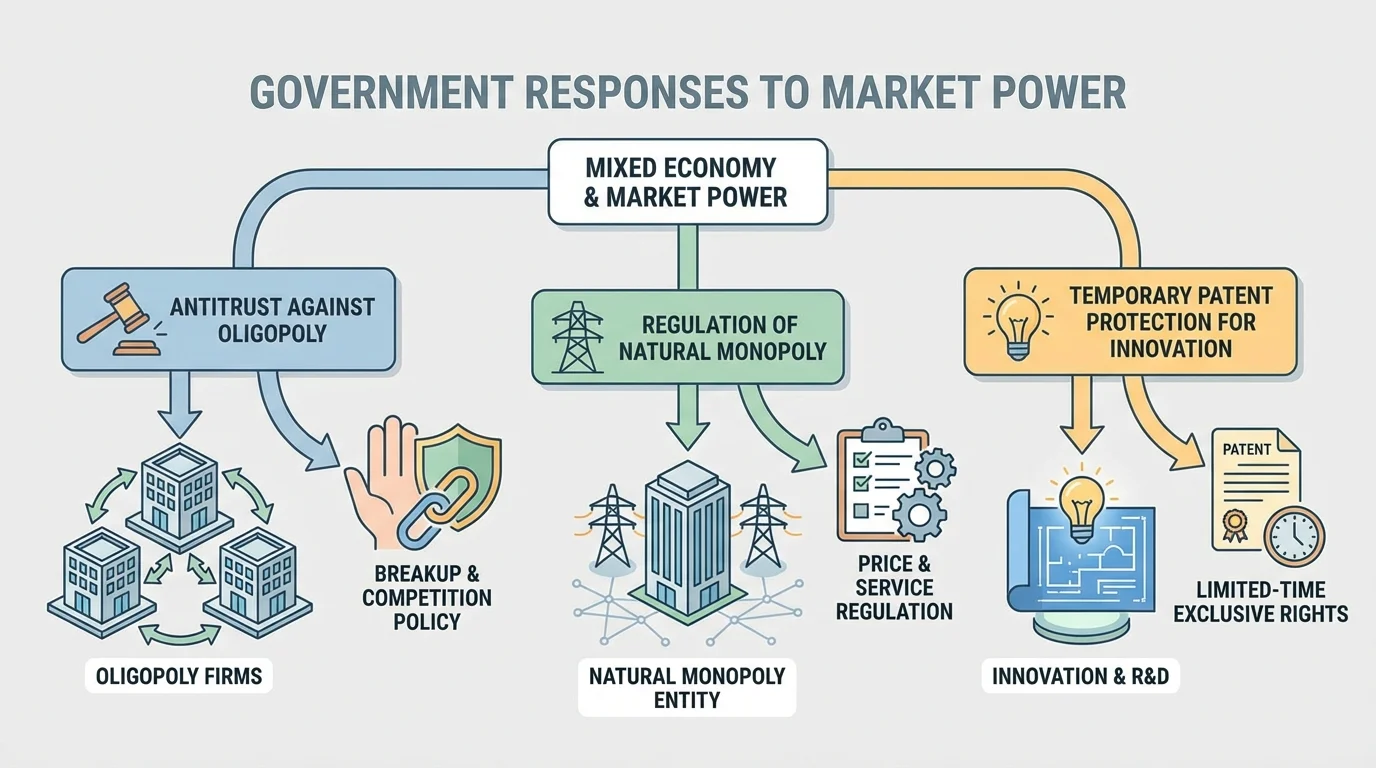
Governments may also permit temporary monopoly through patents and copyrights. The idea is that inventors, writers, and researchers need some protection so they can recover the costs of creating something new. Without that protection, other firms might copy the product immediately, reducing the reward for innovation. But the protection is limited in time because permanent monopoly would harm consumers too much.
These policy choices reveal an important point: market outcomes are not determined by private firms alone. Laws, courts, regulatory agencies, and public values all shape the final result. A mixed economy tries to balance efficiency, fairness, innovation, and access.
Why governments treat structures differently
A government usually does not respond to every large firm the same way. A natural monopoly may be regulated rather than broken up. An oligopoly may be monitored for collusion. A patented monopoly may be accepted temporarily because society wants new inventions. The goal is not simply to punish size, but to improve market outcomes for the public.
The policy branches introduced earlier in [Figure 4] show why mixed economies combine competition with rules. Different structures create different risks, so governments use different tools.
From the producer's perspective, less competition often means more pricing power and potentially higher profits. Firms in monopolistic competition have some freedom to build a brand. Firms in oligopoly may enjoy large market shares and economies of scale. Monopolists may earn substantial profits if regulation is weak or entry is blocked.
From the consumers' perspective, the picture is more complicated. Consumers often prefer lower prices, greater choice, and better service, which usually improve as competition increases. Yet consumers also benefit from some outcomes that can arise in concentrated markets, such as expensive medical research, large transportation networks, and advanced communication systems. The challenge is deciding when those benefits outweigh the harms of reduced competition.
For example, a streaming platform market might look competitive if several large firms offer services, but if only a handful dominate the market, it starts to resemble oligopoly. Prices may not fall much because firms know that aggressive price cuts could trigger responses from rivals. Instead, they compete by securing exclusive shows, improving app design, or bundling services.
Likewise, local utilities show why monopoly cannot be judged by one rule alone. It may be inefficient to build three separate sets of power lines to every home. In that case, a regulated monopoly may serve consumers better than wasteful duplication. But if regulation is weak, the same monopoly can overcharge customers and provide poor service.
The biggest contrast among monopolistic competition, oligopoly, and monopoly is the degree of control sellers have over price and output. In monopolistic competition, firms have limited power because many rivals exist and entry is possible. In oligopoly, a few large firms have substantial power, but each must watch the others closely. In monopoly, one firm has the greatest control because no close competitor exists.
A second major contrast is the balance between choice and concentration. Monopolistic competition gives the broadest variety of products. Oligopoly reduces the number of major choices but can support large-scale innovation and national or global distribution. Monopoly offers the fewest choices, and unless regulated or justified by special circumstances, it usually creates the greatest risk of higher prices and lower output.
A third contrast involves government action. Monopolistic competition usually needs the least intervention because entry and rivalry already discipline firms. Oligopoly often needs antitrust monitoring because strategic behavior and collusion can harm the public. Monopoly often requires the strongest response, either through regulation, public ownership, or rules that limit how monopoly power is used.
Understanding these structures helps explain why the same economy can contain a crowded field of sneaker brands, a handful of wireless carriers, and a single local water provider at the same time. Markets do not all produce the same results. Their structure shapes who has power, who benefits, and how society responds.
