Democracy may sound simple: people rule themselves. In practice, it is one of the hardest forms of government to maintain. Citizens want liberty, but they also want safety. They want their own rights protected, but they also expect government to solve shared problems. They want majority decisions, but they also want minorities treated fairly. The challenge of democracy is not just choosing values; it is learning how to balance them without destroying the system itself.
A democracy is a system of government in which political authority ultimately comes from the people. That idea may seem obvious today, but it was a radical development in world history. Instead of power belonging only to kings, military rulers, or a small elite, democracy is based on the belief that ordinary citizens have both the right and the ability to participate in governing. This includes voting, expressing opinions, organizing, protesting, serving on juries, and holding leaders accountable.
Democracy is more than elections. A country can hold elections and still fail to be truly democratic if people cannot speak freely, if courts are controlled by political leaders, or if some groups are denied equal protection. Real democracy depends on principles, institutions, habits, and limits on power. Those parts must work together over time.
At the center of democracy are several connected principles, as [Figure 1] shows through the relationship between citizens, law, elections, and institutions. One principle is popular sovereignty, the idea that the people are the ultimate source of governmental power. Government is legitimate only because citizens give their consent, directly or through elected representatives.
Another principle is the rule of law. In a democracy, no one is above the law, not even presidents, judges, legislators, or wealthy citizens. Laws should be public, applied fairly, and enforced through regular procedures. Without rule of law, democracy can collapse into favoritism, corruption, or dictatorship.
Democracy also depends on political equality. This does not mean every person has the same income, talents, or influence in everyday life. It means that each citizen has equal standing as a member of the political community. In principle, one person's vote counts as much as another's. Equal protection under the law also grows from this idea.
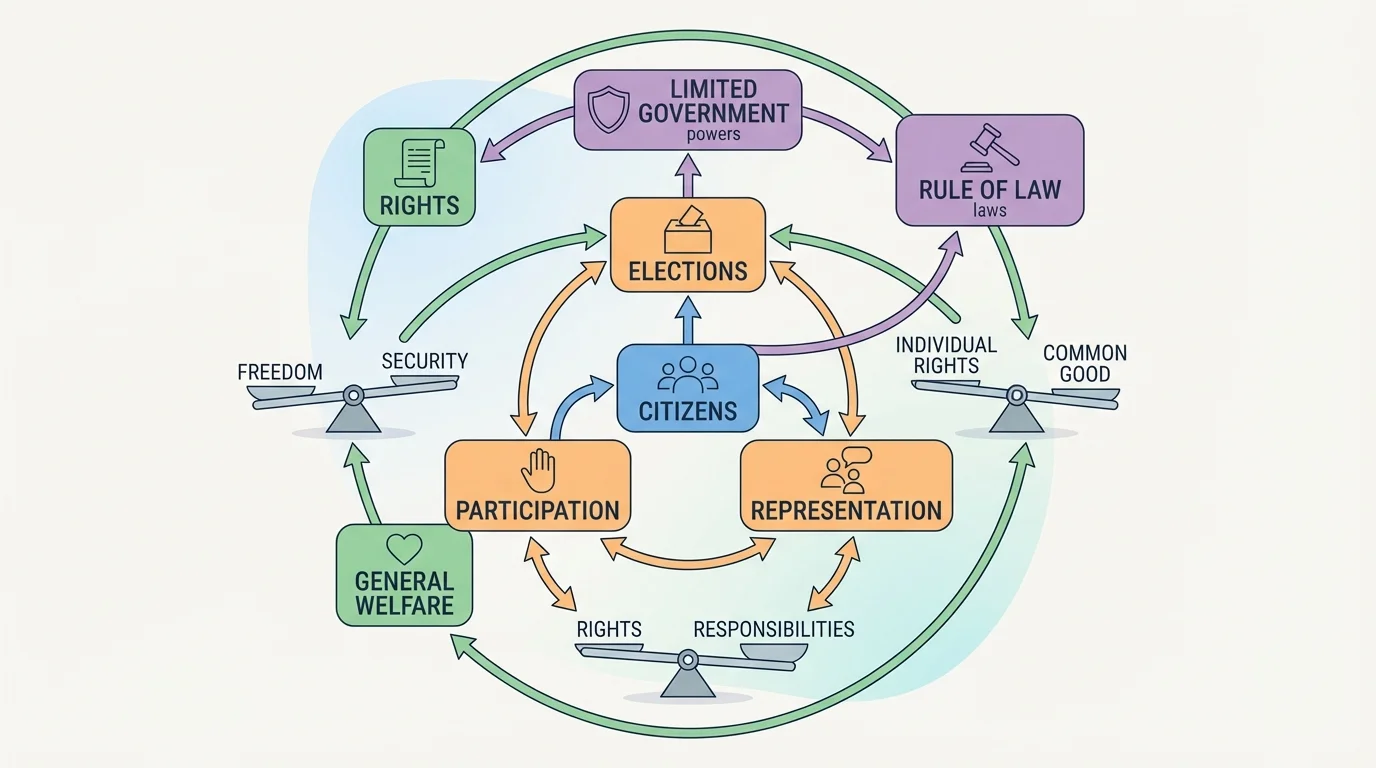
A further principle is majority rule with minority rights. Democratic decisions are often made by majorities because some rule is needed to settle disagreements. But majority rule cannot mean that the majority may do anything it wants. If it could, then freedom of religion, speech, due process, or equal protection could vanish whenever a larger group disliked a smaller one. Democracy therefore combines popular decision-making with protections that cannot be taken away casually.
Democracy also requires participation and representation. Citizens may participate directly in some ways, such as local meetings, protests, petitions, or jury service. In large modern states, however, most democracy is representative. People elect officials to make decisions on their behalf. Representation allows a large society to govern itself, but it also creates a constant need for accountability.
Finally, democracy includes limited government. Even when leaders are elected, their power should be restricted by constitutions, rights, laws, and institutional checks. A democracy is not simply whatever the government claims it is. It is a system in which power is both granted and restrained.
Popular sovereignty means the people are the ultimate source of political authority. Rule of law means government and citizens alike are bound by publicly known laws. Majority rule with minority rights means decisions can be made by majorities, but basic rights and equal protection must still be preserved for everyone.
These principles are powerful because they protect both liberty and legitimacy. Citizens are more likely to accept laws they disagree with if they believe the process is fair, rights are protected, and leaders can be changed peacefully. That is one reason democracy is not just a method of choosing rulers; it is a framework for handling conflict without constant violence.
Democratic values become real only through institutions, and [Figure 2] illustrates how structures of government limit power while allowing decisions to be made. A constitution sets the basic rules of the political system. It defines powers, rights, procedures, and limits. In many democracies, the constitution cannot be changed easily, which helps prevent temporary majorities from rewriting the system whenever they wish.
Legislatures make laws. Executives carry out laws and direct administration. Courts interpret laws and resolve disputes. This separation of powers is meant to prevent any one branch from controlling everything. When branches can check one another, democratic government becomes slower, but it also becomes safer from abuse.
Free and fair elections allow citizens to remove leaders peacefully. Political parties organize ideas and candidates, though they can also increase division. Independent media help inform the public and investigate wrongdoing, though media systems can also spread misinformation. Civil society, including community groups, advocacy organizations, unions, religious organizations, and student groups, gives people ways to act together outside formal government.
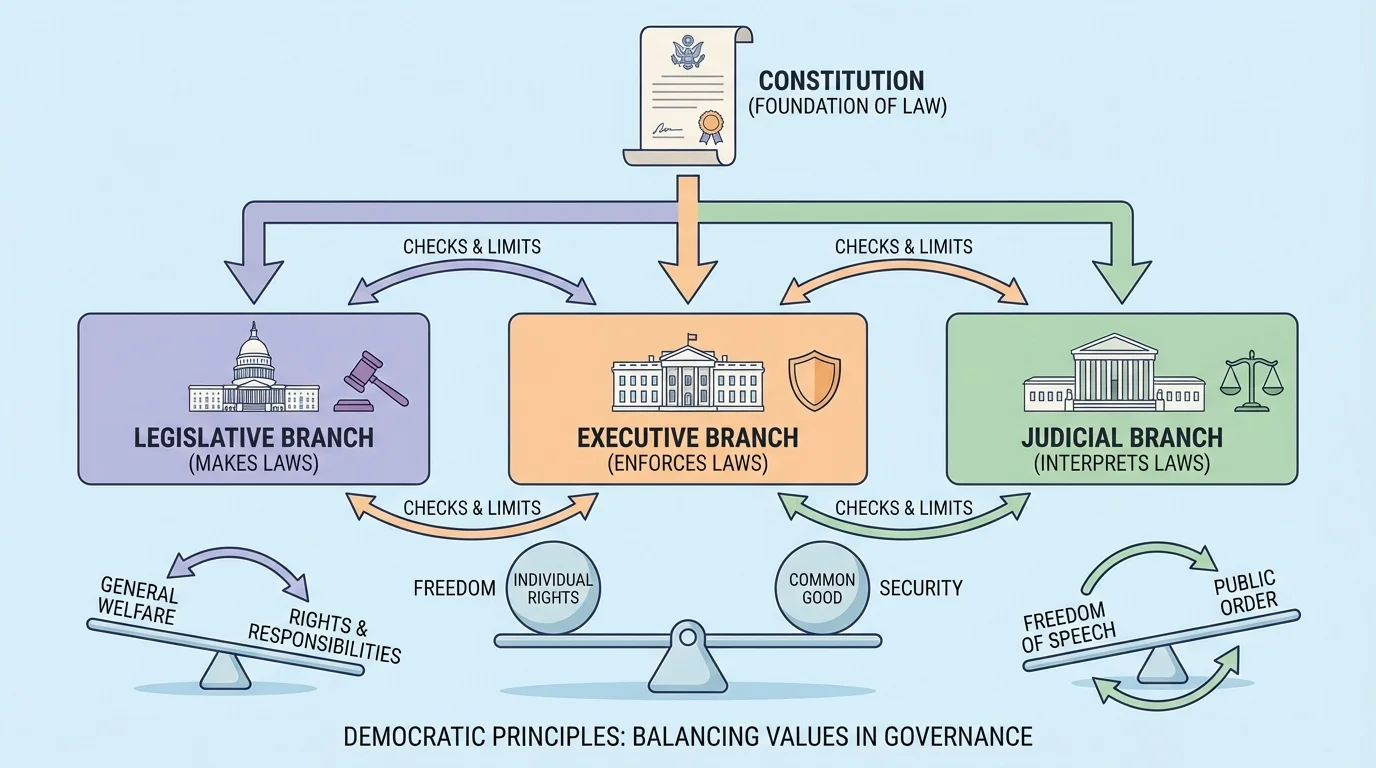
Each democratic structure has both a purpose and a limit. Legislatures are supposed to represent the public, but they may be influenced by money or partisanship. Executives can act quickly in crises, but they may try to gather too much power. Courts protect rights and interpret law, but they depend on public trust and cannot solve every social conflict by themselves. Elections give power to the people, but voting alone does not guarantee informed or fair decisions.
These limitations are not signs that democracy is broken. They are reminders that democratic government is designed to balance energy with restraint. As seen earlier in [Figure 1], rights, participation, and law support one another only when institutions keep power from becoming absolute.
Some of the oldest democratic ideas come from ancient Athens, but most modern democracies differ sharply from Athens because they are representative, constitutional, and far larger and more diverse.
Because democracy depends on institutions, attacks on those institutions can weaken the entire system even if elections continue. If courts lose independence, if the press is intimidated, or if losing candidates refuse to accept legitimate results, the democratic process becomes unstable.
People often talk as if democratic values always fit together perfectly. In reality, they frequently come into tension. A society can increase surveillance to improve safety, but that may reduce privacy. It can protect nearly unlimited speech, but that may allow harmful misinformation or threats. It can defend individual choice, but that may weaken efforts to protect public health or the environment.
This does not mean democracy is contradictory. It means democratic values are complex. Freedom matters. Equality matters. Security matters. Welfare matters. Responsibility matters. The work of democratic politics is to decide how much weight to give each value in different situations and what limits are justified.
Balancing is hard because reasonable citizens can disagree. Two people may both support democracy yet differ strongly about whether a certain law goes too far. One may emphasize liberty; another may emphasize safety. One may see a tax as necessary for the common good; another may see it as excessive government power. Democracy does not erase disagreement. It creates a lawful way to manage it.
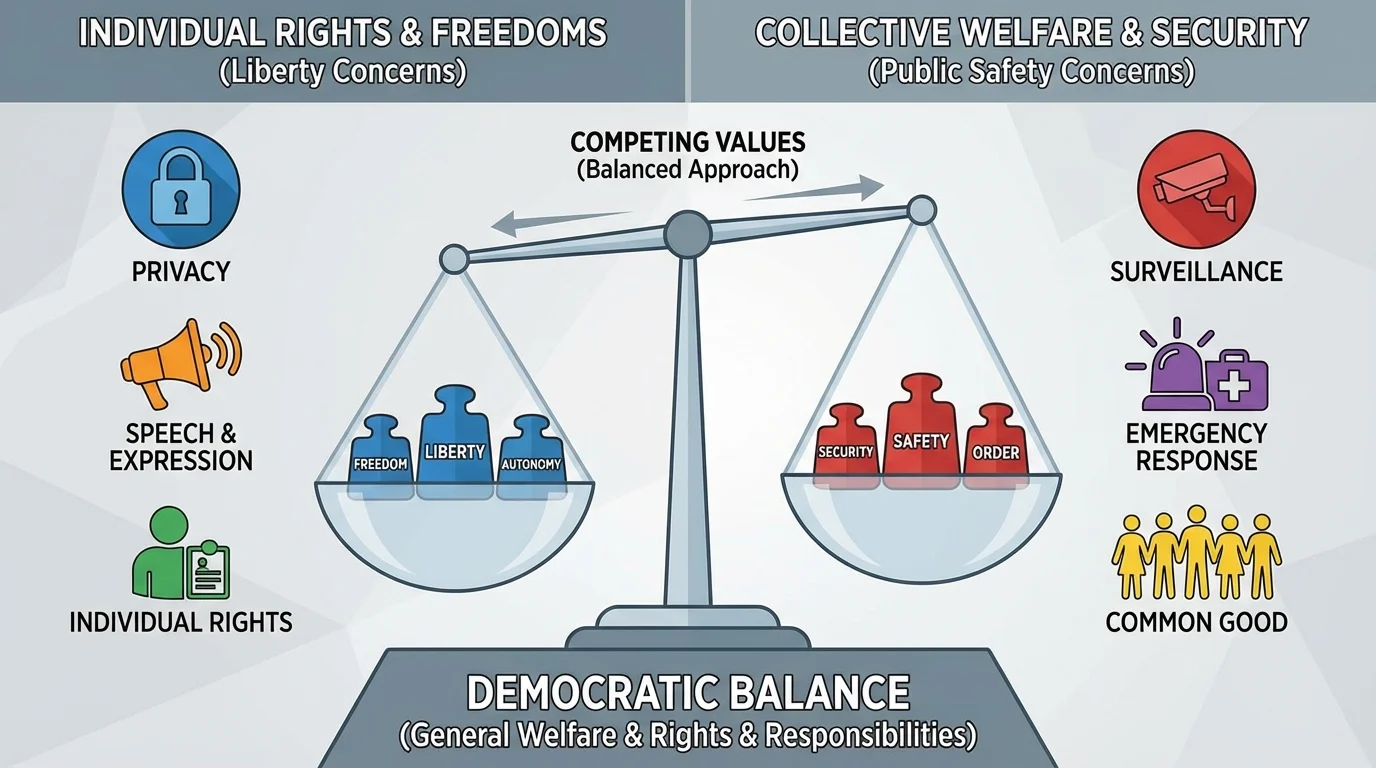
One of the most famous tensions in democracy is between freedom and security, and [Figure 3] presents this as a balance rather than a simple either-or choice. Freedom includes speech, religion, press, assembly, privacy, and movement. Security includes protection from violence, crime, terrorism, invasion, cyberattacks, and public disorder. Most citizens want both.
The difficulty comes when actions taken to increase security reduce liberty. For example, after terrorist attacks, governments may expand surveillance, collect more personal data, increase airport screening, or allow broader law enforcement powers. Supporters argue that these actions can prevent future attacks and save lives. Critics worry that emergency powers can become permanent and that innocent people may lose privacy or due process.
Consider debates over digital privacy. Phones, apps, and online platforms generate enormous amounts of data. Governments may seek access to data to investigate crimes or threats. Yet if the state can easily monitor everyone, citizens may lose a basic sense of personal freedom. A democracy must ask difficult questions: Who can collect information? Under what legal standards? With what oversight? For how long? Can courts review the actions?
Schools also reflect this tension. Students have rights to expression, but schools also have a duty to maintain safety and order. A school may limit certain forms of speech if they are threatening, seriously disruptive, or harassing. The goal is not to eliminate freedom, but to protect a learning environment where everyone can participate safely.
Historical examples show how fragile this balance can be. During wars, democratic governments have sometimes limited speech, detained suspects, censored information, or expanded executive power. Some restrictions were later viewed as necessary; others were later judged unjust or unconstitutional. These cases remind us that fear can pressure democracies to give up liberty too quickly.
The best democratic responses usually include narrow laws, clear standards, independent courts, public oversight, and a willingness to review whether emergency measures are still justified. That is the same institutional logic shown in [Figure 2]: power may need to act, but it must also be checked.
Case study: Security policy after a national emergency
A democratic government faces a major attack and wants to prevent another one.
Step 1: Officials identify the security goal.
They seek faster intelligence sharing, closer monitoring of suspected threats, and stronger border screening.
Step 2: Citizens and lawmakers raise liberty concerns.
They ask whether broader surveillance might collect information on innocent people, reduce privacy, or target certain groups unfairly.
Step 3: Democratic institutions impose limits.
Courts require warrants in some situations, legislatures add reporting rules, and oversight committees review agency actions.
Step 4: The policy is revised over time.
If evidence shows some measures are ineffective or abusive, the law can be narrowed, allowed to expire, or replaced.
This example shows that balancing freedom and security is not a one-time answer. It is an ongoing process of adjustment and accountability.
Democracy works best when citizens resist false choices. Absolute freedom can leave people vulnerable to coercion and violence. Absolute security can become oppression. The real question is how to protect both as fully as possible under law.
Another major tension lies between individual rights and the common good. Individual rights protect personal liberty and dignity. They include freedoms such as speech, religion, due process, and equal treatment. The common good refers to conditions that benefit the community as a whole, such as clean water, safe roads, public education, disease control, and environmental protection.
Rights matter because individuals are not just tools for society. Each person has value and should be protected from arbitrary power. But democratic life is shared life. People live together, drive on the same roads, breathe the same air, attend the same schools, and depend on the same public institutions. This means one person's choices can affect many others.
Public health provides a clear example. A democratic government may require vaccinations for certain settings, quarantine during severe outbreaks, or safety measures in crowded places. Supporters argue that such policies protect vulnerable people and prevent hospitals from being overwhelmed. Opponents may argue that these policies restrict bodily autonomy or personal choice. The issue is not whether rights exist; it is how far rights extend when exercising them may put others at risk.
Environmental regulation raises similar questions. A business owner may want to use property as desired, but pollution from that property can harm neighbors, rivers, farms, or future generations. Zoning laws, building codes, and environmental limits are ways democracies try to protect the broader public while still respecting private rights.
Courts often play a major role here by deciding whether a government action is narrowly tailored, fair, and constitutional. Legislatures contribute by debating evidence, costs, and social consequences. Citizens contribute through public discussion, voting, and advocacy. As [Figure 3] suggests in another context, the key democratic task is not erasing one side but weighing competing claims openly and lawfully.
Why rights are not unlimited
In a democracy, rights are fundamental, but they are not usually absolute in every setting. Free speech does not protect direct threats or certain forms of defamation. Freedom of movement can be restricted when a person is imprisoned after due process. Property rights do not include a right to use property in ways that seriously harm others. Rights remain powerful because government must justify limits, not because limits never exist.
A healthy democracy therefore asks two questions at once: What must government never do to individuals? and What must government sometimes do to protect the community? Good civic judgment requires taking both questions seriously.
The phrase general welfare refers to the wellbeing of the public as a whole. In democratic thought, government is not only a referee that prevents chaos. It also has a responsibility to create conditions in which people can live with basic security and opportunity. That can include roads, schools, disaster response, public health systems, clean water infrastructure, and protections for fair economic activity.
Still, democratic governments must pursue general welfare within limits. They cannot simply do anything that leaders claim is beneficial. Policies must be lawful, accountable, and subject to public debate. A government that tries to solve every problem by centralizing all power may weaken freedom and local self-government.
Debates about taxes often reflect this tension. Taxes fund public goods that individuals cannot easily provide alone, such as highways, emergency services, and public schools. Yet taxation also takes private resources, so citizens may disagree about how much government should spend and which programs truly serve the public. These are democratic questions because they involve values, priorities, and trade-offs.
Responses to natural disasters provide another example. When hurricanes, wildfires, or floods strike, citizens generally expect government action. Emergency services, evacuation planning, rebuilding aid, and infrastructure repair all serve the public good. Yet even then, democratic limits matter: officials must distribute help fairly, follow law, and remain transparent about decisions.
| Democratic Value | Why It Matters | Common Tension |
|---|---|---|
| Freedom | Protects personal liberty and expression | May conflict with security or public order |
| Security | Protects people from harm and instability | May lead to surveillance or broad state power |
| Individual rights | Protect each person from unjust treatment | May conflict with shared regulations |
| Common good | Supports the wellbeing of the whole community | May require limits on some choices |
| General welfare | Promotes conditions for opportunity and safety | May expand government activity |
| Responsibility | Helps citizens sustain democratic institutions | May feel burdensome to individuals |
Table 1. A comparison of major democratic values and the tensions that can arise among them.
General welfare is easiest to support in theory and hardest to define in practice. Citizens often agree that government should promote public wellbeing, but they disagree about what policies actually do that and what costs are acceptable.
Democracy depends not only on rights but also on civic responsibility. If citizens only demand protections for themselves while neglecting duties to others, democratic life weakens. Responsibilities include obeying just laws, paying taxes, serving on juries when called, staying informed, participating honestly in elections, and respecting the rights of people with whom one disagrees.
Voting is a right, but it is also a responsibility. A democracy cannot function well if large numbers of citizens are disengaged or misinformed. The purpose of voting is not merely to express personal identity. It is to make judgments about public issues, leadership, and the future of the community.
Free speech also carries responsibility. In a democracy, citizens should challenge power, debate ideas, and criticize policies. But responsible democratic speech aims at truth, evidence, and persuasion rather than intimidation or deliberate falsehood. A society flooded with misinformation can still have free speech on paper while losing the conditions needed for self-government.
Respect for law is another responsibility, although democratic citizens may sometimes practice civil disobedience against deeply unjust laws. In such cases, people openly break a law to protest injustice and accept legal consequences to expose a moral wrong. The civil rights movement offers powerful examples. Protesters challenged segregation laws not because they rejected democracy, but because they appealed to higher democratic principles of equality and justice.
"The ballot is stronger than the bullet."
— Often attributed to Abraham Lincoln's democratic legacy
Responsibilities also include protecting other people's rights. It is easy to support freedom for people who agree with us. Democratic character is tested when we defend legal rights for those whose views we dislike. Without that discipline, democracy turns into mere factional struggle.
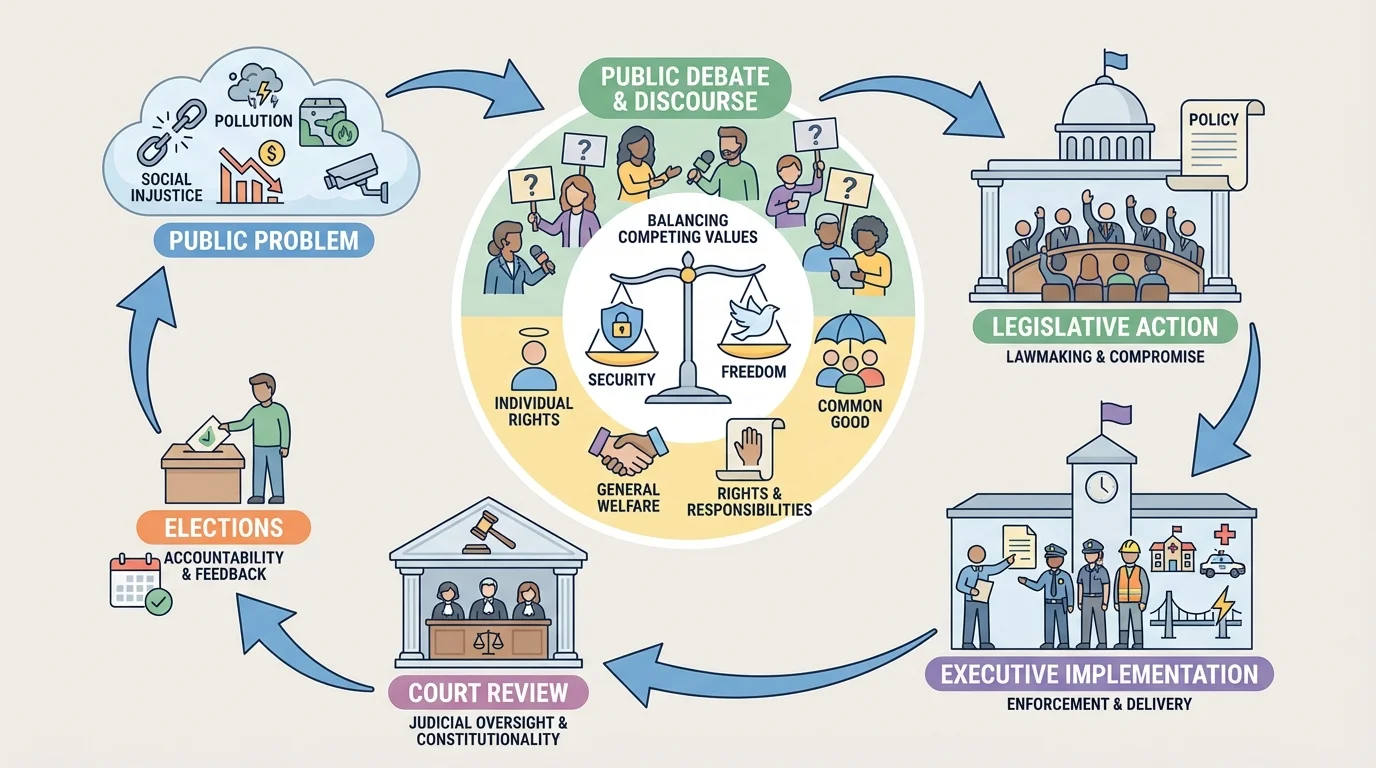
[Figure 4] Balancing democratic values is an ongoing process rather than a single act, tracing how public problems move through debate, lawmaking, court review, implementation, and voter response. Democracies use several mechanisms to do this.
One mechanism is legislation. Lawmakers hear public demands, debate proposals, bargain, amend bills, and pass laws. This process can be frustratingly slow, but slowness can be protective. It forces competing views to confront one another rather than allowing sudden unchecked action.
Another mechanism is judicial review. Courts examine whether laws and government actions violate constitutional principles or rights. Judges do not replace democratic politics, but they help enforce the limits that democracy places on itself. This is especially important when majorities threaten minorities.
Checks and balances also matter. Legislatures can oversee executives. Courts can limit unlawful actions. Executives can veto certain laws. Federal systems can divide power between national and state governments. Local governments can address community needs while national governments protect broader rights and standards. These overlapping structures reduce the chance that one center of power will dominate everything.
Elections provide a further balancing tool. Citizens can reward leaders for wise judgment or remove them for overreach, neglect, or corruption. But elections work well only when voters have access to credible information and when rules are fair and accepted.
Public debate is equally important. News coverage, civic organizations, classrooms, public hearings, and peaceful protest all help shape how values are weighed. As the branch diagram in [Figure 2] suggests, institutions matter, but institutions alone are not enough. Democracy also needs a political culture that tolerates disagreement and values evidence.
Case study: Balancing rights in a public health crisis
A contagious disease spreads quickly across a democratic society.
Step 1: Government identifies the danger to the public.
Hospitals are crowded, vulnerable people face severe risk, and emergency systems are under strain.
Step 2: Officials propose temporary measures.
These may include testing rules, gathering limits in certain settings, or mask requirements in crowded indoor spaces.
Step 3: Citizens and courts examine the limits.
They ask whether the measures are based on evidence, applied equally, limited in duration, and open to challenge.
Step 4: Policies change as conditions change.
If the emergency decreases, restrictions should be reduced or ended. If they remain, government must continue justifying them.
This democratic approach treats public safety as important while insisting that government power remain accountable and temporary.
Compromise is often central to balancing. In everyday language, compromise may sound weak, but in democracy it can be a strength. It allows people with different priorities to live under a shared system. Not every compromise is just, and some values should not be traded away, but many policy questions require negotiated middle ground.
Modern democracies face intense pressures when balancing values. Polarization can make compromise look like betrayal. Social media can spread anger faster than careful reasoning. Economic inequality can give some voices far more influence than others. Distrust in institutions can lead citizens to reject legitimate outcomes whenever they lose.
Emergency powers pose a special challenge. Democracies sometimes must act quickly during war, terrorism, or disaster. Yet temporary powers can outlast the emergency. Citizens may become used to expanded surveillance or executive control. That is why sunset clauses, legislative review, and court oversight are so important.
Another danger is majoritarianism without rights. If citizens come to believe that winning elections gives leaders unlimited authority, democracy loses one of its essential principles. The protections shown in [Figure 1] remain necessary even when a majority is strongly convinced of its cause.
At the same time, excessive mistrust of government can be harmful. If citizens reject every law, tax, or public program as tyranny, then the state may become too weak to protect rights, maintain order, or promote general welfare. Democracy requires vigilance against both too much power and too little effective government.
Government in a constitutional democracy has a dual character: it must be strong enough to act for the public, yet limited enough to preserve liberty. This tension is not a flaw to eliminate; it is a permanent feature of self-government.
Because of these pressures, civic education matters. Citizens need historical knowledge, constitutional understanding, media literacy, and habits of respectful disagreement. A democracy cannot survive on procedures alone if its citizens no longer believe in the value of shared rules.
American history offers many examples of democratic balancing. During the civil rights movement, activists pushed the nation to confront the contradiction between segregation that had majority support in some states and the democratic promise of equal rights. Courts, Congress, the executive branch, and citizens all played roles in changing laws and public expectations.
Debates over national security after the attacks of September 11, 2001, raised major questions about surveillance, detention, and executive power. Some Americans saw expanded security policies as necessary protection. Others warned that fear might lead the nation to erode civil liberties. These disagreements were deeply democratic because they involved competing commitments to both safety and freedom.
Public health policies during recent pandemics sparked similar disputes. Citizens argued about school closures, vaccine rules, mask mandates, business restrictions, and the authority of state and federal governments. Even when people shared the goal of protecting life, they often disagreed about which measures were constitutional, effective, or proportionate.
Student speech cases have also tested democratic principles. Courts have had to consider when schools may regulate expression and when students retain strong First Amendment protections. These cases matter because schools are places where democratic habits are learned, challenged, and practiced.
Across all these examples, one pattern appears: democracy rarely offers perfect answers. Instead, it offers a method for arguing, deciding, revising, and correcting. The process in [Figure 4] helps explain why democratic outcomes can change over time as evidence, public opinion, and constitutional interpretation develop.
Democracy is demanding because it requires patience, judgment, and self-restraint. It asks citizens to live with disagreement, to accept lawful outcomes, to defend rights they may not personally use, and to work through institutions that are often slow and imperfect. Yet those same demands are what make democracy valuable. It treats people not as subjects to be ruled, but as members of a political community responsible for preserving both liberty and justice.
