One of the most powerful realities in American history is that the same Constitution has been used to defend slavery and to challenge segregation, to limit speech in wartime and to protect student expression, and to deny marriage rights and later recognize them. That tells us something important: individual rights do not stay fixed in practice. Even when the words of the Constitution remain the same, their meaning in everyday life can change dramatically through court rulings, political debate, and pressure from ordinary people.
In the United States, rights are shaped by an ongoing conversation between citizens and institutions. Courts interpret constitutional language. Legislatures write and revise laws. Presidents, governors, and local officials enforce policy. Activists, journalists, lawyers, students, and community groups push institutions to act or resist change. Because of that, rights are not just legal ideas on paper. They are lived realities that can widen, narrow, or be unevenly applied depending on the moment in history.
Individual rights include freedoms and protections such as speech, religion, due process, equal treatment under the law, voting, privacy, and protection from discrimination. Some rights are written directly into the Constitution and its amendments. Others have been recognized through interpretation over time. The key point is that rights depend not only on official wording, but also on who has access to them, how strongly they are enforced, and whether institutions recognize them equally.
Rights often change because society changes. New technologies create new questions about privacy. Wars and national emergencies raise conflicts between liberty and security. Social movements expose unfair treatment that had once been accepted by many people. Demographic change, media coverage, and public protest can all force governments to respond. In that sense, rights history is also a history of civic participation.
Civil liberties are freedoms the government is generally expected not to interfere with, such as freedom of speech or religion.
Civil rights are protections against unequal treatment and discrimination, especially by government and in public life.
Judicial review is the power of courts to decide whether laws or government actions violate the Constitution.
Precedent is a prior court decision that guides later cases.
Understanding rights requires seeing both continuity and conflict. Americans often speak of rights as if they are permanent, but history shows repeated struggles over who counts, whose rights matter most, and how far government power may go. Those struggles appear in legislatures, in courtrooms, and in the streets.
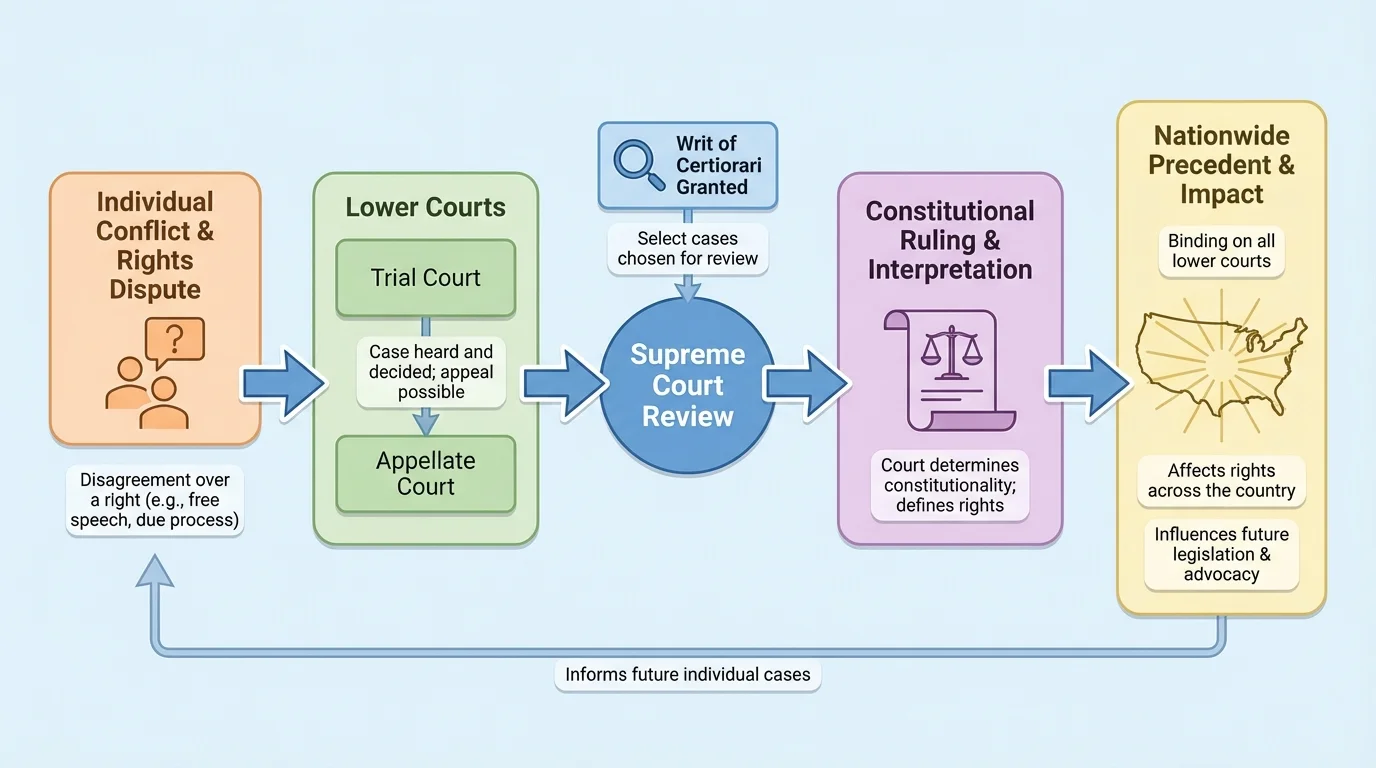
[Figure 1] Many major changes in rights happen through judicial review. Courts hear specific disputes, but their decisions can affect millions of people. When judges interpret broad constitutional phrases such as "equal protection," "due process," or "freedom of speech," they turn general principles into concrete rules. Rights often change because one lawsuit can move through the courts, become a major ruling, and set a nationwide standard through precedent.
The Supreme Court is the most visible court in this process, but lower federal and state courts matter too. A court decision can strike down a law, uphold it, or interpret it in a new way. Sometimes the Court expands rights; sometimes it limits them. That is why studying rights means studying interpretation, not just memorizing amendments.
A famous example is Brown v. Board of Education in 1954. In this case, the Supreme Court ruled that racial segregation in public schools violated the Constitution's equal protection guarantee. This decision overturned the legal logic that had supported segregation in many places. Brown did not instantly create equality; many states resisted desegregation for years. Still, the ruling changed constitutional meaning and gave the civil rights movement a powerful legal foundation.
Another major example is Tinker v. Des Moines in 1969. The Court ruled that students do not "shed their constitutional rights to freedom of speech or expression at the schoolhouse gate." That case mattered because it clarified that young people also hold rights, even in institutions such as public schools, though those rights may be balanced against order and safety.
Courts have also limited rights. In Korematsu v. United States in 1944, the Supreme Court upheld the internment of Japanese Americans during World War II. That decision is now widely criticized as a failure to protect liberty and equality in a time of fear. It reminds us that courts are not automatically defenders of justice. A court decision can become part of the problem as well as part of the solution.
The role of the judiciary becomes even clearer when we compare decisions over time. Plessy v. Ferguson in 1896 upheld "separate but equal," while Brown rejected it. Bowers v. Hardwick in 1986 allowed states to criminalize same-sex intimacy, but Lawrence v. Texas in 2003 reversed that approach. As the process in [Figure 1] shows, a new case can reshape constitutional meaning across the country when the Court changes direction.
Case study: How one court case can affect rights nationally
Step 1: A person or group challenges a law or policy, arguing that it violates a constitutional right.
Step 2: Lower courts review evidence and legal arguments.
Step 3: An appellate court or the Supreme Court issues a ruling interpreting the Constitution.
Step 4: Government institutions must respond, often changing policy, enforcement, or law.
For example, after Obergefell v. Hodges in 2015, states could no longer deny same-sex couples the right to marry. A legal dispute involving specific plaintiffs led to a national change in rights.
That process demonstrates a central idea in civics: political institutions are not isolated. Courts influence legislatures, executives, schools, police departments, and local governments. Judicial decisions can trigger policy changes, resistance, or new laws meant either to strengthen or weaken their effects.
[Figure 2] Rights are shaped at multiple levels of government through the different powers of federal, state, and local institutions. While courts interpret rights, legislatures often decide how those rights are protected, limited, funded, or enforced. Congress can pass nationwide laws, state legislatures can set rules on voting or education, and local governments can influence policing, protests, school policies, and access to public services.
National legislation has often expanded rights when constitutional promises were not being enforced. The Civil Rights Act of 1964 outlawed segregation in public accommodations and discrimination in employment. The Voting Rights Act of 1965 targeted barriers that had kept many African Americans from voting, especially in the South. These laws mattered because even after constitutional amendments existed, states and local officials had often denied equal treatment in practice.
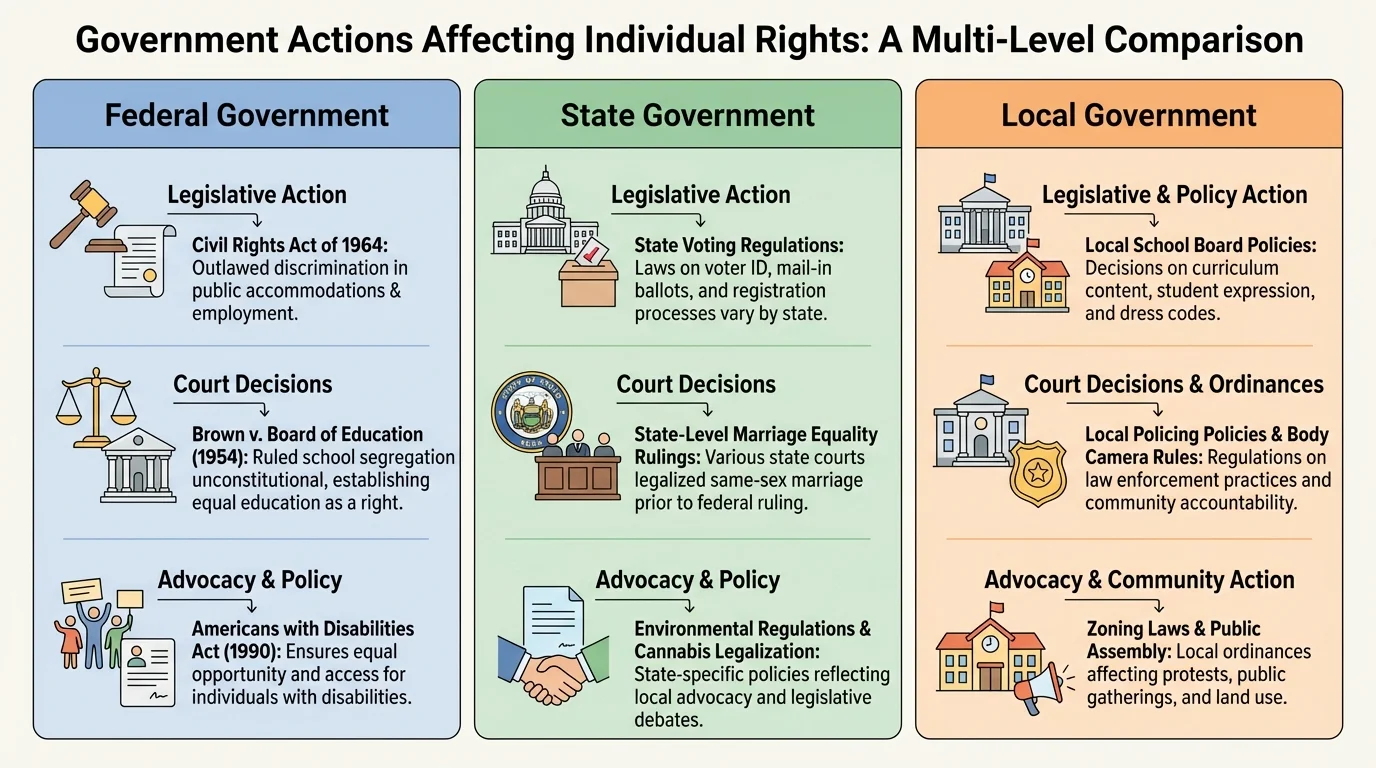
State governments also shape rights in major ways. States set many election rules, oversee criminal justice systems, fund public education, and regulate health policy. A state can broaden access to voting through early voting and mail ballots, or it can impose stricter identification requirements. It can expand anti-discrimination protections beyond federal law, or it can limit them. The same constitutional framework may produce different lived experiences in different states.
Local governments matter more than many people realize. City councils, school boards, county commissions, and police departments make decisions that affect rights daily. A school board may debate what student groups can meet on campus. A city may create protest permit rules that are either fair or overly restrictive. A county jail's policies can shape whether detainees receive due process and humane treatment. Rights are national in theory, but they are often local in experience.
| Level of government | How it affects rights | Example |
|---|---|---|
| Federal | Passes nationwide laws and sets broad protections | Civil Rights Act of 1964 |
| State | Regulates elections, education, health, and criminal justice | State voting access laws |
| Local | Implements policies in schools, policing, housing, and public spaces | School dress code or protest permit rules |
Table 1. Examples of how different levels of government influence individual rights.
Legislative debates reveal that rights questions are often also policy questions. Should voter identification laws be seen as election security or as barriers to participation? Should social media activity by students be protected speech or subject to school discipline? Should public accommodations laws require businesses to serve all customers equally even when owners raise religious objections? In a democracy, these issues move through public hearings, campaigns, lobbying, testimony, and elections.
Many constitutional rights became much more meaningful only after legislatures created enforcement tools. A right on paper may not protect people effectively unless laws provide procedures, penalties, and agencies to enforce it.
Legislatures can also narrow rights or create new conflicts. During moments of fear, lawmakers may support restrictions on speech, immigration, protest, or privacy that later generations judge harshly. Because of that, legislative history is not just a story of progress. It is a story of debate, compromise, backlash, and revision.
Courts and legislatures rarely act in a vacuum. Behind many major rights changes stand people who organized, protested, testified, published, donated, litigated, and voted. Advocacy means taking action to support a cause or policy. It can come from one determined individual or from broad coalitions of citizens, nonprofits, religious groups, labor unions, student organizations, professional associations, and social movements.
Consider the long struggle for women's suffrage. Activists such as Susan B. Anthony, Elizabeth Cady Stanton, Ida B. Wells, Alice Paul, and many others used speeches, petitions, marches, newspapers, and civil disobedience to pressure institutions. Their work helped build support for the Nineteenth Amendment, which prohibited denying the right to vote on the basis of sex in 1920. That change did not happen simply because political leaders acted on their own. It happened because sustained civic action made inaction politically costly.
The modern civil rights movement offers another clear example. Organizations such as the NAACP, the Southern Christian Leadership Conference, and the Student Nonviolent Coordinating Committee combined court cases, boycotts, voter registration drives, sit-ins, and marches. Individuals like Rosa Parks, Martin Luther King Jr., Fannie Lou Hamer, Thurgood Marshall, Ella Baker, and John Lewis became powerful voices, but they worked within wider networks. Their advocacy reshaped public opinion and pushed federal institutions to act.
"Power concedes nothing without a demand. It never did and it never will."
— Frederick Douglass
Advocacy can also come from groups seeking to limit rights or defend older interpretations. That is an important democratic reality. In legislative debates and court battles, people often disagree deeply about what freedom, equality, religion, safety, or family should mean. Civic participation does not guarantee one outcome. It guarantees that institutions face pressure from organized citizens.
Examples from more recent decades include disability rights activism leading to the Americans with Disabilities Act, LGBTQ+ advocacy helping drive changes in marriage and anti-discrimination policy, and student activists drawing attention to school discipline, gun violence, and free expression. In each case, advocacy linked personal experience to public policy.
[Figure 3] The path of rights in the United States is not a straight line of constant improvement. At some moments, rights expanded quickly. At others, courts, legislatures, or local authorities resisted change or even reversed it. Looking across time helps explain both progress and setbacks.
After the Civil War, the Thirteenth, Fourteenth, and Fifteenth Amendments abolished slavery, defined citizenship, promised equal protection and due process, and protected voting rights for men regardless of race. These amendments transformed the Constitution. Yet in the decades that followed, many Black Americans faced violence, disfranchisement, segregation, and discrimination. That gap between law and reality is one of the most important themes in rights history.
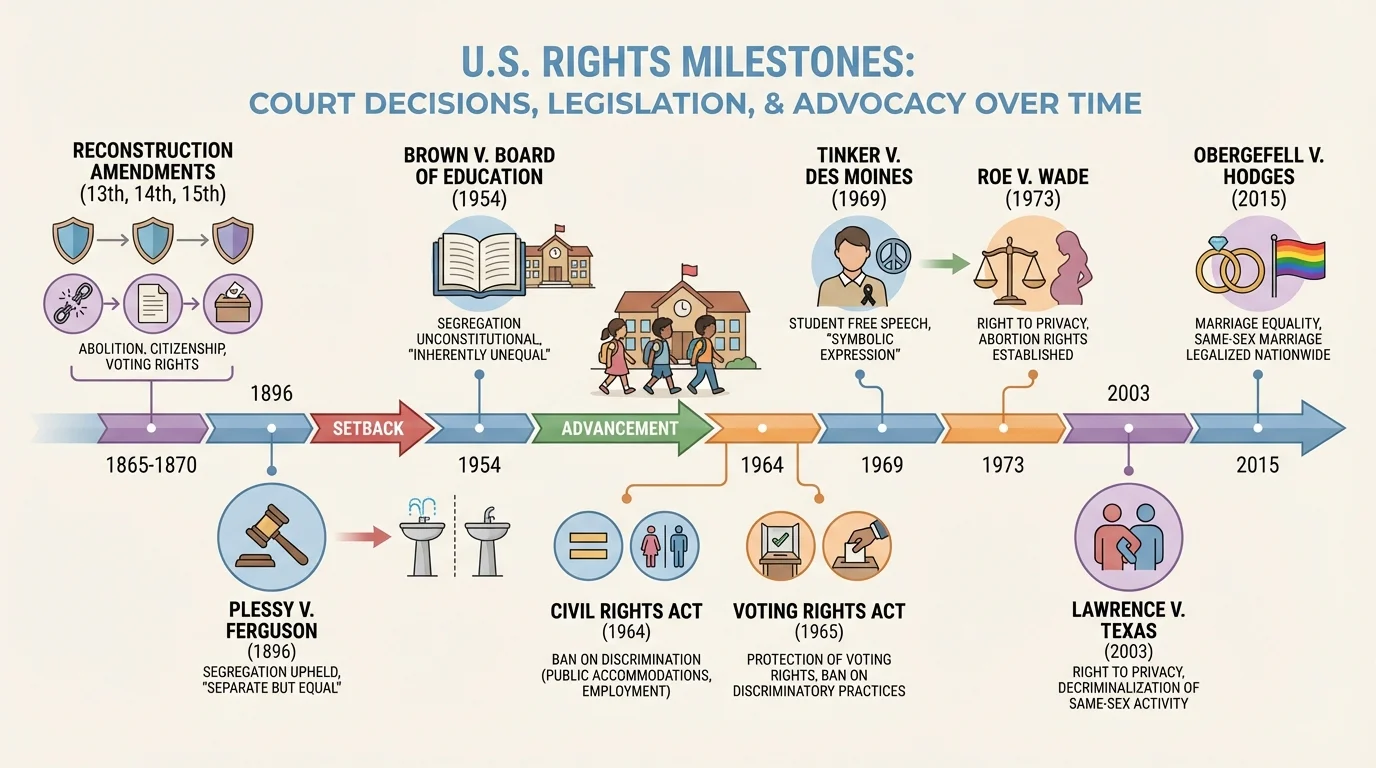
Plessy v. Ferguson in 1896 allowed segregation under the idea of "separate but equal." For decades, that decision helped justify unequal schools, transportation, and public facilities. Brown in 1954 rejected this framework, showing how one court decision can undo another and alter rights nationwide.
Voting rights show a similar pattern. The Fifteenth Amendment promised voting rights, but poll taxes, literacy tests, intimidation, and local discrimination blocked access for many citizens. The Voting Rights Act of 1965 addressed these abuses directly. Later debates over redistricting, voter identification, and federal oversight show that voting rights remain contested rather than permanently settled.
Freedom of speech also evolved. During World War I and the Red Scare, the government punished some antiwar speech. Later rulings gave speech stronger protection, though not without limits. Student speech, symbolic speech, and political protest all became areas where courts had to decide how far the First Amendment reaches.
Privacy rights followed a similar path. In Griswold v. Connecticut, the Court recognized protection for marital privacy. In Roe v. Wade, it extended constitutional protection to abortion decisions, though that ruling remained deeply controversial for decades. In 2022, Dobbs v. Jackson Women's Health Organization overturned Roe, returning greater authority to the states. This dramatic change shows that rights recognized by courts can also be narrowed or no longer recognized.
Marriage equality offers another example of change through advocacy and courts. For years, many states denied legal recognition to same-sex couples. After extensive activism and legal challenges, the Supreme Court ruled in Obergefell v. Hodges that same-sex couples have a constitutional right to marry. Seen alongside earlier moments on [Figure 3], this case shows how rights history often moves through long campaigns followed by decisive institutional action.
Rights are rarely absolute. Freedom of speech does not protect every kind of threat or defamation. Religious liberty does not automatically excuse every action from law. Due process requires fairness, but criminal justice systems still balance individual protections against public safety concerns. That is why rights cases often involve competing claims rather than obvious answers.
Due process refers to fair treatment through the normal legal system, especially when the government may take away life, liberty, or property. Equal protection means the law should apply fairly and not unjustly discriminate among people. These principles often work together, but sometimes they create difficult debates about what fairness requires in specific situations.
Why rights can conflict
A rights issue often involves more than one constitutional value at once. A protest may involve free speech, public safety, and local permitting rules. A school policy may involve student expression, educational order, and equal treatment. A voting law may involve ballot access, election security, and federalism. Understanding rights means identifying the competing principles, not assuming only one value is present.
National emergencies can intensify these conflicts. During war or perceived threat, governments often claim broader power. Sometimes these claims are necessary; sometimes they become excuses for violating rights. The lesson of cases like Korematsu is that fear can distort institutions. Strong civic participation, independent courts, and public debate are especially important when pressure to sacrifice liberty is high.
Rights can also be limited indirectly. A state may not ban voting outright, but it may create rules that make participation harder for some communities. A school may not formally silence students, but it may apply discipline unevenly. A right that exists only in theory is weaker than one backed by fair procedures and equal enforcement.
The most important civic lesson is that citizens help shape what rights mean in practice. Voting, attending school board meetings, contacting legislators, joining organizations, filing lawsuits, writing op-eds, documenting abuses, organizing peaceful protests, and serving on juries are all forms of civic participation. These actions influence political institutions and public policy, sometimes slowly and sometimes dramatically.
Current debates over privacy and technology show this clearly. Questions about facial recognition, government data collection, student monitoring software, and social media regulation are really questions about liberty, security, and the limits of state and corporate power. Courts will interpret these issues, but legislatures and advocacy groups will also shape the outcomes.
Public policy toward policing, immigration, reproductive health, disability access, LGBTQ+ rights, religion in public life, and voting access continues to evolve. Young people are part of that process. Students have organized walkouts, testified before legislatures, challenged school policies, and used digital media to build public awareness. Civic participation does not begin at age eighteen. Long before they can hold office, young people can influence institutions by speaking, organizing, and demanding accountability.
Political institutions include courts, legislatures, executives, and local governing bodies. Public policy is the set of laws, rules, and decisions those institutions make. Civic participation matters because it connects citizens to both institutions and policy outcomes.
When we study how rights have changed, we are really studying the relationship between ideals and action. The Constitution provides principles, but people and institutions determine how fully those principles are honored. Rights expand when individuals and groups force the nation to confront injustice. Rights contract when fear, exclusion, indifference, or unequal power shape policy. That is why the history of rights is also the history of democracy itself.
