Two jobs can offer the same paycheck and still lead to very different lives. One might include health insurance, paid vacation, a retirement match, and a flexible schedule. The other might offer none of those. At first glance, both jobs may seem equal because the pay number looks the same. But once you look closer, one job may be worth thousands of dollars more each year and may also provide more time, stability, and future opportunity.
When many people think about income, they focus only on wages or salary. Those numbers matter, but they are only part of what a worker receives. Employers often provide extra forms of value called employee benefits. Some benefits directly save or add money. Others improve quality of life, reduce stress, or make it easier to balance work with school, family, health, or transportation needs.
That is why smart career decisions require looking at the full package, not just the paycheck. A person who chooses a slightly lower-paying job with better benefits may actually come out ahead financially over time. This broader view also connects to personal financial literacy because the choices people make about careers, education, and job offers shape their lifetime earning potential.
Total compensation is the full value of what an employee receives from a job, including pay and benefits.
Monetary value means a benefit can be estimated in dollars because it saves money or adds money.
Non-monetary value means a benefit may not come as cash, but it still improves a worker's life, options, or well-being.
For example, a worker might earn $18 per hour at one job and $17 per hour at another. If the $17 job includes health coverage, paid sick days, and a retirement match, the total value of that job may be much higher. The key question is not just, "How much do I earn?" but also, "What else does this job provide?"
A compensation package includes several parts working together, as shown in [Figure 1]. These parts often include base pay, insurance, paid time off, retirement contributions, tuition support, and flexible work arrangements. Some parts are easy to price. Others depend on the worker's needs and goals.
Employers use benefits for several reasons. Benefits help attract skilled workers, reduce turnover, and make jobs more competitive. From the employee's point of view, benefits can protect against large expenses, make daily life more manageable, and support long-term financial security.
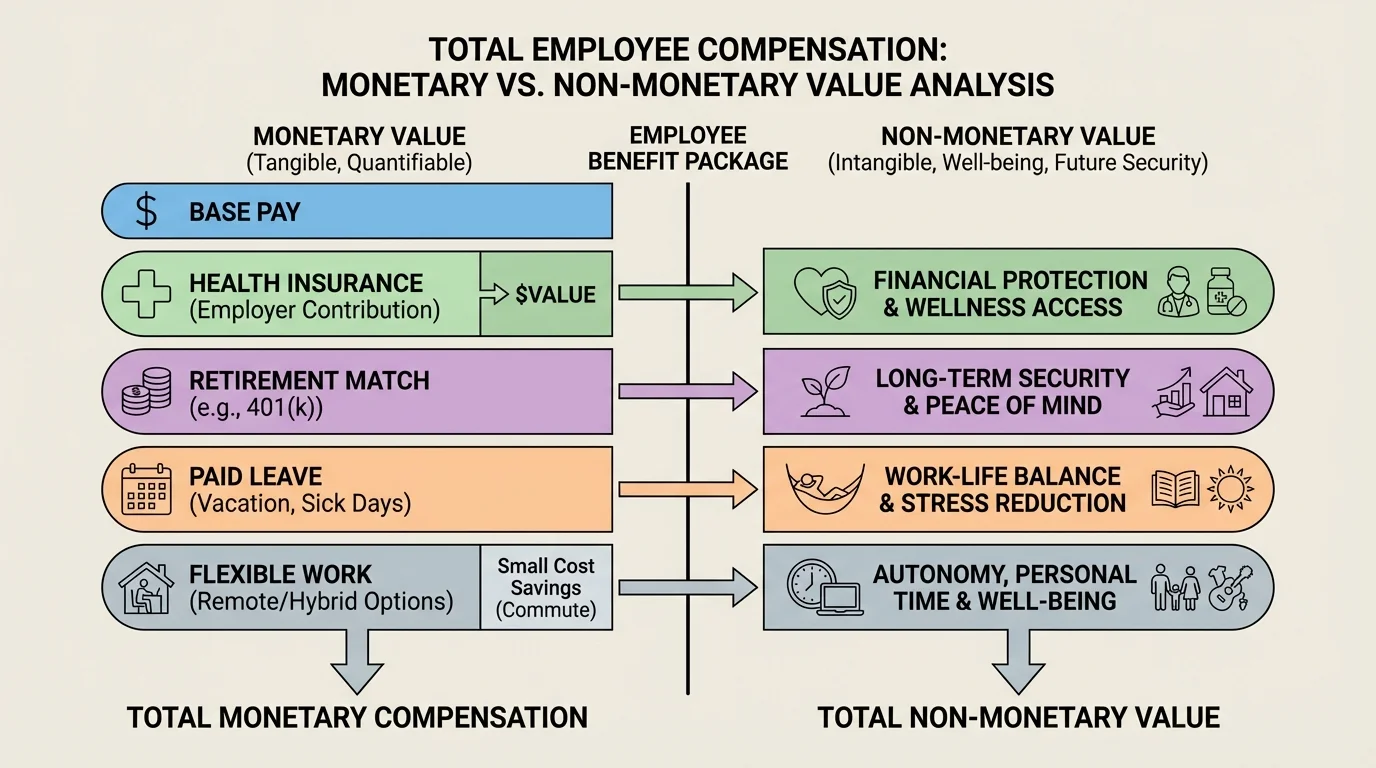
Think of total compensation as a combination of present income and future value. Present income includes wages, salary, bonuses, and benefits that help right now, such as transportation support or free meals during shifts. Future value includes benefits that build security over time, such as retirement plans, training opportunities, and tuition reimbursement.
Students preparing for careers should understand this because jobs in different industries can structure compensation differently. A technology company, hospital, factory, school system, or small local business may all pay workers in different ways. Looking only at the paycheck can lead to poor comparisons.
Some employees turn down a slightly higher salary because a different job offers better health coverage, stronger retirement benefits, or more schedule control. In real life, a smaller paycheck can sometimes support a more stable financial future.
Another important idea is that benefits are not identical for every worker. The same benefit may be extremely valuable to one person and less valuable to another. A student with no car may care a lot about a job near home or on a bus route. A worker with a chronic medical condition may place a very high value on health insurance. A parent may value child-care support or paid family leave more than a larger bonus.
Employee benefits with the clearest monetary value are the ones you can estimate in dollars. These include health insurance, dental insurance, vision coverage, paid vacation, paid sick leave, life insurance, bonuses, tuition reimbursement, transportation assistance, and employer retirement contributions.
Suppose a job offers a salary of $32,000 plus health insurance worth $4,800 per year, paid time off worth $1,200, and a retirement contribution worth $960. The estimated annual total compensation is:
\[32{,}000 + 4{,}800 + 1{,}200 + 960 = 38{,}960\]
That means the job is not just a $32,000 job. It is closer to a $38,960 compensation package.
Health insurance is one of the biggest examples. Medical care can be very expensive. If an employer pays part of the monthly insurance premium, that saves the worker money. If the employer pays $400 per month toward insurance, the annual value is:
\[400 \times 12 = 4{,}800\]
Paid time off also has dollar value. If a worker earns $20 per hour and receives 10 paid vacation days at 8 hours each, the value of that time is:
\[20 \times 8 \times 10 = 1{,}600\]
Even though the worker is not putting in labor on those days, the worker still gets paid. That is a real financial benefit.
Worked example: finding total annual compensation
A job pays $15 per hour for 40 hours each week, for 50 weeks each year. It also offers health insurance worth $3,600 annually, paid leave worth $1,200, and a retirement contribution of $900.
Step 1: Find yearly pay from wages.
\[15 \times 40 \times 50 = 30{,}000\]
Step 2: Add the value of benefits.
\[3{,}600 + 1{,}200 + 900 = 5{,}700\]
Step 3: Find total compensation.
\[30{,}000 + 5{,}700 = 35{,}700\]
The total compensation is $35,700 per year.
Tuition assistance is another major monetary benefit, especially for young workers. If an employer pays for a certification class or helps cover college costs, that may reduce future student debt and improve future earnings. A benefit like this has both immediate value and long-term value.
Bonuses and commissions also count, but students should be careful. Some jobs advertise high possible earnings that depend on performance, sales, or company profits. These amounts are less predictable than guaranteed salary or benefits, so they should be evaluated cautiously.
Some job benefits do not arrive as cash, but they still matter deeply. These include workplace culture, flexible scheduling, supportive managers, safe working conditions, opportunities for advancement, professional training, mental health support, and a sense of purpose or belonging at work.
This kind of value is sometimes harder to measure, but it can affect happiness, stress, health, and even long-term career success. A job with a healthier work environment may reduce burnout and help a person stay employed longer. A job with strong mentoring may open doors to promotions or future careers.
Why non-monetary benefits matter
Not every important advantage can be placed into a perfect dollar amount. A flexible manager may make it possible for a student to finish school. Paid family leave may protect a family during a difficult moment. Professional development may lead to higher wages later. These benefits shape real life, even when they are not listed as cash on a paycheck.
For high school students, non-monetary benefits can be especially important. A part-time job that allows time for homework, sports, caregiving, or transportation needs may be more realistic and sustainable than a job with slightly higher pay but a rigid schedule.
There is also a connection between non-monetary benefits and financial outcomes. Less stress, more training, and better work-life balance can lead to stronger performance and lower turnover. That can improve promotion chances and increase earnings later.
Flexible work arrangements change both money and time, as shown in [Figure 2]. These arrangements may include remote work, hybrid work, flexible start and end times, compressed workweeks, shift swapping, or part-time schedules built around school or family responsibilities.
A flexible work option can have direct monetary value. For example, remote work may reduce transportation costs, parking fees, tolls, and meals purchased away from home. If commuting costs $8 per day and a worker stays home 3 days each week for 50 weeks, the yearly savings are:
\[8 \times 3 \times 50 = 1{,}200\]
That is $1,200 the worker keeps instead of spending on transportation.
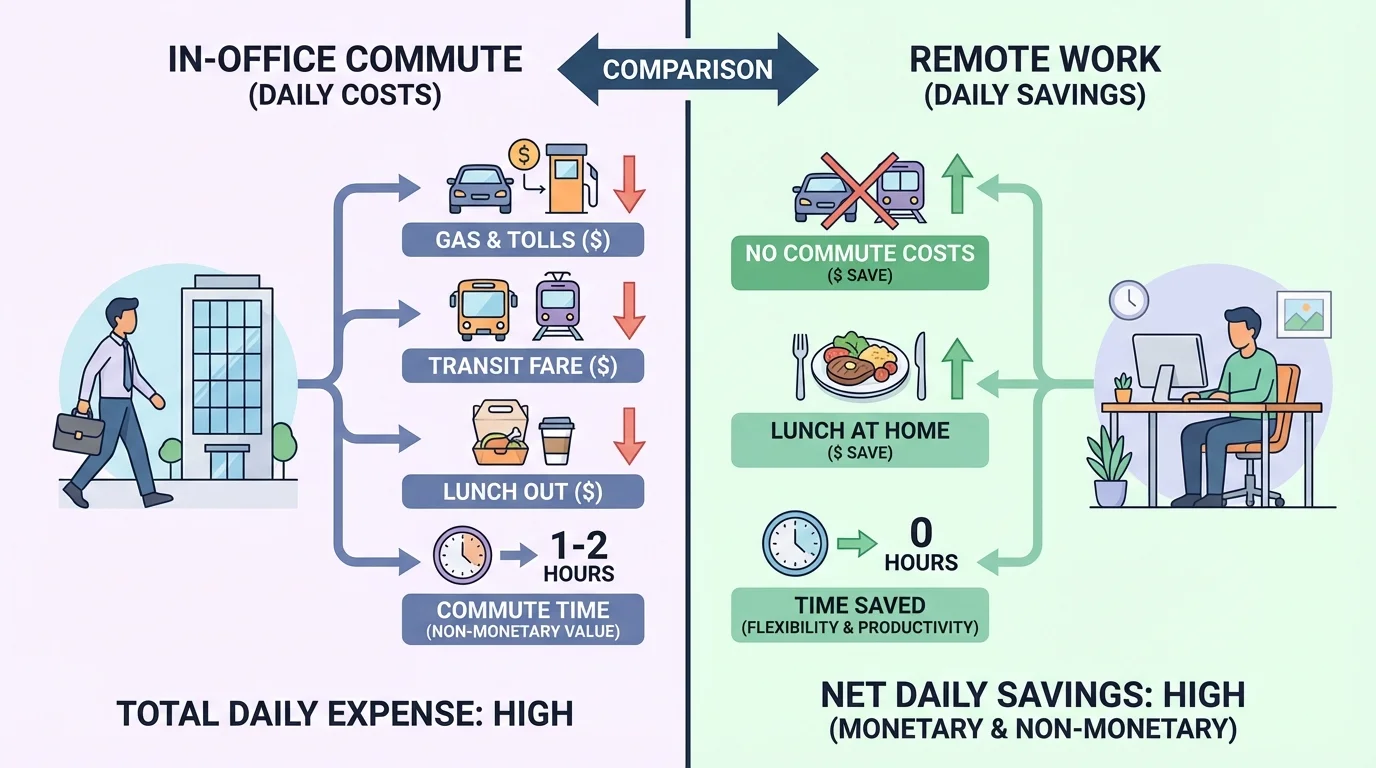
Time also has value. A worker who saves 45 minutes each way by working remotely saves 1.5 hours per day. Over 3 remote days each week for 50 weeks, that is:
\[1.5 \times 3 \times 50 = 225\]
The worker gains 225 hours per year. Those hours could be used for studying, resting, family responsibilities, or a second job.
Hybrid schedules can offer a middle ground. Some people work better from home for focused tasks but benefit from in-person teamwork on other days. The best arrangement depends on the job and the worker's situation.
However, flexible work options are not automatically better in every case. Some jobs cannot be done remotely. Others may involve fewer social connections or less access to hands-on mentoring if employees are rarely in person. A smart evaluation considers both benefits and trade-offs.
Later, when comparing offers, the hidden value shown earlier in [Figure 2] becomes important. Saving money on commuting and gaining time can make a lower-paying but more flexible job more attractive than it first appears.
One of the most powerful job benefits is a retirement plan. Employers may offer plans that allow workers to set aside part of their earnings for the future. Some employers also contribute money to the account, often by matching part of what the employee contributes.
Employer matching increases savings over time, as shown in [Figure 3]. Suppose a worker earns $40,000 and contributes 5% of salary to a retirement account. The worker's contribution is:
\[0.05 \times 40{,}000 = 2{,}000\]
If the employer matches that 5%, the employer also contributes $2,000. That means $4,000 goes into the account that year, even though the worker only contributed half of it.
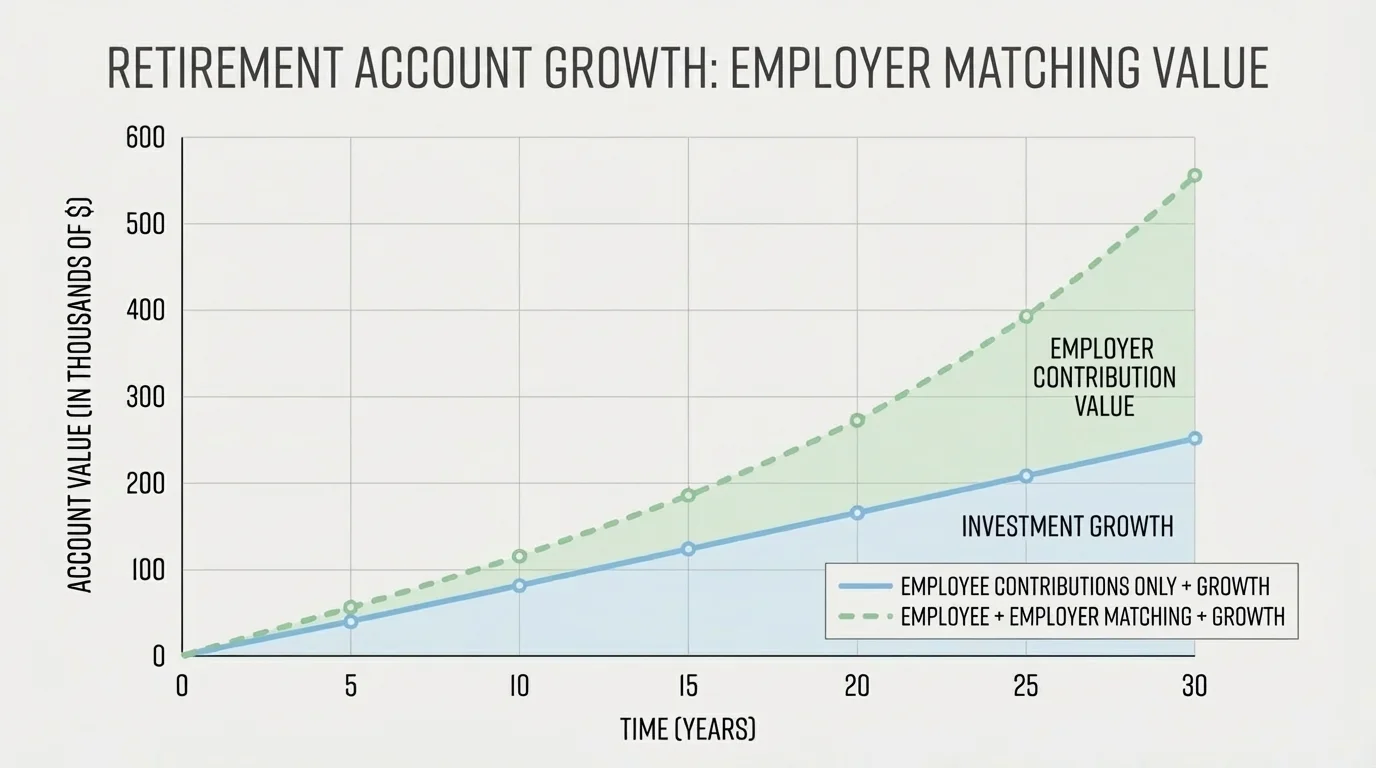
This benefit is especially important because of compound interest, which means money can earn returns, and then those returns can also earn returns. Over many years, matched contributions can grow into a much larger amount.
Worked example: employer match
A worker earns $36,000 and contributes 4% of salary to a retirement account. The employer matches the full 4%.
Step 1: Find the worker's contribution.
\[0.04 \times 36{,}000 = 1{,}440\]
Step 2: Find the employer's match.
The employer matches the same amount, so the employer adds $1,440.
Step 3: Find the total yearly deposit.
\[1{,}440 + 1{,}440 = 2{,}880\]
The retirement account receives $2,880 in one year.
Some plans involve vesting. Vesting means a worker may need to stay with the employer for a certain period before fully owning the employer's contributions. If someone leaves too early, part of the matched money may be lost. That makes vesting an important question to ask when evaluating retirement benefits.
Students may feel retirement is far away, but starting early matters. If two workers save the same yearly amount, the one who starts younger usually ends up with more because the money has more time to grow. The long-term pattern visible in [Figure 3] helps explain why retirement benefits are a major part of total compensation, not just a distant detail.
When comparing jobs, it helps to list both numerical and personal factors side by side. The table below shows how two offers might look once benefits are considered.
| Category | Job A | Job B |
|---|---|---|
| Base annual pay | $34,000 | $32,500 |
| Health insurance value | $0 | $4,500 |
| Paid time off value | $400 | $1,300 |
| Retirement contribution | $0 | $975 |
| Tuition assistance | $0 | $1,000 |
| Estimated total monetary value | $34,400 | $40,275 |
| Schedule flexibility | Low | High |
| Remote option | No | Hybrid |
Table 1. Comparison of two job offers showing how benefits can change the total value of employment.
Even though Job A pays more at first glance, Job B has much higher total value once benefits are added. The difference in estimated monetary value is:
\[40{,}275 - 34{,}400 = 5{,}875\]
Job B is worth $5,875 more in estimated annual compensation, before even assigning a dollar value to flexibility and hybrid work.
Worked example: comparing two offers
A student is choosing between Job X and Job Y.
Job X pays $16 per hour for 20 hours per week over 50 weeks. It offers no major benefits.
Job Y pays $15 per hour for 20 hours per week over 50 weeks, plus $2,000 in tuition help and $800 in paid leave.
Step 1: Find Job X yearly pay.
\[16 \times 20 \times 50 = 16{,}000\]
Step 2: Find Job Y yearly pay.
\[15 \times 20 \times 50 = 15{,}000\]
Step 3: Add Job Y benefits.
\[15{,}000 + 2{,}000 + 800 = 17{,}800\]
Although Job Y pays less per hour, its total value is $1,800 higher.
Of course, calculations do not decide everything. A person must also consider transportation, schedule, stress level, opportunity to learn, and future career pathways. Still, putting numbers on benefits helps reveal hidden value.
Career preparation and continuing education often affect not only whether a person gets hired, but also what level of compensation package they can access. Workers with certifications, technical training, apprenticeships, college degrees, or specialized skills are often more competitive for jobs with stronger benefits.
For example, a teenager might begin in an entry-level retail job with limited benefits. With training in healthcare, information technology, advanced manufacturing, education, or skilled trades, that same person may later qualify for jobs offering insurance, retirement plans, paid leave, and tuition support. Education can increase both pay and benefit quality.
Income is influenced by more than effort alone. Skills, education, industry, experience, and labor market demand all affect wages and benefits. Continuing education can expand a worker's choices and increase long-term earning power.
This matters over a lifetime. A worker who earns slightly more but has no retirement plan, no paid leave, and no training support may fall behind a worker whose employer invests in long-term growth. Strong benefits can reduce out-of-pocket costs, prevent debt, and improve financial stability during illness, emergencies, or retirement.
That is why career planning is not just about finding any job. It is about building toward work that offers both income and support. Students should think about industries where education and skill-building lead to stronger total compensation.
Before accepting a job, workers should ask clear questions. Is health insurance offered? How much does the employee pay? Is paid time off included? Is there a retirement match? When does vesting begin? Are schedules flexible? Is remote or hybrid work possible? Is there training or tuition support?
They should also ask when benefits begin. Some jobs start benefits immediately, while others require waiting periods. Workers should learn whether part-time employees receive benefits, because eligibility rules vary by employer.
Reading the details matters. A benefit may sound impressive in advertising but may have limits, conditions, or costs. For example, a retirement match may only apply up to a certain percent of pay. Health insurance may involve deductibles and copayments. Tuition help may require good academic standing or a commitment to remain employed for a set period.
"The best job offer is not always the one with the biggest paycheck. It is the one that best supports your life now and your goals later."
Analyzing benefits is part of being financially literate. It helps people make smarter decisions, avoid surprises, and plan for both short-term needs and long-term success. As students move toward college, technical training, military service, apprenticeships, or direct entry into the workforce, this skill becomes increasingly important.
