What happens when two children want the same red crayon at the same time? That can become difficult very quickly. A classroom needs rules so everyone can learn, play, and feel safe. Good class rules are not just about stopping noise. They help children share, take turns, and solve problems in kind ways.
A rule is something people agree to do. In a classroom, rules help everyone know what to do. A rule might be "Use walking feet inside" or "Raise your hand to speak." Rules help the class work together.
When children know the rules, they can make better choices. Rules are important because they help people know what is expected. They also help the teacher be clear and help children feel secure.
Rule means a statement people agree to follow. Fairness means people are treated in a way that gives everyone a chance. Conflict means a problem or disagreement between people.
Some rules are made to keep people safe. Some rules help people be kind. Some rules help everyone get a turn. A strong class rule helps the whole group, not just one person.
Fairness means people are treated in a fair and consistent way. In class, fairness does not always mean everyone gets the exact same thing at the exact same moment. It means everyone gets a chance and the same rule is used for everyone.
For example, if there is one toy truck, a fair rule could be, "Each child gets a turn." One child uses it first, and then another child gets a turn. That is fair because everyone can play. The rule is the same for all children.
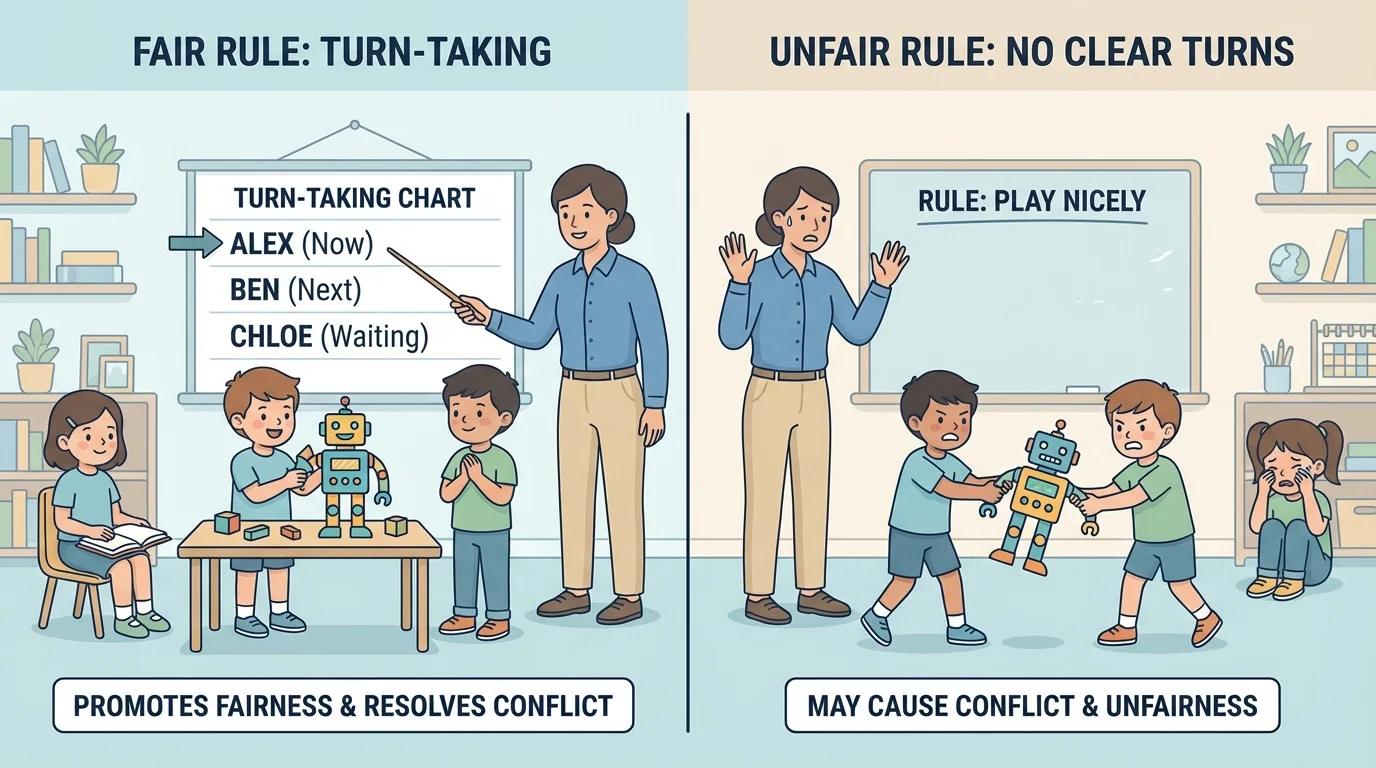
A fair rule helps children trust the classroom. They know they will not be left out. They know they do not need to grab or shout to get what they need. Fair rules can make the room feel calm and kind.
Very young children can learn simple democratic ideas by listening, sharing ideas, and taking turns making choices together.
Sometimes fairness means helping everyone join in. A rule like "Listen when someone else is talking" is fair because every child gets a chance to be heard. That helps quiet voices and loud voices both matter.
A conflict can happen when people want different things. One child may want to go first. Another child may want the same seat. A fair rule helps because it gives a peaceful answer to the problem.
Think about a rule such as, "We take turns on the slide." If two children both want the slide, the rule tells them what to do. One child goes, then the next child goes. The problem is smaller because the rule helps them know the next step.
How a fair rule resolves conflict
A fair rule resolves conflict by giving everyone a clear way to act. Instead of pushing, arguing, or crying, children can follow the rule. The rule helps feelings settle down because the decision is not based on who is louder or faster. It is based on what the class agreed is right.
Fair rules also help teachers solve problems kindly. The teacher can remind children of the rule instead of choosing favorites. That is important because children should see that rules are for everyone.
We can think again about turn-taking. When children know a turn is coming, they can wait more calmly. The rule does not make every child happy right away, but it helps everyone be treated with care.
[Figure 2] Now we can compare a helpful class rule with a rule that may not help. Looking at both helps us see why some rules promote fairness and some do not.
A fair rule might be, "We line up in the order we are ready." This rule can work for everyone. Children know what to do. If someone is ready first, that child lines up first. If someone is ready next, that child goes next. The rule is clear and can be used the same way each time.
| Rule | Why it helps or does not help |
|---|---|
| We take turns with classroom toys. | This is fair because everyone gets a chance. |
| We listen when others speak. | This is fair because every voice can be heard. |
| Only the same two children may be line leader every day. | This is not fair because most children never get a turn. |
| Children with blue shoes can use the blocks, but others cannot. | This is not fair because the rule helps some children for no good reason. |
Table 1. Comparison of fair and unfair classroom rules.
An unfair rule may give special treatment to only a few children for no good reason. For example, "Only children sitting by the window may use the art center" is not fair. Where a child sits should not decide who gets to create art. That kind of rule can cause hurt feelings and more conflict.
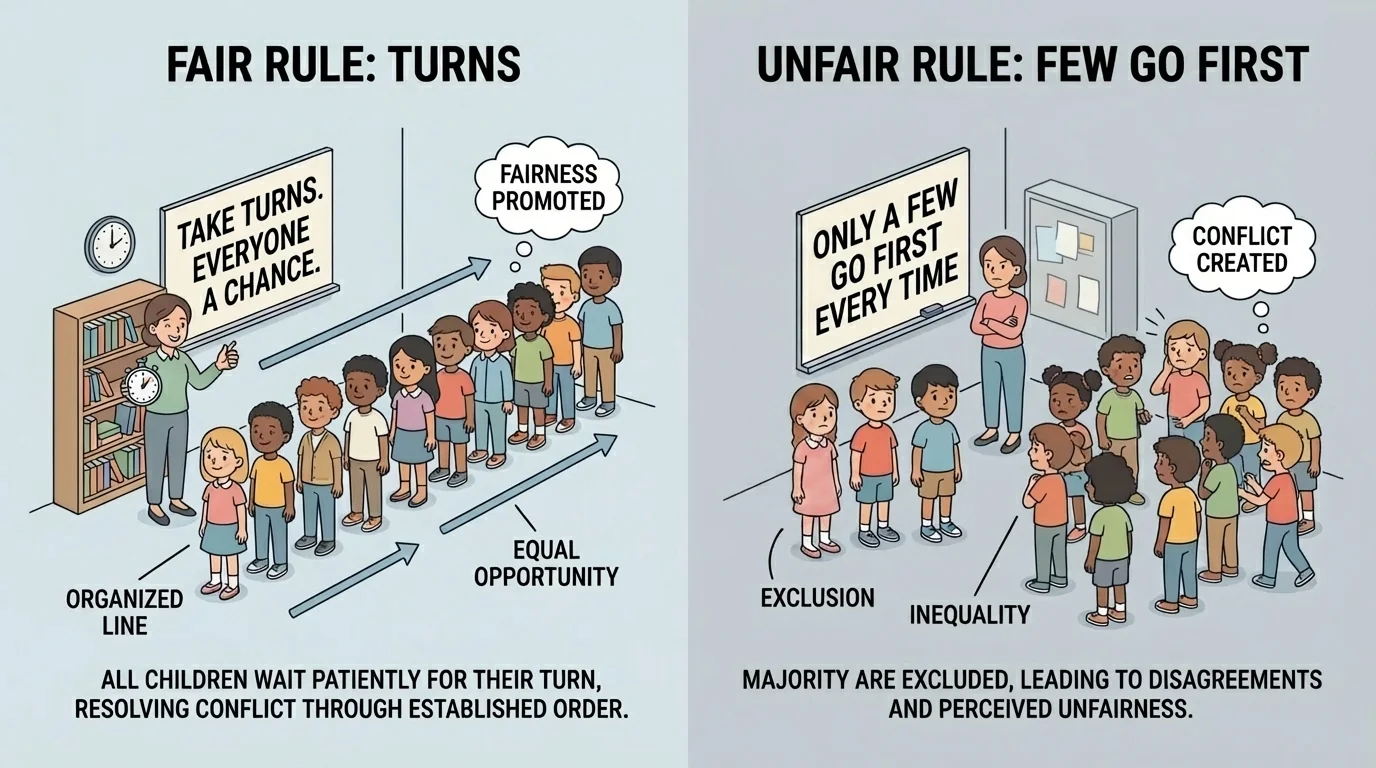
Unfair rules can make children feel left out, angry, or confused. They may think, "That is not the same for everyone." Then the rule does not help the class work together. A class rule should solve problems, not create new ones.
Classroom examples
Step 1: Two children want the same puzzle.
A fair rule is, "Use a timer and take turns." This gives both children a chance.
Step 2: Three children all want to answer first.
A fair rule is, "Raise your hand and wait to be called on." This helps everyone know how to join in.
Step 3: Some children want to be helpers every day.
A fair rule is, "Helper jobs rotate." This lets many children participate.
Later, when the class talks about good rules, they can compare a fair rule with an unfair one. A rule is better when it helps everyone know what is right and gives people a fair chance.
In a classroom, children can use simple democratic principles. That means people listen, share ideas, and help make choices together. The class may talk about which rule helps everyone clean up, wait, or share.
When children help talk about rules, they can learn that good decisions are made by thinking about the whole group. A child may want a rule that helps only one person, but the class learns to ask, "Is this good for everyone?" That is an important civic idea.
When people take turns speaking, listen carefully, and think about others, they are practicing respectful group decision-making.
A class can choose rules that are logical. A logical rule makes sense. For example, "Walk inside so everyone stays safe" makes sense. "Only tall children may use the reading rug" does not make sense. Good rules have a reason that helps the group.
When children practice fair rules every day, they are learning how to live and work with others. They are learning to solve small conflicts with words, patience, and kindness. These are important habits for school, home, and community life.
