What happens when a whole class wants different things at the same time? One child wants the blue crayon box, another wants the red one, and someone else wants to read a different story. A classroom works best when everyone helps make good choices together. That is how a class becomes a happy, safe, and fair place to learn.
A classroom is a community. A community is a group of people who belong together and help one another. In our class community, we learn, play, share, and solve problems together.
Each person in the class matters. The teacher matters. Each child matters. When we work together, we can make the classroom better for everyone. That means we think about not only what I want, but also what we need.
Class community means all the people in the classroom working together. A decision is a choice. An agreement is something people say yes to together and try to follow.
Being part of a class community means using kind words, listening carefully, and helping others feel included. It also means helping with choices that affect the whole class, like where supplies go, how to line up, or what rules help everyone stay safe.
A decision is a choice we make. Some decisions are made by one person, like choosing which pencil to use. Some decisions are made by the whole class, like choosing a game for indoor recess or deciding how to keep the reading corner neat.
Class decisions should be fair. Fair does not always mean everyone gets exactly the same thing at the same time. Fair means people are treated in a kind and reasonable way. For example, if everyone wants the same toy, fair choices might include taking turns or making a sharing plan.
Good class decisions help people learn, stay safe, and feel respected. A decision is not just about what is fun. It should also help the whole class work well together.
[Figure 1] shows children helping make class choices in a democratic process by sharing ideas, listening to others, and helping choose what is best for the group. Sometimes the class talks together. Sometimes children raise their hands. Sometimes the class votes between two choices.
When we make decisions together, we take turns speaking. We listen when someone else is talking. We do not shout over others. We can say, "I think this is a good idea because…" We can also say, "I heard your idea." Listening is important because good choices come from hearing many voices.
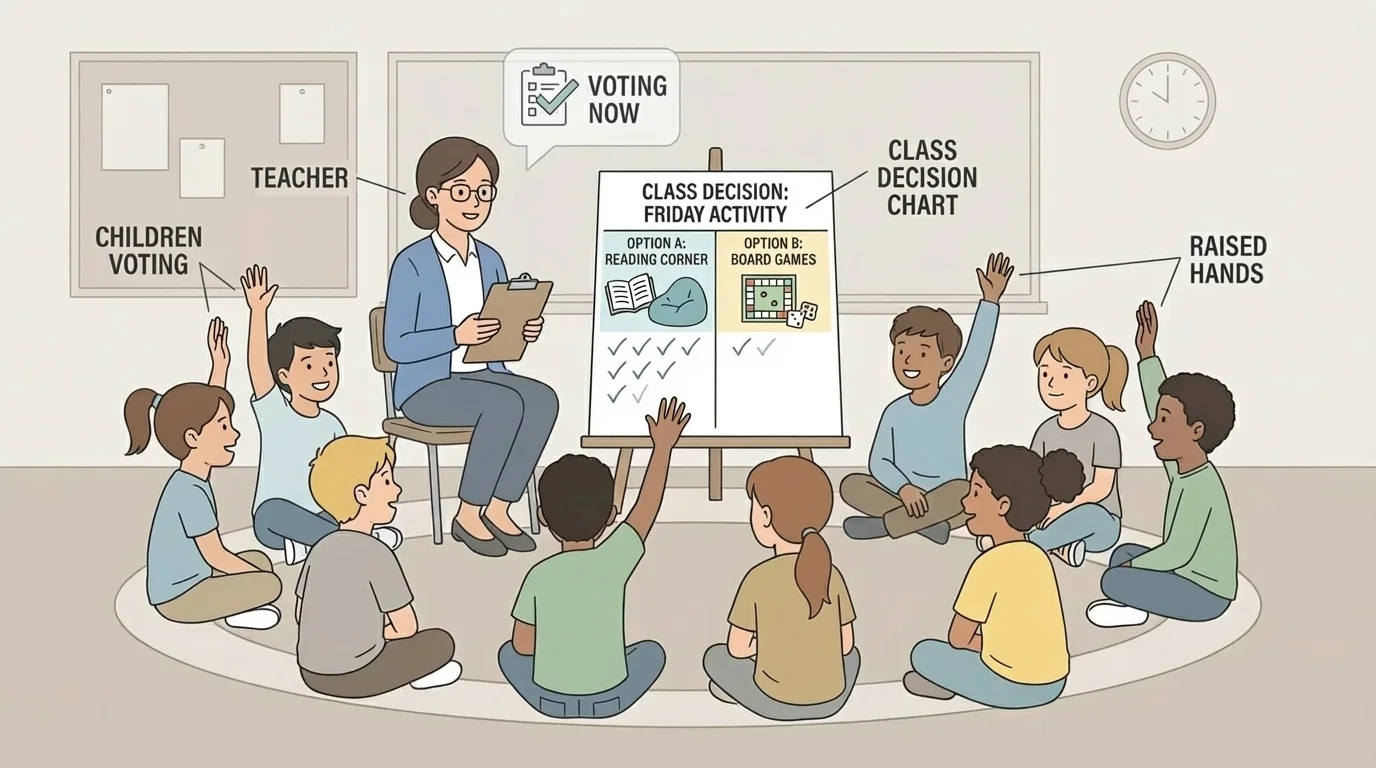
Sometimes the teacher helps the class choose between ideas. For example, the class might choose between reading one of two books. If more children vote for one book, the class may read that one first. That is one way a group can decide.
Voting is helpful, but it is not the only way. Sometimes a class uses turns, sharing, or discussion instead. If one child says, "Let's run in the classroom," the class should not choose that, even if it sounds exciting, because it is not safe. Good group decisions must be safe, kind, and helpful for learning.
Making logical class decisions means thinking about what helps the whole group. A logical choice fits the problem. If the problem is that too many children want one center, a logical solution might be taking turns, making smaller groups, or choosing another center for now.
Making a class choice is not only about picking something. It is also about the way we act while choosing. Respectful voices, patient listening, and calm bodies help everyone join the decision.
Classes often make simple rules or agreements together. A rule tells what people should do. An agreement is like a class promise. These help everyone know how to act.
Examples of class agreements might be: use gentle hands, listen when others speak, clean up after play, and walk inside. These agreements help keep children safe and help the room stay ready for learning.
When children help talk about the rules, they understand them better. They can see that rules are not just commands. Rules are tools that help the whole community. A classroom with clear agreements can feel calmer and friendlier.
Many classrooms make picture rules instead of using only words. Pictures can help young children remember what the class decided together.
A class rule should match the need. If paints are left open, a helpful rule might be "Close the paint lids when you finish." If children crowd at the sink, a helpful agreement might be "Wait for your turn." The rule connects to the problem and helps fix it.
[Figure 2] shows that making a good class choice is only the beginning. We also need to show responsibility by following our class decisions every day. To maintain a class decision means to keep following it, remember it, and help others remember it too.
For example, if the class decides that blocks go on the bottom shelf, then everyone helps put blocks there. If the class agrees to walk in line, everyone tries to walk in line each day. A decision helps only when people follow it.
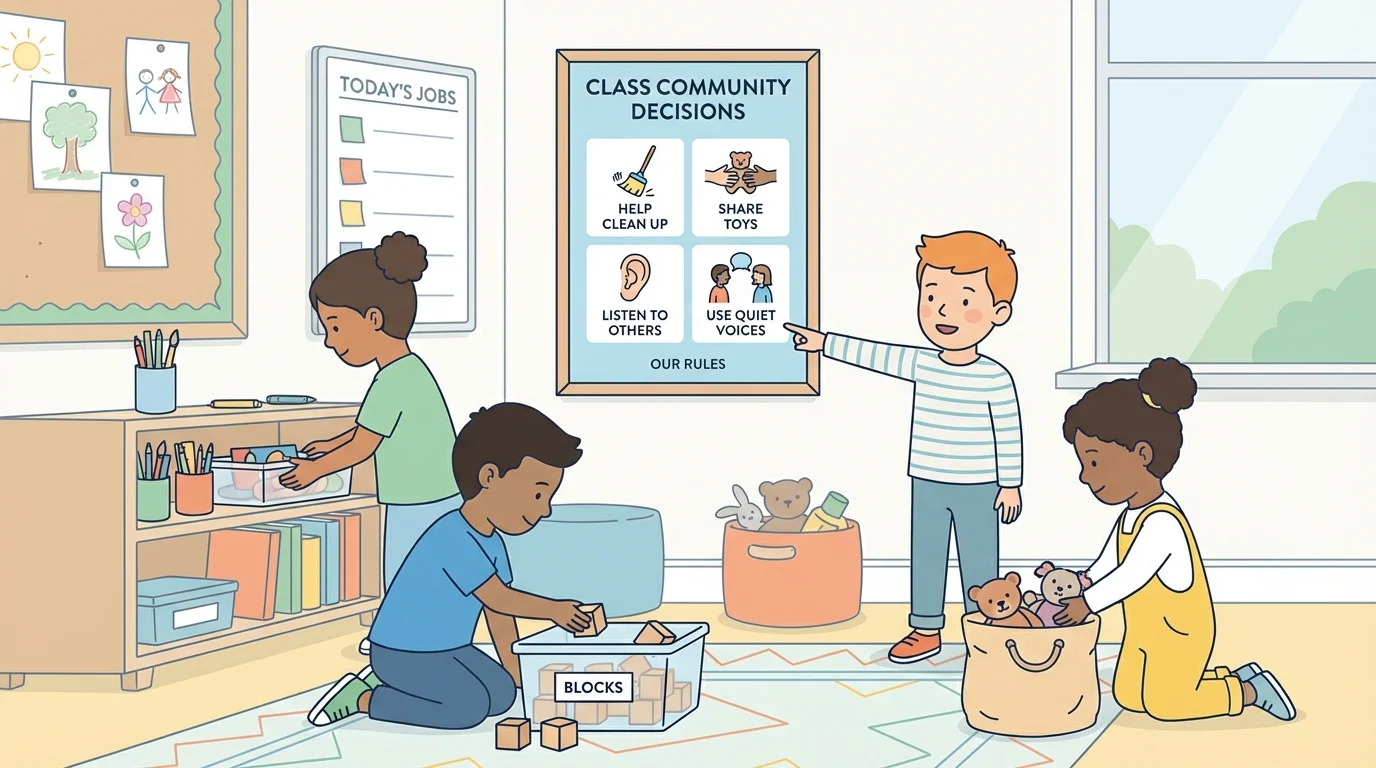
Sometimes people forget. That is normal. We can give kind reminders such as, "The crayons go in this basket," or "We are using walking feet." Kind reminders help the community. Mean reminders can hurt feelings, so we choose gentle words.
Sometimes a class decision needs to change. Maybe a cleanup plan is not working well. Maybe too many children are waiting too long for one center. Then the class can talk again and make a better plan. Good communities do not give up when a choice is hard. They work together to improve it.
Classroom example: choosing and keeping a cleanup plan
Step 1: The class notices a problem.
Toys are left on the floor after playtime.
Step 2: Children share ideas.
One child says to sort toys into bins. Another child says to have a cleanup song.
Step 3: The class agrees on a plan.
The class uses labeled bins and starts cleaning up when the song begins.
Step 4: The class maintains the plan.
Children put toys in the right bins each day and remind one another kindly.
This helps the classroom stay neat and ready for the next activity.
The teamwork shows that class decisions stay strong when everyone helps. Even small actions, like putting away markers or waiting quietly for a turn, help the whole group.
Here are some classroom situations where children can contribute to decisions:
Story choice: The class picks between two read-aloud books. Children listen to the choices, then vote.
Center time: If too many children want one center, the class may agree on a turn-taking plan.
Line order: The class may choose a fair system, such as rotating helpers or lining up by table groups.
Cleanup jobs: Children may help decide who waters plants, who checks the art shelf, and who straightens books.
Playground use: If many children want the same ball, they can decide to share, take turns, or use another ball.
In each example, children are not just following directions. They are helping the class solve problems and make choices that work for many people.
A good class community member shows respect. Respect means treating people, spaces, and materials with care. Respectful children listen, wait for turns, and use kind words.
A good community member also shows responsibility. Responsibility means doing your part. If the class agrees to clean up, you clean up. If the class agrees to use quiet voices in the library corner, you try to do that.
Sometimes you may not get your first choice. That can feel disappointing. But in a class community, we remember that other people matter too. If the class chooses a different game today, another game may be chosen another time. Taking turns and accepting group choices help the class stay peaceful.
"We all help our class when we listen, share, and do our part."
When children contribute to making and maintaining class community decisions, they help build a classroom where people feel safe, included, and ready to learn. These habits are important in school, and they are also important in families, neighborhoods, and many other groups.
