Look around for a moment. There are many places all around you, and each place has a purpose. A table is for doing work, a road is for traveling, a garden is for growing plants, and a room is for living or sleeping. Learning about places helps us know where we are and how we move safely through our world.
Inside, we spend time in places we know well. In preschool, you may see a reading corner, a blocks area, an art table, a snack area, a cubby area, a door, and a bathroom. A classroom has different parts, and each part helps us do something special. We read in one place, build in another place, and wash hands in another place.
At home, we may know a bedroom, kitchen, bathroom, living room, or yard. Your own room may have a bed, toys, books, and clothes. The kitchen is where food is prepared. The bathroom is where we wash. The living room is a place to sit and talk. Knowing these places helps us feel safe and ready.
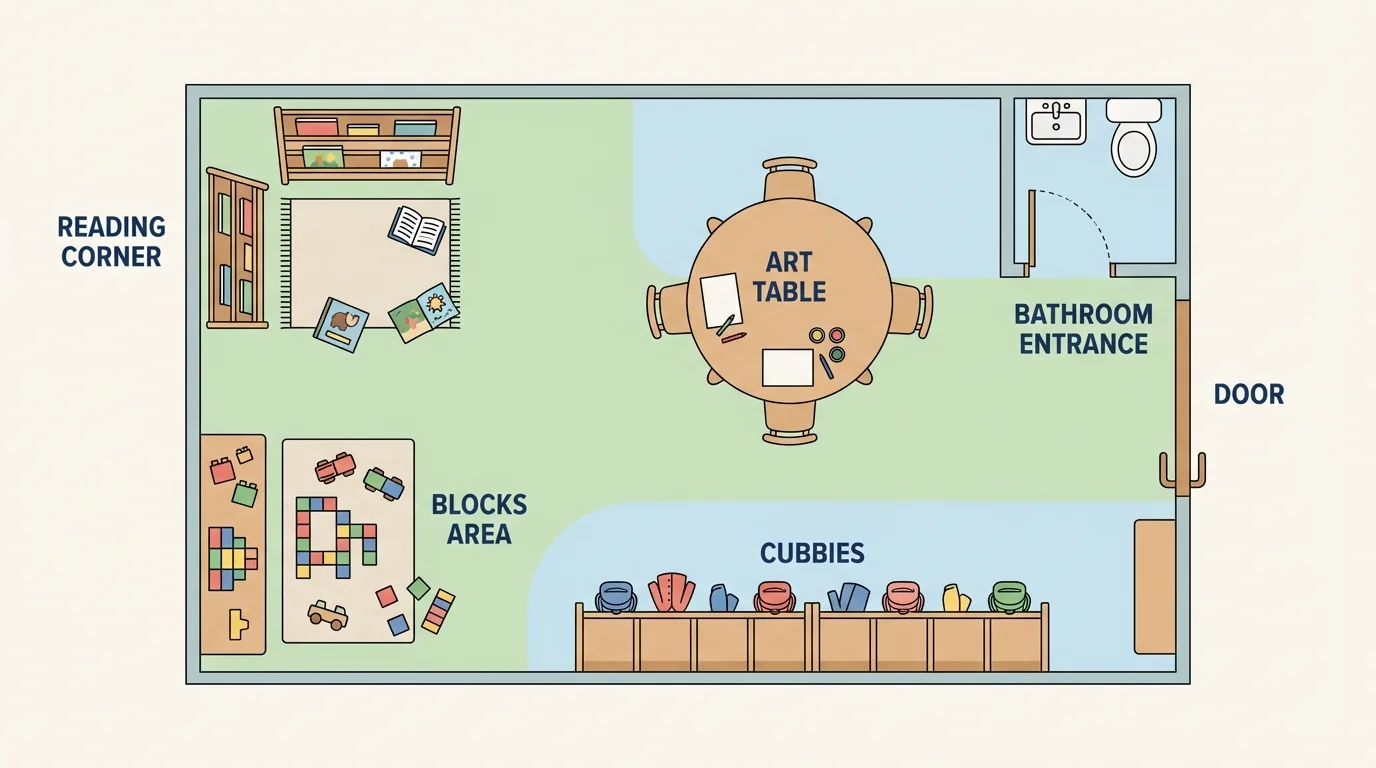
Some indoor places are quiet, and some are busy. A reading area may be calm and soft. A blocks area may be active and full of children building. We learn that one big place can have many smaller places inside it.
Environment means the places and things around us. It can include indoor places, outdoor places, people, plants, water, and land.
When we move from one room to another, we are moving through our environment. We can notice what stays the same and what changes. The classroom in [Figure 1] shows that each area has its own purpose, just like rooms in a house do.
Outside, we can find many familiar places too. A neighborhood may have a building, a road, a tree, a garden, and a small body of water such as a pond or creek. Some places are made by people, like buildings and roads. Some places are part of nature, like trees, water, and hills.
A building can be a school, a house, a store, or an apartment. Roads help cars, buses, bikes, and people move from place to place. Trees give shade and homes for birds. Gardens grow flowers, fruits, or vegetables. Water may be found in places such as a pond, stream, or lake.
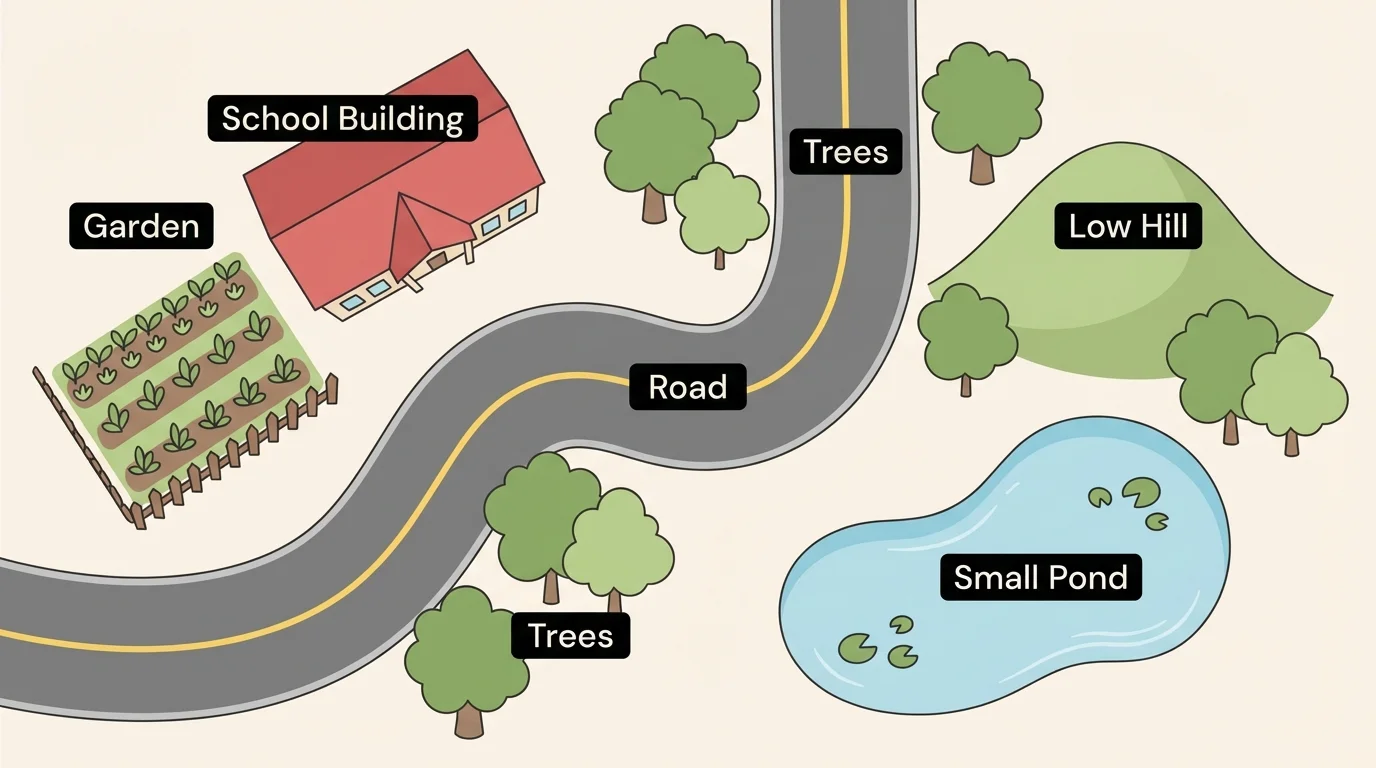
The land can look different in different places. Some land is flat. Some land is bumpy. A small hill is land that rises up. A valley is land that dips down between higher places. These are simple kinds of landforms. Children may notice a hill in a park or a sandy area near water.
Outdoor places are important for play, travel, growing food, and caring for nature. When we walk outside, we can notice what is near us and what is farther away. The outdoor scene in [Figure 2] helps us see how many different parts can belong to one place.
Some trees can be much older than any person in your family. A tree in your neighborhood may have been growing for many years before you were born.
Even small children can begin to observe the world like geographers do: by noticing places, features, and where things are found.
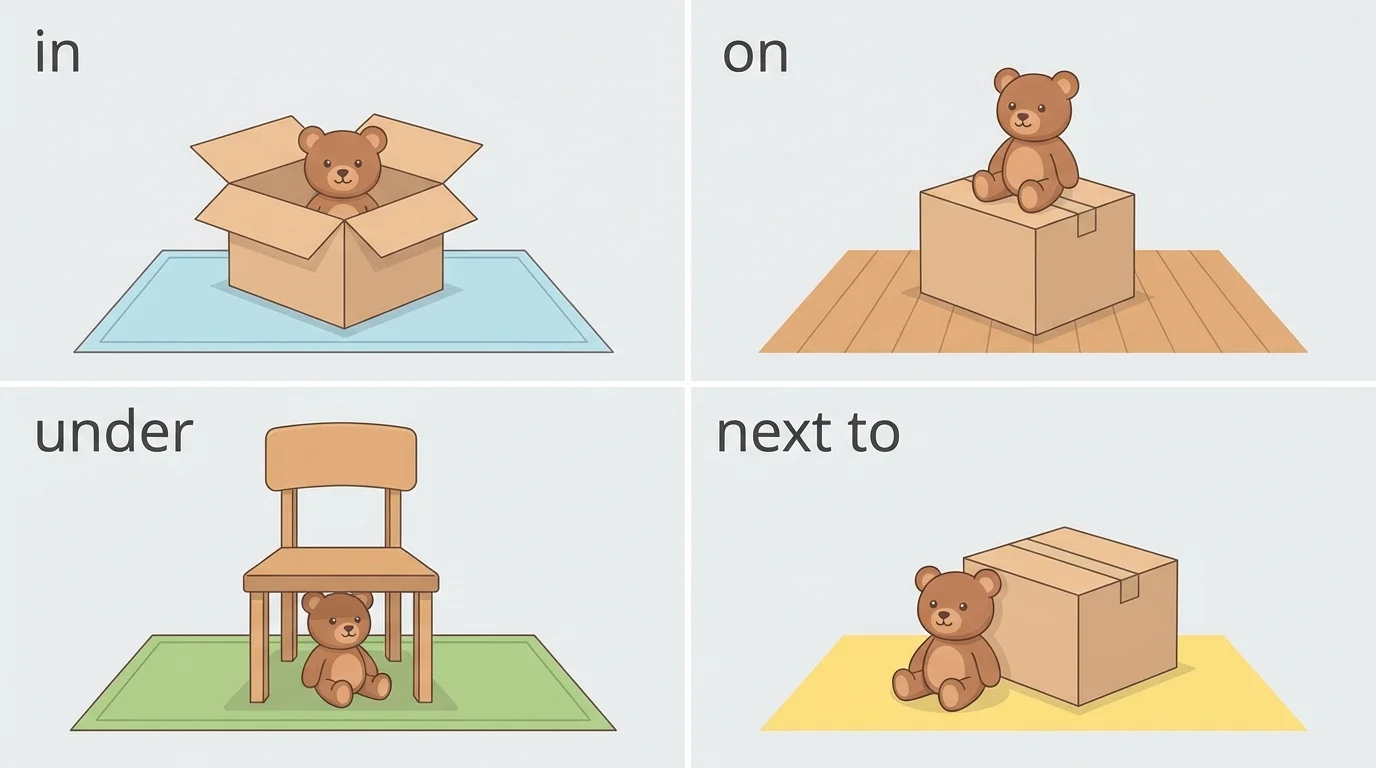
[Figure 3] We use spatial words to talk about location. These are words such as in, on, under, next to, behind, near, and far. These words help us describe where something is. We might say, "The book is on the table," or "The ball is under the chair."
We also use place words for our own movement. We can go into the room, out of the room, across the rug, or toward the door. These words help us follow directions and understand our surroundings.
Here are some simple examples. The cubby may be near the door. The slide may be outside the building. The garden may be beside the fence. A pond may be far from the classroom but near a group of trees. These words help us compare places.
| Word | What it tells us | Example |
|---|---|---|
| near | close | The tree is near the road. |
| far | not close | The hill is far from the house. |
| under | below | The toy is under the table. |
| next to | beside | The garden is next to the building. |
Table 1. Simple spatial words and examples for describing location.
When children describe the classroom or home, they are building an early understanding of place. The positions in [Figure 3] show that objects can be in different locations even when they are in the same room.
Places and positions work together. A place is a part of the environment, such as a room, road, garden, or pond. A position tells where something is in that place, such as on the shelf, near the tree, or under the table.
Knowing both the place and the position helps children talk clearly about the world around them.
People use places for different reasons. We sleep in bedrooms, cook in kitchens, read in libraries, learn in schools, drive on roads, and walk in parks. A garden may be used for growing food. A road may connect homes and schools. A building may be used for living, working, shopping, or learning.
Children also learn that the same place can be used in more than one way. A classroom can be a place to sing, build, paint, listen, and rest. A yard can be a place to play, watch birds, and feel the weather.
Real-world example
A child goes from the bedroom to the kitchen and then to preschool.
Step 1: The bedroom is a place for sleeping and keeping personal things.
Step 2: The kitchen is a place for eating or helping prepare food.
Step 3: Preschool is a place for learning, playing, and being with others.
This child moves through several familiar places in one day and learns that each place has a purpose.
Understanding how places are used helps children connect their own lives to the larger world.
We can care for the places around us. Inside, we put toys away, keep books on shelves, and help keep the room clean. Outside, we can stay on paths, be gentle with plants, and throw trash in a bin. Caring for a place shows that it matters.
We can also notice safety in our environment. Roads are for travel, so we stay with a trusted adult and watch carefully. Water is beautiful, but we stay safe near ponds, streams, or lakes. Buildings have doors and hallways that help us move safely inside.
We already know that places have names and uses. Now we add more detail by noticing where these places are and what natural and human-made features are around them.
When children talk about their classroom, room, house, yard, road, tree, or garden, they are learning to observe the world closely. This is an important beginning in geography because it helps them understand place, position, and connection.
