Have you ever played with other children and noticed that everyone wants to have fun at the same time? That works best when people know how to treat one another. In a family, a class, or a playgroup, each person matters. Groups work well when people are kind, safe, and fair.
A group is a collection of people who are together. Your family is a group. Your class is a group. Children playing in the block area are a group too. Groups help us learn, play, sing, build, and help each other.
When we are in a group, we are not alone. Other people are there with us. That means we share space, toys, time, and attention. Because we are together, we need simple rules so everyone can do well.
Rights are things every person should have in a group, like safety, kindness, and a chance to join in.
Responsibilities are things each person should do to help the group, like listening, sharing, and following rules.
Rules are agreed ways to act so the group can work well.
Even very young children can learn this big idea: every person is important. No one should be left out or treated badly. No one gets to do everything their own way all the time.
[Figure 1] In a group, each person has a right to be safe and treated kindly. In a classroom circle, children listen and wait for a turn. A child has a right to have space to sit, a chance to speak, and a chance to play. A child also has a right to be helped by an adult when something is wrong.
Rights help us remember that every person matters. If one child always grabs the toy, other children do not get their rights. If someone is pushed, that child is not safe. If one child is never allowed to talk during circle time, that child is not being heard.
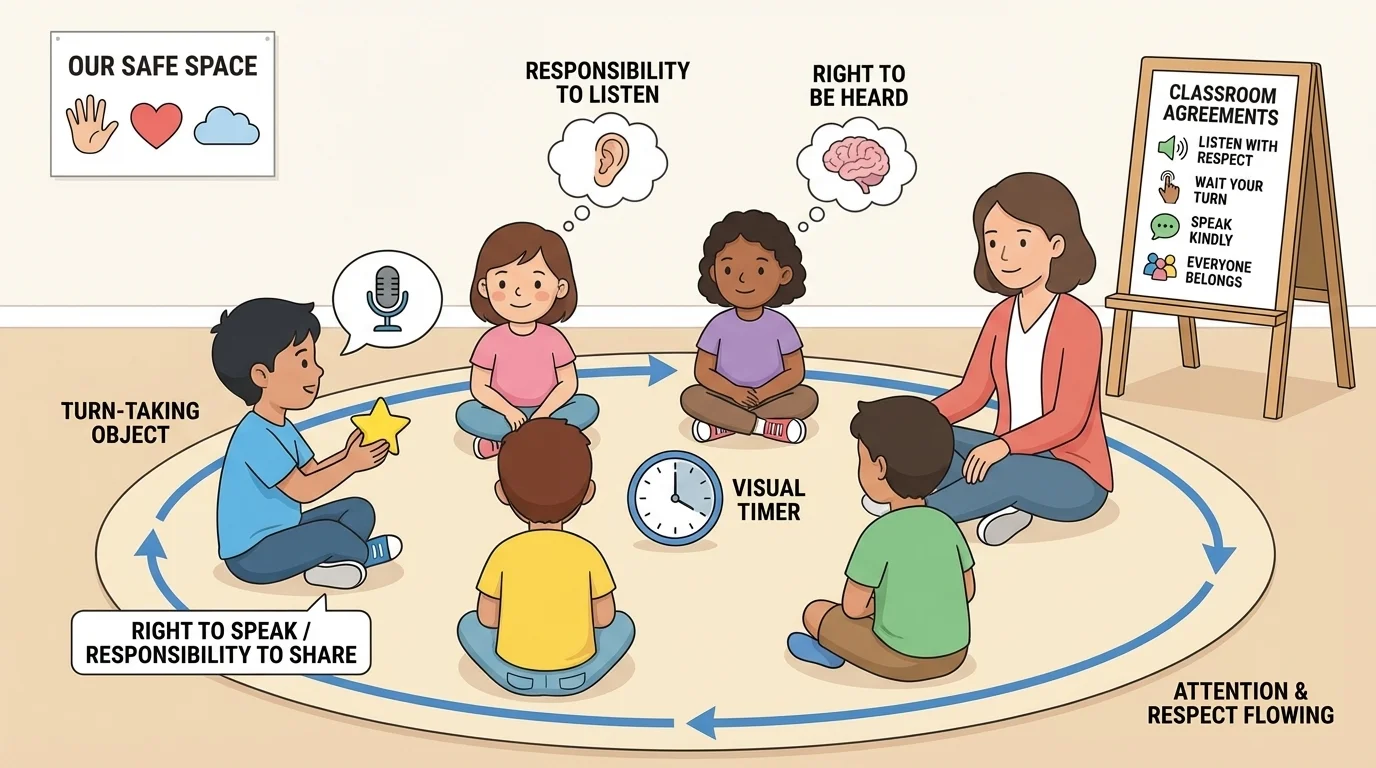
Some rights in a young child's group are very simple. You have the right to be safe. You have the right to be included. You have the right to be spoken to with kind words. You have the right to learn and play.
Very small rules can protect very big rights. A rule like "walking feet indoors" helps everyone stay safe.
When children understand rights, they begin to see fairness. Fair does not mean one child gets everything. Fair means each person is cared for and respected.
[Figure 2] Along with rights, each person has a responsibility. Responsibilities are the things we do to help the group work well. Children may share and clean up together. When children listen, use gentle hands, and put toys away, the whole group is helped.
A responsibility can be very small but still important. Waiting for a turn is a responsibility. Helping clean up is a responsibility. Using a quiet voice indoors can be a responsibility. Looking at the teacher when directions are given is a responsibility too.
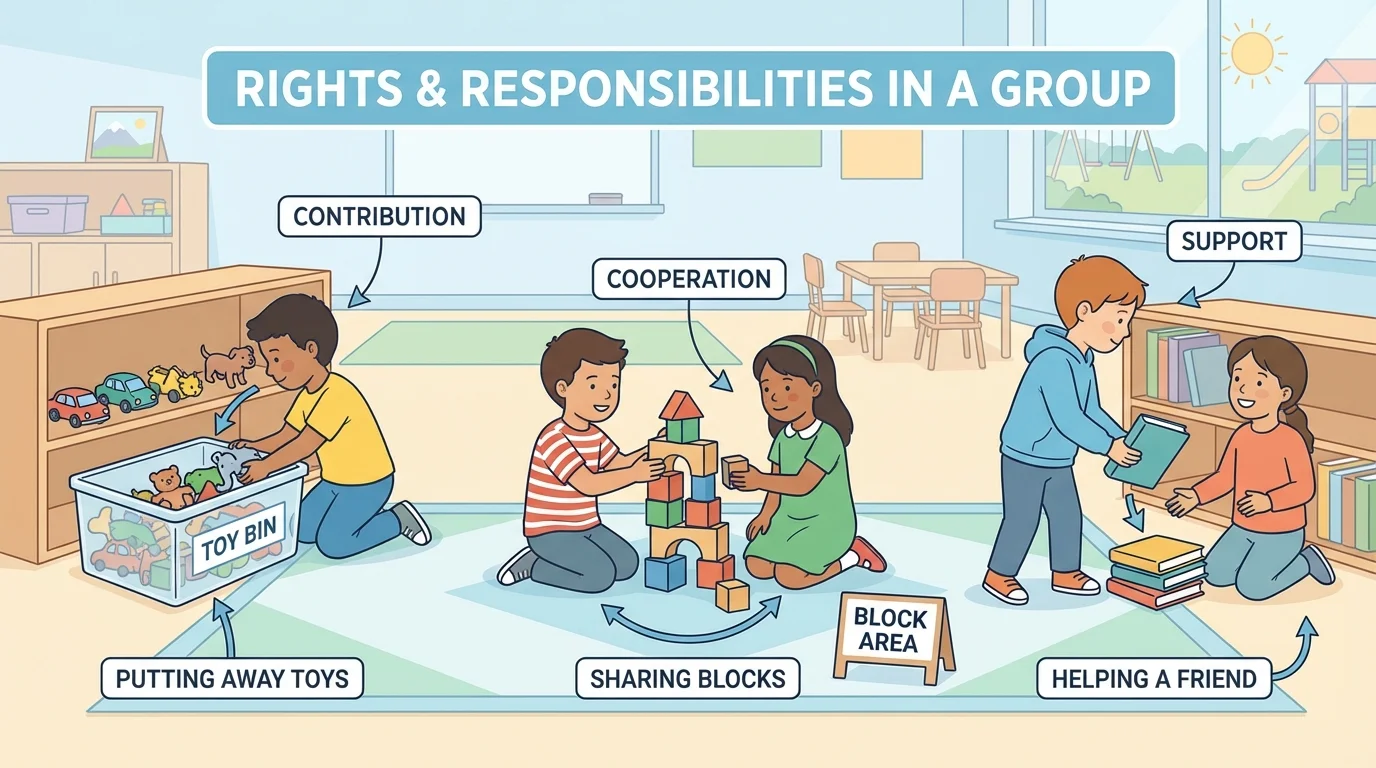
Responsibilities show that being in a group is not only about what we get. It is also about what we give. We give care, patience, listening, and help. When everyone does a little, the group becomes a happier place.
Rights and responsibilities work together. If everyone has the right to be safe, then everyone has the responsibility to keep hands gentle. If everyone has the right to have a turn, then everyone has the responsibility to wait and share. A healthy group needs both.
We can think of it this way: "I matter, and other people matter too." That idea helps children learn respect.
Rules are not just words adults say. Rules are helpful guides. They tell us what to do so the group can learn, play, and stay safe. A rule like "use kind words" helps protect everyone's feelings. A rule like "clean up before snack" helps keep the room neat and ready.
Without rules, groups can become confusing. Two children may want the same truck at the same time. Someone may run indoors and bump into a friend. Toys may stay on the floor and make people trip. Rules help stop these problems before they get bigger.
Rules also help children know what is expected. When children know the rules, they can make better choices. This makes the group calmer and more fair.
Simple classroom examples
Step 1: The rule is "raise your hand to talk."
This helps everyone get a turn to speak.
Step 2: The rule is "walking feet indoors."
This helps keep everyone safe.
Step 3: The rule is "put toys back."
This helps the room stay ready for the next children to play.
Each rule connects to a right and a responsibility.
The same idea shown in [Figure 1] appears during circle time: one child speaks, others listen, and everyone gets a chance. Rules help protect that fairness.
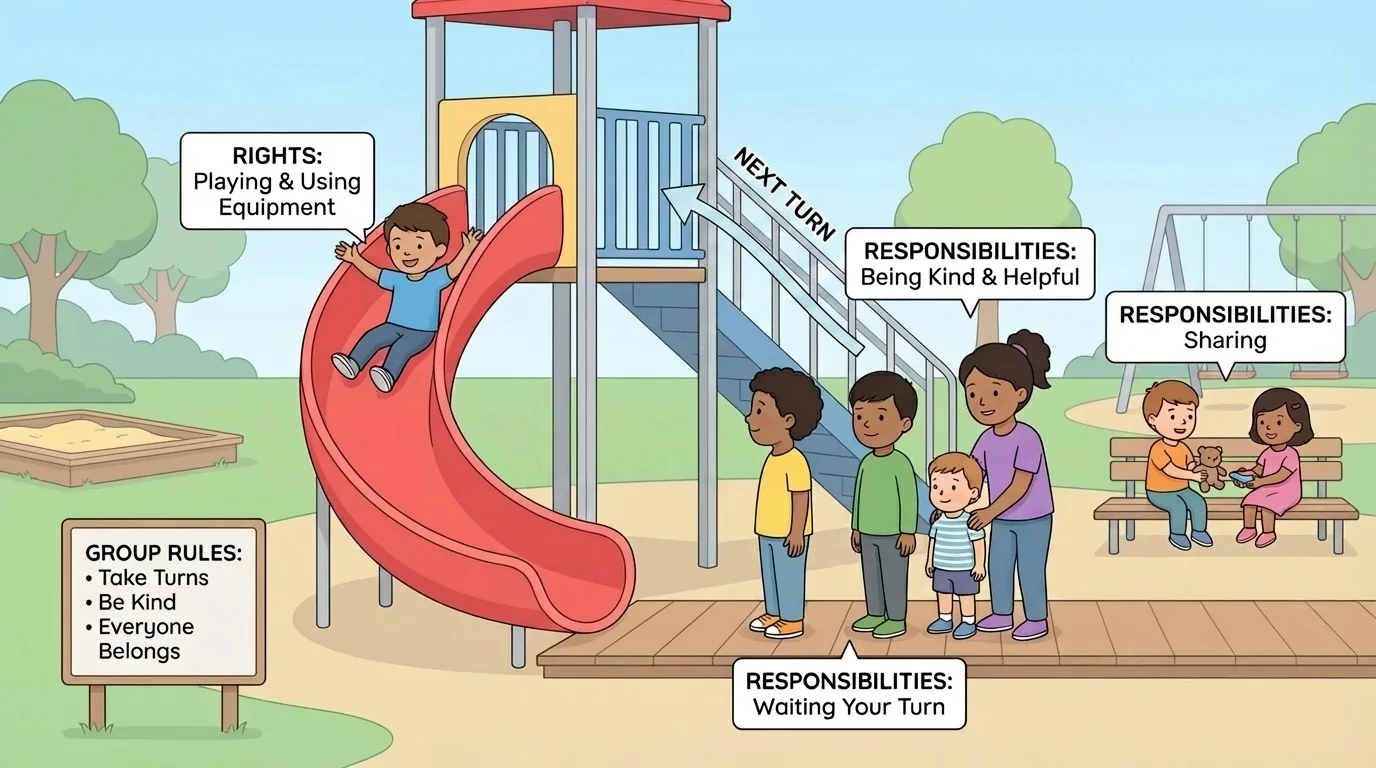
[Figure 3] Real life gives us many chances to practice these ideas. On the playground, children may want the slide at the same time. At snack time, children may need to wait for cups or napkins. In these moments, rules and kindness help the group. Children can take turns on playground equipment and show patience.
If one child goes down the slide, the next child waits. Waiting is a responsibility. Getting a turn is a right. If children push to get ahead, the group is not safe and not fair.
At snack time, everyone has a right to a place to sit and a chance to eat. Everyone also has a responsibility to use calm hands, wait, and help with cleanup. In the block area, everyone has a right to build and play. Everyone also has a responsibility to share space and use the blocks carefully.
| Place | Right | Responsibility |
|---|---|---|
| Circle time | Have a turn to speak | Listen when others speak |
| Playground | Play safely | Wait and take turns |
| Snack time | Have a place and food | Use calm hands and clean up |
| Block area | Build and explore | Share tools and put them away |
Table 1. Rights and responsibilities in common preschool group settings.
The sharing and helping in [Figure 2] also matter during cleanup and play. A group works best when children remember that everyone needs care, space, and respect.
Sometimes group life feels hard. A child may grab a toy. Someone may shout. Two children may both say, "Mine!" Problems happen because children are still learning. What matters is learning a better way.
One helpful way is simple: stop, listen, talk, and solve. First, stop your body. Next, listen to what happened. Then use words such as "My turn next, please" or "I was using that." If the problem does not get fixed, ask an adult for help.
You already know how to use kind words like "please," "thank you," and "my turn next." Those words are part of being responsible in a group.
Children do not have to solve every problem alone. Teachers and family members help groups stay safe and fair. Asking for help is not wrong. It is a smart way to protect everyone's rights.
The playground scene in [Figure 3] reminds us that taking turns is not only polite. It protects everyone's chance to join in.
"I matter, and you matter too."
When children learn this idea early, they build strong habits for school, friendships, and life. Groups become places where people can belong, learn, and feel safe.
