Have you ever seen shiny round coins in a pocket or crinkly bills in a wallet? Those small objects are very important. They are money. People use money every day to buy food, toys, books, and many other things. Learning to recognize money helps us understand how people pay for what they need and want.
Money is something people use to pay for things. If someone wants an apple, a loaf of bread, or a bus ride, money can help them get it. Money is not the same as a toy or a rock. Money has a special job: it helps people trade for goods and services.
Money is what people use to buy things. It can be coins or bills.
Some money is made of metal. Some money is made of paper. When we learn to recognize both kinds, we begin to understand how money works in everyday life.
A coin is a round piece of metal money. Coins can look different, as [Figure 1] shows. Some are bigger, some are smaller, and they may have different pictures on them. People can learn their names by looking carefully.
Common coins are the penny, nickel, dime, and quarter. A penny is worth 1¢. A nickel is worth 5¢. A dime is worth 10¢. A quarter is worth 25¢. These values can be compared as numbers: \(1 < 5 < 10 < 25\).
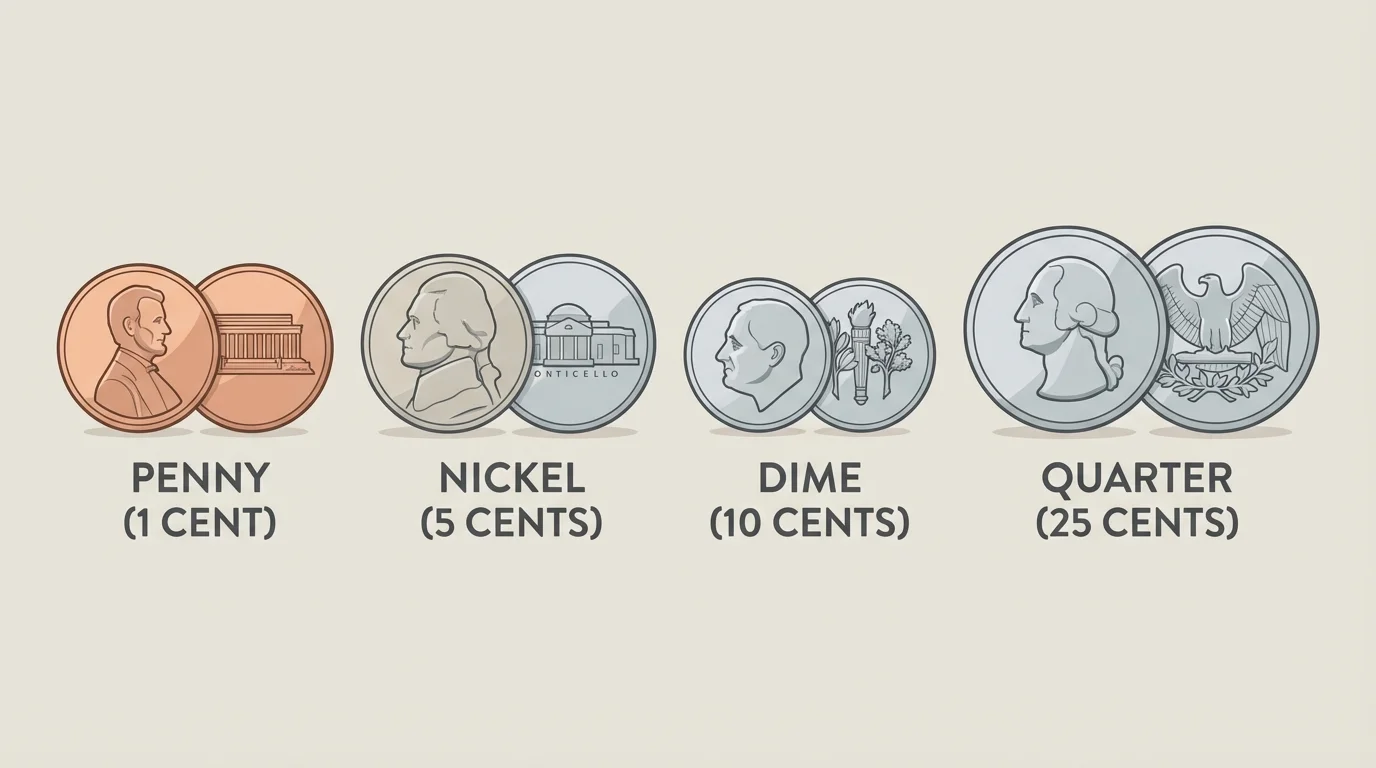
Coins do not all look the same. A penny often looks copper-colored. Nickels, dimes, and quarters often look silver-colored. A dime is small, and a quarter is larger. Looking at color, size, and pictures helps children tell coins apart.
Sometimes a coin with a smaller size can still be worth more. For example, a dime is smaller than a nickel, but its value is greater because \(10 > 5\). This is an important idea: the size of money does not always tell its value.
A dime is tiny, but it is worth more than a nickel. Money can surprise us because value and size are not always the same.
When we see a group of coins, we can say which one is which by naming them: penny, nickel, dime, and quarter. We can also remember the coin families again by looking back at [Figure 1], which displays their different appearances.
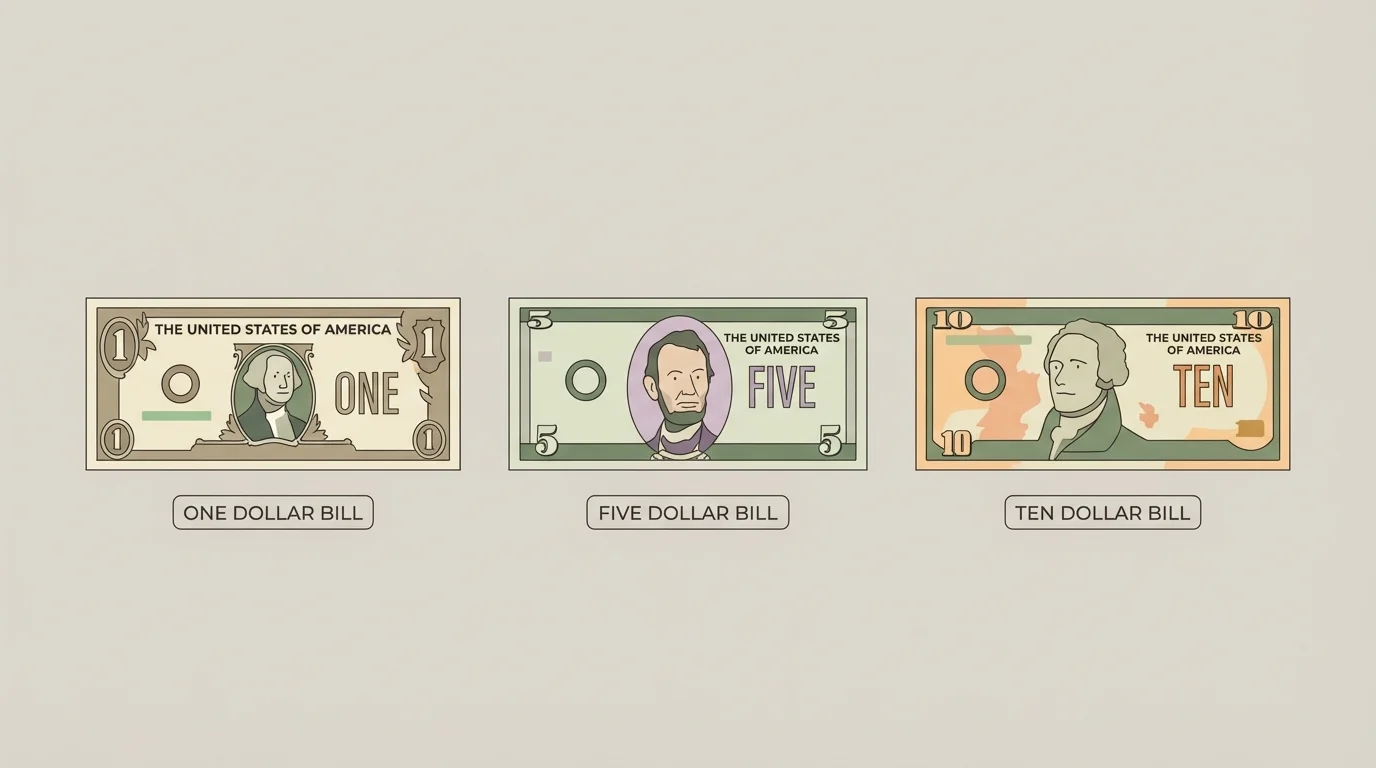
Currency includes paper money, often called a bill. Bills are flat and flexible, not round like coins. They have printed numbers and pictures on them.
[Figure 2] Some common bills are the $1 bill, $5 bill, and $10 bill. The number printed on the bill helps us know its value. A $5 bill is worth more than a $1 bill because \(5 > 1\). A $10 bill is worth more than a $5 bill because \(10 > 5\). Figure 2 shows how these bills can be recognized by their printed numbers.
Paper money is important because one bill can be worth as much as many coins together. For example, $1 is the same as 100¢. Children do not need to count all those coins yet to understand the big idea: bills can stand for larger amounts of money.
Coins and bills work together to help people pay. Sometimes a person uses coins, sometimes bills, and sometimes both at the same time.
When we look closely at paper money, we can find numbers, pictures, and special designs. These details help people recognize one bill from another. Later, when we compare bills again, [Figure 2] remains useful because it highlights the large printed numbers.
People use money to buy things they need and things they want. At a store, a person may use coins or bills to pay for milk, fruit, crayons, or a ball. Money can also be saved for later.
[Figure 3] When someone pays for an item, the money is exchanged for that item. This means money helps with trade. If a snack costs less than a bigger toy, people may choose what they can pay for. Money helps people make choices, and Figure 3 shows both spending and saving in a familiar way.
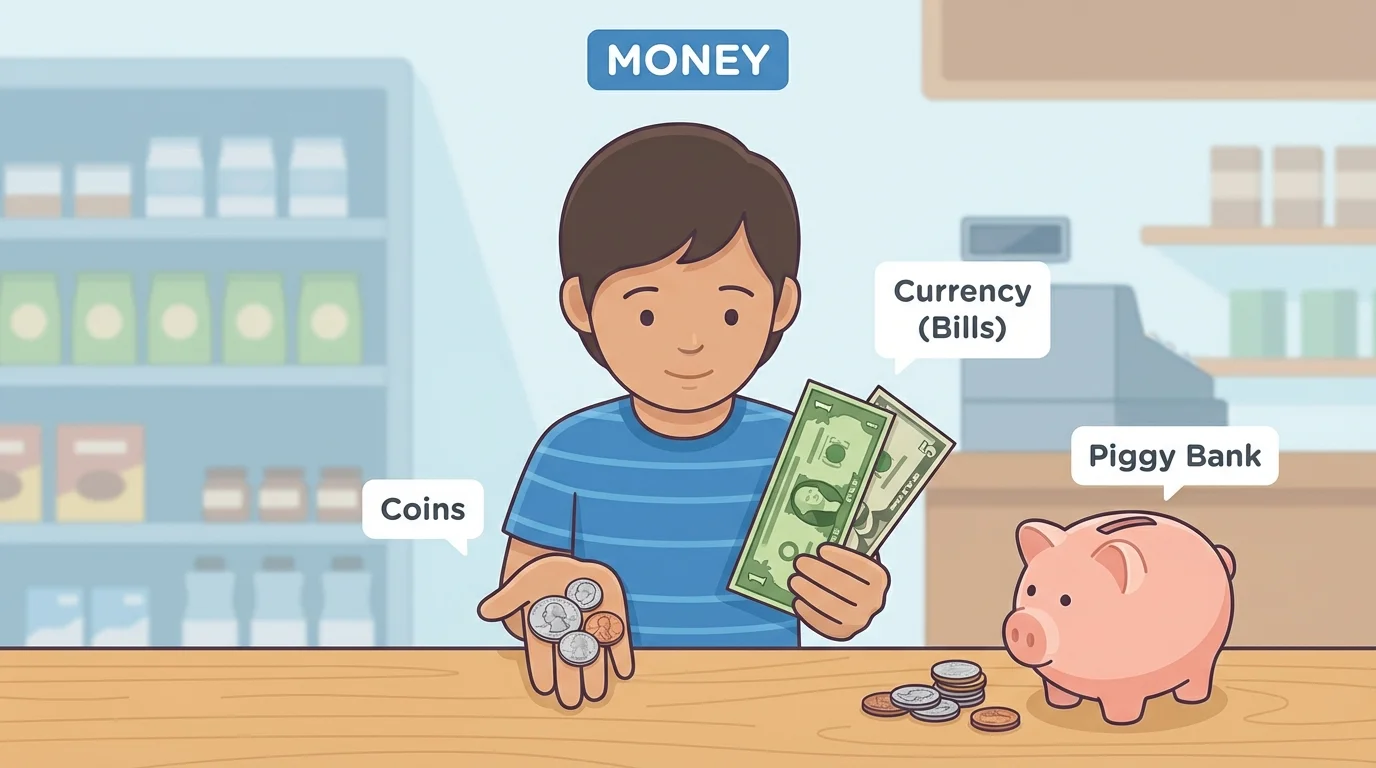
Saving money means keeping it for another time instead of spending it right away. A child might put coins into a piggy bank. An adult might keep bills in a wallet or in a bank. Spending and saving are both important uses of money.
Everyday money examples
Step 1: A child sees a penny and says, "This is money." That is correct because a penny is a coin.
Step 2: A child sees a $1 bill and says, "This is also money." That is correct because a bill is paper money.
Step 3: A child puts coins in a piggy bank. That is called saving money.
These examples show that money can be recognized, used, and saved.
When children notice how people pay at a store, they begin to understand the purpose of money. The store scene in [Figure 3] connects coins and bills to real life.
To recognize money well, we look carefully. We can notice shape, color, size, numbers, and pictures. Coins are round. Bills are flat and rectangular. Coins often feel hard and smooth. Bills often bend and fold.
A printed number helps tell us the value of a bill. A coin can be recognized by its look and name. Adults also teach children to treat money carefully and to notice real money only when a trusted grown-up shows it.
| Kind of money | What it looks like | Example |
|---|---|---|
| Coin | Round, metal | Penny |
| Coin | Round, metal | Quarter |
| Bill | Flat, paper | $1 bill |
| Bill | Flat, paper | $5 bill |
Table 1. Examples of coins and bills and how they look.
Recognizing money is a careful looking job. We compare one piece of money with another and learn what makes each one special.
Money should be kept in a safe place, such as a wallet, purse, drawer, or piggy bank. Coins can jingle in a pocket, but bills can tear if they are crumpled too much. Taking care of money helps it last longer.
Children should always use money with a trusted adult. Grown-ups can help children notice coins, point to the numbers on bills, and talk about what money is used for in daily life.
You already know that people exchange one thing for another. Money makes that exchange easier because many people agree that coins and bills can be used to pay.
As children grow, they will learn more about counting money. Right now, the big idea is to recognize coins and currency as money and to understand that money helps people buy and save.
