Suppose a roller coaster says you must be taller than a certain height to ride. That rule is not asking for one exact height. It allows many heights, as long as they are above the limit. Math has a powerful way to describe rules like that: inequalities. Inequalities help us describe values that are greater than or less than a number, and they are used everywhere from sports scores to weather reports to shopping budgets.
An equation tells us that two amounts are equal. For example, \(x = 5\) means the value of \(x\) is exactly \(5\). But a inequality compares two amounts that are not necessarily equal. It can tell us that one amount is greater than another or less than another.
[Figure 1] The two inequality forms we focus on here are:
\(x > c\)
and
\(x < c\)
In these inequalities, \(x\) is a variable and \(c\) is a number. The symbol \(>\) means greater than, and the symbol \(<\) means less than.
Greater than means a value is larger than another value. Less than means a value is smaller than another value. In an inequality like \(x > 7\), the variable can be any number larger than \(7\). In an inequality like \(x < 7\), the variable can be any number smaller than \(7\).
Notice something important: \(x > 7\) does not mean \(x\) is only \(8\). It could be \(8\), \(9\), \(10\), \(100\), or \(7.5\). There are many possible values. That is one big difference between equations and inequalities.
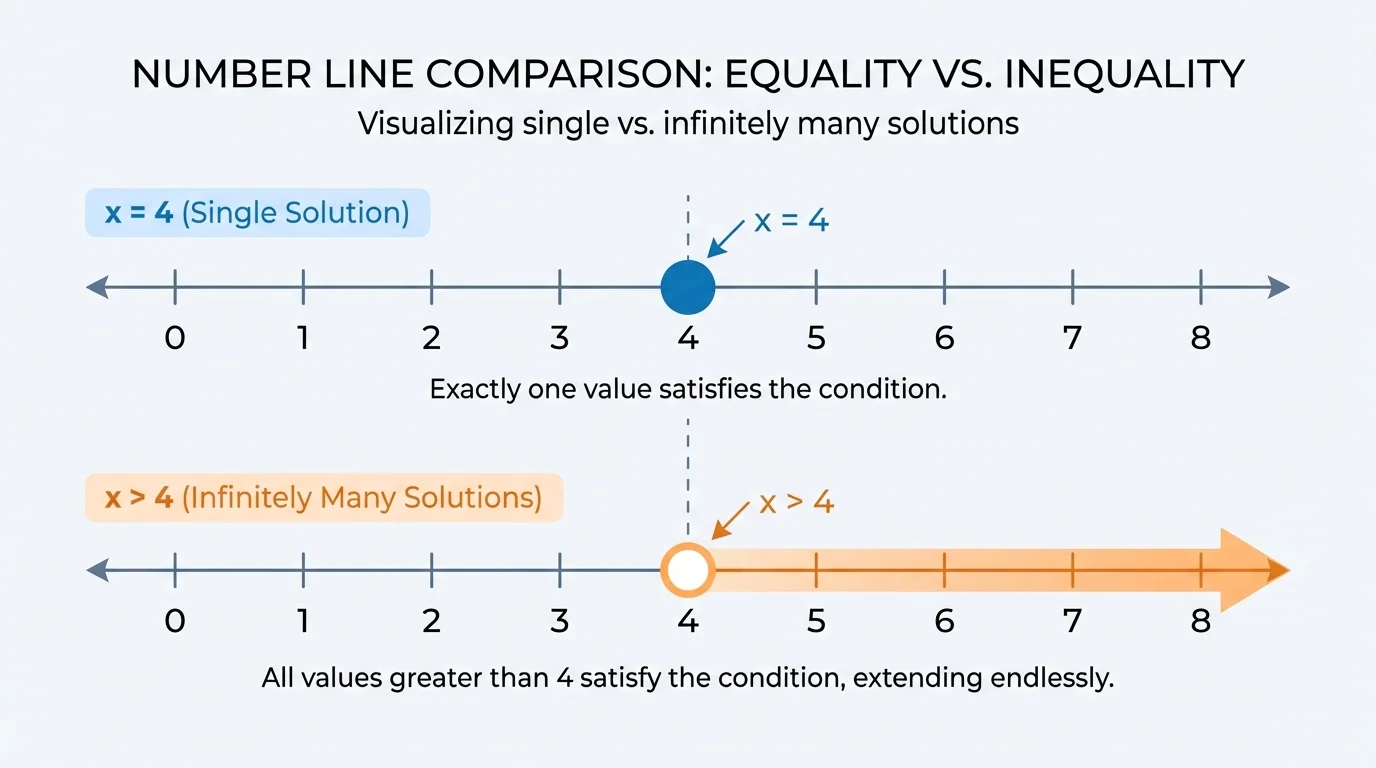
You can test a value to see whether it is a solution. A solution to an inequality is a number that makes the inequality true. For example, if the inequality is \(x > 3\), then \(5\) is a solution because \(5 > 3\) is true. But \(2\) is not a solution because \(2 > 3\) is false.
Many inequality problems begin with words. Your job is to turn the words into a math statement. The variable stands for the unknown amount, and the number stands for the boundary value.
Some common phrase matches are shown below.
| Words | Inequality |
|---|---|
| greater than \(6\) | \(x > 6\) |
| less than \(12\) | \(x < 12\) |
| more than \(20\) | \(x > 20\) |
| below \(0\) | \(x < 0\) |
| older than \(10\) | \(x > 10\) |
| shorter than \(150\) | \(x < 150\) |
Table 1. Common word phrases and their matching inequalities.
When you read a situation, ask yourself, "Is the variable supposed to be larger than the number or smaller than the number?" That question helps you choose the correct symbol.
Remember that a variable is a letter that stands for a number. In this lesson, \(x\) often represents the unknown value, but any letter can be used.
Here are some examples of turning words into inequalities:
If a score must be higher than \(50\), you can write \(x > 50\).
If the temperature is below \(32\), you can write \(x < 32\).
If a swimmer is younger than \(12\), you can write \(x < 12\).
These statements describe a condition or rule. They do not tell one exact answer. Instead, they describe a set of possible answers.
An inequality like \(x > 2\) has infinitely many solutions. That means the list of solutions never ends. We can name some of them, such as \(3\), \(4\), \(5\), and \(10\), but there are also decimals like \(2.1\), \(2.01\), and \(100.5\). There is always another number bigger than \(2\).
In the same way, \(x < 9\) also has infinitely many solutions. Some are \(8\), \(0\), \(-3\), and \(8.9\). There is no complete list you can finish, because you can always find another number less than \(9\).
Why there are infinitely many solutions
Between any two different numbers, there are more numbers. For example, between \(4\) and \(5\), there are numbers like \(4.1\), \(4.2\), \(4.25\), and many more. So if an inequality allows all numbers greater than or less than a certain number, the number of solutions goes on forever.
Checking solutions is a smart way to build confidence. For \(x > 6\), test \(9\): since \(9 > 6\), it works. Test \(6\): since \(6 > 6\) is false, it does not work. This tells us that in a strict inequality using \(>\) or \(<\), the boundary number itself is not included.
[Figure 2] A graph on the number line makes an inequality easy to see. On a number line, the boundary number is marked with an open circle when the inequality is strict, as in \(x > c\) or \(x < c\). The open circle means the endpoint is not included. Then you shade in the direction of all the solutions. You can also use this figure later when checking your graphs: open circle for "not included," left for less than, and right for greater than.
For \(x > 4\), place an open circle at \(4\). Then shade to the right, because numbers to the right are greater than \(4\).
For \(x < -1\), place an open circle at \(-1\). Then shade to the left, because numbers to the left are less than \(-1\).
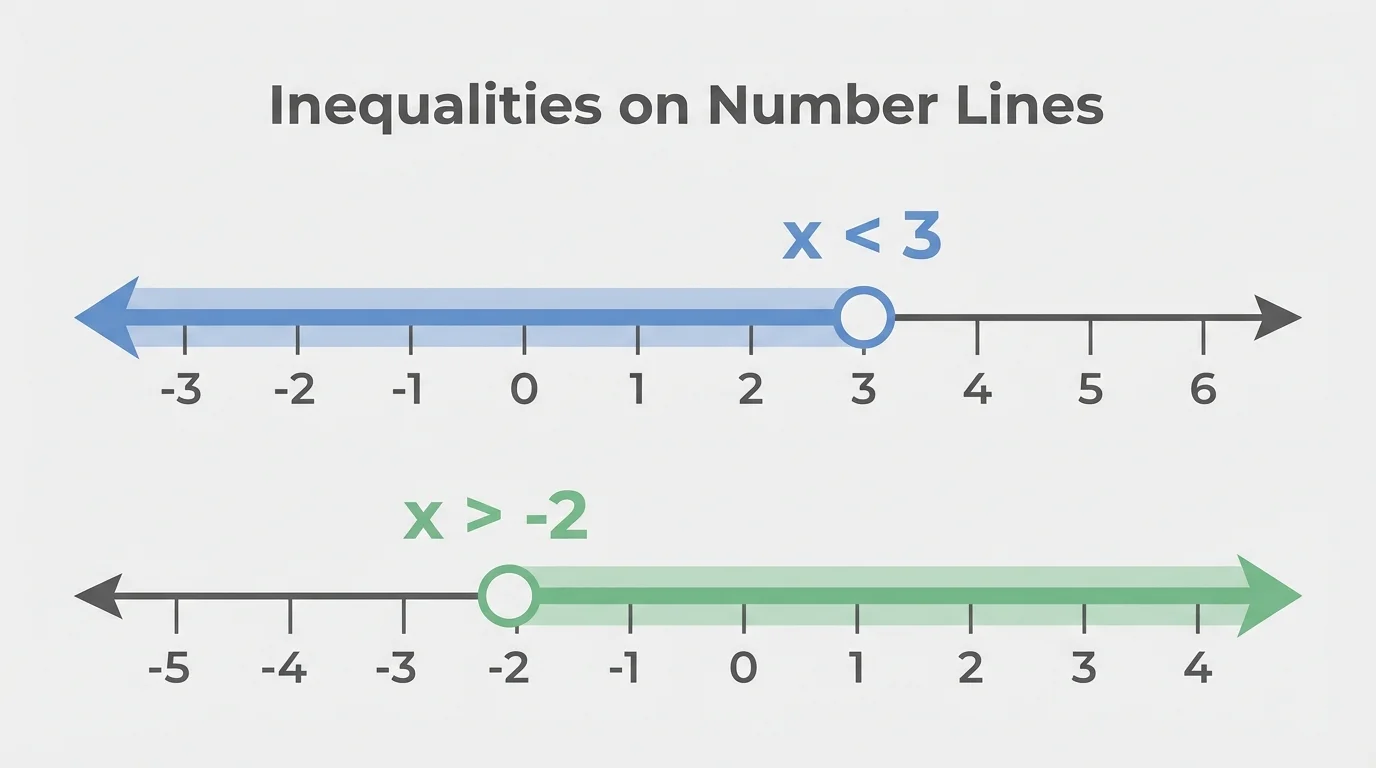
This picture matters because inequalities describe ranges of values, not just one point. A single point is enough for an equation like \(x = 4\), but a shaded line is needed for an inequality because many numbers work.
Be careful with direction. Right means greater. Left means less. If you remember how numbers are arranged on a number line, the graph makes sense immediately.
The number line can represent whole numbers, negative numbers, and decimals all at once. That is one reason it is so useful for inequalities with infinitely many solutions.
These ideas also help when checking your graphs: open circle for "not included," left for less than, and right for greater than.
The best way to learn inequalities is to connect words, symbols, and graphs. The following examples show each part clearly.
Worked example 1
Write an inequality for this statement: "A number is greater than \(11\)."
Step 1: Choose a variable.
Let the number be \(x\).
Step 2: Translate the words.
"Greater than \(11\)" means the number is larger than \(11\).
Step 3: Write the inequality.
\(x > 11\)
The inequality is \(x > 11\).
This example is simple, but it shows the basic idea: identify the variable and match the words to the correct symbol.
Worked example 2
A science club allows only students younger than \(13\) to join a special group. Let \(x\) be a student's age. Write an inequality.
Step 1: Identify what the variable represents.
\(x\) represents the student's age.
Step 2: Translate the phrase "younger than \(13\)."
"Younger than \(13\)" means less than \(13\).
Step 3: Write the inequality.
\(x < 13\)
The rule is \(x < 13\).
Notice that age \(13\) does not work here, because \(13 < 13\) is false.
Worked example 3
Graph the solutions of \(x > 2\) on a number line.
Step 1: Find the boundary number.
The boundary number is \(2\).
Step 2: Decide whether the endpoint is included.
Because the symbol is \(>\), the endpoint is not included, so use an open circle at \(2\).
Step 3: Decide which direction to shade.
Numbers greater than \(2\) are to the right, so shade to the right.
The graph has an open circle at \(2\) and shading to the right.
This is exactly the same pattern shown earlier in [Figure 2].
Worked example 4
Which of these numbers are solutions to \(x < 5\): \(7\), \(4\), \(5\), \(-2\)?
Step 1: Test \(7\).
\(7 < 5\) is false, so \(7\) is not a solution.
Step 2: Test \(4\).
\(4 < 5\) is true, so \(4\) is a solution.
Step 3: Test \(5\).
\(5 < 5\) is false, so \(5\) is not a solution.
Step 4: Test \(-2\).
\(-2 < 5\) is true, so \(-2\) is a solution.
The solutions from the list are \(4\) and \(-2\).
One common mistake is mixing up the symbols. If the words say "less than," the symbol must be \(<\), not \(>\). If the words say "greater than," the symbol must be \(>\).
Another mistake is using a closed circle instead of an open circle on the number line. For the inequalities in this lesson, \(x > c\) and \(x < c\), the boundary number is not included. That is why the circle is open, not filled.
A third mistake is shading the wrong direction. For \(x > 1\), shade right. For \(x < 1\), shade left. The diagram in [Figure 1] helps you compare one exact value with a whole set of values, and Figure [Figure 2] helps you remember the direction.
[Figure 3] Inequalities are useful because real life often involves cutoffs, limits, and rules. A person may need to be taller than a mark, younger than an age, or score more than a certain number. These are perfect situations for writing \(x > c\) or \(x < c\).
Here are several real-world situations:
If a basketball player needs more than \(15\) points to beat a personal record, write \(x > 15\), where \(x\) is the number of points.
If water freezes below \(32\) degrees Fahrenheit, write \(x < 32\), where \(x\) is the temperature.
If a contest is only for children under \(11\), write \(x < 11\), where \(x\) is age.
If a track runner wants a time faster than \(14\) seconds, then the time must be less than \(14\), so write \(x < 14\). Faster can mean a smaller time, which is a useful reminder that you must think about what the number means.
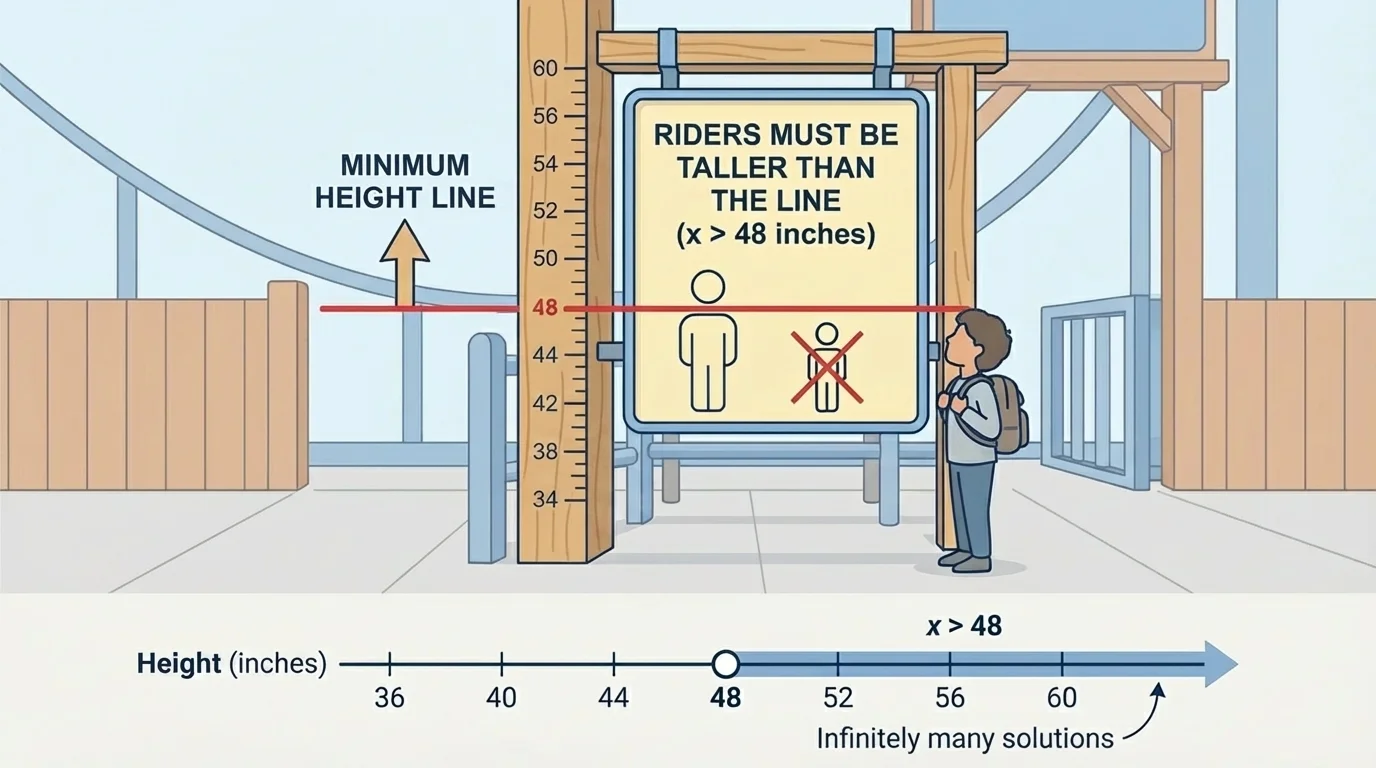
Real situations also show why there are infinitely many solutions. A ride height rule like "taller than \(120\) centimeters" does not just allow heights of \(121\), \(122\), and \(123\). It also allows heights like \(120.5\), \(136.2\), and many others. The possible heights continue without end.
Thinking carefully about the meaning
The same number can lead to different inequalities depending on the situation. "Score more than \(20\)" means \(x > 20\), but "finish in less than \(20\) seconds" means \(x < 20\). Always ask whether bigger or smaller numbers meet the condition.
That is why words matter. The symbol is chosen by the meaning of the situation, not by guessing.
When you see a rule or condition, first decide what the variable represents. Next, decide whether the value must be greater than a number or less than a number. Then write the inequality and, if needed, graph it with an open circle at the boundary and shading in the correct direction.
For example, if a plant grows only in temperatures below \(10\) degrees Celsius, let \(x\) be the temperature. The inequality is \(x < 10\). On a number line, use an open circle at \(10\) and shade left. If a game level requires more than \(200\) points, let \(x\) be the score. The inequality is \(x > 200\). On a number line, use an open circle at \(200\) and shade right.
These simple inequalities are powerful because they describe a whole set of possible values in a short mathematical statement.
