Have you ever heard someone talk one way with friends and a completely different way in front of a class or at a job interview? Skilled speakers do that on purpose. They do not change their ideas; they change how those ideas are expressed. A person who can adapt speech to different contexts and tasks has a powerful real-world skill. That skill matters in school, in leadership, in teamwork, and later in careers where people must explain ideas clearly and professionally.
Speaking is not just about saying words out loud. It is about making choices. You choose what details to include, what tone to use, how formal to sound, and how to organize your ideas. When those choices fit the audience and purpose, your message becomes easier to understand and more convincing.
A context is the situation in which communication happens. A classroom presentation, a debate, a conversation with a friend, and a speech to community leaders are all different contexts. A task is the specific job your speaking must do. You might need to inform, explain, persuade, welcome, thank, or present a claim.
The way you speak should match both the context and the task. If you are explaining a science project to your class, you may need clear steps and accurate vocabulary. If you are thanking volunteers at a community event, your speech may be warmer and more appreciative. If you are presenting a claim about school lunch options, you need reasons, evidence, and a confident tone.
Audience also matters. Audience means the people listening. Their age, background knowledge, interests, and expectations affect your speaking choices. A group of eighth graders may understand examples from school life quickly. Adults at a school board meeting may expect more formal wording and a more complete explanation.
Formal English is language that follows standard grammar, avoids slang, and fits serious or professional situations.
Informal English is more casual language often used with friends, family, or relaxed situations.
Purpose is the reason for speaking, such as to inform, entertain, explain, or persuade.
One of the biggest mistakes speakers make is assuming that one style works everywhere. It does not. A style that sounds natural during lunch with friends may sound disrespectful or unprepared during a formal presentation. On the other hand, a style that is too stiff for a friendly conversation may sound unnatural and distant.
The same message can sound very different depending on setting and audience, as [Figure 1] shows. Formal and informal English are not about one being always better than the other. They are about choosing the style that fits the moment.
Informal English often includes contractions, everyday expressions, shortened phrasing, or slang. Formal English uses complete thoughts, careful grammar, and more precise vocabulary. For example, in a casual conversation, a student might say, "Yeah, our idea kind of worked, but we had to fix some stuff." In a formal presentation, the same student might say, "Our original design worked partially, but we made several improvements after testing it."
Notice what changed. The second version is more exact. It replaces vague words like "stuff" with clearer terms such as "improvements." It also sounds more polished and respectful for an academic setting.
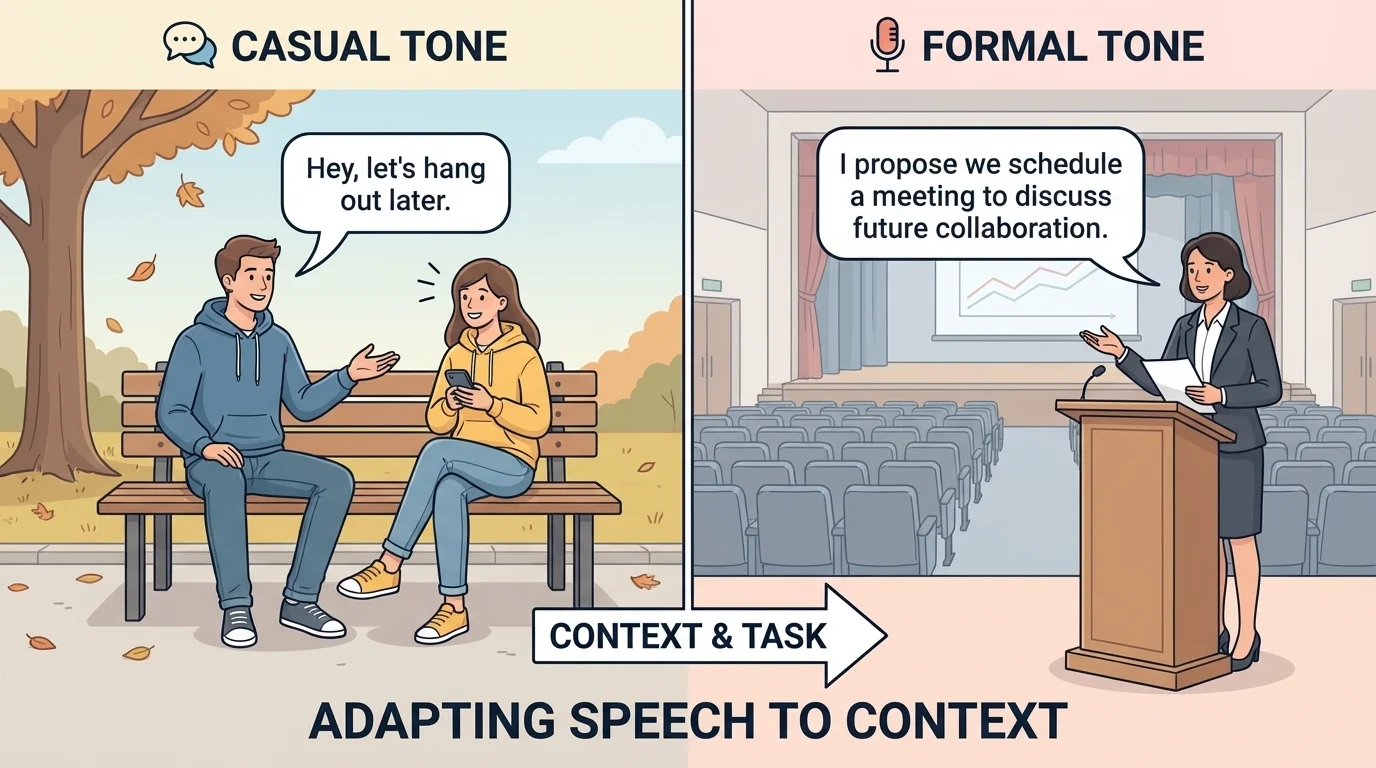
Formal English is often appropriate in presentations, speeches, interviews, ceremonies, and discussions with unfamiliar adults. Informal English is often appropriate in personal conversations, friendly group work, and relaxed settings where a casual tone fits. Many situations fall in between, so good speakers pay attention and adjust.
This does not mean formal English must sound robotic. Strong formal speaking still sounds natural. It simply avoids language that is too casual, overly vague, or disrespectful. Later, when you organize a presentation and choose evidence, the distinction we saw in [Figure 1] becomes even more important, because strong ideas can be weakened by a style that does not match the occasion.
When speakers think about audience, they ask questions such as: What does my audience already know? What do they need explained? What examples will matter to them? What tone will they expect?
Suppose you are speaking about reducing plastic waste. If your audience is your classmates, you might mention cafeteria utensils, water bottles, and school recycling bins. If your audience is a neighborhood association, you might discuss local parks, community cleanup events, and the cost of waste disposal. The topic is similar, but the examples and emphasis change.
Audience awareness also affects the amount of explanation you provide. Speaking to younger students may require simpler vocabulary and shorter sentences. Speaking to adults may require more detail and a more formal tone. In both cases, the goal is clarity, not showing off. Good speakers do not try to sound impressive by making ideas hard to understand. They make their ideas accessible.
Professional speakers often spend as much time studying their audience as they spend writing their message. Knowing who is listening helps them choose the right examples, tone, and level of detail.
Respect is part of adapting speech. Respectful speakers avoid talking down to listeners, but they also avoid assuming that listeners know everything already. They explain enough, define important terms when needed, and speak in a way that invites attention rather than pushes people away.
Your purpose shapes the structure and style of your speech. If your goal is to inform, you focus on accuracy, order, and clear details. If your goal is to persuade, you present a claim, support it with reasons and evidence, and address what listeners may wonder or doubt.
A claim is a statement you want your audience to accept as true or reasonable. In a school presentation, a claim might be, "Our school should add more shaded outdoor seating." That claim needs support. You could explain the problem, give evidence about hot weather, describe benefits, and answer possible concerns about cost or space.
Different tasks also call for different levels of energy and emotion. A ceremonial speech, such as introducing an award winner, may sound warm and celebratory. A report about a historical event may sound more neutral and informative. A persuasive speech may sound more urgent, but still controlled and respectful.
If your speaking task includes listening and responding, such as in a discussion or panel, adaptation matters even more. You must listen carefully, build on others' ideas, and answer in a tone that fits the conversation. Effective oral communication includes both speaking and listening.
An organized presentation helps listeners follow your ideas from beginning to end, and [Figure 2] illustrates how each part connects. Even strong ideas can be confusing if they are presented out of order.
Most organized presentations include an introduction, a clear main point or claim, supporting details, and a conclusion. The introduction gets attention and introduces the topic. The body develops the main ideas. The conclusion leaves the audience with the strongest final impression.
Transitions are especially important. A transition is a word or phrase that connects ideas. Words such as "first," "for example," "in addition," "however," and "as a result" help listeners track the flow of the speech. Because listeners cannot reread spoken words the way readers can reread a page, spoken organization must be very clear.
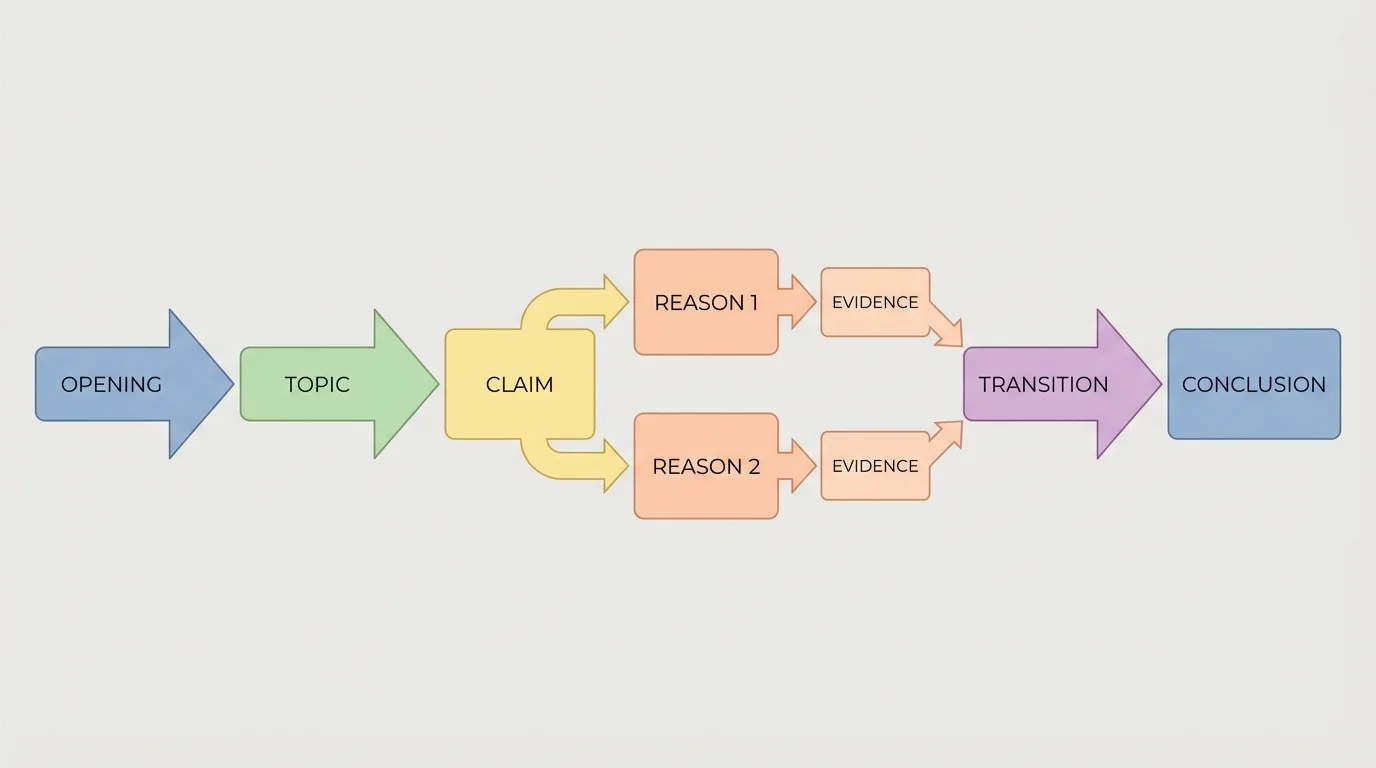
For presentations that include claims, the order matters a great deal. One useful pattern is: state the claim, explain reason one, support it with details, move to reason two, support it, and then conclude. This structure helps the audience understand not only what you believe, but why you believe it.
Consider a presentation about later school start times. A strong beginning might briefly state the topic and claim. The body might present research on sleep, then explain effects on attention and learning, then discuss transportation concerns. The conclusion might restate the claim in a confident, concise way. The sequence shown in [Figure 2] works because each point builds logically on the one before it.
Example: reshaping a message for a formal class presentation
Core idea: the school should create a quiet study area in the library.
Step 1: Start with a clear opening.
"Many students need a dependable place to focus before and after school."
Step 2: State the claim directly.
"Our school should create a designated quiet study area in the library."
Step 3: Add reasons and details.
"First, it would help students complete assignments without distractions. Second, it would support students who do not have a quiet workspace at home."
Step 4: End with a purposeful conclusion.
"A quiet study area would be a practical change that supports student learning every day."
This version is organized, direct, and suited to a formal academic audience.
Good organization also means choosing only the most useful details. Too many unrelated details can bury your point. Each detail should support your purpose instead of distracting from it.
How you say something can affect your audience as much as what you say, and [Figure 3] shows several delivery choices that influence how listeners respond. Delivery includes volume, pace, pronunciation, expression, posture, and eye contact.
Tone is the feeling or attitude your speech communicates. Tone can be serious, enthusiastic, respectful, calm, urgent, or reflective. A mismatch between tone and purpose can confuse listeners. For instance, a joking tone during a serious announcement may seem careless. A flat tone during an exciting presentation may make strong ideas sound weak.
Pace means how quickly or slowly you speak. Speaking too fast can make you hard to follow. Speaking too slowly can make the speech feel awkward. Effective speakers vary pace: they may slow down for a key point, pause before an important detail, and speed up slightly through less important information.

Volume matters too. You should be loud enough for everyone to hear without shouting. Clear pronunciation helps your audience focus on the message rather than struggle to understand words. Eye contact and posture also signal confidence and attention. Looking occasionally at notes is fine, but reading every word from a page often weakens connection with listeners.
Delivery choices support meaning. If you are emphasizing a claim, your voice may become firmer. If you are sharing a thoughtful reflection, your tone may soften. The balanced posture and eye contact shown in [Figure 3] help a speaker appear prepared and trustworthy.
Word choice matters because words create tone, precision, and credibility. A speaker who says, "The results were good," gives the audience only a vague idea. A speaker who says, "The results improved by the final test, especially in accuracy and speed," gives clearer information.
When formal English is appropriate, avoid slang, overused filler phrases, and expressions that may sound careless. Filler words include "like," "um," "you know," and "basically" when they are repeated too often. Almost everyone uses them sometimes, but too many fillers can make a speaker seem less prepared.
Precise language is especially important when presenting evidence or explaining a process. In a history presentation, saying "The policy increased tensions between groups" is stronger than saying "It made things bad." In science, saying "The temperature changed the rate of the reaction" is clearer than saying "The heat did stuff." The goal is not to sound fancy. The goal is to sound accurate.
Adaptation is not pretending. Adapting speech does not mean becoming a different person. It means choosing the version of your language that best helps your audience understand you. A respectful, formal style in one setting and a relaxed, friendly style in another are both honest forms of communication when they fit the situation.
Another part of careful language is inclusiveness. Good speakers avoid insulting language, harmful stereotypes, and dismissive comments. They choose words that welcome listeners into the conversation.
Students already move through many speaking contexts. In a small group, you may sound collaborative and flexible. In a class presentation, you need stronger organization and more formal wording. In a debate, you must respond directly to opposing ideas while staying respectful. In an interview, you should sound confident, clear, and professional.
The following table shows how speech choices shift across common situations.
| Situation | Audience | Appropriate Style | Main Goal |
|---|---|---|---|
| Talking with a friend | Peer who knows you well | Informal, relaxed, natural | Share thoughts quickly and comfortably |
| Class presentation | Classmates and teacher | Clear, organized, mostly formal | Explain or support ideas |
| Student council speech | Students and staff | Formal, confident, persuasive | Gain support for a claim |
| Interview | Adult evaluator | Formal, respectful, polished | Present yourself well |
| Community announcement | Mixed-age public audience | Formal, clear, accessible | Inform a broad audience |
Table 1. Comparison of speaking choices across different situations and audiences.
Notice that no single style fits every row. That is the heart of adaptation. Effective speakers study the situation, then choose the language and delivery that fit.
One useful skill is taking the same basic message and rewriting it for a different audience or task. Suppose your core message is that students need more time for lunch.
To friends, you might say, "Lunch is too rushed, and barely anyone has time to eat and relax." To the principal, a stronger formal version might be, "A slightly longer lunch period would give students enough time to eat and return to class more focused." The message is similar, but the tone, structure, and phrasing shift.
This kind of revision also affects organization. In a casual setting, you may speak more freely and less formally. In a presentation, you need a clear claim, reasons, and transitions. The structure from [Figure 2] helps when transforming an opinion into a well-organized speech.
Example: one topic, three contexts
Topic: asking for support for a school garden.
Context 1: Informal conversation with classmates
"We should totally help with the school garden. It would make the space look better, and we could grow food or flowers."
Context 2: Formal presentation to a teacher
"Our class would like to support a school garden project because it would improve the campus and create hands-on learning opportunities."
Context 3: Persuasive speech to community partners
"A school garden would benefit students academically and socially, and community support could help make the project sustainable."
Each version fits a different audience and purpose.
As speakers grow more experienced, this adjustment becomes faster and more natural. They begin to notice what each situation requires before they even start speaking.
Some speaking mistakes appear again and again. One is using language that is too casual for a formal setting. Another is organizing ideas poorly so the audience cannot follow the point. A third is ignoring the audience and giving examples that mean little to the listeners.
Other common problems include speaking too softly, reading every word from notes, rushing through important points, and using too many filler words. Some speakers also try to sound "formal" by using overly complicated words. That can backfire if the language sounds forced or confusing. Clear and respectful is better than stiff and unnatural.
The contrast between casual and formal language we saw in [Figure 1] can help you notice when your style does not match the setting. The delivery choices shown in [Figure 3] also remind us that confidence comes from clear habits, not from speaking in the most dramatic way possible.
Flexible speakers pay attention. They listen to strong speakers, notice how language changes across situations, and reflect on what worked. They prepare their ideas, but they also stay aware of audience reactions. If listeners look confused, a flexible speaker explains more clearly. If the mood is serious, the speaker adjusts tone. If the setting is formal, the speaker chooses more polished language.
Being able to adapt speech is part of leadership. It helps you present claims effectively, participate in discussions thoughtfully, and communicate with respect in many settings. Whether you are speaking to one person or to a room full of people, the goal stays the same: make your message clear, appropriate, and meaningful for the people who hear it.
