[Figure 1] Have you ever felt a drum thump in your hands or seen a guitar string wiggle? That wiggle is a big science clue. Scientists ask questions, make plans, and gather evidence to learn how the world works. When we study sound, we learn something amazing: things that vibrate can make sound, and sound can make other things vibrate too.
A science investigation begins with a question. A good question is something we can test by watching, listening, and comparing. For sound, we might ask: What happens when a rubber band is plucked? or Can a loud sound move tiny pieces of rice? A question helps us know what to look for.
In science, we do not just guess. We look for evidence. Evidence is what we notice and record. If a ruler shakes and makes a humming sound, that is evidence. If rice jumps on plastic wrap when someone hums nearby, that is evidence too.
Investigation is a careful way to answer a question. Evidence is what we observe that helps answer the question. Sound is something we hear when materials vibrate. Vibration is a rapid back-and-forth motion.
When students work together, each person can help. One student may tap, one may watch closely, one may listen, and one may record what happened. Working as a team helps everyone notice more.
Before we start, we make a plan. A good plan tells what materials we need, what we will do, and what we will look for. In a fair test, we try to change one thing at a time. For example, we might change how tight a rubber band is, but keep the same box, the same person plucking, and the same place in the room.
This is called keeping the test fair. If we change too many things, it is hard to know what caused the result. Scientists also plan how to stay safe, such as using gentle sounds and handling materials carefully.
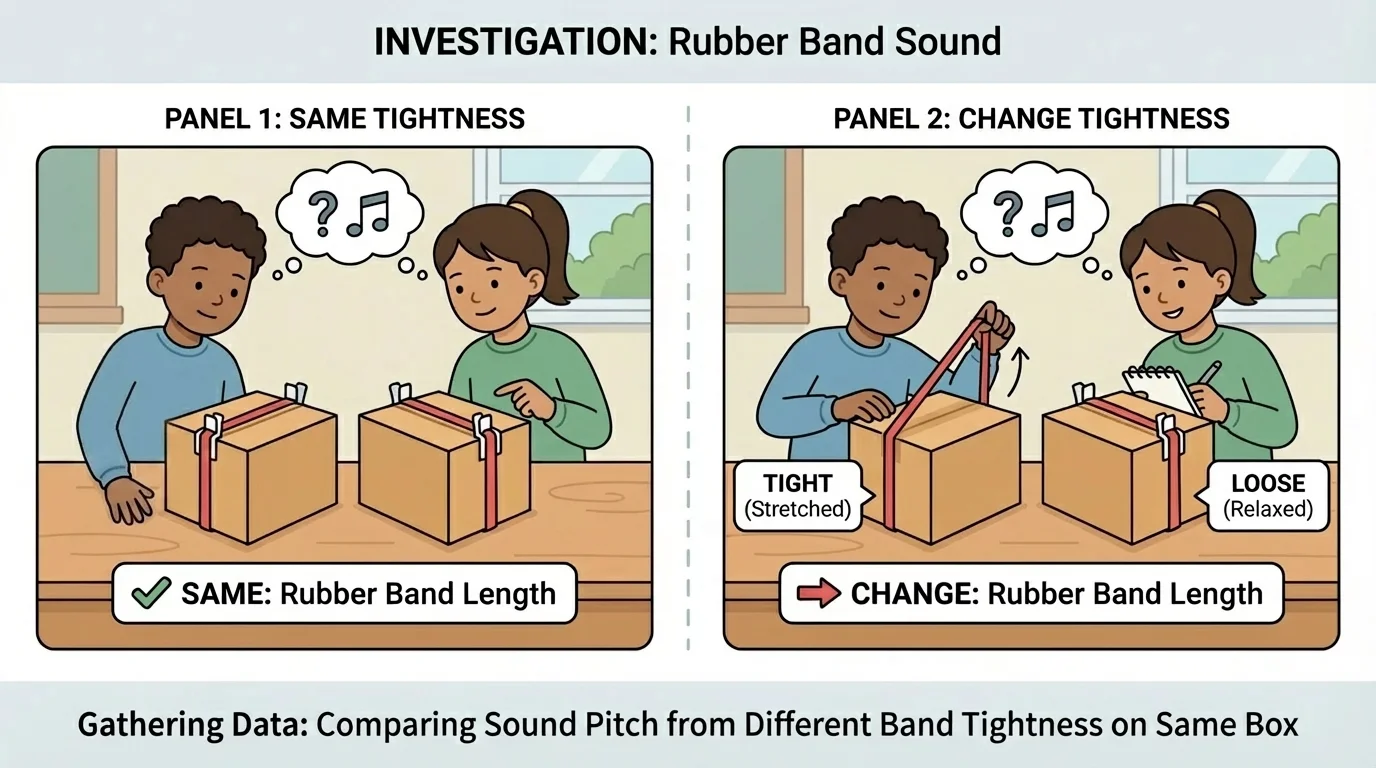
We also decide how to share jobs. One person can be the observer, watching for movement. Another can be the listener. Another can place a check mark on a chart. Collaborative work means helping one another and taking turns.
You already know that we can learn by using our senses. In science, we use seeing, hearing, and sometimes touch to notice what happens during a test.
Sometimes we collect data with words such as loud, soft, moved, or did not move. Sometimes we count. No math is needed to understand the idea, but we can still compare results, such as hearing sound on all tries or seeing movement on only some tries.
During an investigation, we make observations. An observation is something we notice. We may hear a sound, see a material shake, or feel a tiny buzz with our fingers. These details help us answer our question.
We can record our data in a simple table.
| Test item | Did it vibrate? | Did we hear sound? |
|---|---|---|
| Rubber band | Yes | Yes |
| Ruler | Yes | Yes |
| Plastic wrap with rice nearby | Yes | Rice moved |
Table 1. A simple data table showing what students may record during sound investigations.
Data can be pictures, words, check marks, or counts. The important part is that data come from what really happened, not from what we hoped would happen.
Some sounds are so strong that you can feel them in your body. At a concert or near a large drum, your chest may feel the beat because the air is vibrating.
When we repeat a test, we make our evidence stronger. If the ruler hums each time we flick it, we can be more confident about our answer.
A simple test with a ruler helps us see that vibrating materials make sound. In this investigation, a ruler hangs over the edge of a desk. One part stays on the desk, and the other part sticks out over the edge.
We gently press the ruler down and let it go. The end moves back and forth very fast. We hear a sound, and we can also see the ruler shaking. That shaking is the vibration.
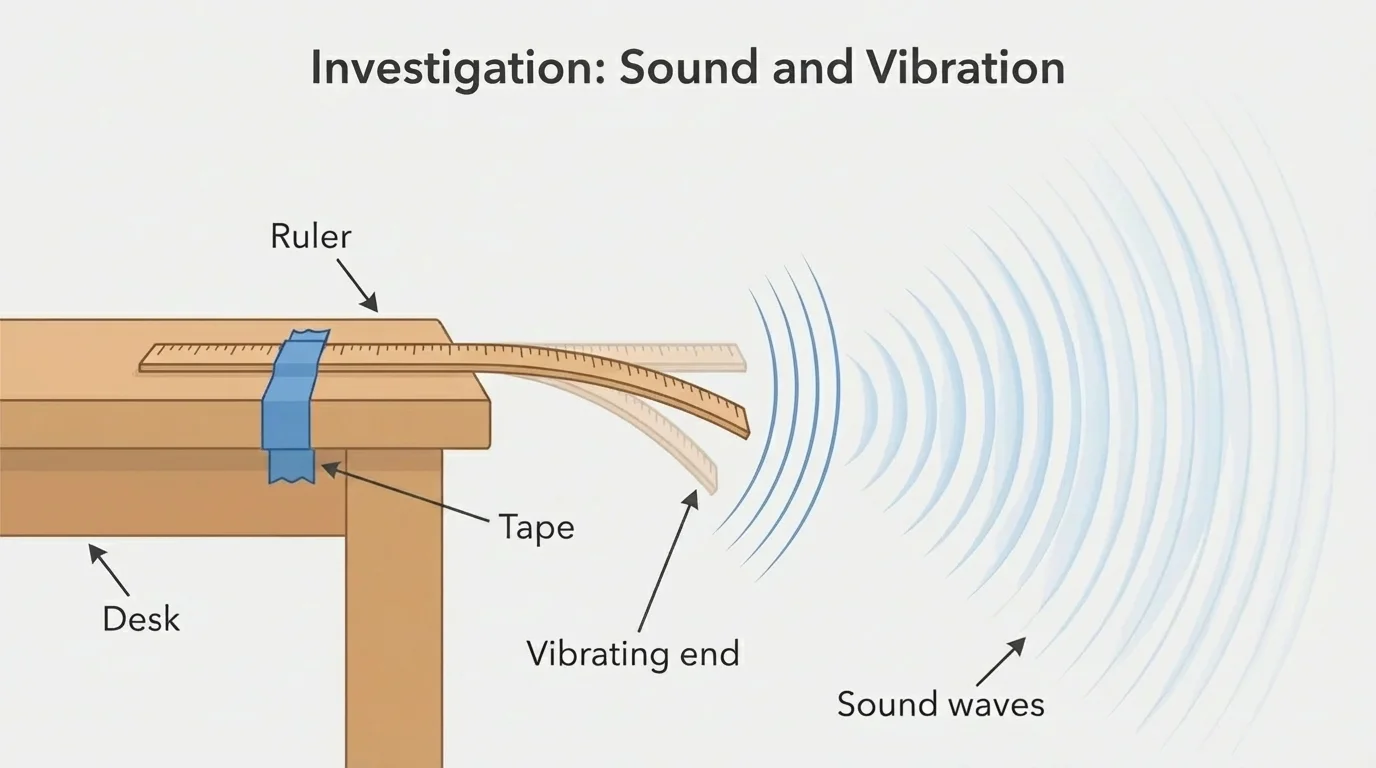
If we let only a small part of the ruler stick out, the sound may be different from when a longer part sticks out. The important idea is that the ruler must move back and forth to make the sound. No vibration, no sound.
Class investigation with a rubber band
Step 1: Put a rubber band around a small box.
Step 2: Pluck the rubber band gently.
Step 3: Watch closely and listen.
Step 4: Record what happened: the band moved and a sound was heard.
The class uses this evidence to say that the vibrating rubber band made the sound.
Musical instruments work this way too. Guitar strings vibrate. Drum tops vibrate. Even your voice box vibrates when you speak or sing.
[Figure 3] Sound does not only come from vibrations. Sound can also cause vibrations. In this investigation, a bowl is covered with stretched plastic wrap and tiny grains of rice are placed on top.
When someone hums, speaks loudly, or taps a drum near the bowl, the rice may bounce or wiggle. The sound travels through the air and reaches the plastic wrap. Then the plastic wrap vibrates, and the rice moves because it is sitting on top.
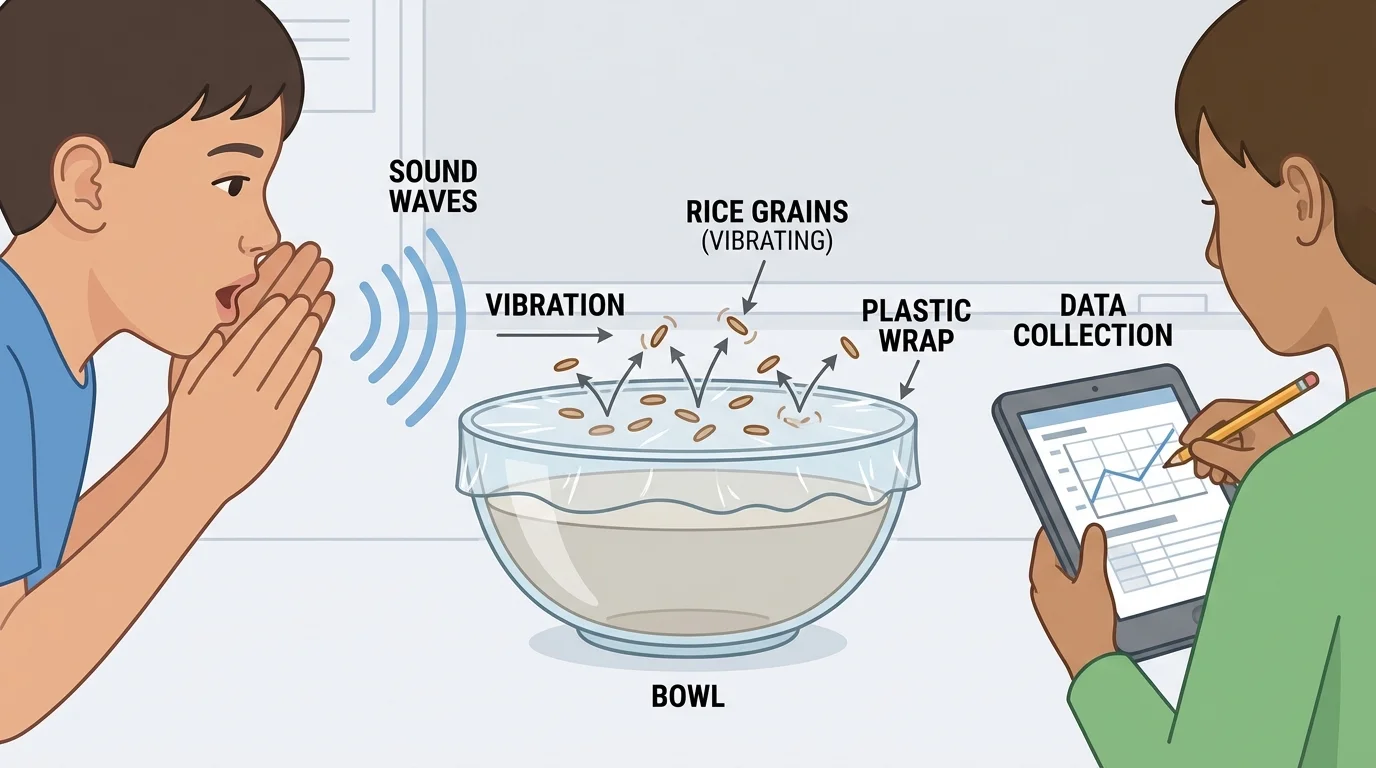
This gives us evidence that sound can make materials vibrate. We may not see the air move, but we can see what the sound does to the plastic wrap and rice.
Another way to notice this is to place a hand gently on a speaker while music is playing softly with adult help. The speaker vibrates as it makes sound. That is why speakers in phones, tablets, and radios can send sound to our ears.
[Figure 4] After testing, we look at our data together. A class chart helps us compare results from different tests. We ask: What happened every time? What happened only sometimes? What pattern do we notice?
If every plucked rubber band moved and made a sound, that is strong evidence. If rice moved when there was sound nearby, that is also evidence. We use these results to answer the question with a science sentence, such as: Vibrating materials can make sound, and sound can make other materials vibrate.
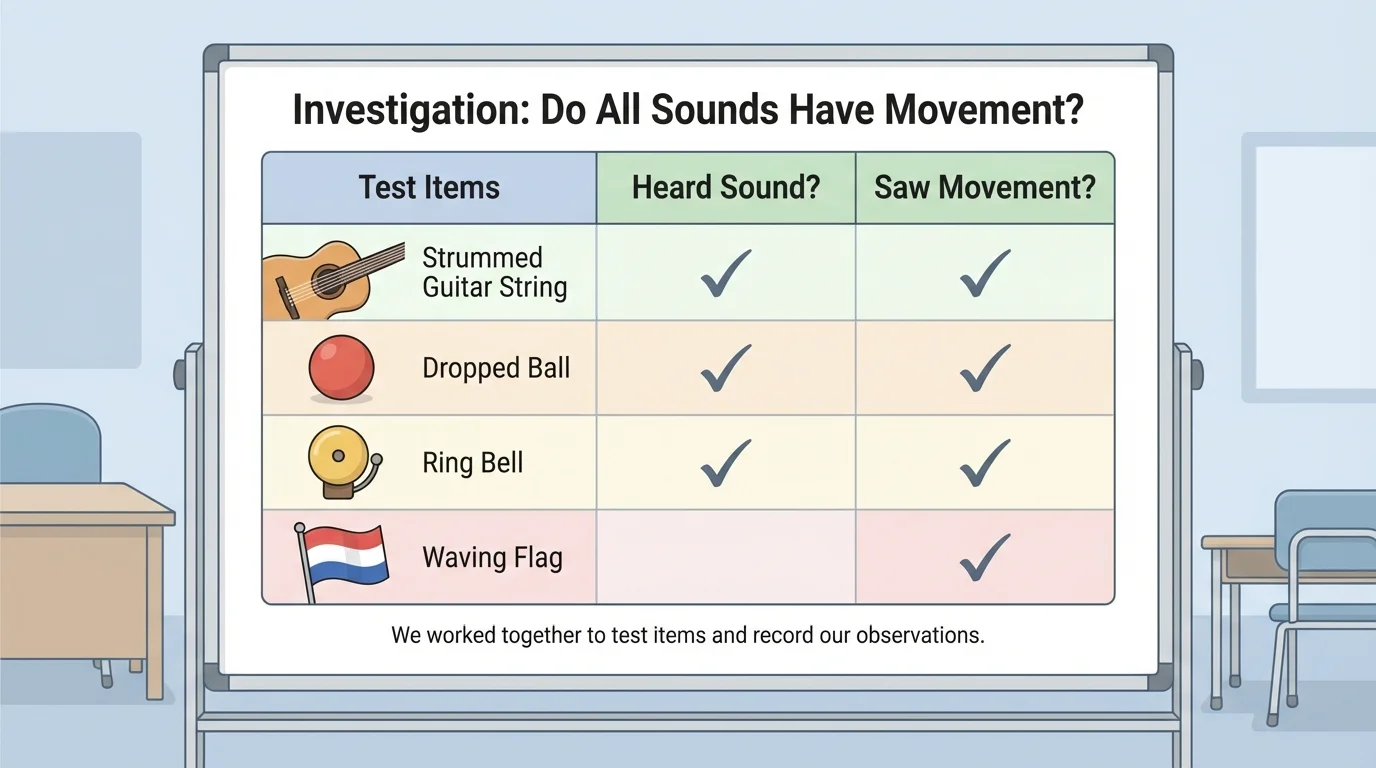
A chart of data helps us stay organized. We do not have to guess which test worked best because we wrote down what happened. Later, when we talk about the ruler in [Figure 2] or the rice on plastic wrap in [Figure 3], we can point to the evidence we collected.
Why teamwork matters in science
Scientists often work with other people. One person may notice a detail that someone else misses. Sharing jobs, taking turns, and discussing results helps a group collect better evidence and make stronger explanations.
Sometimes classmates may get different results. That is okay. The class can repeat the test, check whether the same steps were followed, and see if something changed. Careful scientists learn from every result.
These ideas are all around us. When you knock on a door, the door vibrates and makes sound. When a bell rings, the metal vibrates. When you talk, parts in your throat vibrate. When your ear hears sound, tiny parts inside your ear vibrate too.
Technology uses sound and vibration every day. A phone speaker vibrates to make voices and music. A microphone works in the opposite direction: sound makes part of the microphone vibrate, and the device turns that into a signal. That is one way information can travel from one place to another.
Looking back at the fair test in [Figure 1], we can see why good planning matters. If we change only one thing at a time, our evidence is clearer. Looking again at the class chart in [Figure 4], we can see how recording results helps us explain our thinking.
"Science helps us answer questions by looking carefully at evidence."
When we plan carefully, work together, and use evidence, we do real science. We learn not only about sound, but also about how scientists discover things.
