Have you ever noticed that a zebra has stripes, a sunflower has a spiral center, and day always follows night? Nature is full of amazing repeats. Some patterns are easy to see right away, and others appear only when we watch carefully over time. When we look closely, the natural world starts to feel like a giant puzzle made of repeating clues.
A pattern is something that repeats or happens in a regular way. A pattern can be in form, which means shape or appearance, or in an event, which means something that happens. In nature, patterns can be seen in the stripes on an animal, the petals on a flower, or the way the seasons come each year.
Some patterns repeat in a way we can count. A flower may have petals all around its center. A pinecone may have scales arranged in rows. A spider web has lines that spread out and also circle around. Other patterns are about change over time. The sun rises in the morning. The moon seems to change shape through the month. Leaves may grow in spring, stay green in summer, change color in fall, and drop in winter.
A natural pattern is a repeating shape, color, movement, or event found in nature. Observe means to look closely and carefully. Classify means to group things by shared features.
When we observe patterns, we do more than just say, "That looks nice." We begin to notice order in nature. This order helps us describe the world, compare things, and think about why they are alike or different.
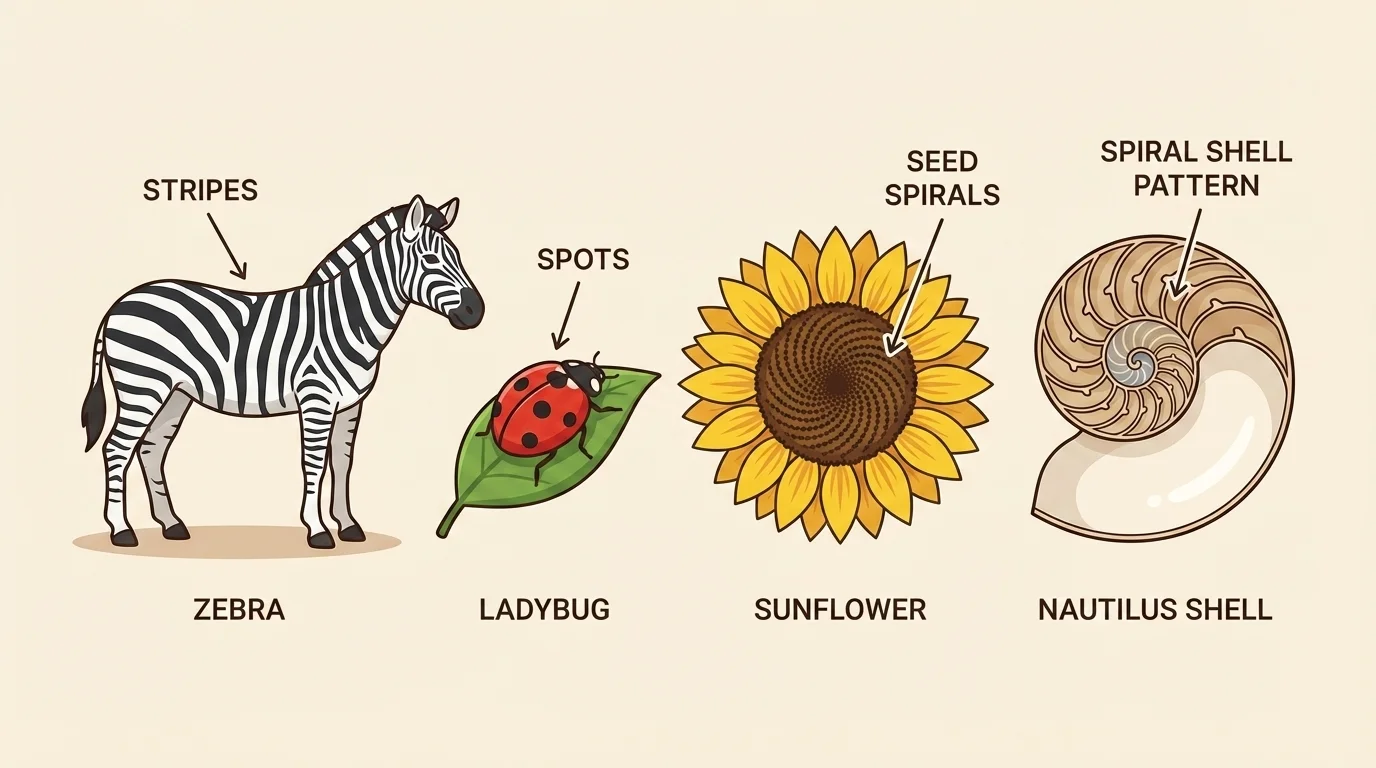
Many natural patterns are easy to see when we look at colors, lines, and shapes. As [Figure 1] shows, nature often repeats marks and forms in beautiful ways. Zebras have stripes. Ladybugs have spots. A snail shell curls in a spiral. A sunflower has seeds packed in a swirling design.
Plants also show patterns. Leaves can have lines called veins that branch out like tiny roads. Flower petals often grow around a center in a balanced arrangement. Fern leaves repeat the same small leaf shape again and again along a stem. Even tree branches can split into smaller branches in a repeating way.
Some patterns help living things survive. A tiger's stripes can help it blend into the surrounding vegetation. A stick insect looks like a twig. The colors and markings on animals can help them hide, warn enemies, or attract mates. This means a pattern is not just pretty. It can also have a job.
Another important shape pattern is symmetry. Symmetry means two sides match or almost match. A butterfly's wings often have similar shapes and colors on both sides. Many flowers also have symmetry. If you fold a simple flower picture down the middle, each side may look almost the same.
Nature also has patterns that are similar but not exactly the same. Snowflakes all have six sides, yet each one can look a little different. Leaves from the same tree may have the same basic shape, but some are bigger or smaller. So a pattern does not always mean everything is perfectly identical. It means there is a regular arrangement we can notice.
Sunflowers, pinecones, and some shells show swirling arrangements that help parts fit together neatly. Nature often uses patterns that use space efficiently and function well.
When we compare these examples again to [Figure 1], we can see that patterns in form help us tell one kind of plant or animal from another. Spots, stripes, petal shapes, and shell curves all give us clues.
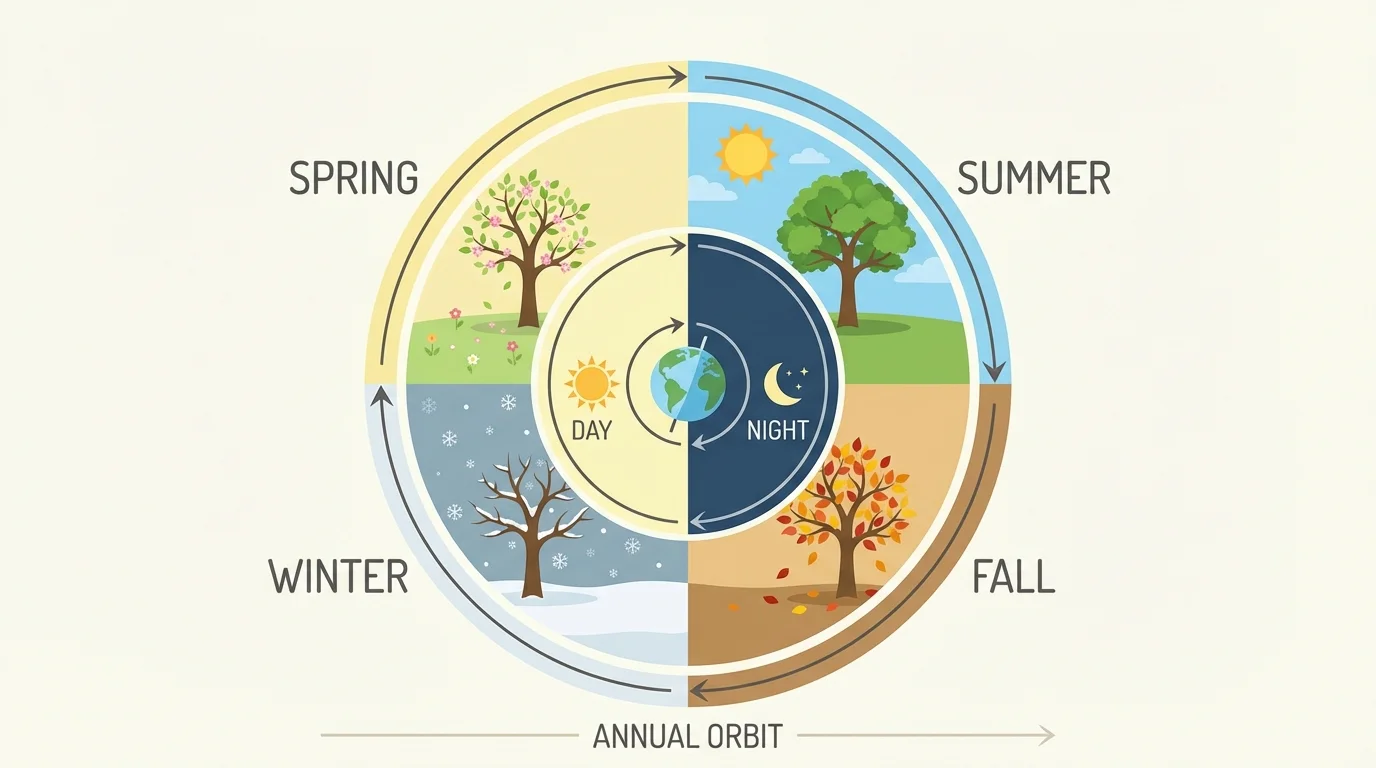
Not all patterns stay still. Some patterns happen in time. As [Figure 2] illustrates, the natural world has many events that repeat over and over. Day turns to night, and night turns to day. This cycle happens every day.
The seasons are another pattern. In many places, spring brings new growth, summer brings warm weather, fall brings cooler air and leaf color changes, and winter brings cold days. These changes happen in a repeating order each year. People can use this pattern to know when to plant gardens, wear warmer clothes, or look for certain animals.
The moon also seems to follow a pattern. Sometimes we see a thin crescent. Sometimes we see a full round moon. Then it changes again. Children and adults can observe this pattern by watching the sky at night over many days.
Weather has patterns too, although they are not always exact. It may rain more in some months than others. Some places have windy seasons. Some places are usually hot, while others are usually cold. These patterns help people prepare, but weather can still surprise us.
Living things show event patterns as well. Birds may migrate, which means they move from one place to another at certain times of year. Bears may rest for long periods in winter. Some flowers open in daytime and close at night. Seeds grow into plants in a pattern: first roots, then shoots, then leaves, and later flowers or fruit.
Patterns can be about time as well as shape. A pattern is not only something we see in lines or colors. It can also be a sequence of events. When something happens in a regular order, such as the seasons or the phases of the moon, we can describe that order and use it to make predictions.
Because these events repeat, people can make good guesses. If it gets dark every evening, we can predict that night will come after day. If trees lose leaves every fall in a certain place, we can expect similar changes next year. Predictions are stronger when we have made careful observations many times.
Looking back at [Figure 2], we can see that cycles are special kinds of patterns. A cycle returns to the beginning and starts again.
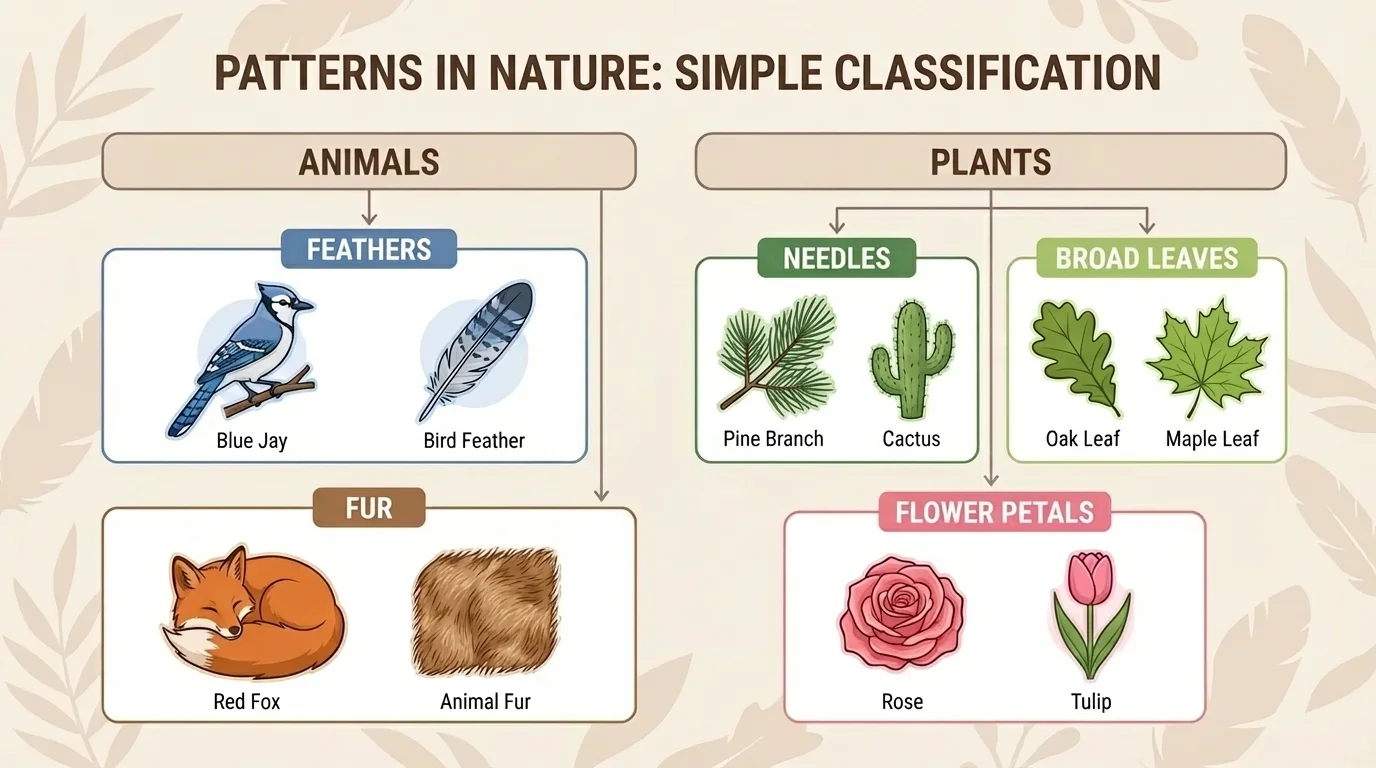
Scientists look for shared patterns so they can sort and classify things. As [Figure 3] shows, when we group things by what they have in common, the world becomes easier to study. Animals with feathers can be placed in one group. Animals with fur can be placed in another.
Plants can also be grouped by patterns. Some have needles, like pine trees. Some have broad flat leaves. Some flowers have a certain number of petals. Some seeds grow inside fruit, and some grow in cones. These visible clues help people identify living things.
Rocks, clouds, and shells can be organized by patterns too. A smooth round stone looks different from a jagged rough rock. Puffy clouds differ from thin wispy clouds. A shell with ridges differs from a shell with a smooth spiral. When we sort by patterns, we are noticing relationships. We are saying, "These belong together because they share important features."
Classification helps in real life. Gardeners learn which plants need similar care. Bird watchers use beak shapes and feather colors to identify birds. Farmers watch patterns in weather and seasons to decide when to plant. Doctors and scientists also look for patterns, because patterns can help them understand health and the environment.
| Natural thing | Pattern noticed | How it helps classify |
|---|---|---|
| Bird | Feathers, beak, wings | Grouped with other birds |
| Mammal | Fur or hair | Grouped with other mammals |
| Pine tree | Needles and cones | Grouped with cone-bearing plants |
| Flowering plant | Petals and flowers | Grouped with flowering plants |
Table 1. Examples of visible patterns used to sort living things into groups.
We can return to [Figure 3] and notice that patterns are like clues in a sorting game. Shared features help us decide what belongs together.
Patterns do not just help us organize. They also make us curious. When we see a pattern, we often ask, "Why does this happen?" and "What affects it?" These are important science questions.
For example, why do some animals have stripes while others have spots? Why do leaves on the same plant have a similar shape? Why do some birds come back in spring? Why does the moon seem to change shape? A pattern tells us there may be a reason behind what we see.
Sometimes patterns show relationships between living things and their surroundings. If a flower opens during the day, maybe sunlight matters. If frogs appear more often after rain, maybe water conditions matter. If certain plants grow best in shady places, maybe the amount of light affects them.
Real-world observation example
A child notices that many flowers in a yard open in the morning and close later in the day.
Step 1: Observe carefully
The child looks at the flowers at breakfast time, lunchtime, and evening.
Step 2: Record the pattern
The flowers are open in the morning, partly open at noon, and closed by evening.
Step 3: Ask a question
The child asks whether sunlight, temperature, or time of day affects the flowers.
This is how noticing a pattern leads to a science question.
Patterns can also help us predict, but we must be careful. If something usually happens, it does not mean it happens exactly the same way every single time. Nature often has patterns with small differences.
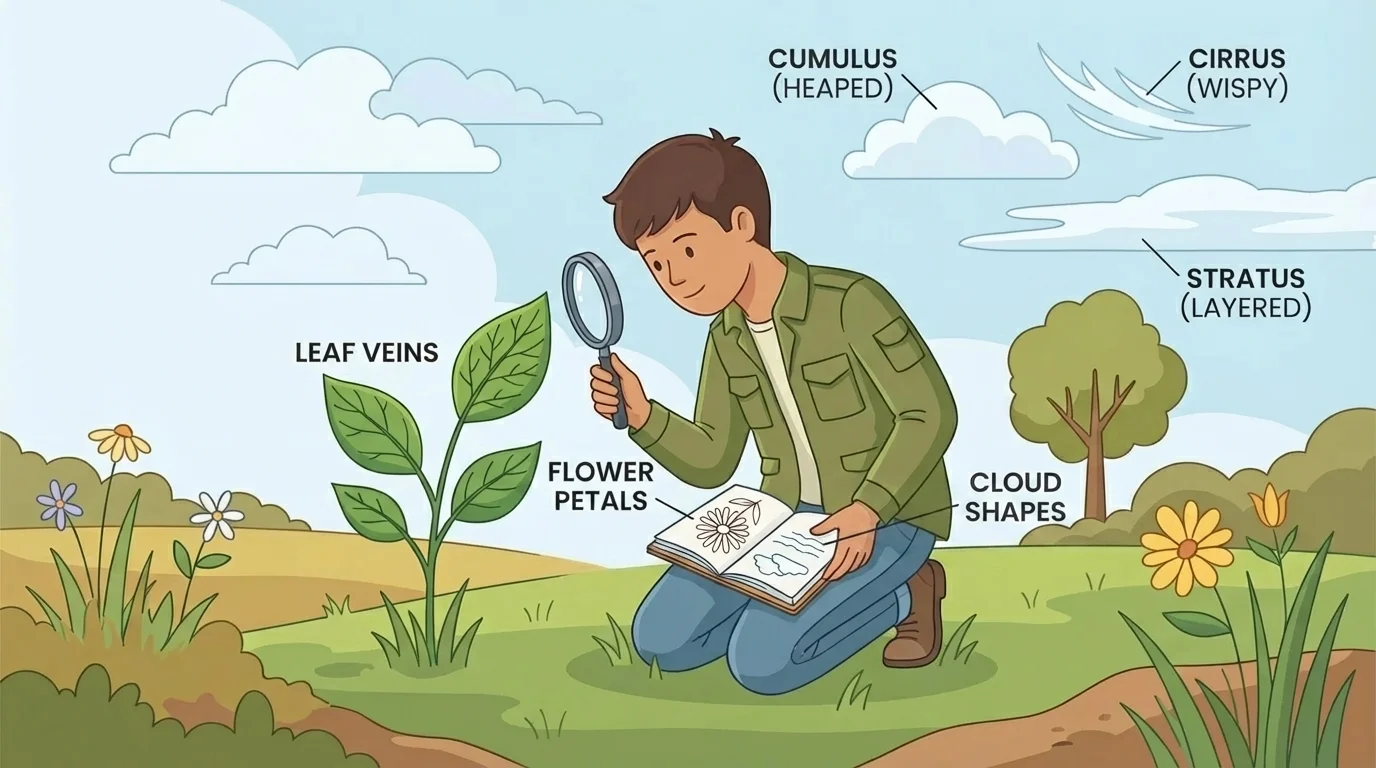
Scientists use observation to find patterns. As [Figure 4] shows, careful looking is an important science skill. We can observe with our eyes, ears, and sometimes simple tools like a magnifying glass, ruler, or notebook.
When we observe, we try to notice details. We may look at the number of petals on flowers, the shapes of clouds, or the way ants move along a path. We may draw what we see or write notes. Recording helps us remember and compare our observations later.
Comparing is also useful. We can compare two leaves, two shells, or two kinds of birds. We can ask what is the same and what is different. If we see the same feature again and again, that may be part of a pattern.
Sometimes we count to help describe patterns. A flower may have about five petals. An insect may have six legs. A spider has eight legs. Counting helps us be more exact when we describe what we observe, such as comparing six and eight, written as \(6 \neq 8\).
Scientists also repeat observations. One day of watching may not be enough. If we watch for many days, we can tell whether something is a real pattern or just a one-time event. Repeating observations helps make our ideas stronger.
Later, when we look back at [Figure 4], we can remember that science often begins with quiet, careful noticing. A notebook full of observations can reveal patterns we might miss at first.
You do not have to travel far to find natural patterns. They are in parks, gardens, ponds, beaches, forests, and even outside a school window. Clouds drift in recognizable shapes. Grass grows in repeating blades. Tree bark has lines and cracks. Birds make repeated calls. Waves roll toward shore again and again.
At home, you might notice that houseplants bend toward light, that shadows change during the day, or that certain insects appear after rain. In the kitchen, fruits and vegetables also show natural patterns. A sliced orange has sections. A kiwi has seeds arranged around the middle. A broccoli head is made of many small parts that look like the whole.
You already know how to sort objects by color, shape, or size. Science uses that same idea, but now we sort natural things by patterns we observe in the world.
The more carefully we look, the more patterns we find. Some are patterns of form, like spirals and symmetry. Some are patterns of events, like day and night or growing seasons. These observed patterns help us organize nature into groups and ask better questions about how the world works.
