Why does a puddle appear on the playground on some days, but not on others? Why does a plant grow taller near a sunny window? Science begins with questions like these. When something happens, there is usually a reason. Scientists look for those reasons, called causes, and they look for clues in the world around them. Those clues often appear as patterns we can see again and again.
[Figure 1] A cause is something that makes another thing happen. The thing that happens is called an effect. If you tap a ball, the ball rolls. The tap is the cause. The rolling is the effect. One event leads to another.
Sometimes the cause is easy to spot. If you flip a light switch and the lamp turns on, the switch being flipped is a cause of the light turning on. If the wind blows a paper off a table, the wind is a cause of the paper moving. When we ask, "What made this happen?" we are looking for a cause.
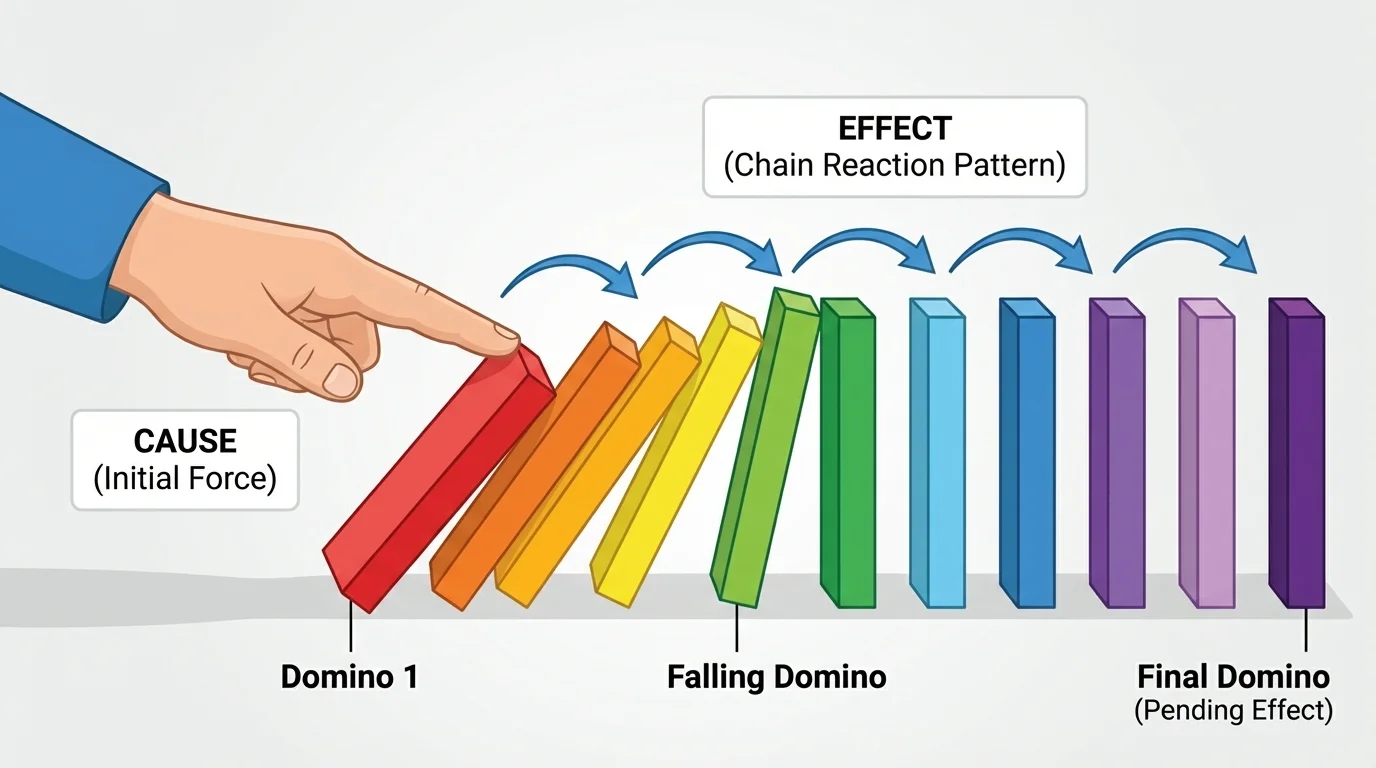
An effect can happen right away, or it can happen later. If you water a thirsty plant, it does not grow taller in one second. But after days, you may notice it looks healthier. Some causes work quickly. Some work slowly.
Cause means the reason something happens. Effect means what happens because of the cause. A pattern is something that happens in a way we can notice again and again.
It is also important to know that not everything happens by magic or luck. Science teaches us to look carefully and search for reasons. Sometimes the reason is simple. Sometimes we need more time and more evidence to understand it.
[Figure 2] A pattern is something that repeats. If you notice that the sidewalk is wet every time it rains, you are noticing a pattern. Patterns help us think about causes. When rainy days keep matching puddles, that repeated pattern gives us a clue.
Suppose you see that your shadow is long in the morning, shorter at noon, and long again in the late afternoon. That is a pattern. By watching many times, you begin to understand that the Sun's position in the sky is connected to the length of your shadow.
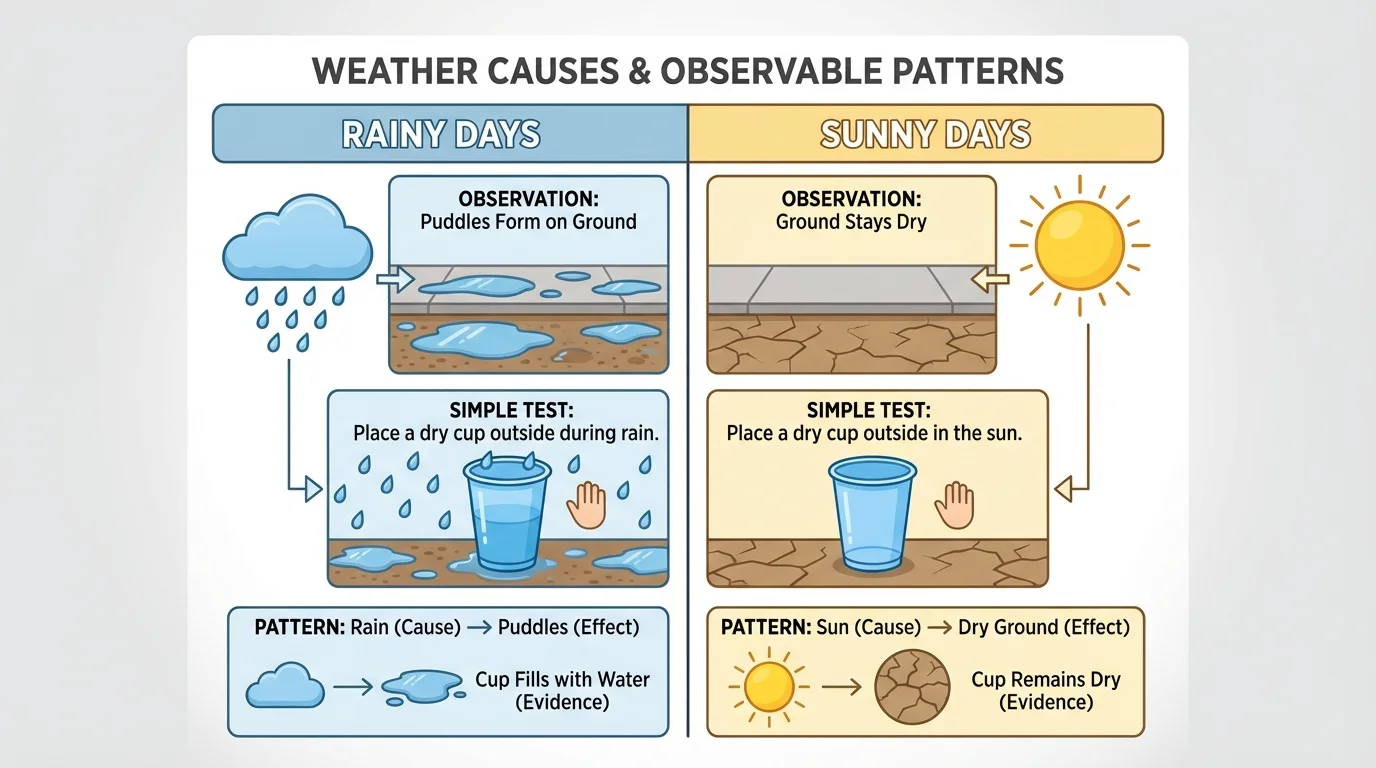
Patterns do not always prove a cause all by themselves, but they are very helpful clues. If a classroom plant droops every time it is not watered for several days, the repeated drooping may mean the lack of water is causing the change. We still need to observe carefully and sometimes test our idea.
Scientists pay close attention to patterns because patterns help them explain the world. If the same thing happens over and over, there may be a cause behind it.
Birds, insects, and people all use patterns to learn about the world. Even your brain is always noticing what usually happens next.
When scientists find a pattern, they ask, "What could be causing this?" That question leads to new observations and tests.
Some events have one clear cause. If a toy car moves because you pushed it, that is a simple cause. If ice melts because it is placed in the warm sun, warmth is a simple cause of the melting.
Other events have more than one cause. A plant may grow well because it has water, sunlight, healthy soil, and enough space. If one of those is missing, the plant may not grow as well. This means the cause of plant growth is not just one thing. It has several parts working together.
When an event has many causes, we say it is multifaceted. That means there are several connected reasons. For young scientists, it is fine to begin with one small idea and test one part at a time.
Mechanism and explanation
A mechanism is how a cause makes an effect happen. For example, sunlight helps a plant because the plant uses light to make food. Water helps because it moves through the plant. An explanation is stronger when it tells not only what caused something, but also how it worked.
Learning about mechanisms helps us understand why the same cause often makes the same kind of effect. That is one reason science can be used to predict what may happen next.
Scientists are careful observers. First, they notice something. Then they ask a question. Next, they think of a possible answer. That possible answer is called an idea or explanation. After that, they do a test and gather evidence.
Evidence is the information we collect by observing, measuring, and comparing. Evidence helps us decide whether our idea makes sense. If the evidence matches the idea, the idea is supported. If it does not match, the idea may need to change.
Science is not guessing wildly. It is careful thinking. A student may say, "I think this plant grew more because it got more light." That is an idea. To know if the idea is strong, the student needs evidence from a test or careful observations.
You already know how to use your senses to observe. In science, we use seeing, hearing, touching carefully, and sometimes measuring tools to collect information.
Scientists often write down what they see. Writing observations helps them notice patterns they might forget later.
[Figure 3] A fair test helps us find out if one thing is causing another. In a fair test, we change only one thing at a time and keep the other important things the same. This helps us compare results clearly.
For example, if we want to know whether sunlight helps a plant grow, we can use two similar plants. We keep the same kind of pot, the same amount of water, and the same kind of soil. We change only the amount of light. Then we watch what happens.
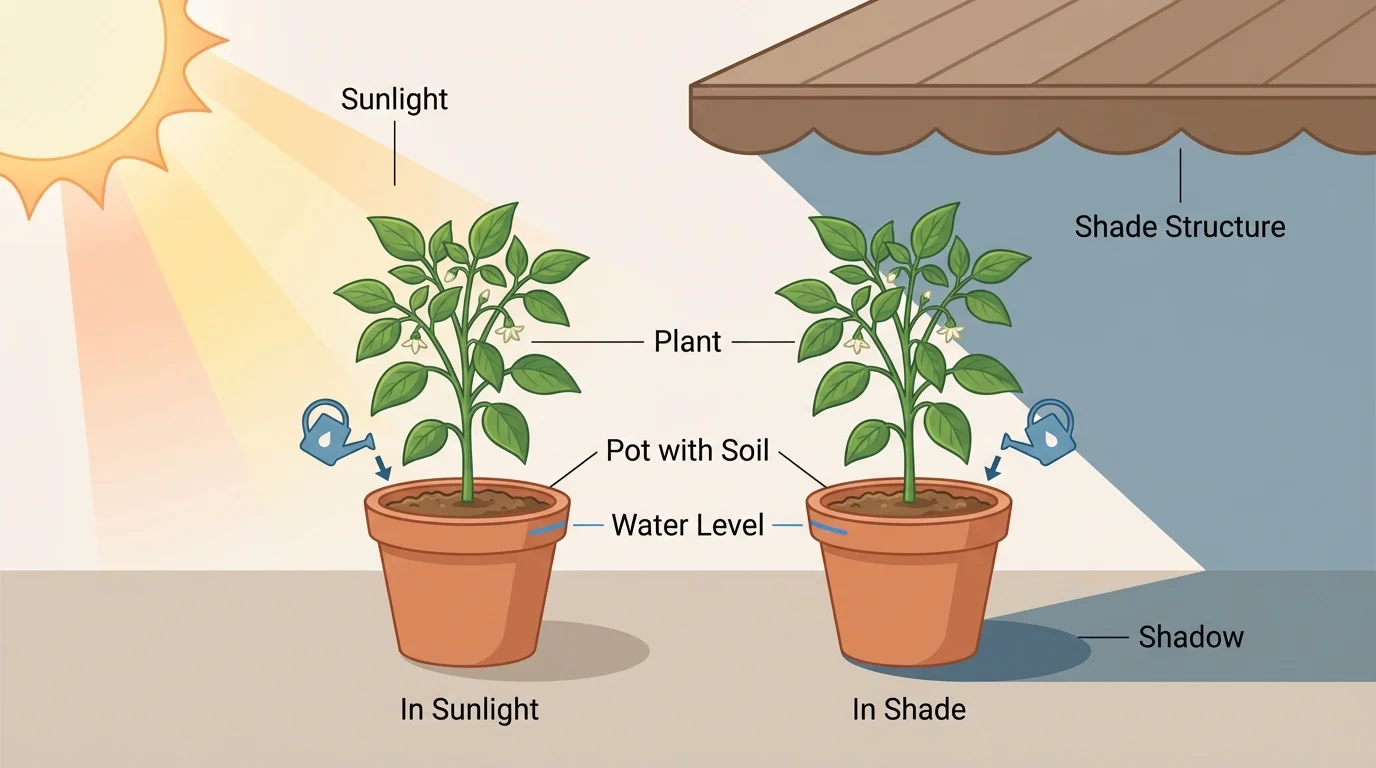
If we changed many things at once, we would not know which cause mattered most. If one plant had more water, better soil, and more light, then the test would not be fair. We could not tell which change made the difference.
A fair test is useful because it helps us connect cause and effect more clearly. It makes our evidence stronger.
| Question | What changes? | What stays the same? |
|---|---|---|
| Does light help a plant grow? | Amount of light | Plant type, pot, water, soil |
| Does a steeper ramp make a toy car go farther? | Ramp height | Same car, same floor, same starting place |
| Does warm air melt ice faster? | Temperature | Same size ice cubes, same plates |
Table 1. Examples of fair tests showing one change and several things kept the same.
Simple tests can help students answer real questions about the world. These tests do not need fancy tools. They need clear thinking, careful observing, and recording what happens.
Example 1: Does a steeper ramp make a toy car travel farther?
Step 1: Ask the question.
We want to know if ramp height changes how far the toy car rolls.
Step 2: Make an idea.
The idea is: "A steeper ramp will make the car go farther."
Step 3: Plan a fair test.
Use the same toy car and the same floor each time. Change only the ramp height.
Step 4: Gather evidence.
Roll the car from a low ramp, then a higher ramp, and measure the distance each time.
Step 5: Look for a pattern.
If the car goes farther again and again from the higher ramp, the evidence supports the idea.
This kind of test shows a possible mechanism too. A higher ramp gives the car a faster start, so it can travel farther across the floor.
Example 2: Does sunlight affect plant growth?
Step 1: Ask the question.
We want to know whether more light helps a plant grow better.
Step 2: Make an idea.
The idea is: "The plant in more sunlight will grow taller."
Step 3: Plan a fair test.
Use two similar plants. Give both the same water and soil. Put one in a sunnier place.
Step 4: Gather evidence.
Observe for several days and measure the heights.
Step 5: Decide.
If the sunnier plant grows taller, the evidence supports the idea.
Later, when we think back to the two plants in [Figure 3], we can see how keeping most things the same makes the result easier to trust.
Example 3: Does warmth melt ice faster?
Step 1: Ask the question.
We want to know if an ice cube melts faster in a warm place.
Step 2: Make an idea.
The idea is: "Ice in a warmer place will melt faster."
Step 3: Plan a fair test.
Use two equal ice cubes. Put one in a warmer place and one in a cooler place.
Step 4: Gather evidence.
Check them after the same amount of time.
Step 5: Explain the result.
If the ice cube in the warmer place melts faster, warmth is a cause of faster melting.
These tests are simple, but they teach a powerful science habit: ask, test, observe, and explain.
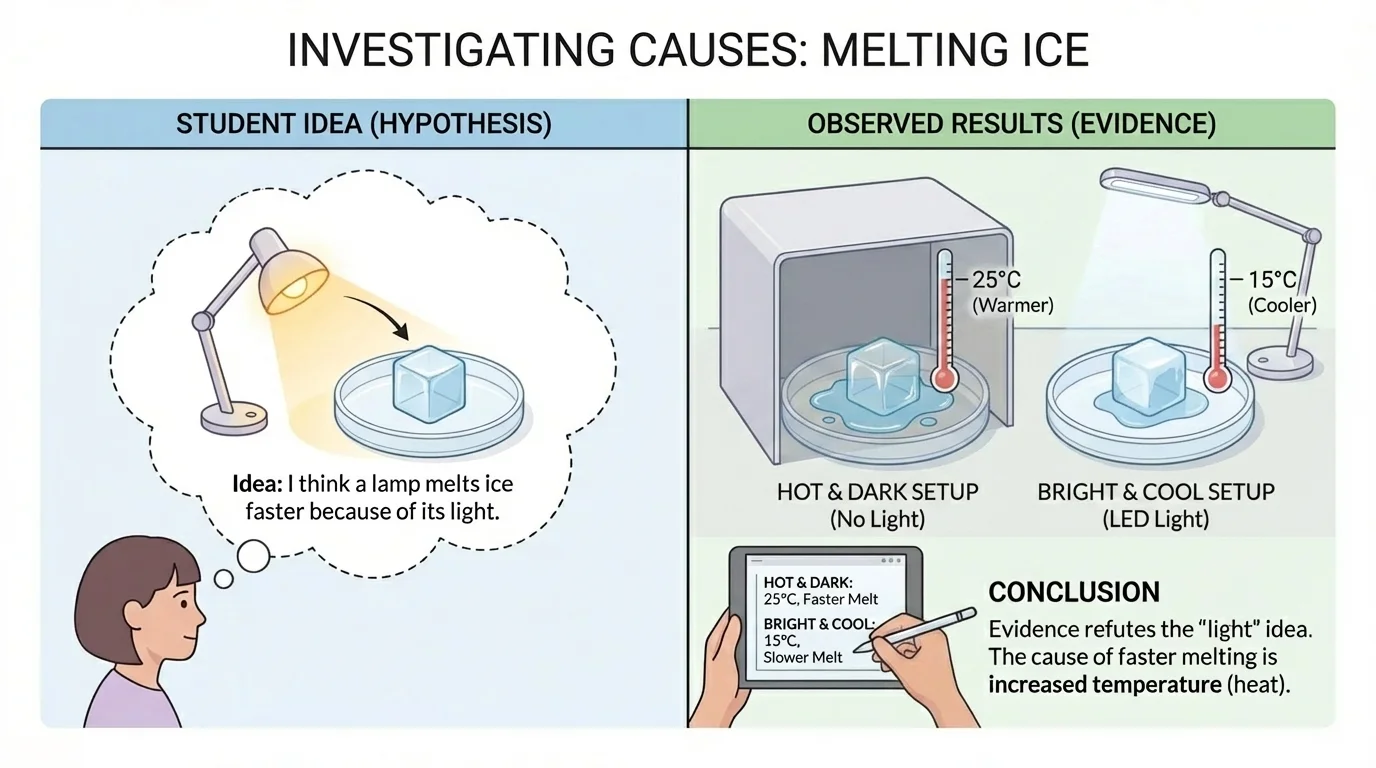
[Figure 4] Sometimes evidence tells us our idea was a good one. Sometimes it tells us our idea was not correct. This is important in science. We do not try to force the world to agree with us. We let the evidence guide us by comparing an idea with real observations.
If a student says, "Big ice cubes always melt faster than small ice cubes," a test may show the opposite. The evidence would refute the idea. Refute means to show that an idea does not match the evidence.
If another student says, "Plants without enough water droop," and repeated observations show drooping after missing water, the evidence may support the idea. Support means the evidence fits the idea well.
Supporting an idea does not always mean we know everything forever. It means the idea matches the evidence we have so far. Good scientists stay open to learning more.
"Science is a way of asking the world questions and listening carefully to the answers."
The chart in [Figure 4] reminds us that we compare what we thought with what actually happened.
When scientists understand a cause and have evidence for it, they can make predictions. A prediction is a careful guess about what may happen next. If we know that dark clouds often come before rain, we may predict puddles later. If we know that a higher ramp often makes a toy car travel farther, we may predict that the car will go farther on a steeper ramp in a new test.
Predictions are useful because tested causes can work in new situations. If a plant near one sunny window grew well, we may predict that another similar plant will also grow better with enough light. This does not mean every plant is exactly the same, but it helps us make smart guesses.
Scientists use causes, patterns, tests, and evidence to explain many parts of everyday life. Gardeners think about what causes plants to grow. Builders think about what causes strong structures to stay standing. Doctors think about what causes illness and what treatments help people get better. Science is all around us.
From observing to explaining
Science becomes stronger when we move from just seeing a pattern to explaining the cause and mechanism behind it. If rain is followed by puddles, the explanation is that water falls from clouds and collects on the ground. If more light helps a plant, the explanation is that the plant uses light to help make food for growth.
Long ago, people often noticed patterns without always knowing the mechanism. Over time, testing helped them learn more. That is how science grows: from noticing, to testing, to explaining.
