A river can look peaceful one day and spill over its banks the next. A hillside can seem firm until heavy rain makes the soil slide. Earth is always changing, and people have to live safely on a changing planet. That is why engineers, scientists, and communities do more than just notice problems. They explain what is happening and then design solutions that can protect people.
When we talk about solving problems in science, we do not mean guessing one answer and hoping it works. We mean studying the situation, thinking of several possible fixes, and comparing them carefully. A strong solution is not just clever. It must meet the needs of people and also fit the limits of the real world.
Earth has many natural processes. Rivers flow, waves hit shores, wind moves sand, rain soaks into the ground, and tectonic plates cause earthquakes. These processes are natural, but they can become dangerous when people live nearby. Floods can cover roads and homes. Coastal erosion can wear away beaches and cliffs. Landslides can bury buildings. Earthquakes can crack walls and roads.
Scientists try to explain natural hazards by asking questions such as: What caused the event? Where did it happen? How often does it happen? Who is affected? The answers help communities decide what kind of protection is needed. A town near a river may need a wall to hold back water, raised buildings, or an early warning system. Another town on a steep slope may need deep-rooted plants, drainage channels, or a retaining wall.
Criteria are the things a solution should do well. For example, a flood solution should keep people safe and work during heavy rain.
Constraints are the limits on a solution. Constraints can include cost, time, space, available materials, and how the solution affects the environment.
A trade-off is giving up one advantage to gain another. A stronger wall might protect better, but it may cost more or take longer to build.
Because every place is different, the best solution in one area may not be the best in another. A beach town, a mountain village, and a city near a fault line face different problems. Good design begins with understanding the local hazard.
A design problem starts with a need. People may need to stay dry during storms, keep roads from washing away, or receive a warning before danger arrives. The problem must be stated clearly. For example: "How can our town reduce flood damage to homes near the river?" That sentence tells what needs to be protected and what hazard is causing the trouble.
After stating the problem, designers think about what success looks like. If a town wants flood protection, one criterion might be that water stays away from houses during a storm. Another criterion might be that people can still travel safely on roads. Constraints might include how much money the town can spend, how much space exists along the river, and how quickly the work must be done.
Sometimes a design problem has no perfect answer. That is normal. Engineers often compare solutions that each have strengths and weaknesses. One idea might be very safe but expensive. Another might be cheaper but protect fewer homes. Comparing these choices is an important part of designing.
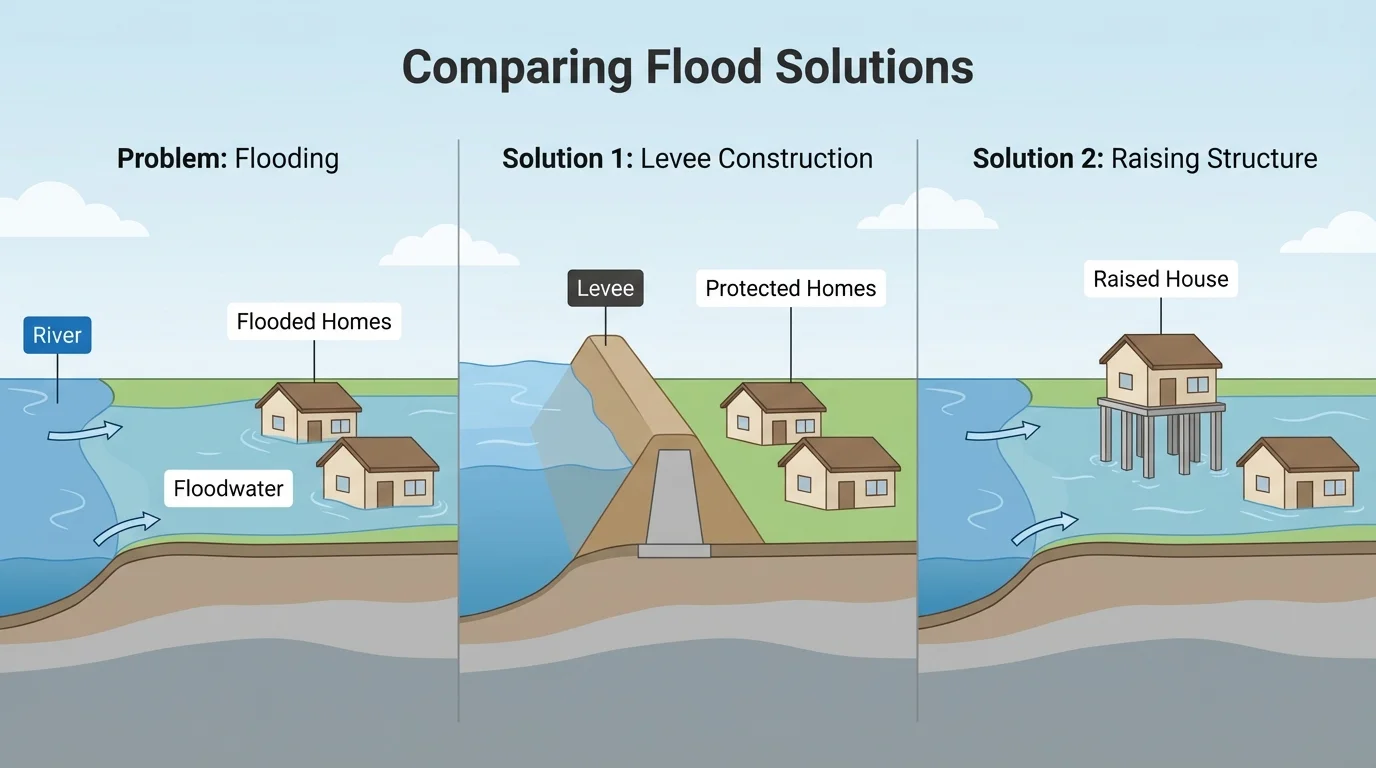
Before building anything, scientists and engineers study the hazard carefully, as [Figure 1] shows with a flooded riverside area. They examine where water flows, where soil moves, or how ground shaking affects buildings. This helps them understand not only what happened in the past, but what may happen again.
For floods, they may look at low land near rivers, past storm records, and places where water spreads after heavy rain. If one neighborhood floods every spring, that pattern gives useful evidence. If houses closest to the river flood first, that also matters. The shape of the land helps explain why some places are at greater risk than others.
For landslides, experts study steep slopes, loose soil, and the effects of heavy rain. For coastal erosion, they watch how waves wear away shorelines over time. For earthquakes, they study places where the ground shakes and which building types suffer the most damage. Explanations based on evidence help communities choose smarter solutions.
Studying hazards also means looking for patterns. If a warning sound is too hard to hear during a storm, that signal may not protect people well. If a flashing light cannot be seen in bright sunlight, it may need to be brighter or placed somewhere else. In science and engineering, patterns help us improve our ideas.
Scientists use evidence to build explanations, and engineers use evidence to design solutions. These two ways of thinking work together. First we ask, "What is happening and why?" Then we ask, "What can we do about it?"
The explanation and the solution are connected. If a river floods because water spreads over a flat area, raising homes may help. If waves erode a beach because they hit the shore again and again, barriers or planted dunes may help. A good solution matches the cause of the problem.
A common mistake is to stop after one idea. But strong engineering begins by generating several solutions. If a town has a flood problem, possible solutions might include building a levee, raising houses on taller supports, creating a better drainage system, moving playgrounds to higher land, or making a warning system that tells people when to leave.
This step is called brainstorming. During brainstorming, people try to think broadly. They may draw sketches, talk with community members, read about solutions used in other places, and combine ideas. One solution may be physical, such as a wall. Another may be a system, such as an alarm with lights and sounds. Sometimes the best answer combines both.
Generating multiple solutions matters because each idea solves the problem in a different way. A wall may block water, while raised houses allow water to pass underneath. A warning system does not stop the flood, but it gives people time to move to safety. Since each one has different strengths, comparing them is important.
Some communities use both natural and built solutions. Plants with strong roots can help hold soil in place, while walls or barriers add extra protection where needed.
Designing also means thinking about people. A town might choose a solution that protects schools first, or one that can be built quickly before the next storm season. Real-world problems are about safety, fairness, and practical choices.
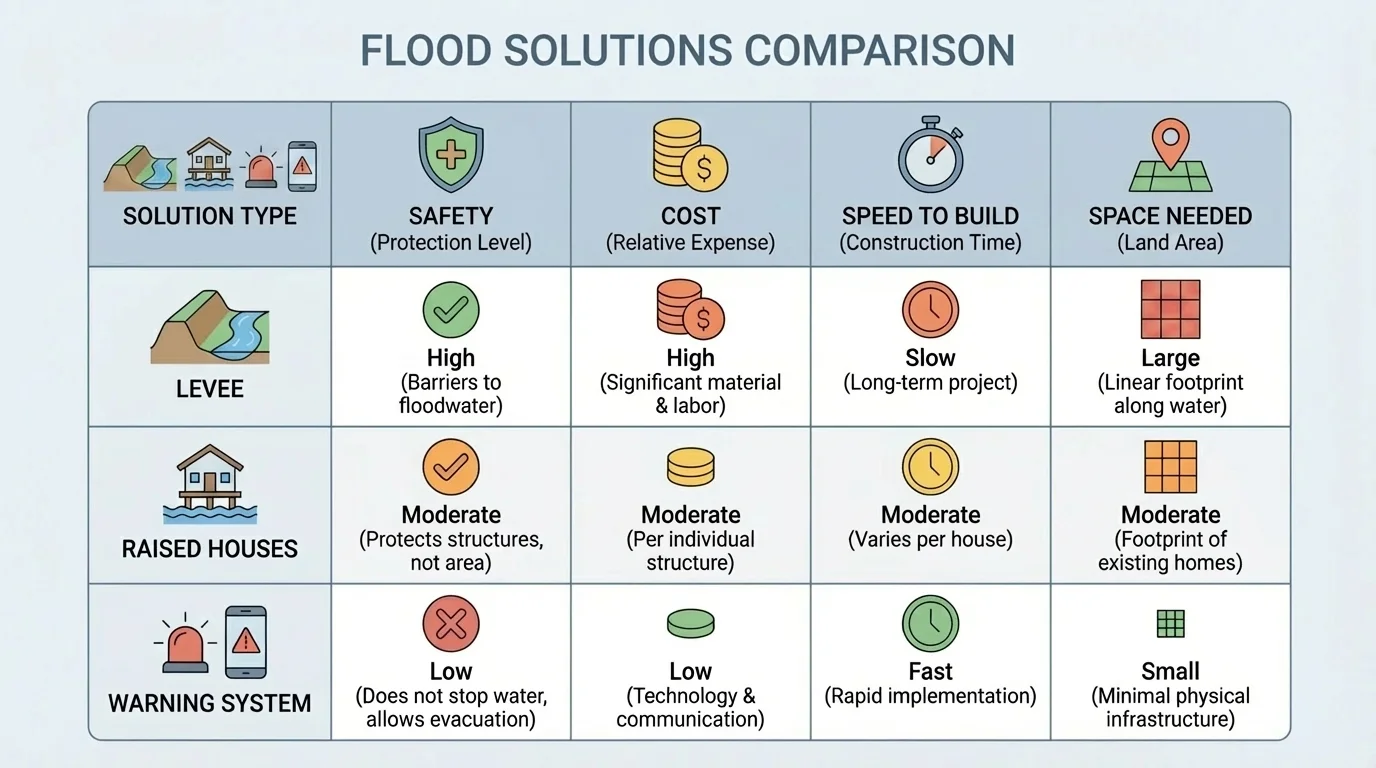
As [Figure 2] shows, once several ideas are on the table, engineers compare them using the same criteria and constraints. A simple way to do this is with a criteria list or a chart. Instead of saying, "I like this one best," they ask, "Which one protects more people? Which one costs less? Which one can be built faster? Which one fits this location?"
Suppose a town compares three flood solutions: a levee, raised houses, and an early warning system. The levee may protect many homes but require lots of materials and space. Raised houses may protect individual families very well but cost a lot for each home. A warning system may be cheaper and faster to install, but it does not keep water out of buildings.
A chart helps students and engineers compare ideas side by side. Each row can list a solution, and each column can list an important question. Then people can see strengths and weaknesses clearly.
| Solution | What it does well | Possible limit |
|---|---|---|
| Levee | Blocks floodwater from reaching many homes | Needs space and many materials |
| Raised houses | Keeps homes above flood level | Can be expensive for each building |
| Warning system | Alerts people quickly | Does not stop water from entering buildings |
Table 1. A simple comparison of three flood-protection solutions and their strengths and limits.
Comparing fairly means using evidence, not just opinions. If one design works in a place with steep hills but not on a flat river plain, that matters. If one signal can be seen from far away and another cannot, that matters too. Evidence helps communities make better choices.
Sometimes people score solutions using numbers, such as rating each one from \(1\) to \(5\) for safety or cost. The exact numbers are less important than the thinking behind them. The goal is to compare ideas in a clear and organized way.
Case study: Choosing a flood solution for a small town
A town wants to protect homes near a river. It has three ideas: build a levee, raise homes, or install a warning system.
Step 1: Name the criteria
The town wants a solution that keeps people safe, protects homes, and works during heavy rain.
Step 2: Name the constraints
The town has limited money, limited space near the river, and only a short time before storm season.
Step 3: Compare the ideas
The levee protects many homes but needs space. Raised homes protect individual buildings but cost more per house. The warning system is fast to install but does not stop water.
Step 4: Make a reasoned choice
The town might choose the warning system right away for quick safety and plan raised houses for the homes at highest risk.
This choice uses evidence and accepts that sometimes a combination of solutions works best.
As the flood example in [Figure 1] reminds us, where people live matters. A home very close to the river may need a different solution from a home farther uphill.
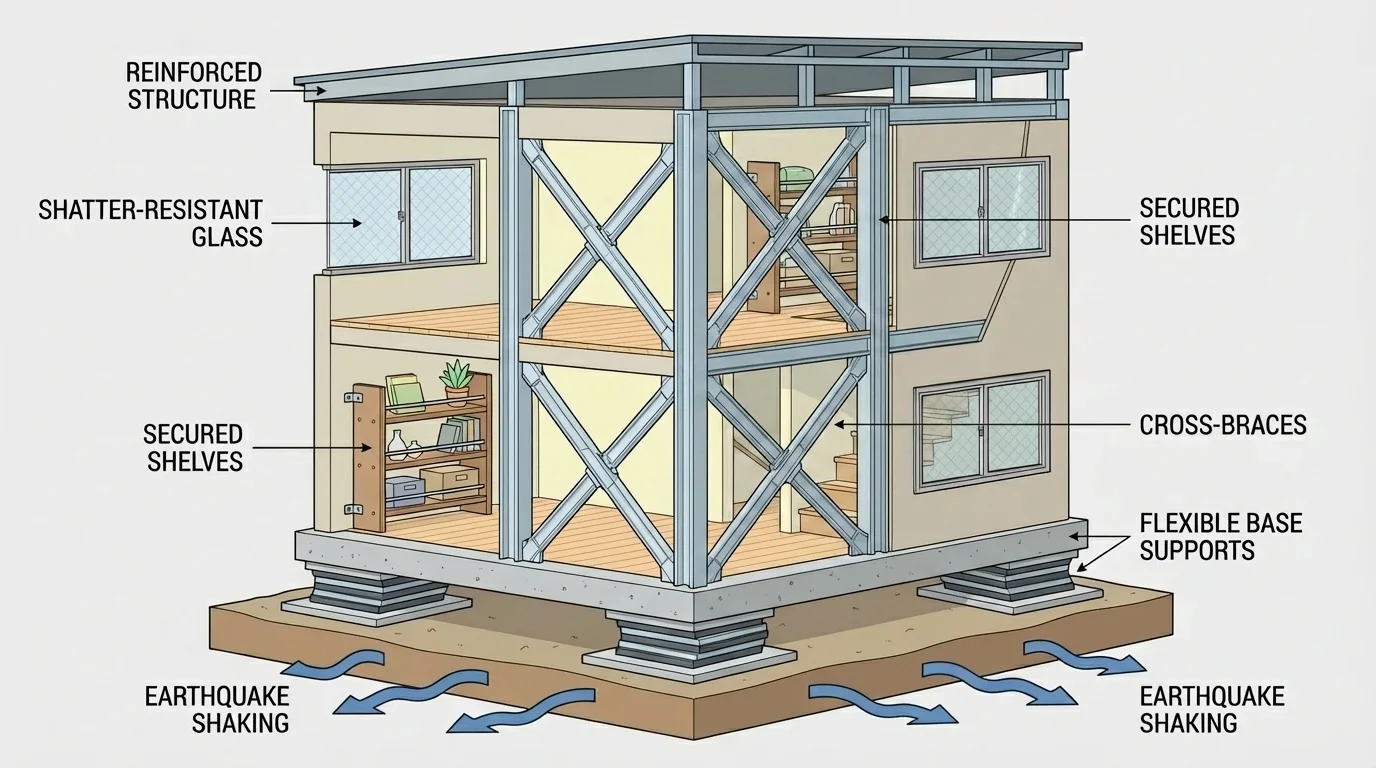
[Figure 3] Different hazards call for different types of designs. For flooding, communities may build levees, dig drainage channels, raise buildings, or make safe evacuation routes. For coastal erosion, they may plant grasses on dunes, place barriers, or limit building too close to the shore. For landslides, they may add retaining walls, plant deep-rooted vegetation, or redirect water so the slope stays more stable.
Earthquakes are different because we usually cannot stop the shaking. Instead, we design structures to handle it better. In an earthquake-resistant design, a building may include strong braces and flexible parts so it can move a little without collapsing. Shelves and heavy objects can also be secured so they do not fall easily.
These examples show that the "best" solution depends on what the hazard does. A retaining wall helps with moving soil but not with ground shaking. A warning alarm helps people move quickly but does not hold back water. Matching the solution to the hazard is a key part of good design.
Another useful idea is to combine natural systems and human-built systems. Plant roots can help hold soil. Wetlands can soak up some floodwater. Strong buildings can reduce injury during earthquakes. Design solutions do not always mean "build a giant object." Sometimes they mean using nature wisely along with technology.
Why multiple solutions matter
One solution may protect property, another may protect lives quickly, and another may preserve the environment better. Engineers compare these choices because communities need solutions that fit more than one goal at the same time.
The comparison chart in [Figure 2] stays useful here too. The same thinking can be used for erosion, landslides, earthquakes, or storms: list the goals, list the limits, and compare the choices carefully.
Designing is not a one-time event. After choosing an idea, engineers often test it, observe what happens, and improve it. A model wall may turn out to be too short. A warning light may not be bright enough. A drainage channel may clog with mud and leaves. Testing helps reveal these problems before a full disaster happens.
This process of making a design better is called optimization. Optimization means improving a solution so it meets the criteria better while still staying within the constraints. It does not always mean making something bigger or more expensive. Sometimes a small change makes a big improvement.
For example, a community might add both a flashing light and a loud sound to a warning system because some people may notice one signal better than the other. If the sound pattern is clear and repeated, people can recognize it quickly. If the light flashes in a special pattern, people can tell that it means danger rather than an ordinary announcement.
Improving a warning signal
A school wants an emergency signal for severe weather.
Step 1: Identify the need
Students and teachers must notice the warning quickly in classrooms, hallways, and outside areas.
Step 2: Test one idea
A sound-only alarm is tried first. It works indoors, but some people outside do not hear it well in strong wind and rain.
Step 3: Revise the design
The school adds a bright flashing light and a repeated sound pattern.
Step 4: Compare again
The new design meets the safety criterion better, although it may cost more. The school decides the extra cost is worth the improved warning.
This is an example of using evidence to improve a solution.
Testing can happen with models, drawings, computer simulations, or real small-scale trials. Even simple observations can help. If one design fails in a strong rain test and another stays in place, that evidence guides the next decision.
Two towns with the same hazard may choose different solutions because their constraints are different. One town may have more money. Another may have more open land. One community may care strongly about protecting a natural habitat, so it avoids a design that harms plants and animals. Another may need a fast temporary solution before a larger project begins.
Location also matters. A steep mountain road may need barriers and drainage. A flat coastal town may need raised structures and evacuation routes. A city may need stricter building rules because many people live close together. Engineers do not copy one design everywhere. They adapt it to local needs.
Trade-offs are part of these decisions. A bigger wall may protect more land but block a nice view of the river. A cheaper solution may help now but need more repairs later. Communities must weigh these trade-offs carefully and choose what fits their goals best.
Some places use maps of flood zones, earthquake zones, or landslide risk to decide where new homes, schools, and roads should be built. Good planning can prevent danger before construction even begins.
That is why designing solutions is also about responsibility. A good design protects people not only today, but in the future as weather, land, and human needs change.
[Figure 4] Science explains causes, and engineering uses those explanations to solve problems. In warning systems, this teamwork is easy to see. Engineers need to know how signals travel and how people notice them. A flashing light must be bright enough and easy to distinguish from other lights. A sound must be loud enough and have a clear pattern in an emergency alert system.
When a signal reflects from surfaces or gets blocked by walls, people may not receive the message clearly. Designers think about where to place speakers, lights, and signs so the warning reaches as many people as possible. They may test different sound patterns or light colors to see which one is noticed fastest.
This connection matters for natural hazards. A flood alarm, storm siren, or earthquake alert only helps if people can detect it and understand what to do. The design must match the environment and the needs of the people using it.
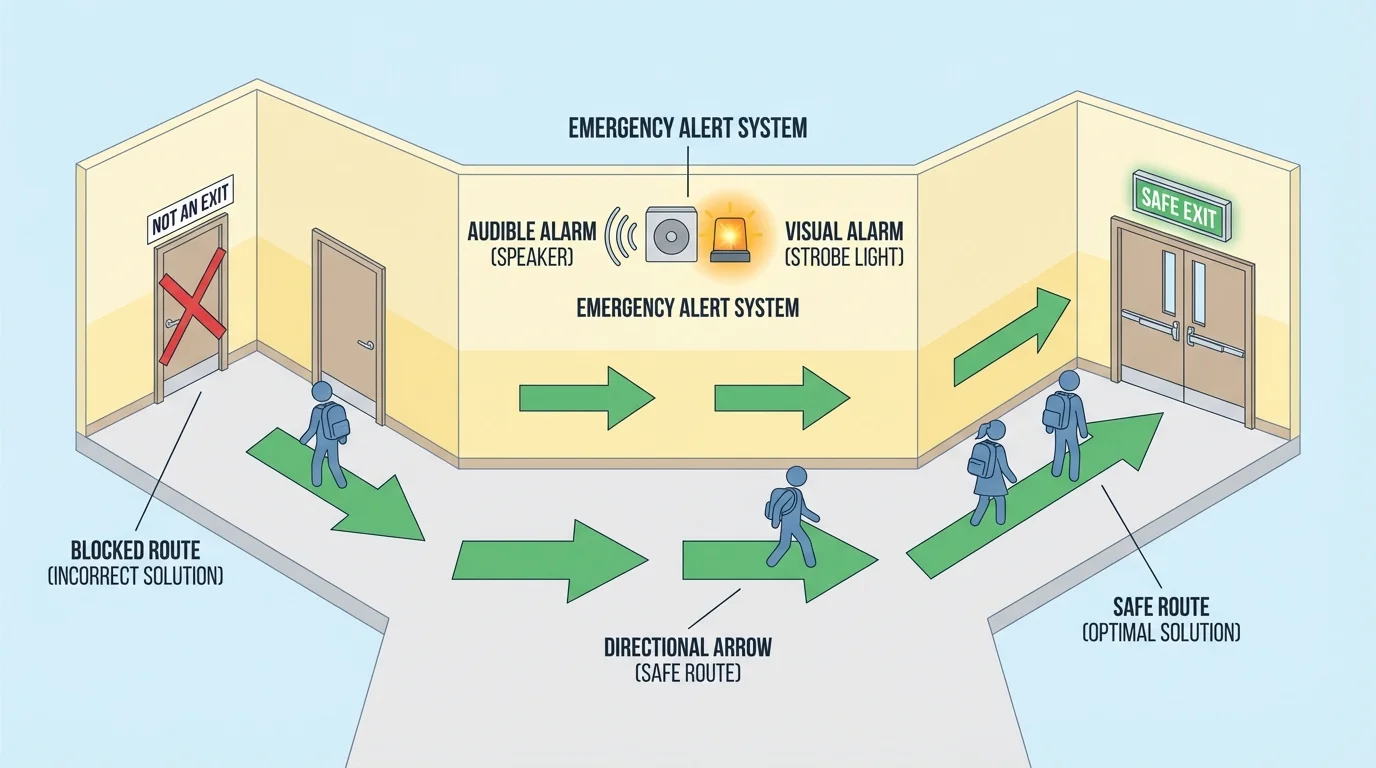
Earlier, [Figure 3] showed how a building can be designed for shaking, while [Figure 4] showed how information can be designed for fast action. Both are solutions, but they solve different parts of the problem. One reduces damage to structures. The other helps people respond safely.
Constructing explanations and designing solutions are powerful because they help people live more safely on Earth. We study hazards, generate several ideas, compare them using criteria and constraints, and improve designs with evidence. That is how communities make thoughtful choices instead of lucky guesses.
