A tiny crack in a sidewalk can allow a weed to grow, a patch of shade can cool the ground, and two seeds planted on the same day can grow at different speeds. Science often starts when someone notices something small and asks, "Why did that happen?" The best science questions are not always the most ambitious ones. They are the ones we can actually investigate.
Scientists learn about the natural world by asking questions and gathering evidence. Engineers also begin with questions, but their questions are usually about solving a problem for people. Both science and engineering start with curiosity, careful thinking, and a plan.
In grade 4, you can engage in real scientific thinking using simple tools in familiar places. A classroom, a schoolyard, a park, a garden, a museum, a zoo, or a nature center can all become places to investigate. The important part is not having fancy equipment. The important part is asking a question that fits the place, the time, and the materials available.
Investigable question means a question that can be answered by observing, measuring, testing, or collecting data. Hypothesis means a possible explanation or prediction that is based on observations and scientific ideas. Observation means information gathered with the senses or with tools such as rulers, timers, thermometers, or magnifiers.
When you ask strong questions, you are more likely to get useful answers. If the question is too big, too vague, or impossible to test, the investigation becomes confusing. Good scientists learn to shape their wonder into questions they can actually study.
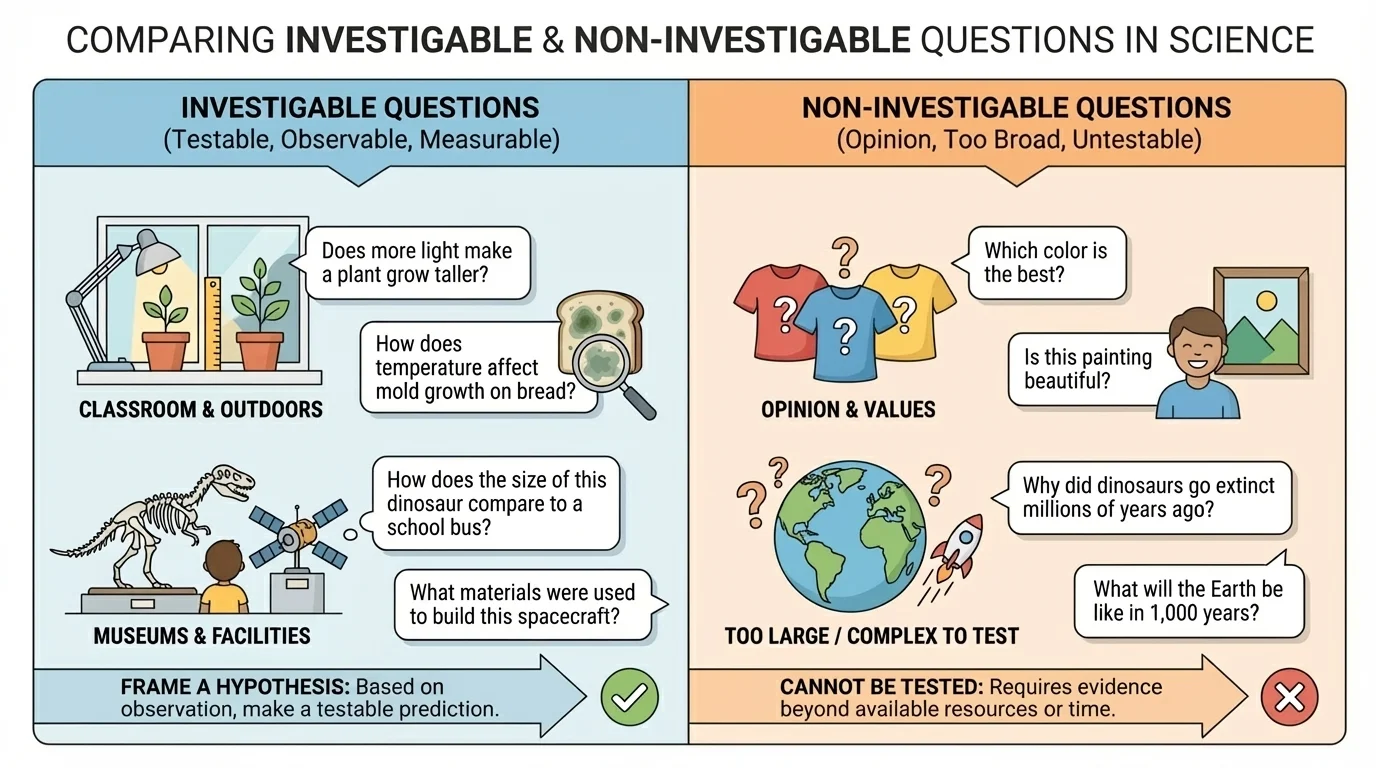
A investigable question can be answered with evidence. That means you can observe something, measure something, count something, compare something, or test something, as [Figure 1] shows. The answer does not come just from guessing or from someone's opinion.
For example, "Which lunch is the tastiest?" is not a strong science question because taste is mostly an opinion. But "Which type of bread gets mold first under the same conditions?" is investigable because you can observe the bread each day and record what happens.
A good investigable question usually has these features:
Questions like "How do all animals survive on Earth?" are interesting, but far too large. A better version might be "Do pill bugs move more quickly in light or in darkness?" That smaller question can be explored in a classroom or outdoor area.
Some famous discoveries began with very simple questions. People noticed apples falling, mold growing, or magnets pulling metal and then asked questions that led to major scientific ideas.
As you saw earlier in [Figure 1], changing a broad question into a focused one is often the first important step in science.
Different places allow different kinds of questions. In a classroom, you might study magnets, shadows, evaporation, plant growth, sound, or how objects roll. In an outdoor environment, you might observe insects, soil, leaves, temperature, clouds, or where puddles dry fastest.
Museums and other public facilities also offer great chances to ask questions. In a science museum, you may compare how different machines move. In a history museum, you may ask how materials helped people build tools. In a zoo or aquarium, you may observe how animals move, eat, or use body parts. In a botanical garden, you may compare leaf shapes, flower colors, or where certain plants grow best.
The place matters because it affects what evidence you can gather. If you are in a museum for only one hour, you need a question that can be explored by observing displays, reading labels, sketching details, or comparing objects. If you are outside for several days, you may be able to measure changes over time.
Science and engineering are related, but they are not exactly the same. One asks how the world works, and the other asks how to solve a need or problem for people, as [Figure 2] illustrates.
A science question asks about nature. For example: "Does the amount of sunlight affect how tall bean plants grow?" This question studies what happens in the natural world.
An engineering problem focuses on designing or improving something. For example: "How can we build a paper bridge that holds the most pennies?" This is not mainly about explaining nature. It is about making a solution that works well.
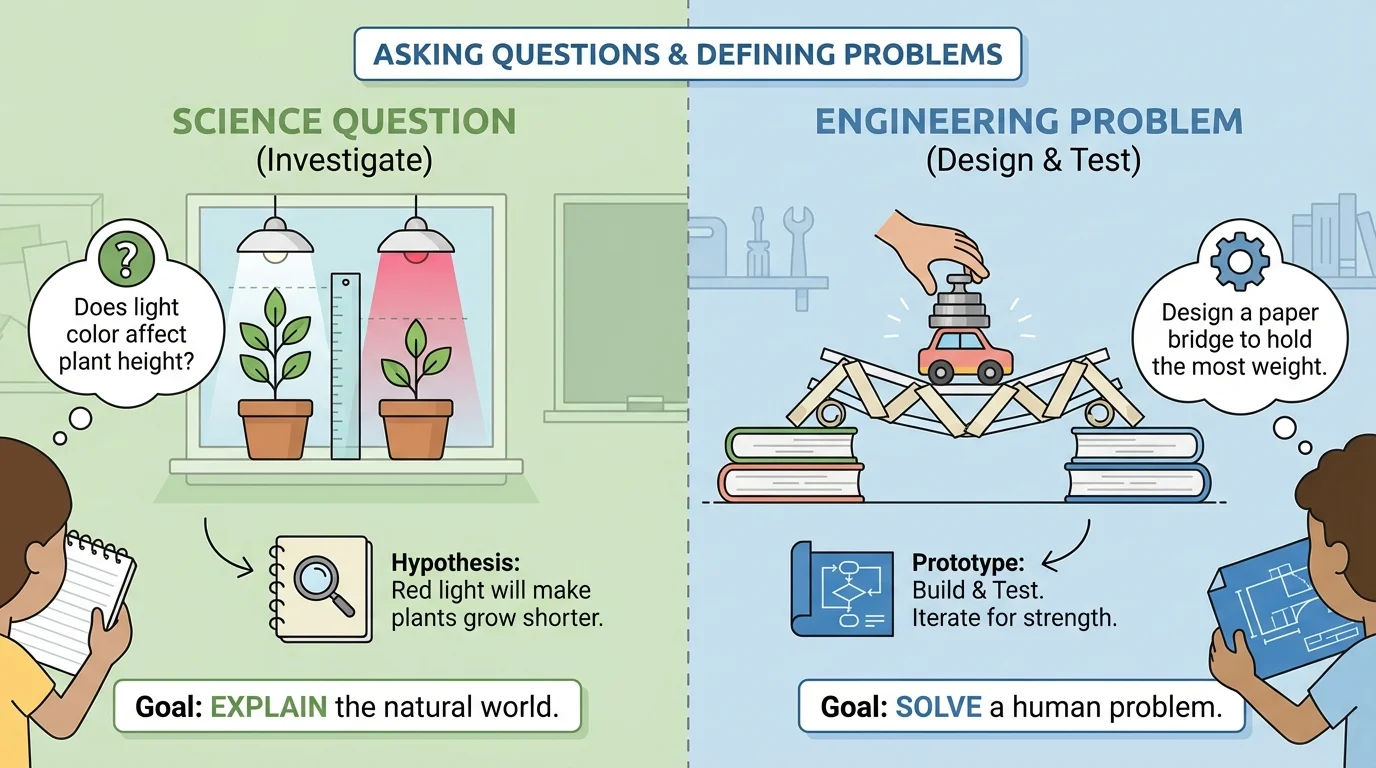
In science, you often ask, "What happens if...?" or "Why does...?" In engineering, you often ask, "How can we...?" or "What design works best when...?" Both need careful evidence, but their goals are different.
Later, the difference in [Figure 2] remains important: science seeks explanations, while engineering seeks solutions that meet criteria and stay within limits.
Science asks about understanding; engineering asks about solving. Scientists look for patterns and explanations in the natural world. Engineers use science ideas to create tools, structures, and systems. A student investigating why ice melts faster in one place than another is doing science. A student designing a better insulated lunch container is doing engineering.
Sometimes the two work together. A scientist may study how birds fly. An engineer may use that knowledge to help design aircraft wings.
Many investigations begin with a broad wonder. You might wonder, "Why do plants grow differently?" That is a great starting point, but it is too broad to test right away. To make it useful, narrow it down.
You can narrow a question by thinking about what you will observe, where you will observe it, which one factor you might change, and what tools you have. Then the broad wonder becomes a focused question such as "Does the amount of water affect the height of radish seedlings over one week?"
Focused questions often mention one object or living thing, one main condition to compare, and one measurable result. This helps you collect data instead of random opinions.
Turning broad questions into focused investigations
Step 1: Start with a broad wonder.
Example: "Why do some places on the playground feel hotter?"
Step 2: Pick one factor to study.
You might choose sunlight or surface type.
Step 3: Choose something you can measure.
You can measure temperature with a thermometer.
Step 4: Write the focused question.
"Is the temperature higher on blacktop than on grass at the same time of day?"
This focused question can be answered with evidence. It fits a schoolyard, needs simple tools, and can be done safely with adult guidance.
Before writing a hypothesis, scientists often begin with observations. They notice patterns, differences, or changes. A leaf in the sun may feel warmer than a leaf in the shade. A metal spoon may feel colder than a wooden spoon in the same room. These observations can lead to questions.
When you investigate, you often work with variables. A variable is something that can change. In a plant test, variables might include amount of water, amount of light, type of soil, or plant height. A fair test changes one main variable and keeps the others as similar as possible, as [Figure 3] shows.
If you change too many things at once, you cannot tell which change caused the result. For example, if one plant gets more sunlight, more water, and a bigger pot, then you do not know which factor mattered most.
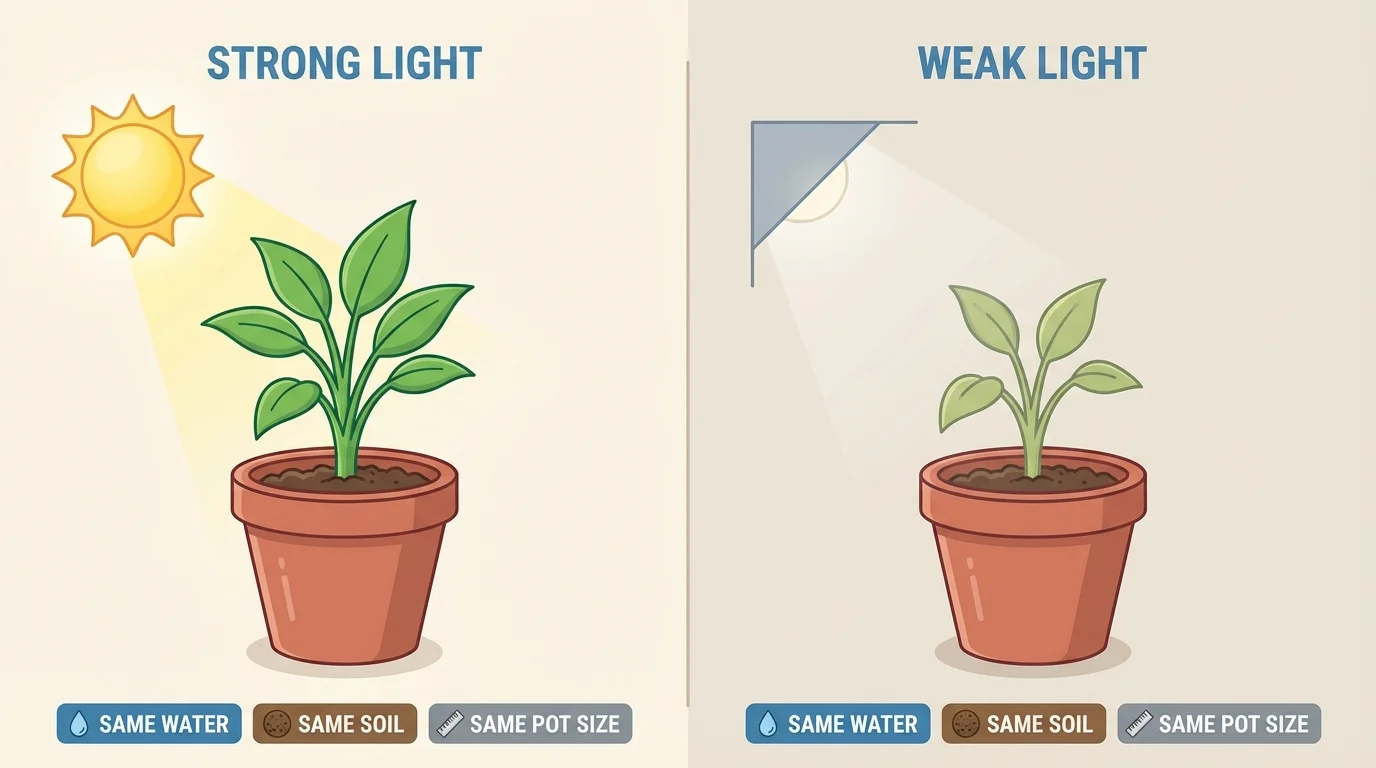
A fair test helps you make stronger conclusions. If two plants are the same except for light, and the brighter one grows taller, then light may be an important factor. This does not prove everything, but it gives useful evidence.
The idea in [Figure 3] also works in other settings. If you compare how fast ice cubes melt in sun and shade, the size of the cubes and the type of container should stay the same.
| Part of the investigation | Example with plants |
|---|---|
| Question | Does more sunlight affect plant height? |
| Variable changed | Amount of sunlight |
| Things kept the same | Type of plant, water, soil, pot size |
| What is measured | Height of each plant |
Table 1. Parts of a fair test using a simple plant investigation.
Measurements do not always need complicated formulas. If one plant is initially \(5 \textrm{ cm}\) tall and later \(9 \textrm{ cm}\) tall, the change in height is \(9 - 5 = 4 \textrm{ cm}\). That is a simple measurement you can calculate and record.
Other weak questions are unsafe or impractical. "What happens if we mix unknown cleaning chemicals?" is unsafe. "How does weather change over the next ten years?" may be too long for a classroom investigation. "Why does every volcano erupt?" is too broad for available resources.
A stronger question should fit the setting. Instead of asking about all volcanoes, a museum visitor might ask, "What features do different volcano models have in common?" That can be investigated by observing displays and recording evidence.
You already know that scientists use evidence, not just opinions. You also know that measuring, counting, and comparing help make observations more exact.
When a question does not work, scientists do not give up. They revise it. That is a strength, not a mistake.
These skills are not only for school. Doctors ask investigable questions about health patterns. Farmers ask how soil, water, and sunlight affect crops. Wildlife biologists ask where animals live and what changes their habitats. Museum researchers ask how objects were made and what materials were used. Engineers define problems such as how to make helmets safer or how to design buildings that stay cool with less energy.
Even everyday life uses the same thinking. If a family wants to know why one room feels warmer, they can compare sunlight, window size, and air flow. If a cook wants to know which container keeps ice from melting the longest, that becomes an engineering design problem involving testing and design.
"The important thing is not to stop questioning."
— Albert Einstein
Questioning alone is not enough, though. Strong questions must connect to observations, evidence, fairness, and practical limits.
A careful investigator looks closely, asks clearly, and thinks about what can really be tested. That means using places and materials wisely. A classroom may offer rulers, cups, paper, magnets, timers, lamps, and seeds. Outside, you may have soil, leaves, insects, puddles, sun, and shade. In museums and public facilities, you may have exhibits, labels, specimens, models, and guided observations.
When you begin with a good question, the next steps become easier. You can decide what to observe, what to compare, what to measure, and what kind of evidence matters. From there, you can frame a hypothesis, carry out a fair test or structured observation, and learn from the results.
Great science does not always begin with giant machines or dramatic experiments. Often, it begins with a student noticing something ordinary and turning that moment into a smart, investigable question.
